
You sold appreciated stock, exited a business, or closed on a San Diego property sale. Now the tax bill is staring back at you. That's usually the moment people start searching for qualified opportunity zone tax benefits and realize the program is both powerful and easy to mishandle.
For the right investor, a Qualified Opportunity Zone strategy can defer tax on an existing gain, reduce part of that deferred gain if the investment was timed early enough, and potentially eliminate federal tax on the future appreciation of the QOF investment itself after a long hold. For the wrong investor, or for the investor who gets the timing wrong, it becomes a paperwork-heavy distraction with disappointing results.
California adds another layer. Federal rules drive the main Opportunity Zone incentives, but California investors need to think beyond the federal headline and model the state impact before committing capital. If you live in San Diego, hold California real estate, or run a California business, you need a federal strategy and a California strategy. One without the other is incomplete.
Table of Contents
- A Smart Strategy for Your Capital Gains
- The Three Core QOZ Tax Benefits Explained
- Investment Timelines and Critical Deadlines
- Navigating Eligibility Rules for Investors and Funds
- Sample Scenarios A San Diego Investor's Guide
- Reporting Requirements and Common Pitfalls
- QOZ FAQs and Your Next Steps with Allied Tax Advisors
A Smart Strategy for Your Capital Gains
A San Diego landlord sells a rental in North County, wires out the proceeds, and then learns the gain could have been positioned for Opportunity Zone treatment. A founder closes on a business sale and realizes the 180-day clock is already running. A public company executive unloads a concentrated stock position and assumes California will follow the federal rules. It will not.
Qualified Opportunity Zone planning works best before the sale closes, not after. For California investors, that matters even more because the federal benefit gets plenty of attention, while the California mismatch changes the economics and the cash flow planning.

Congress created the Opportunity Zone program in the 2017 tax law to push capital into designated communities through Qualified Opportunity Funds, or QOFs. For an Allied Tax Advisors client, the appeal is straightforward. You may be able to defer federal tax on an eligible gain, and if the investment is structured and held correctly, the long-term federal upside can be meaningful. The catch is timing, fund compliance, and state tax treatment.
Start with the number. Before you evaluate any fund, measure the gain accurately and confirm it is the kind of gain that qualifies. If you are selling real estate, use a practical tool to compute capital gains on investment property, then compare that estimate against your federal and California exposure. If you need a better framework for the calculation itself, review our guide on how to calculate capital gains.
Why San Diego investors need a different answer
High-basis complacency is expensive. San Diego investors often sit on appreciated rental property, business interests, stock, or partnership gains and assume any federal tax strategy will carry over cleanly to Sacramento. QOZs do not.
California does not conform to the federal Opportunity Zone rules. That means a federal deferral does not automatically produce a California deferral, and the state may still tax the gain on its own timetable. Post-2026, this distinction matters even more because the original federal deferral period is ending, so the decision is less about chasing an old headline benefit and more about whether the remaining economics still justify the risk, illiquidity, and compliance burden.
My advice is simple. Treat a QOZ investment as a tax-sensitive private investment with a federal incentive attached, not as a tax product that excuses weak underwriting.
Use the strategy only if these facts line up:
- You have a clearly identifiable eligible capital gain and a clean reinvestment timeline.
- You can hold through the fund's business plan without forcing a sale for liquidity.
- You have modeled the California tax cost separately from the federal benefit.
- You have reviewed the actual QOF manager, asset mix, fees, and exit assumptions.
Clients get into trouble when they start with the pitch deck and work backward. Start with the gain, the deadline, and the state tax bill. Then decide whether the fund is good enough to merit tying up capital for years.
The Three Core QOZ Tax Benefits Explained
A San Diego investor sells appreciated stock, rolls the gain into a QOF, and expects three tax wins. That framework is correct. The mistake is assuming all three benefits carry the same value today, especially for a California taxpayer.
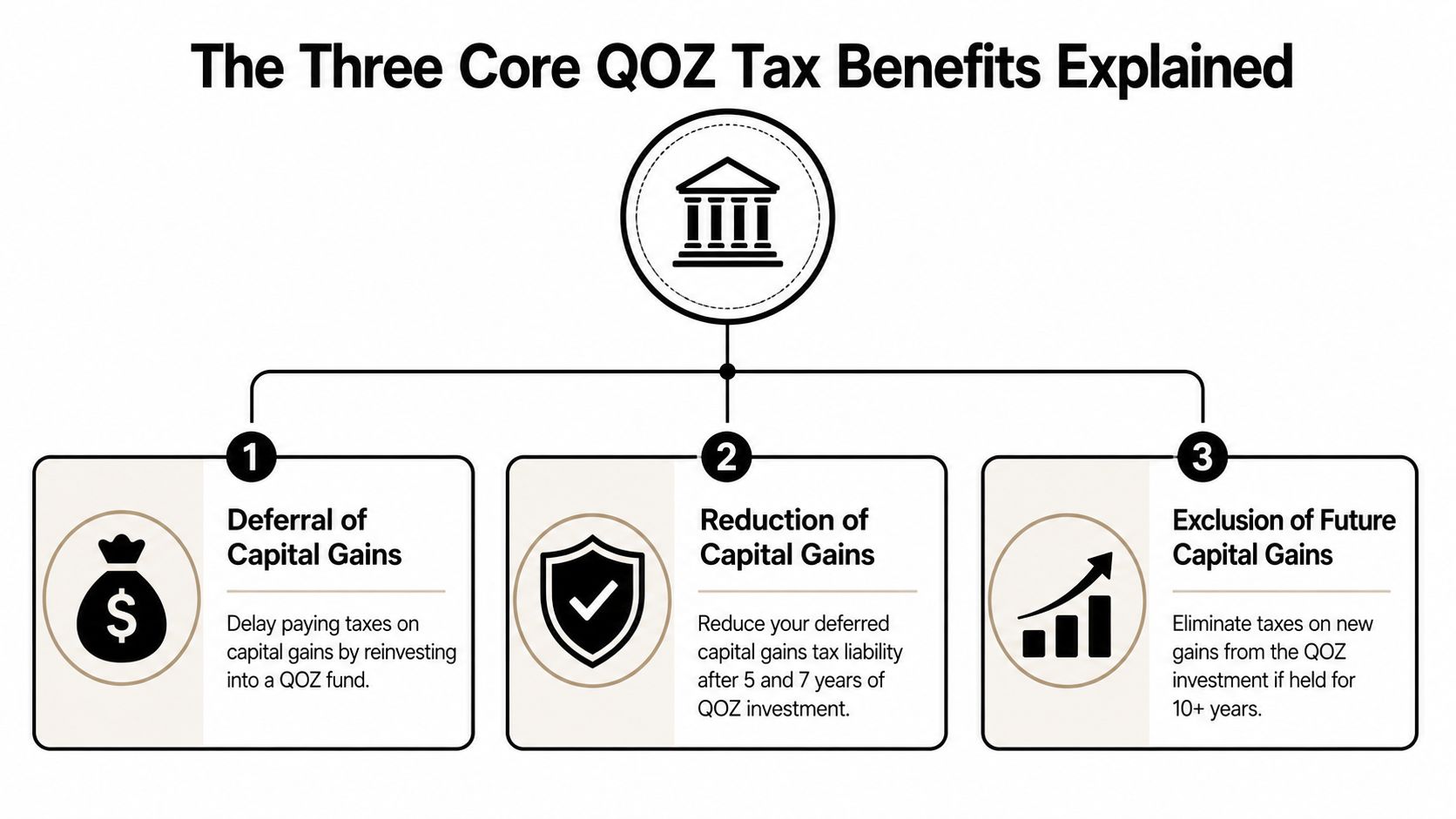
At the federal level, QOZ investing offers three separate benefits. First, you can defer recognition of an eligible capital gain when you reinvest on time. Second, some earlier investors qualified for basis increases that reduced part of that deferred gain. Third, a long holding period can eliminate federal tax on appreciation inside the QOF investment itself. For Allied clients, the real planning question is simple. Which of these benefits is still meaningful now, and which ones belong to an earlier phase of the program?
Deferral buys time, not forgiveness
The first benefit is federal deferral of the original eligible gain. If you reinvest within the required window, you postpone federal tax on that gain instead of paying it immediately.
That helps with cash flow. It also gives you more capital working inside the deal.
What it does not do is erase the original tax bill. Under the current federal structure, the deferred gain is scheduled to come back into income by the end of 2026 unless a triggering event happens sooner. For a California investor, the gap is even wider because California does not follow the federal QOZ deferral rules. You may get federal deferral and still owe California tax without delay.
That state mismatch changes the math. A client in San Diego who expects a full tax holiday is planning with the wrong assumptions.
| Benefit | What it does | What it does not do |
|---|---|---|
| Deferral | Postpones federal tax on the original eligible gain | It does not eliminate the original gain, and it does not create California deferral |
| Basis step-up | Reduced part of the deferred federal gain for investors who entered early enough to meet the holding rules | It is generally not the reason a new investor should enter a QOF now |
| Exclusion | Can remove federal tax on appreciation in the QOF investment after a long hold | It does not wipe out tax on the original deferred gain |
Basis step-up was real, but it is mostly a legacy benefit now
The second benefit was the basis step-up on the deferred gain. Investors who got in early enough and held long enough could increase basis and reduce the amount of deferred gain later recognized. That was one of the strongest selling points in the early years of the program.
It is not the main reason to invest now.
The timing window that made the step-up valuable has largely passed for new entrants because the deferred gain is still scheduled to be recognized on the federal timetable tied to the end of 2026. If a promoter is still leading with the old basis step-up story, the pitch is outdated. Current planning should focus on the remaining deferral period, the quality of the underlying investment, and the long-term exclusion on post-investment appreciation.
That is the practical answer. Treat the basis step-up as a historical advantage for earlier investors, not a current headline benefit for most new California investors.
The long-term exclusion is still the reason to pay attention
The third benefit is the one that still matters. If you hold the QOF investment for at least 10 years, federal law allows you to exclude gain from the appreciation of that QOF investment when you exit, assuming the structure and reporting have been handled correctly.
This is the part of the program that can still justify serious review.
For the right client, the tax benefit is substantial because it applies to the growth inside the QOF investment itself, not just the timing of the original gain. That said, the investment has to earn the hold. You are accepting illiquidity, manager risk, project execution risk, and a California tax result that is less favorable than the federal one.
My recommendation is straightforward. If you are evaluating a QOF in 2026 or later, ignore the marketing around old step-up benefits and underwrite the deal based on two questions. First, is the asset or operating business strong enough to justify a long hold on its own merits? Second, is the federal exclusion on future appreciation large enough to outweigh the California mismatch, fees, and compliance burden?
If the answer to either question is no, pass. A weak QOF does not become a good investment because the tax code gives it a better headline.
Investment Timelines and Critical Deadlines
You sell a San Diego property, a concentrated stock position, or part of your business. The gain is real. The clock starts right away. If you wait until your CPA is preparing the return to ask about a Qualified Opportunity Fund, you waited too long.
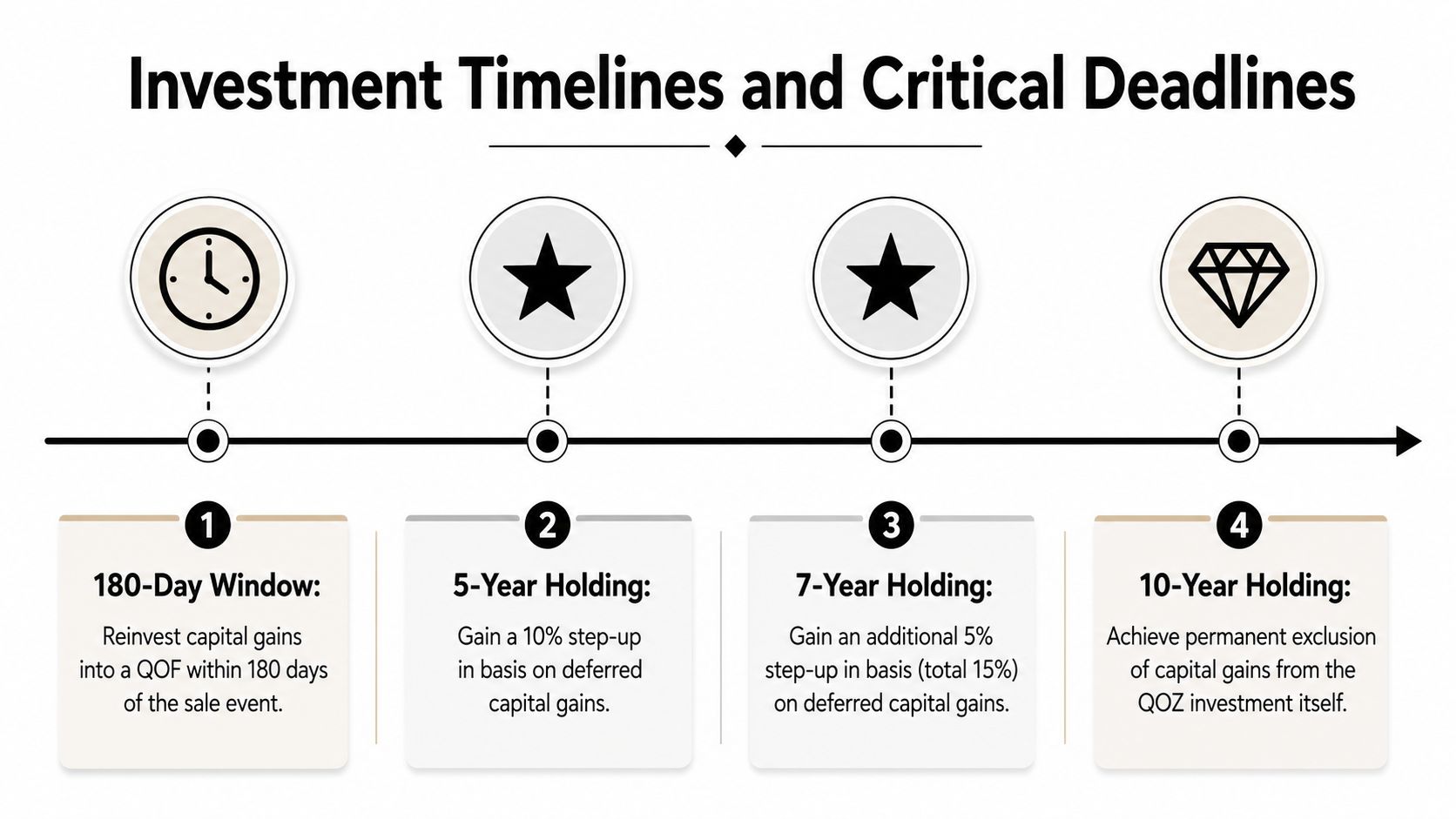
The first deadline is the 180-day reinvestment window. If you want federal deferral treatment, the eligible gain has to be contributed to a properly structured QOF within that period. Miss it, and the deferral is gone.
The timeline that matters
Here is the practical sequence:
- A gain is recognized. The date matters. So does the character of the gain.
- Your reinvestment period begins. In many cases, you have 180 days to invest the eligible gain into a QOF.
- You hold the QOF interest and track compliance. The tax result depends on both your holding period and the fund's execution.
- The deferred original gain does not stay deferred forever. Under current federal law, that deferred tax is scheduled to come due on the statutory recognition date unless an earlier inclusion event triggers it first.
- The long hold still drives the main upside. The federal exclusion applies to post-investment appreciation in the QOF if you meet the required holding period and exit correctly.
That fourth point is where many California investors get sloppy. They hear “deferral” and treat it like forgiveness. It is not. You need a cash plan for the federal tax bill tied to the original deferred gain, and you need a separate California plan because California does not conform to the federal Opportunity Zone rules.
Why timing matters more for California investors
A San Diego investor has two calendars to respect. One is federal. One is practical.
At the federal level, the value of the deferral feature is tied to the current statutory framework. If Congress does not extend or revise it, the original deferred gain is scheduled to be recognized on the existing federal timetable. That means waiting too long can reduce or eliminate the deferral value for new investments.
At the California level, there is no state deferral to match the federal benefit. California generally taxes the gain under its own rules even when the federal gain is deferred. That mismatch changes the economics. You may still have a good federal planning opportunity, but you need to evaluate it with open eyes instead of using a generic national QOZ pitch deck.
My advice is simple. If a California investor wants to use a QOF, model the federal deferral as a temporary cash flow benefit and model the California tax as a current cost.
A timeline check before you fund
Run through these points before money leaves your account:
- Confirm the exact gain date. The deadline runs from the triggering event, not from the day you decide to explore QOZs.
- Confirm that the gain is eligible. A gain can be taxable and still fail the QOZ deferral rules if it is the wrong type or reported the wrong way.
- Review the subscription timing. Wire instructions, admission documents, and entity formation delays can push you past the deadline.
- Reserve for the future federal inclusion event. Do not spend all of the tax you deferred.
- Budget for California tax now. Federal deferral does not mean California deferral.
- Match the investment to your liquidity horizon. If you may need the money back early, the tax benefit usually will not save a bad decision.
Good QOZ planning happens before the sale closes, not after. For founders, real estate owners, and closely held business owners in San Diego, that usually means reviewing the transaction documents and the fund timeline while the deal is still being negotiated.
Delay costs options. In this program, dates decide outcomes.
Navigating Eligibility Rules for Investors and Funds
You sell a business interest, stock position, or property, then a fund sponsor tells you the gain can go into a QOF and the tax benefits will follow. That is where expensive mistakes start. For a California investor, the right question is not whether the project sits in a zone. The right question is whether your gain, the fund, and the underlying business all satisfy the federal rules well enough to survive scrutiny after 2026, while you still pay California tax under a different framework.
Start with the gain itself. A QOF investment only works for eligible capital gains that are contributed the right way and tied back to a clear recognition event. If your records are weak, or the transaction was reported incorrectly, the tax benefit can fall apart long before the project does.
California investors need to be extra disciplined here. Federal deferral does not change the state result, so you need a file that is clean enough for both planning and audit defense.
The investor and the gain
Eligible gain is the first gate. Cash in the bank is not enough. The deferred amount must come from a qualifying gain, and the contribution has to match that gain with the right timing, entity, and documentation.
That includes more than direct real estate sales. We regularly review QOF questions tied to sales of partnership interests, securities portfolios, closely held business assets, and other capital transactions. The planning opportunity can be real. So can the reporting risk.
My recommendation is simple. Before you sign subscription documents, confirm these points in writing:
- What created the gain. Identify the exact sale, exchange, or other taxable event.
- How the gain is characterized. Do not assume every recognized amount qualifies the same way.
- Who is making the deferral election. The taxpayer with the gain and the taxpayer investing in the QOF must line up properly.
- What records support the position. Closing statements, brokerage reports, K-1 data, and entity workpapers should be ready before year-end.
If you are rolling gain from a property sale or redevelopment transaction, this is the stage where a real estate tax preparer for complex gain and basis reporting should review the numbers before the return is filed, not after the IRS sends a notice.
The fund itself
A Qualified Opportunity Fund is not just a branded real estate deal in a designated tract. It is a tax-sensitive vehicle with its own testing, reporting, and operational discipline. If the manager treats compliance as back-office cleanup, assume trouble.
The main issue is asset qualification. The fund has to keep enough of its assets in qualifying opportunity zone property and document how it meets that standard on its testing dates. Investors should ask how the manager tracks contributions, deployment schedules, working capital, related entities, and asset classification. If the answer is vague, pass.
A polished investor presentation proves nothing. Compliance lives in the tax workpapers, the entity structure, and the testing calendar.
The operating business inside the structure
Many QOFs invest through a lower-tier business. That business has its own rule set, often causing San Diego investors to get burned. A project can have a zone address and still fail because business activity, asset use, or operational facts do not support qualification.
This matters most in operating companies, mixed-use developments, and businesses with customers, employees, or management functions spread across and beyond the zone. Location alone does not carry the analysis. The business has to be set up and run in a way that supports the tax position.
Ask direct questions:
| Area | What to verify |
|---|---|
| Gain eligibility | The exact transaction that created the gain and how it was reported |
| Investor entity | Which taxpayer is making the election and funding the QOF |
| QOF compliance | How the fund monitors asset qualification, testing dates, and penalty exposure |
| Lower-tier business | Whether business operations and property use support QOZ treatment |
| Reporting | Who prepares Forms 8996 and investor reporting packages, and when |
What I tell San Diego clients
Do not buy a QOF because the map looks good and the deck sounds impressive. Buy it only if the gain qualifies, the fund has real tax controls, the operating structure holds up, and the economics still make sense after current California tax.
Post-2026, that discipline matters even more. The easy selling point of federal deferral is fading. What remains is execution. Investors who treat eligibility as a checklist item usually find the problems late, when the return is due and the money is already locked up.
Sample Scenarios A San Diego Investor's Guide
Most investors don't need another abstract summary. They need to know when a QOZ strategy fits and when it doesn't.
These San Diego-style examples stay qualitative because the right answer depends on your exact gain, basis, holding period, financing structure, and California tax profile.
Scenario one with a La Jolla real estate investor
A La Jolla investor sells an appreciated apartment property and realizes a large capital gain. She's looking at a federal tax hit, wants to stay invested in real estate, and doesn't need immediate liquidity from all sale proceeds.
A QOF becomes attractive if it meets three conditions. First, she can reinvest the eligible gain within the required federal window. Second, the QOF is investing in a project she'd own even without the tax angle. Third, she's willing to hold long enough for the long-term federal exclusion on appreciation to matter.
Her decision usually comes down to two competing truths:
- The federal tax incentives are meaningful. Deferral can help preserve capital for reinvestment, and the long-term exclusion may be powerful if the project performs.
- California changes the economics. She can't assume the state follows the federal treatment in the same way, so the after-tax return has to be modeled with state consequences included.
- The investment is illiquid. If she may need access to capital for another acquisition, family transfer, or debt event, the strategy loses flexibility.
For a local investor who wants additional guidance on real estate tax issues tied to transactions and compliance, a practical resource is real estate tax preparer support.
Scenario two with a Carlsbad founder after an exit
A Carlsbad founder sells equity in a closely held company and recognizes substantial gain. He doesn't want to overconcentrate in public markets immediately and is open to a long-horizon private investment.
A QOF focused on operating businesses or development projects may fit if he's comfortable with delayed liquidity and can tolerate manager risk. For this type of client, the tax analysis is only one piece of the file. The bigger issue is whether the QOF investment belongs in his post-exit asset allocation.
Here's how I'd frame it:
| Question | If the answer is yes | If the answer is no |
|---|---|---|
| Can you live with a long hold? | QOZ may be worth serious analysis | The structure may be too restrictive |
| Do you trust the sponsor's compliance process? | The tax benefits may be usable | The audit risk isn't worth it |
| Are you modeling California separately? | You're evaluating the real after-tax outcome | You're probably overstating the benefit |
The common thread
Both investors are dealing with the same core issue. A QOZ strategy is strongest when the gain is already there, the investor doesn't need short-term liquidity, and the underlying deal stands on its own.
The tax benefit should improve a good investment decision, not manufacture one.
That's the right way to evaluate these structures in San Diego. Start with the asset, then the timeline, then the tax treatment.
Reporting Requirements and Common Pitfalls
You invest capital gain proceeds into a QOF, file the return six months later, and assume the hard part is over. It isn't. In QOZ work, the tax benefit is often won or lost in the records, the annual forms, and the sponsor's compliance process after you wire the money.
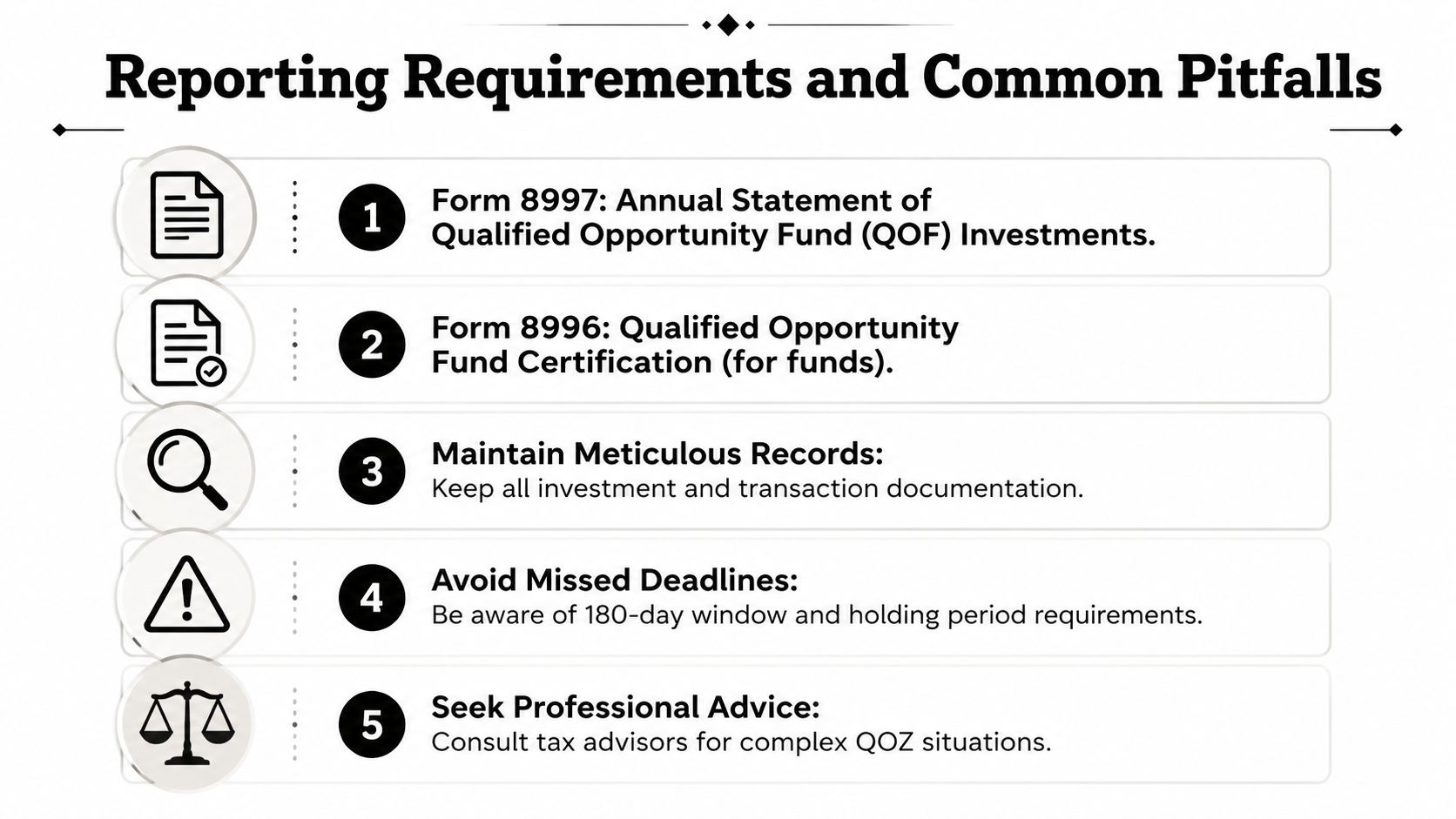
At the investor level, the annual filing burden starts with Form 8997. At the fund level, the QOF files Form 8996 each year to show whether it satisfied the required asset testing and to calculate any penalty if it did not. If those filings are wrong, late, or unsupported, you create a problem that can follow the investment for years.
Where deals go off track
The failures I see are usually boring. That's what makes them expensive.
- The gain timeline was tracked loosely. The client remembers the sale date but cannot prove the correct deferral period, contribution date, or amount of eligible gain invested.
- The sponsor can sell the project but not the compliance file. If a fund manager cannot clearly explain testing dates, working capital plans, related-party limits, and annual reporting, I assume the tax side is weak.
- The file is incomplete. Missing subscription documents, capital call support, basis schedules, K-1s, and inclusion event records become a serious problem when the IRS asks questions or the investment is sold.
- California was treated as an afterthought. That is a mistake for any San Diego investor. California generally does not follow the federal QOZ tax treatment, so the state tax cost can hit while the federal gain is still deferred.
- The exit plan was never modeled. Post-2026, this matters more. The old basis step-up benefits are gone for new investments, so investors need the long-hold federal appreciation exclusion to do much of the work. An early sale can leave you with complexity, fees, and a weaker tax result than expected.
California needs a separate model
Many national QOZ articles fail California readers. They explain the federal rules correctly, then leave investors with the wrong economic conclusion.
For a San Diego client, I run two tax tracks from day one. One for federal. One for California. If you only model the federal deferral and potential exclusion, you are overstating the benefit and understating the cash needed for state tax payments and estimates.
That separate modeling also affects entity choice, reserve planning, and distribution expectations. A deal that looks attractive on a federal-only summary can look average once California tax is included.
A practical fix is to organize the file from the start using an audit readiness checklist for tax records and support. That process will not repair a bad fund or a missed deadline, but it will force discipline around the documents you need to defend the treatment.
Keep the sale documents, gain calculation, QOF subscription papers, proof of funding dates, K-1s, annual forms, and exit analysis in one file. If your team has to rebuild the story from emails three years later, control was lost at the beginning.
My recommendation
Treat a QOZ investment like an audit-sensitive transaction from the day the gain is recognized. Get the dates right. Get the forms right. Demand real compliance answers from the sponsor. Model California separately.
That is the standard I expect for Allied Tax Advisors clients, especially now that the program is in its post-2026 phase. The easy tax benefits are gone. What remains can still be valuable, but only for investors who handle the reporting with discipline.
QOZ FAQs and Your Next Steps with Allied Tax Advisors
A few questions come up in almost every QOZ conversation.
What if you sell before the long hold is complete
Then the strategy usually becomes less attractive. You may still have had a deferral period, but the most valuable long-term federal feature is tied to holding the QOF investment long enough for the exclusion on future appreciation to matter. If there's a real chance you'll need to exit early, weigh that before you invest, not after.
Can you combine a QOZ strategy with a 1031 exchange
Sometimes investors compare them as if they're interchangeable. They aren't. A 1031 exchange has its own rules and applies in a different way than a QOF investment. The right answer depends on the asset being sold, the type of gain, replacement property goals, and how much flexibility you need. Treat them as separate planning tools and model both, rather than assuming one is automatically better.
Can you create your own QOF
Yes, in some cases that may be possible from a structural standpoint. But “can” and “should” are not the same question. Creating a fund means taking responsibility for entity setup, annual compliance, asset testing, reporting, investor administration, and the operating rules that sit underneath the structure. For many business owners and families, investing through an established compliant vehicle is simpler. For others, a self-created structure may be worth analyzing.
Is a QOZ still worth considering close to the current deadline
It can be, but only for the right facts. Near the deadline, the basis step-up story becomes less relevant and the analysis shifts toward whether the remaining federal benefits, the investment quality, and the California outcome still justify the complexity. That's why generic articles don't help much at this stage. The program now requires sharper judgment.
The right next move
If you've already recognized gain, or expect a sale soon, don't wait until return preparation season. Review the gain event, the reinvestment timing, the fund structure, the projected federal outcome, and the California treatment together.
That's how you decide whether a QOZ is a smart strategy or a tax distraction.
If you're weighing a sale, a QOF investment, or the California impact of a federal Opportunity Zone plan, talk with Allied Tax Advisors. Their San Diego team can help you evaluate the gain, model the federal and state consequences, review compliance risks, and build a tax plan that fits your actual timeline instead of a generic national template.