
The first tuition bill arrives, and the relief of finally using your 529 plan lasts about five minutes. Then the questions start. If you move money from the account today, is it taxable? What if some of it goes to housing? What if your student got a scholarship? What if the school sends a refund back later?
Those questions are normal. Most families understand the big promise of a 529 plan: money grows tax-free, and withdrawals can also be tax-free. Where people get stuck is the second part. Are 529 distributions taxable? Sometimes no. Sometimes partly. The answer depends on what the money paid for, when it was withdrawn, and how you calculate the earnings portion.
Think of a 529 plan like a bucket with two layers. One layer is the money you contributed. The other layer is the investment growth on top of it. If you use the withdrawal the right way, both layers come out tax-free. If you don't, the IRS doesn't tax the whole bucket. It focuses on the earnings portion.
That distinction matters because it often lowers the tax impact quite a bit from what families fear.
If you've spent years building this account, you already know how valuable disciplined saving can be. Many of the same habits that help families build college funds also show up in the essential features of savings apps, especially goal tracking and earmarking money for a specific purpose. A 529 works best when withdrawals are handled with that same level of intention.
Table of Contents
- Introduction Your Guide to 529 Plan Withdrawals
- The Tax-Free Promise Qualified Distributions Explained
- When 529 Withdrawals Become Taxable
- How to Calculate the Taxable Portion of Your Distribution
- Important Exceptions and Special Withdrawal Rules
- Tax Reporting and Proactive Planning with Allied Tax
Introduction Your Guide to 529 Plan Withdrawals
A family saves in a 529 plan for years. Their student gets accepted. Bills start coming in for tuition, books, a laptop, and housing. Then someone asks the tax question nobody wants to guess at: “If we withdraw this money, are we going to owe tax on it?”
The short answer is this: 529 distributions are tax-free when they match qualified education expenses. If part of the withdrawal doesn't match qualified expenses, the tax result changes. But it usually doesn't change in the dramatic way people expect.
Many parents assume an imperfect withdrawal means the whole distribution becomes taxable. That's not how it works. In most cases, only the earnings piece tied to the non-qualified amount is exposed to tax, and the IRS uses a proration method to calculate that amount.
Practical rule: Don't treat a 529 withdrawal like a simple bank transfer. Treat it like a reimbursement tied to specific education expenses in the same tax year.
That one shift in mindset clears up a lot of confusion. You're not just taking money out. You're matching a withdrawal to allowed expenses, then keeping records that support the match.
Families also get tripped up by ordinary life events. A scholarship reduces how much you can safely withdraw tax-free. A school refund can create a problem if you leave the money sitting outside the account too long. Off-campus housing may count, but only within the school's rules. A January withdrawal for a December payment can break the tax-free treatment.
The good news is that this isn't mysterious once you see the moving parts separately. Qualified expenses, timing, earnings allocation, penalty exceptions, and reporting each have their own rule. Handle them one at a time, and the picture gets much clearer.
The Tax-Free Promise Qualified Distributions Explained
A qualified distribution is a 529 withdrawal that matches an allowed education expense for the same student in the same tax year. When that match is clean, the earnings come out free of federal income tax.
What counts as a qualified expense
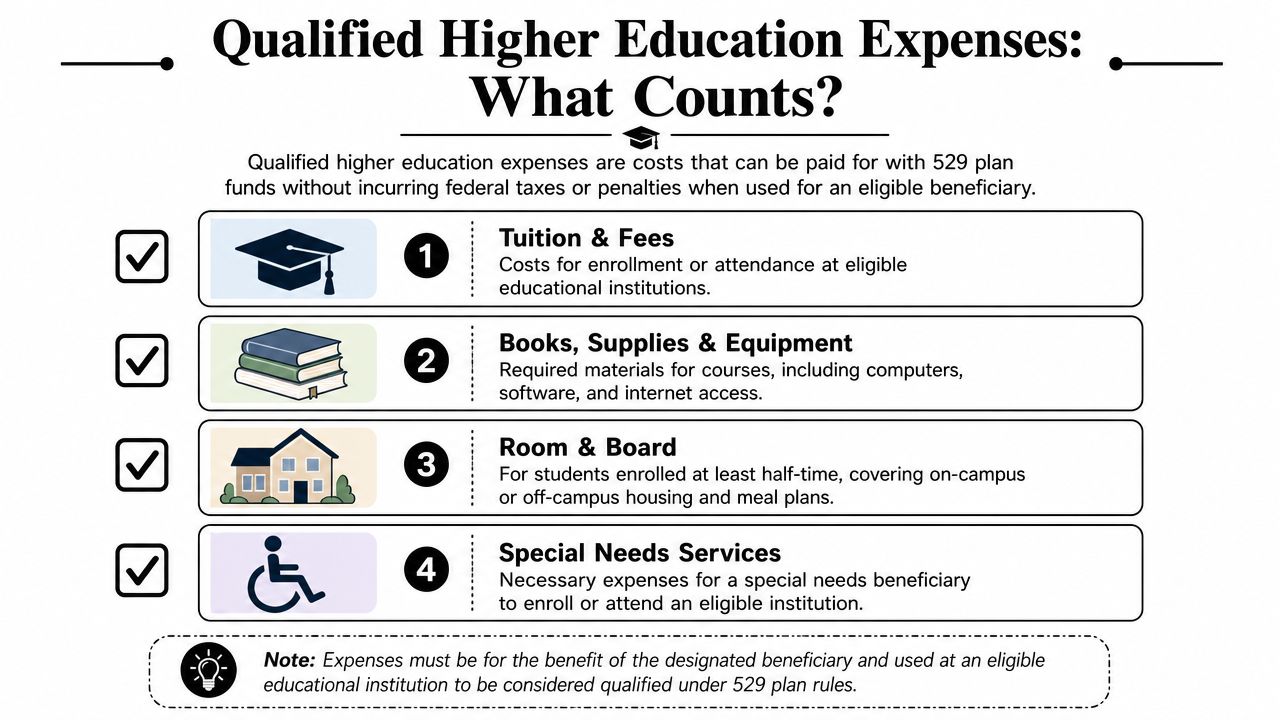
The IRS groups qualified higher education expenses into a few practical categories. The core items are tuition and required fees. Required books, supplies, and equipment can also qualify. Computers, software, and internet access often qualify when the student uses them during enrollment. Room and board may qualify too, but only if the student is enrolled at least half-time and the amount stays within the applicable school limit.
K-12 tuition has its own rule. A 529 plan can be used for tuition at elementary or secondary schools, but the annual amount is limited. Families often miss that this rule applies to tuition only, not the full range of school costs.
A good way to test an expense is to ask a plain question: was this cost required for enrollment or attendance, or was it just useful to have? Required costs are the safer category. Optional costs are where mistakes usually happen.
Here is a practical way to sort them:
- Usually qualified: tuition, mandatory fees, required books, required supplies, certain technology, and eligible room and board
- Often misunderstood: off-campus housing over the school's allowance, transportation, health insurance, club dues, and other personal expenses
- Special-rule item: K-12 tuition, subject to the annual limit
For a fuller list with examples, see this guide to 529 plan qualified expenses.
The same-year timing rule
Timing decides whether an otherwise valid expense can support a tax-free withdrawal. IRS Publication 970 explains that the distribution and the qualified education expense need to line up in the same tax year: IRS Publication 970.
Here is a common real-world example. A parent pays the spring tuition bill in December, then takes the 529 distribution in January to reimburse that payment. The expense and the withdrawal fell into different tax years. On paper, that creates a problem even though the money was clearly used for school.
The cleanest approach is to match dates as you go:
- Take the withdrawal in the same calendar year the expense is paid.
- Subtract scholarships, grants, employer assistance, or other tax-free educational aid before deciding how much 529 money to withdraw.
- Check the school's published room-and-board allowance before treating off-campus housing as fully qualified.
That last point matters more than families expect. If a school's cost-of-attendance allowance for room and board is $12,000 and the student spends $14,500 living off campus, the full $14,500 does not automatically become a qualified expense for 529 purposes.
Why this matching step matters
The safest way to view a 529 withdrawal is as a reimbursement request with receipts attached. You are pairing each dollar withdrawn with a specific allowed expense. If part of the expense was already covered by tax-free aid, that part is no longer available to support a tax-free 529 distribution.
This matching process also makes the later math easier if a withdrawal turns out to be partly non-qualified. Once you know your actual qualified expense total, you have the starting number needed for the IRS proration formula. That formula is what determines how much of the earnings, if any, becomes taxable.
When 529 Withdrawals Become Taxable
A family takes $18,000 from a 529 plan for the fall semester. After scholarships and other tax-free aid are backed out, only $14,000 of expenses can support that withdrawal. The tax question is no longer whether the whole $18,000 is taxable. The tax question is which part of that distribution is earnings, and how much of those earnings belongs to the $4,000 excess.
Only part of the withdrawal may be taxed
Families often assume a non-qualified withdrawal makes the entire distribution taxable. That is not how 529 taxation works.
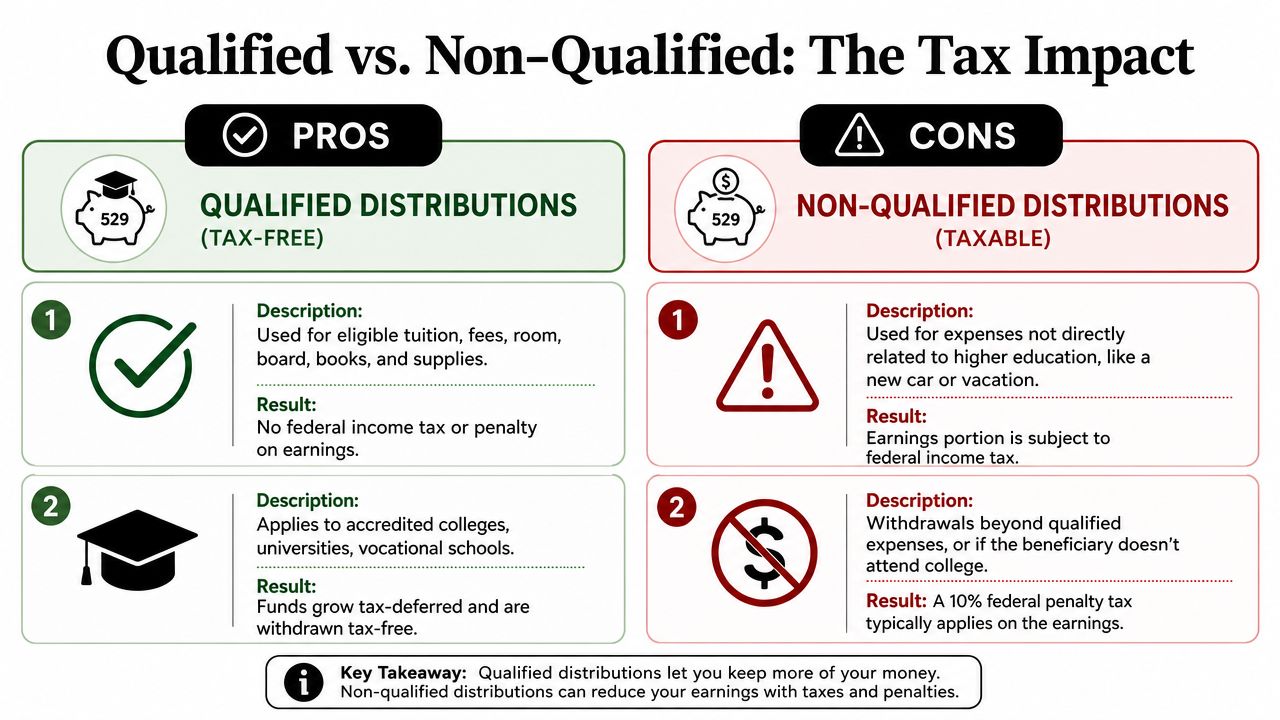
A 529 distribution has two pieces: your contributions and the account's earnings. Your contributions went into the plan with money that was already taxed, so they are not taxed again when withdrawn. The tax risk sits in the earnings portion. If part of a withdrawal is non-qualified, the IRS focuses on the earnings allocated to that non-qualified amount.
That distinction matters because it changes the size of the problem. A withdrawal can be partly non-qualified without turning the full distribution into taxable income.
Here is the practical breakdown:
| Part of withdrawal | Tax treatment |
|---|---|
| Your contributions | Not taxed again |
| Earnings used for qualified expenses | Tax-free |
| Earnings used for non-qualified expenses | Subject to ordinary income tax |
| Penalty on taxable earnings | Federal 10%, plus California 2.5% on non-qualified earnings for California taxpayers |
What usually causes a taxable 529 withdrawal
Taxable treatment usually shows up in a few recurring situations.
You withdraw more than your adjusted qualified education expenses for the year. This often happens after a scholarship posts, an employer provides education assistance, or the student claims an education tax credit using some of the same expenses.
You use the money for a cost the plan rules do not treat as qualified.
You miss the calendar-year matching rule and reimburse yourself in a different tax year than the expense was paid.
In each case, the account does not lose all of its tax benefits. The calculation is narrower than many families assume. The IRS isolates the earnings inside the distribution, then applies tax and any penalty only to the earnings tied to the non-qualified portion.
A simple way to frame the penalty
The federal additional tax is 10% of taxable earnings, not 10% of the full withdrawal. For California taxpayers, state rules can add a 2.5% penalty on the same non-qualified earnings amount, as noted by the Franchise Tax Board's guidance on ScholarShare 529 withdrawals.
That is why the math matters so much. If a family withdraws too much by a few thousand dollars, the tax bill is based on the earnings attached to that excess amount, not on every dollar that came out of the account.
A good way to read a 1099-Q is this: first identify the total distribution, then identify the earnings included in that distribution, then compare the withdrawal to the qualified expenses available for that same year. Once those three numbers are clear, the taxable portion can be computed in a structured way instead of guessed at.
If your situation is messy, that does not automatically mean the whole withdrawal is taxable. It often means part of the earnings needs to be allocated to the non-qualified piece, reported correctly, and documented with care.
How to Calculate the Taxable Portion of Your Distribution
Families usually need the most help with this aspect. Many articles stop after saying “earnings are taxed.” The important issue is figuring out how much of the earnings are taxable when a distribution is partly qualified and partly non-qualified.
The formula in plain English
The IRS proration method can be stated this way: find the total earnings included in the distribution, then allocate those earnings between the qualified and non-qualified portions. As summarized by Saving for College's explanation of the 529 penalty calculation, the formula is:
(Qualified Expenses / Total Distribution) × Total Earnings = Tax-Free Earnings
The remainder of the earnings is taxable. The same source also notes that, in practice, the 10% penalty often equals only 1–3% of the total distribution because of that proration.
That last point surprises people. They hear “10% penalty” and picture losing a tenth of the withdrawal. Usually, that's not what happens.
A step-by-step example
Let's use a clean example with easy numbers.
Assume all of the following for one tax year:
- Total distribution: $15,000
- Qualified expenses available for the withdrawal: $10,000
- Total earnings included in that $15,000 distribution: $3,000
That means part of the withdrawal was qualified and part was not.
Step 1: Find the non-qualified portion
If you withdrew $15,000 but only had $10,000 of qualified expenses, then $5,000 of the distribution is non-qualified.
Step 2: Calculate tax-free earnings
Use the formula:
($10,000 / $15,000) × $3,000 = $2,000
So $2,000 of the earnings is tax-free because it is tied to the qualified part of the distribution.
Step 3: Find taxable earnings
The distribution contained $3,000 of total earnings. If $2,000 of that earnings amount is tax-free, then the remaining $1,000 of earnings is taxable.
Step 4: Apply the penalty to the taxable earnings
The federal penalty is 10% of the taxable earnings. In this example, that means the penalty applies to the $1,000 taxable earnings amount, not to the full $15,000 withdrawal.
If the taxpayer is subject to California's extra 2.5% penalty on non-qualified earnings, that extra penalty also applies only to the taxable earnings portion, not the whole distribution.
Why families often miscalculate
People usually make one of three mistakes:
- They tax the whole withdrawal. That's too broad.
- They ignore the earnings split. A 529 distribution always contains some mix of basis and earnings.
- They forget that qualified expenses may need adjustment. Scholarships and other tax-free educational assistance reduce the amount you can match against the withdrawal.
Here's a quick worksheet approach you can use before filing:
- Start with the gross distribution shown by your records.
- Identify total qualified expenses for that same tax year.
- Reduce those expenses by tax-free educational assistance if applicable.
- Determine the earnings included in the distribution from the 529 reporting information.
- Run the proration formula to separate tax-free earnings from taxable earnings.
- Apply income tax and any penalty only to the taxable earnings amount.
When families ask whether 529 distributions are taxable, they're usually asking the wrong first question. The better first question is: “How much of this distribution was earnings, and how much of that earnings piece was linked to non-qualified use?”
Once you look at it that way, the math becomes manageable. It's arithmetic, not guesswork.
Important Exceptions and Special Withdrawal Rules
A family can do the math correctly and still get the tax result wrong if they miss an exception. That usually happens in years when the student gets a scholarship, changes housing, or receives a refund from the school after the 529 money has already gone out.
When the penalty is waived
The tax law separates two pieces of the result. First, is any part of the earnings taxable as income? Second, does the extra federal penalty apply? Those are different calculations.
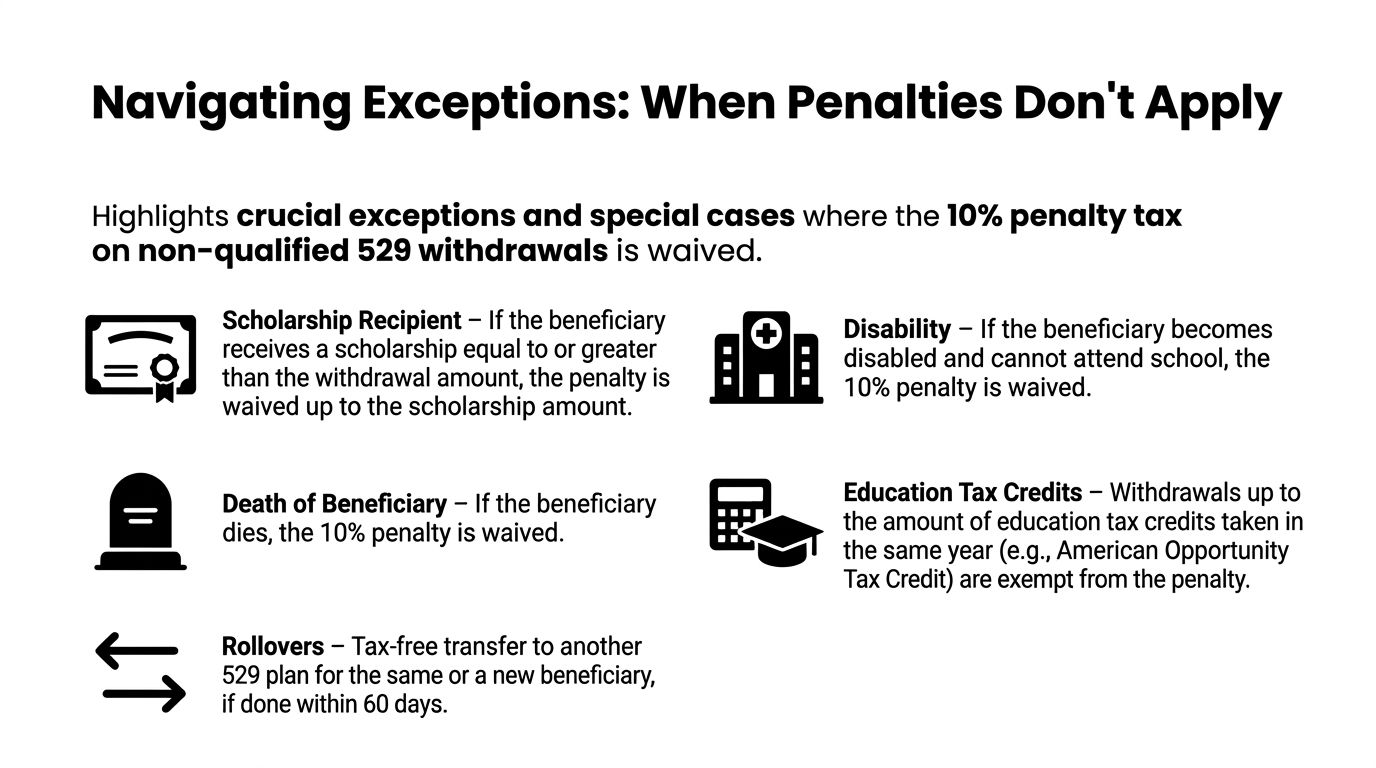
According to CFNC's summary of tax-free and non-qualified 529 distributions, the federal penalty can be waived in several situations, including:
- Scholarship received. If the beneficiary receives a scholarship, you can usually withdraw up to that amount without the extra federal penalty.
- Disability. If the beneficiary becomes disabled, the penalty may be waived.
- Death of the beneficiary. The penalty may be waived for distributions made after death.
- Attendance at a U.S. military academy. A withdrawal tied to that benefit can qualify for penalty relief.
The part many parents miss is the income tax piece. The penalty may disappear, but the earnings portion of that withdrawal can still be taxable.
A simple way to remember it is this: the exception may excuse the surcharge, but it does not erase the earnings.
How these exceptions work in real life
Start with a scholarship example, because that is where confusion shows up most often.
Say your student gets a $12,000 tax-free scholarship after you already planned to use the 529 for that same semester's bill. You may choose to take a $12,000 withdrawal that is no longer matched to qualified expenses. The federal penalty can often be waived up to the scholarship amount. If part of that $12,000 withdrawal represents earnings, that earnings slice may still be included in taxable income.
That matters because families often hear "scholarship exception" and assume the whole withdrawal becomes tax-free. It does not.
Special rules that change what counts as qualified
Housing is a common trouble spot. Room and board can qualify, but only within the plan rules and the school's allowance limits when the student lives off campus. Our guide to 529 room and board rules for off-campus housing and meal costs explains how to check whether rent, food, and related costs fit within the allowed amount.
Refunds create a different problem. A withdrawal can be proper on the day you make it, then become mismatched later if the college refunds part of the tuition or housing charge. IRS Publication 970 explains that recontributed refunds from an eligible educational institution can be returned to a 529 plan within the allowed time period to avoid turning that amount into a non-qualified distribution.
That rule works like returning an item to a store after you already paid for it. If the school gives the money back, you need to deal with the 529 side of the transaction too.
Practical situations to review before filing
These are the cases I would ask a family to check line by line:
- Scholarship year changes. Did aid reduce the expenses you originally expected to match with the withdrawal?
- Off-campus housing. Did you compare the student's actual costs to the school's published room and board allowance?
- School refunds. Was any refunded amount put back into a 529 plan within the permitted window?
- Education credit coordination. Did you use the same expenses both for a 529 distribution and for a tax credit?
The safest habit is a semester-by-semester reconciliation. Match the 529 withdrawals to bills, scholarships, refunds, and enrollment records while everything is easy to verify. That is how you catch the exception that helps you, and the special rule that could create taxable earnings if you miss it.
Tax Reporting and Proactive Planning with Allied Tax
Even when the calculations are straightforward, the paperwork still matters. A 529 distribution generates a tax form, and that form tends to make families nervous because they aren't sure whether receiving it means they automatically owe tax.
What to do with Form 1099-Q
According to Charles Schwab's overview of 529 plan tax reporting and refunds, distributions from a 529 plan trigger Form 1099-Q. The same source explains that funds not used for qualified educational expenses must be reported as other income on Schedule 1, and if a college refunds 529 funds, the account owner has 60 days to redeposit them to avoid taxes and penalties.
If you receive this form, don't panic. Form 1099-Q reports the distribution. It doesn't by itself tell the IRS whether the withdrawal was fully qualified, partly taxable, or protected by an exception. That's why your own documentation matters so much.
If you're trying to decode a distribution form generally, this overview of 1099 distribution codes can help you understand how tax reporting documents communicate what happened.
Planning beats cleanup
The best 529 strategy usually happens before the withdrawal, not after the form arrives. Good planning means:
- Calendar matching. Make sure withdrawals and payments fall in the same tax year.
- Expense coordination. Track tuition, books, housing, and required technology separately.
- Aid adjustments. Reduce available qualified expenses for scholarships and other tax-free assistance.
- Refund response. If the school returns money, don't let the deadline drift.
- Credit coordination. If you're using education tax credits, review the overlap before taking a 529 withdrawal.
A family can do many of these steps on its own. But when scholarships, refunds, mixed-use withdrawals, or California rules enter the picture, getting a second set of eyes often saves time and stress.
The core question, “Are 529 distributions taxable?”, rarely has a one-word answer. The better answer is: they can be fully tax-free, partly taxable, or taxable without a penalty, depending on the facts. Once you know how to match expenses, apply the proration formula, and report the result correctly, the rules become far less intimidating.
If you're sorting through a 529 withdrawal, a scholarship adjustment, or a confusing Form 1099-Q, Allied Tax Advisors can help you review the numbers, calculate the taxable earnings correctly, and plan future withdrawals with better tax efficiency.