
Your student picked the school. Then the housing bill showed up.
Now you're looking at dorm invoices, apartment listings, meal plan options, grocery runs, and a 529 account you've funded for years. The obvious question is whether that money can cover housing without creating a tax problem. The answer is yes, but only if you follow the rules carefully.
Most families make the same mistake. They assume “room and board” means any rent and any food expense tied to college life. That's not how this works. 529 room and board is allowed, but the student's enrollment status matters, the school's published numbers matter, and off-campus food costs have a nuance that many guides barely explain.
That last point is where people get tripped up. Parents hear that groceries aren't qualified, then stop there. Or they hear that room and board is qualified, then assume every supermarket charge is fine. Both interpretations are sloppy. If your student lives off campus, food costs may fit within qualified room and board, but only within the school's cost-of-attendance limit.
Table of Contents
- Your Guide to Using 529 Funds for College Housing
- The Core Rules for Qualified Room and Board Expenses
- On-Campus Dorms vs Off-Campus Apartments
- How to Calculate Your Maximum 529 Withdrawal
- Common Pitfalls and Essential Record-Keeping
- Tax Reporting and Strategic Financial Aid Coordination
- Your Action Plan for Tax-Free College Housing
Your Guide to Using 529 Funds for College Housing
A typical family gets to this point fast. The tuition plan seemed manageable. Then the school posts the housing portal rates, or your student decides dorm life isn't for them and starts sending apartment links. Suddenly, you're not asking whether college is expensive. You're asking which part of the expense can be paid from the 529 without blowing the tax benefits.
The good news is that housing often qualifies. The bad news is that families routinely overestimate what qualifies, especially once a student moves off campus. Dorm charges are usually straightforward. Off-campus rent is not. Food is where the confusion gets worse, because “board” sounds broad, but the tax treatment depends on how the school defines the allowable amount.
I'll give you the practical CPA answer. Don't treat your 529 like a checking account for student living costs. Treat it like a tax-advantaged reimbursement system with strict boundaries. If you stay inside those boundaries, the account does exactly what it was meant to do. If you ignore them, part of your withdrawal can become taxable.
Use the college's published room-and-board figures as your control document. If you don't have that document saved, you're making decisions blind.
Parents usually want one clear answer to start with. Yes, a 529 can help pay for college housing. But before you pull money, you need to know whether the student qualifies, whether the school is eligible, whether the housing is on campus or off campus, and whether your food spending fits inside the school's limit.
The Core Rules for Qualified Room and Board Expenses
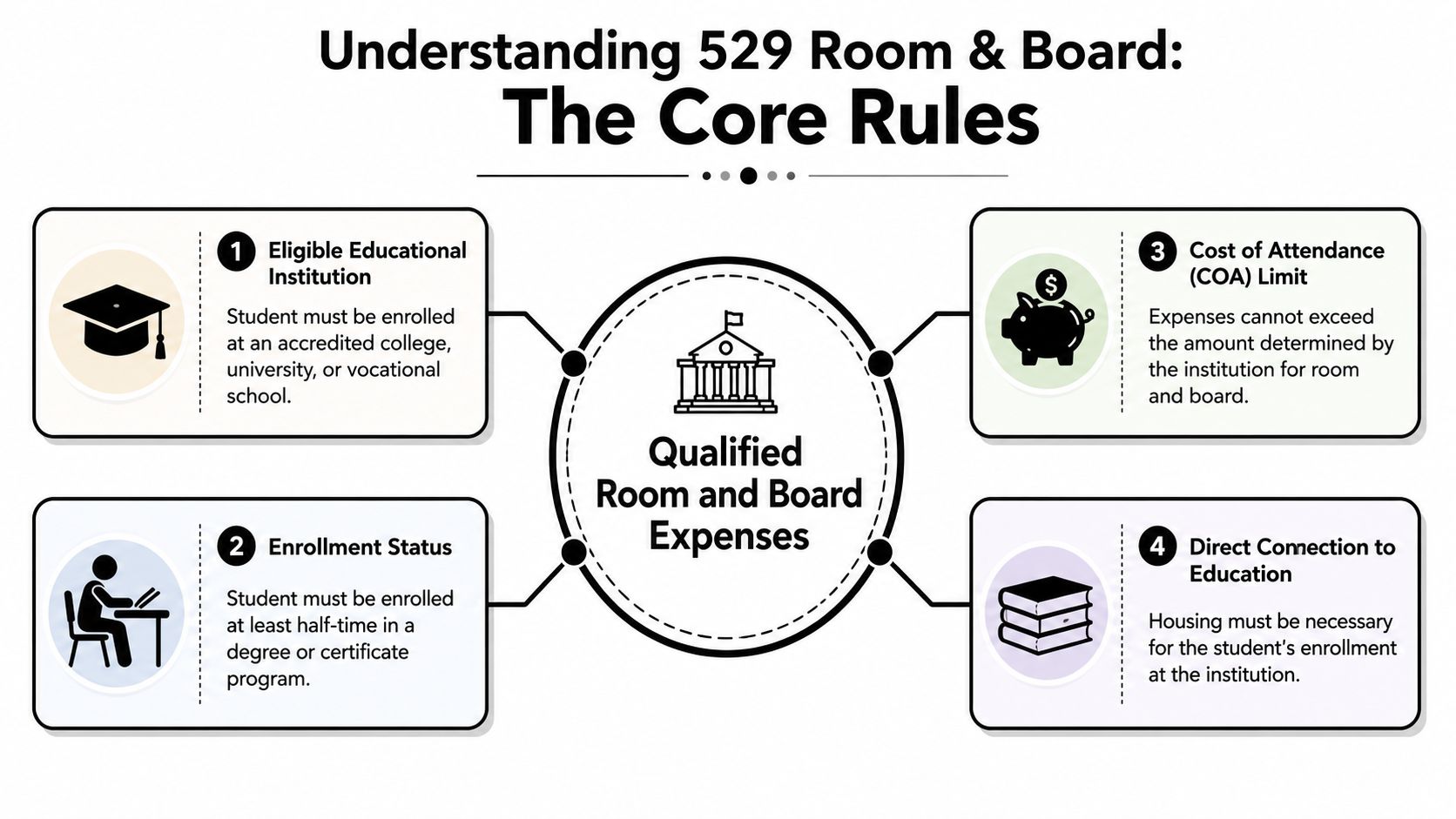
The rules aren't complicated once you strip away the vague language. There are two pillars. First, the student has to meet the enrollment requirement. Second, the housing and food costs have to stay within the qualified framework.
Start with enrollment status
This is the rule families miss because they assume any enrolled student counts. That's wrong.
Practical rule: For federal tax purposes, room and board expenses are qualified higher education expenses under a 529 plan only when the beneficiary attends school at least half-time, and non-qualified withdrawals trigger federal income tax plus a 10% penalty on the earnings portion according to The Education Plan's explanation of 529 room and board rules.
If your student drops below half-time, room and board stops being a qualified 529 expense for federal tax purposes. That's the kind of midyear change that causes trouble because the parent keeps paying housing costs the same way while the tax treatment has changed underneath them.
You also need the school to be an eligible educational institution. If you want a broader review of what generally falls inside qualified education costs, this overview of 529 plan qualified expenses is a useful starting point.
The school sets the ceiling
The second pillar is the limit itself. Families often think qualification depends only on whether the student needed a place to live while attending school. That's incomplete. The school's Cost of Attendance, usually called the COA, controls how much room and board can be treated as qualified in many off-campus situations.
Use this checklist before withdrawing:
- Confirm half-time status: Check the student's actual enrollment for the term, not what you expected it to be.
- Pull the official COA: Use the school's financial aid figures for room and board, not your estimate.
- Match the expense to the student's education period: Housing has to connect to attendance at the institution.
- Separate qualified from personal spending: If a charge doesn't fit room and board, don't run it through the 529.
Here's my opinion as a tax advisor. If you haven't downloaded the school's current COA page and saved proof of the student's enrollment status, you're not ready to take a room-and-board distribution.
On-Campus Dorms vs Off-Campus Apartments
Housing rules change once a student leaves a school-operated residence. That's why parents who handled freshman-year dorm charges with no problem often get blindsided in year two.
On-campus is simpler
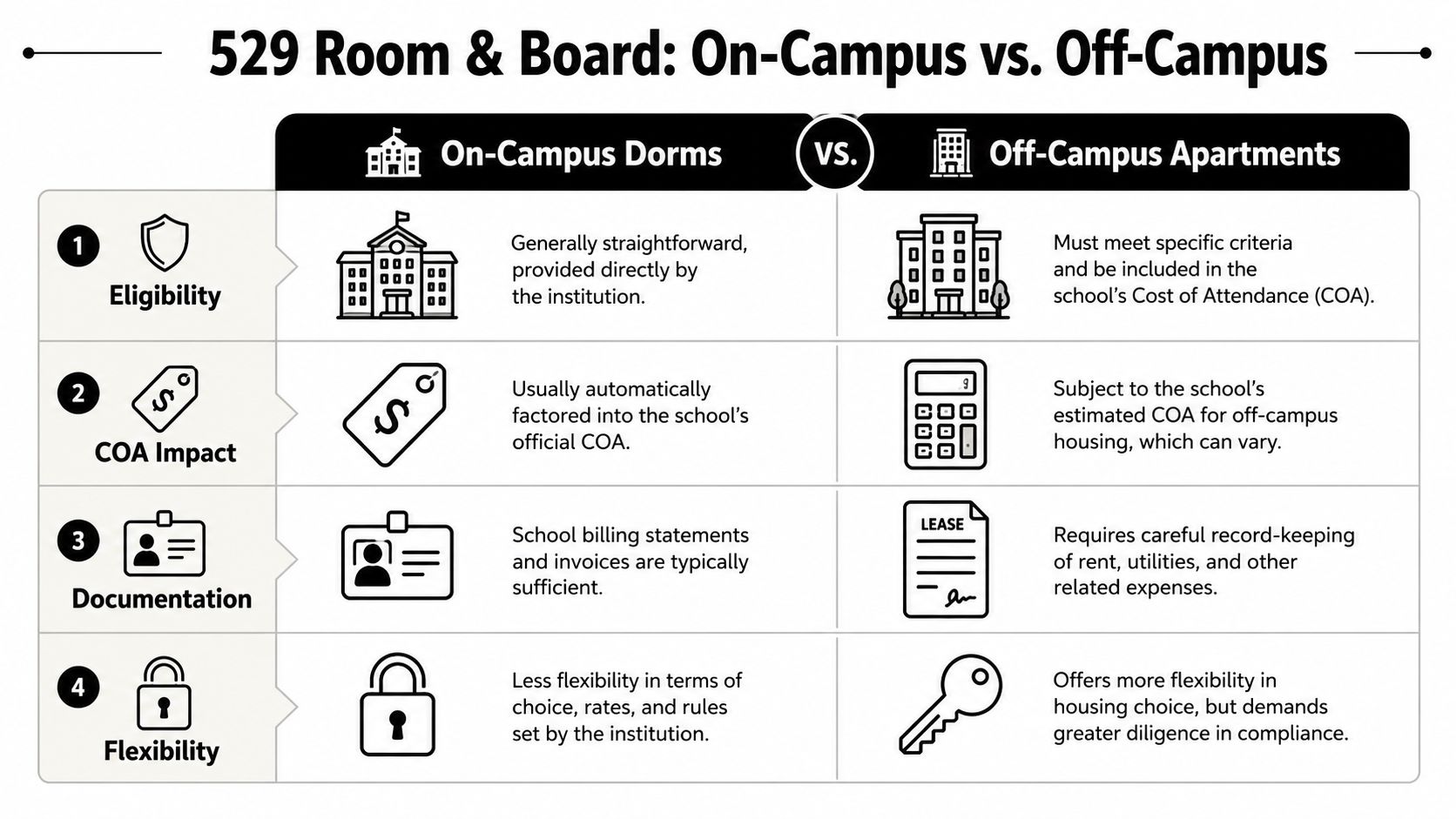
When the student lives in housing operated by the institution, the cleanest number is usually the amount the school charges. You have a bill, a student account statement, and a direct tie between the charge and the institution.
That's why on-campus housing is easier to defend. The school created the charge, billed the charge, and can document the charge. You're not trying to prove market rent, shared utility allocations, or whether a separate grocery receipt belongs in the housing category.
A simple way to think about it:
| Housing type | Main reference point | Audit risk |
|---|---|---|
| On-campus dorms | School billing statement | Lower if records are saved |
| Off-campus apartments | School COA plus your records | Higher if records are weak |
Off-campus requires discipline
Off-campus housing is where families over-withdraw. The rule is blunt. The withdrawal for room and board can't exceed the greater of the school's official room-and-board COA allowance or the actual amount charged if the student lives in institution-operated housing. Saving for College gives a clear example: if on-campus housing is $800/month, off-campus rent can't exceed $800/month even if the student's actual rent is higher, as explained in this guide to using a 529 plan for room and board.
That means your student's expensive apartment does not create a bigger qualified withdrawal. The school's published allowance controls the tax treatment. Your actual spending may be higher, but the 529 benefit doesn't expand just because the lease does.
If your student is comparing housing options, budgeting upfront matters. A practical tool is Koru's guide to budgeting rent. It helps families pressure-test whether an off-campus choice fits the student budget before tax rules become part of the problem.
Use this decision framework for off-campus housing:
- Start with the school number: Find the room-and-board allowance before signing the lease.
- Then compare actual cost: If the apartment costs more, expect to cover part of it outside the 529.
- Build in food costs carefully: Don't let rent consume the full allowance if you expect to include board expenses.
- Keep categories clean: This isn't unlike tracking mixed-use items in rental tax compliance. Once personal and qualified expenses blur together, documentation becomes harder.
The bottom line is simple. Dorm billing is mostly administrative. Off-campus housing is a tax record-keeping project.
How to Calculate Your Maximum 529 Withdrawal
Families need precision here. Don't guess. Don't round up. Don't pull “about the right amount.” Calculate the maximum qualified withdrawal based on the housing setup and the school's published allowance.
Example 1 on-campus housing
Your student lives in a dorm and buys the school meal plan. The school bills both items directly through the student account.
In that case, your working number is usually the billed amount for those qualified housing and meal charges. This is the cleanest fact pattern because the institution created the charges and the student lives in school-operated housing.
What should you keep? Save the student account statement, proof of payment, and proof the student was enrolled for that term.
Example 2 off-campus below the allowance
Your student rents an apartment off campus. The rent and food spending together are below the school's published room-and-board allowance.
That's generally the favorable setup. If total housing and food costs stay under the school's allowance, the withdrawal is easier to support. You still need records, but you're not fighting the cap.
A clean way to document this is to keep:
- The lease
- Rent payment proof
- Grocery receipts and meal records
- The school's published COA page
- Enrollment verification
Example 3 off-campus above the allowance
This is the expensive-city problem. The student signs a lease that costs more than the school's housing allowance. Parents often assume they can still use the 529 because the student needed housing near campus.
That logic won't save the tax treatment. The school's limit still controls qualified room and board. The excess has to be paid from non-529 funds if you want to avoid creating a non-qualified withdrawal.
Your lease doesn't rewrite the tax rule. The school's allowance does.
That's why I tell parents to review the school's published numbers before the lease is signed, not after.
Example 4 groceries and the board question
This is the part most articles handle poorly.
Many families hear “groceries aren't a qualified expense” and stop there. That statement is incomplete for an off-campus student. According to Schwab's summary of 529 eligible expenses, groceries are not a qualified expense on their own, but they can be treated as part of room and board if the total housing and food costs do not exceed the school's published COA allowance.
That means the right question isn't “Are groceries always allowed?” The right question is “Do rent and food together stay within the school's room-and-board allowance?”
Here's the practical interpretation:
- If your student lives off campus and buys groceries instead of a university meal plan, food costs may still fit within qualified board.
- If rent already uses up the allowance, adding groceries on top can push you into non-qualified territory.
- If you can't document the total, don't claim the food.
This is the safest way to think about it. Groceries don't stand alone as a free-floating qualified expense. They work only as part of the total room-and-board calculation under the school's cap. That's the nuance parents need.
Common Pitfalls and Essential Record-Keeping
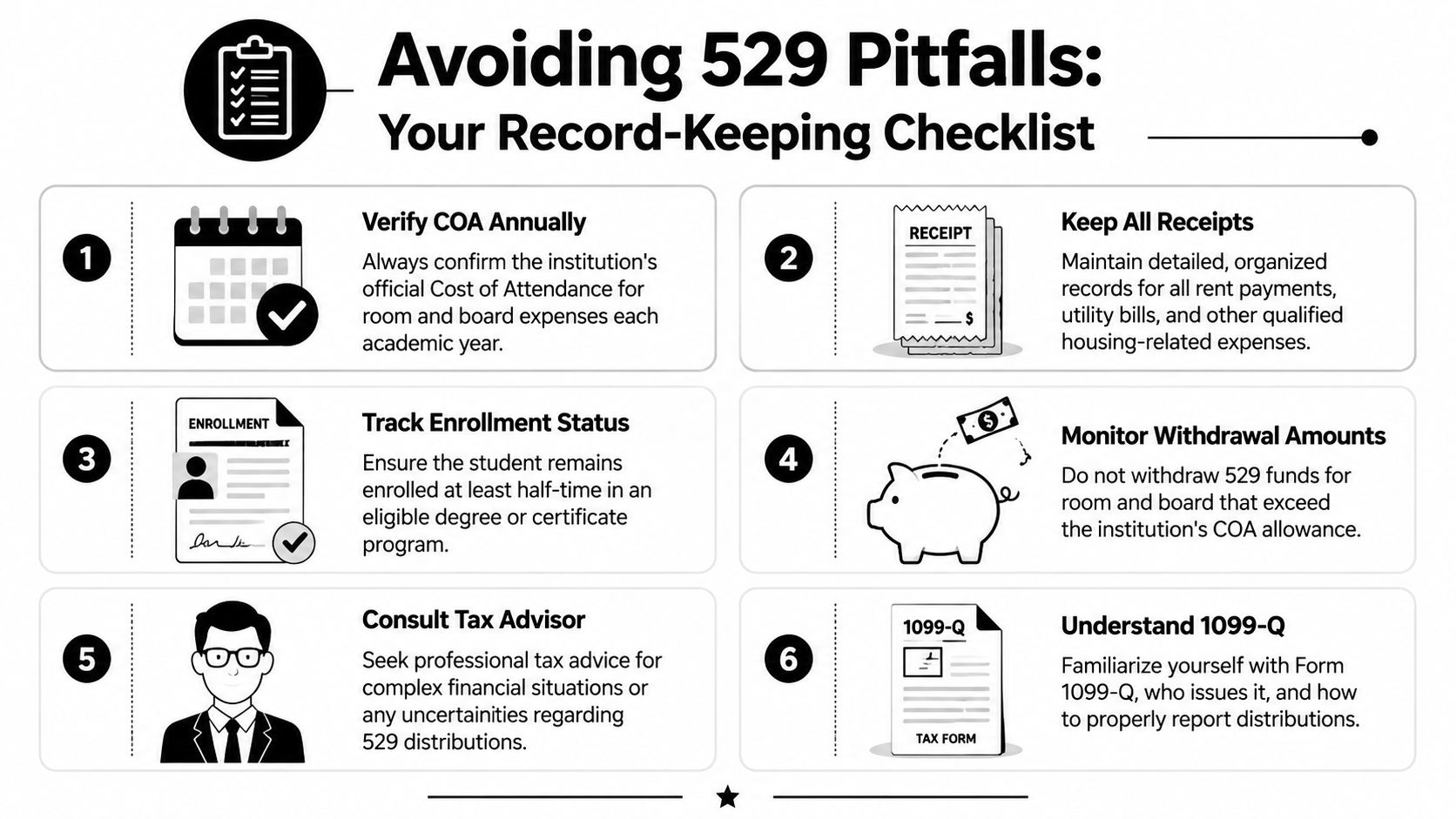
Tax problems with 529 room and board usually don't come from bad intentions. They come from casual bookkeeping. A family withdraws too much, loses the school's COA page, mixes grocery spending with household shopping, or reimburses itself without a clear paper trail.
That's fixable if you set up a system early.
Mistakes that create taxable withdrawals
These are the errors I'd watch first:
- Over-withdrawing: Parents pull the full apartment cost even though the school's allowance is lower.
- Ignoring enrollment changes: The student drops below half-time, but housing withdrawals continue.
- Treating every food purchase as qualified: Grocery spending is only defensible within the full room-and-board framework discussed earlier.
- Weak reimbursement records: Money leaves the 529, but there's no clear match to the expense paid.
- Claiming obviously personal costs: Security deposits, decor, and setup costs are where people often get too aggressive.
The tax consequence is straightforward. If a withdrawal is non-qualified, the earnings portion is subject to federal income tax and the 10% penalty already noted earlier.
What to keep in your file
You want an audit-ready folder, not a pile of screenshots. Use a digital folder by school year and term. Keep PDFs whenever possible.
For an on-campus student, save:
- Student billing statements: Keep the official school charges for housing and meals.
- Proof of payment: Bank records, card records, or confirmation from the school account.
- Enrollment proof: A schedule, registrar record, or term verification.
For an off-campus student, keep more:
- Lease agreement: The signed lease is your starting point.
- Rent payment records: Bank transfers, canceled checks, or landlord receipts.
- Utility documentation if included in your calculation: Only keep what you're using to support the withdrawal.
- Food records: Grocery receipts should be organized and separate from unrelated family purchases.
- The school's COA page: Save the exact term or academic year allowance you relied on.
Save the COA page the same day you calculate the withdrawal. School websites change, and you don't want to reconstruct the number later.
I also recommend a simple spreadsheet that shows date paid, vendor, amount, term, and whether the item was counted toward room or board. It doesn't need to be fancy. It needs to be consistent.
If you need a model for how long to keep tax-related support, this document retention policy guide gives a useful framework for organizing records.
Tax Reporting and Strategic Financial Aid Coordination
The tax side doesn't end when the withdrawal hits your bank account. You still need the distribution and the qualified expenses to line up if anyone asks questions later.

What Form 1099-Q means
If you take money out of a 529, the plan administrator may issue Form 1099-Q showing the distribution. That form is part of the reporting trail. It doesn't prove the withdrawal was qualified by itself. Your documentation does that.
The form matters because it creates visibility. If a distribution was made, you need records showing qualified expenses support it. That's why families who treat 529 withdrawals casually often get nervous at tax time. The form exists, but the receipts are scattered.
Keep your approach simple:
| Item | What it tells you | What you still need |
|---|---|---|
| 1099-Q | A distribution occurred | Proof the withdrawal matched qualified expenses |
| School records | Enrollment and billed charges | Confirmation of payment |
| Your records | Off-campus costs and food support | A clean calculation tied to the school limit |
Coordinate withdrawals with other benefits
Strategy matters. You can't use the same dollars twice. If a scholarship covers certain costs, or if you're claiming an education tax benefit such as the American Opportunity Tax Credit, you need to coordinate which expenses support which benefit. Otherwise, you create a double-dipping problem.
State tax treatment can also differ from federal treatment. That means a withdrawal that works one way federally may need a second look at the state level. Families often ignore that until return preparation, when it's much harder to unwind.
A practical approach is to make the 529 withdrawal plan before year-end, not during return prep. Review the school ledger, housing costs, scholarships, and intended education credits together. Then assign expenses deliberately.
When scholarships, credits, and 529 withdrawals all hit the same year, casual planning stops working.
If the student has multiple funding sources or changing enrollment, get professional help before filing. That's the point where tax-free treatment depends less on the account itself and more on how well the pieces were coordinated.
Your Action Plan for Tax-Free College Housing
If you want to use 529 room and board correctly, keep it disciplined.
First, pull the school's official room-and-board allowance before the term starts. Don't rely on memory, and don't use a housing estimate from a blog, apartment listing, or parent Facebook group. Use the school's published figure.
Second, build a documentation system now. Create one digital folder for each school year. Save enrollment proof, the COA page, dorm statements or lease documents, payment records, and food receipts that support your calculation.
Third, coordinate the withdrawal with the rest of the student's financial picture. If scholarships, tax credits, or enrollment changes are in play, don't wing it. Small mistakes here can convert a tax-free distribution into a taxable one.
My strongest recommendation is this: be conservative with off-campus food and housing calculations. If an expense is hard to explain, hard to document, or clearly above the school's allowance, don't run it through the 529.
That caution doesn't limit the value of the account. It protects it.
If you want help reviewing a 529 withdrawal plan, matching distributions to qualified expenses, or coordinating college costs with the rest of your tax return, talk with Allied Tax Advisors. A short review before you withdraw can prevent an expensive cleanup later.