
For 2025 decedents, the Connecticut estate tax exemption is $13.99 million, and the rate above it is a flat 12%, so the tax only reaches a small slice of households. Most families won't owe anything, but some still have to file, and lifetime gifts can change the outcome in ways that catch people off guard.
A parent dies, the family starts gathering account statements, and someone asks the question that always comes up later than it should, do we need to worry about Connecticut too? That's where the planning starts, because the answer isn't just about whether the estate is large enough. It's also about what gets counted, what gets filed, and whether gifts made years ago are still sitting in the background waiting to matter.
Table of Contents
- What the Connecticut Estate Tax Actually Is
- Current Rates, Exemptions, and How We Got Here
- Who Must File and When
- How Connecticut Coordinates With Federal Estate Tax
- Planning Strategies That Move the Needle
- Two Worked Examples From Real Numbers
- Pitfalls That Catch Connecticut Families Off Guard
- Your Next Steps and When to Bring in Help
What the Connecticut Estate Tax Actually Is
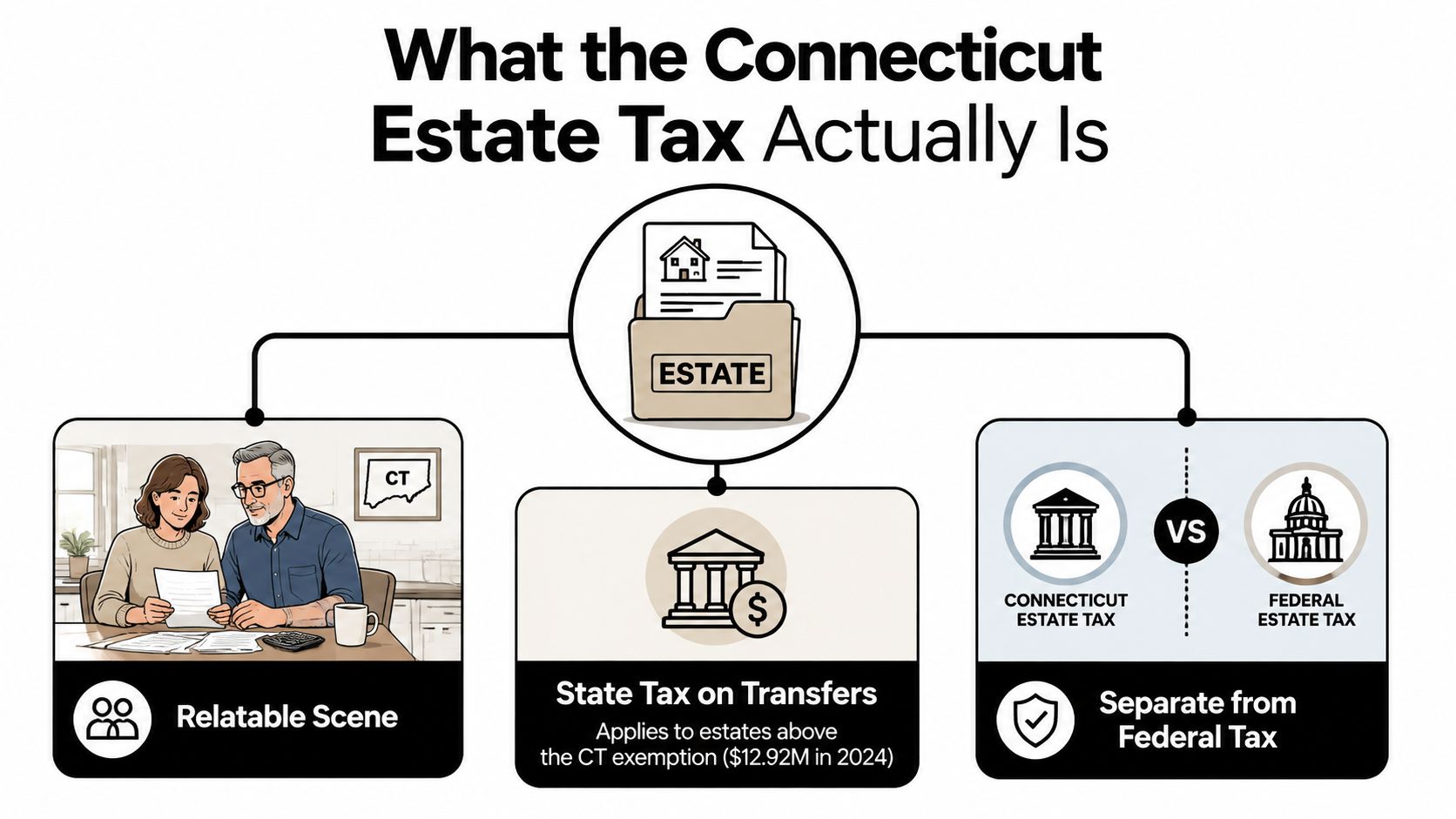
A Fairfield County couple sitting at the kitchen table after a parent's death usually isn't thinking about tax theory. They're trying to understand whether Connecticut will take a share before the family can settle accounts, transfer property, or move forward. That practical question is the right one, because the Connecticut estate tax is a state-level transfer tax on the estate itself, not a tax on the people who inherit.
That distinction matters. Connecticut used to have an inheritance tax system, but the current regime taxes the estate before assets are distributed, which is a very different question from “who receives what.” If you want a plain-English comparison of the two concepts, this estate tax basics for families guide is a helpful starting point, and Connecticut's own rules also sit in a separate lane from the federal system and from older state tax ideas. For a deeper contrast between estate and death-tax terminology, this Connecticut explainer on death tax vs estate tax is a useful reference point.
What gets pulled into the Connecticut taxable estate
For Connecticut residents, the taxable estate starts with the federal gross estate and then adjusts for Connecticut-specific deductions and Connecticut taxable gifts made during life, as shown in the state's 2026 instructions for the estate and gift tax return. That means the final state tax picture can be broader than the probate file sitting in the local courthouse, because probate and tax are not the same thing. The state looks at transfer value, not just the assets that happen to pass through probate.
Practical rule: if a family is only asking, “Was this asset in probate?” they may be asking the wrong question for Connecticut estate tax purposes.
This is also why the return itself can surprise people. Families often think the exemption ends the conversation, but the filing analysis starts with the estate's structure, not just its headline size. If the family owns a home, a closely held business, investment accounts, retirement assets, or lifetime gifts that may be pulled back into the tax base, the Connecticut return question deserves attention early, not after deadlines get tight.
Current Rates, Exemptions, and How We Got Here
A family can hear “Connecticut estate tax” and assume the rules have stayed frozen for years. They have not. The state moved from an older bracket system to a flatter structure, and that shift matters because older summaries often describe a different tax than the one families face now. Before the current flat-rate system took effect on January 1, 2023, Connecticut taxed estates above lower thresholds with rates ranging from 7.8% to 12%. Today, the tax is a flat 12% above the exemption, which makes the current system easier to describe but still easy to misread if someone is relying on outdated guidance. According to the Connecticut General Assembly, the change reflects a move from a broader state tax to a narrower levy focused on larger estates. Connecticut General Assembly estate tax summary
The headline numbers for recent and near-future decedents
For 2024, Connecticut's exemption was $13.61 million, and for 2025 it is $13.99 million. The state says the exemption is scheduled to revert to $5 million adjusted for inflation starting in 2026 under federal law, while the 2026 Connecticut instructions show a $15 million exemption for decedents dying during 2026. Families run into trouble when they assume one printed threshold applies across several years, because the answer can change depending on the date of death and the specific guidance in force. 2026 Connecticut estate and gift tax instructions
Here is the practical picture in one place.
| Year | CT Exemption | Rate Above Exemption | Notes |
|---|---|---|---|
| 2024 | $13.61 million | 12% | Flat-rate structure in effect after the 2023 change. |
| 2025 | $13.99 million | 12% | Connecticut says estates at or below this level owe no estate tax for 2025 decedents. |
| 2026 | $15 million | 12% | Shown in 2026 Connecticut guidance for decedents dying during 2026. |
The tax still matters as a source of state revenue. Connecticut's Tax Incidence Study 2025 reported that the combined Estate and Gift Tax totaled $183.6 million in 2022, and historical budget documents cited in that analysis showed $223.8 million in FY 2018 and $225.2 million in FY 2019. Those figures show a tax that reaches a limited slice of estates, yet still produces meaningful revenue from the top end of transferred wealth. Connecticut Tax Incidence Study 2025
At the national level, the Tax Policy Center estimates that for decedents in 2022, only about 7,600 federal estate tax returns were filed and about 0.14% of decedents paid estate tax. That helps explain why many families never deal with estate tax at all, while the smaller group that does face it needs to plan carefully because the bill can be material. Tax Policy Center estate tax estimate
A gift made during life can also matter later. In Connecticut, prior taxable gifts can be pulled back into the calculation, so the question is not just what sits in the estate at death. It is also what has already been transferred in a way the state still counts.
For charitable planning, the basic idea is similar. A carryover or deduction can change the tax base, but only if it is handled correctly and tied to the right return. For a plain-English example of how carryover rules work in another tax setting, see this explanation of charitable contributions carryover rules. The point is simple. Transfer-tax planning lives in the details, and those details often include gifts made long before the estate is opened.
That is also where state and federal rules can pull in different directions. Connecticut does not use state portability the way many families expect, so unused exemption does not automatically move to a surviving spouse. A couple can have a clean federal picture and still miss a Connecticut issue if they assume the state follows the same rules. For families comparing approaches, these Texas death tax strategies show how different state systems can shape planning, even when the basic goal is the same.
Who Must File and When
A lot of people stop after asking, “Do we owe tax?” Connecticut doesn't always let you stop there. The filing question is separate, and that's where families get tripped up, especially when the estate is under the exemption but the administrator still needs paperwork to document values, deductions, or elections.
The return and the timing
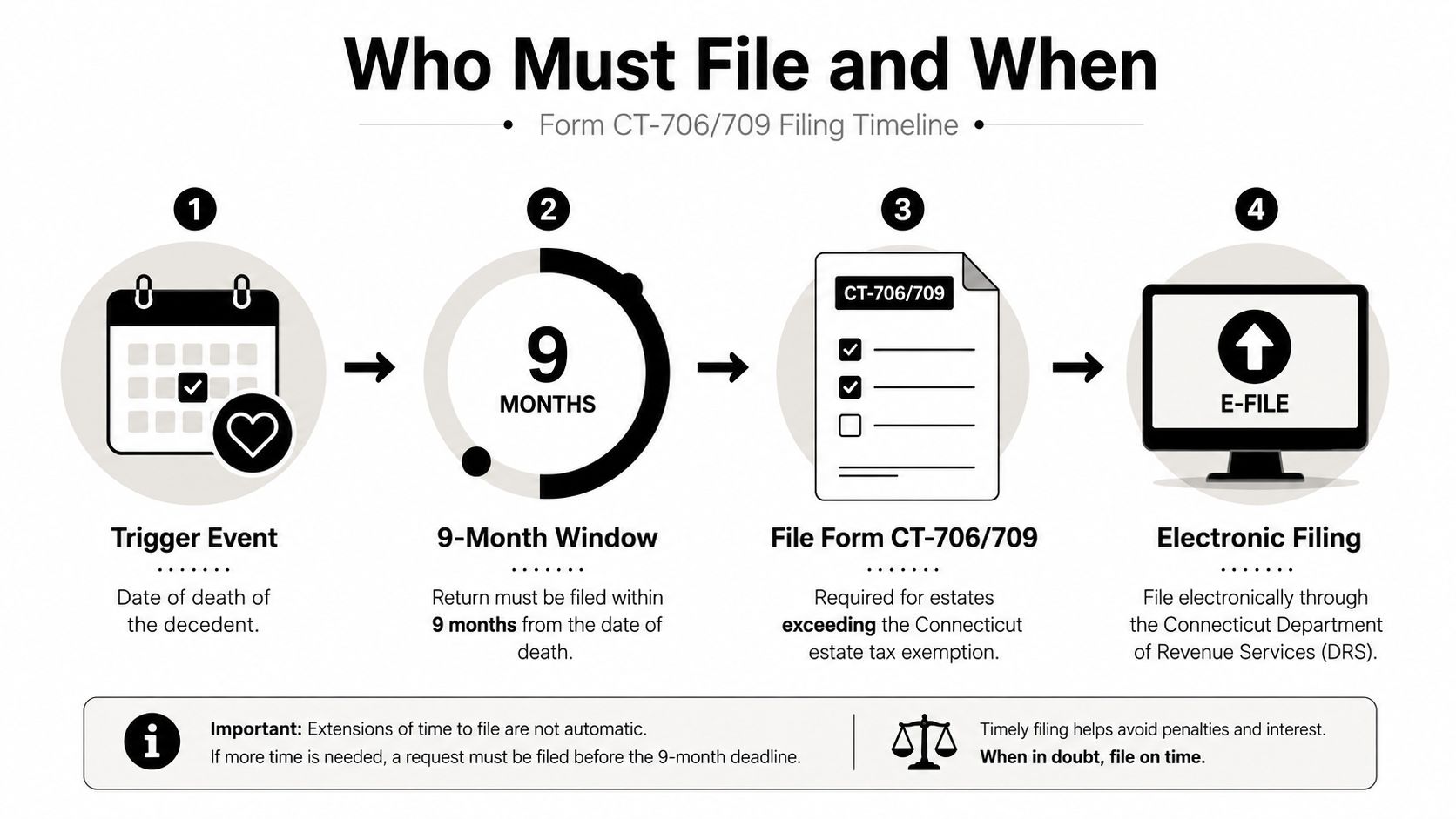
Connecticut uses Form CT-706/709 for the estate and gift tax return. The state's practical filing window is tied to the nine-month period after death, which means the calendar starts moving quickly once someone dies and the estate is opened. If you're handling an estate, that deadline is part of the administration job from day one, not something to revisit at the end.
Some estates owe no Connecticut estate tax and still need a return filed. That's the part that surprises families most often.
The state guidance says estates with a Connecticut taxable estate of $13.99 million or less owe no estate tax for 2025 decedents, but filing can still be required in some situations. That can include documenting deductions, supporting values, or handling estate administration issues that don't disappear just because the final tax comes to zero. Connecticut tax information page
How the estate gets measured
The Connecticut taxable estate starts with the federal gross estate, then applies Connecticut-specific deductions and adds back Connecticut taxable gifts made during the decedent's lifetime. That pullback rule is the reason a lifetime gift log matters so much. If someone made large transfers years ago, those gifts may still affect the final Connecticut calculation even if the federal side has already been handled.
In plain terms, the state isn't just asking, “What did the person own on the date of death?” It's asking, “What did the person own, what deductions apply, and what taxable transfers already happened during life?” That broader lens is why a return can be required even when a family expects to be safely under the line.
How Connecticut Coordinates With Federal Estate Tax
Many assume the federal exemption automatically handles the state side. It doesn't. The two systems can look similar from a distance, but they run on separate rules, separate filings, and in some places separate planning logic.
Similar thresholds, different mechanics
Federal and Connecticut exemptions are in the same neighborhood for 2024 and 2025, but similarity ends there. Connecticut imposes its own state gift tax, uses its own estate-tax return, and does not offer portability between spouses at the state level. That means a surviving spouse can't inherit the deceased spouse's unused Connecticut exemption the way families often expect from federal planning. A married couple that ignores that difference can lose valuable state exemption room permanently. For a broader discussion of related inheritance issues, this 401(k) inheritance tax overview is a useful companion piece.
Why lifetime gifts matter more than many families realize
Connecticut's system is unified in a practical sense, because taxable gifts made during life reduce what's left at death. That's different from a simple “wait until the end and see what happens” model. A gift that looked harmless five years ago can shrink the available exemption now, which is why careful tracking matters as much as the tax return itself.
Practical rule: if a gift would help a family for non-tax reasons, it still needs to be checked against the Connecticut exemption ledger before anyone assumes it was free.
The lack of state portability makes the married-couple picture even more delicate. In federal planning, unused exemption can sometimes be preserved through portability if the proper election is made. Connecticut doesn't mirror that outcome, so couples often need trust-based or disclaimer-based planning if they want to avoid wasting the first spouse's unused state exemption.
The state and federal filings also need to be coordinated. A federal Form 706 may be relevant on the federal side, while Connecticut's own return handles the state tax computation. If the federal and state teams aren't talking to each other, the same asset may be valued differently or the same gift may be documented inconsistently, and that creates avoidable trouble later.
Planning Strategies That Move the Needle
The best Connecticut planning starts with one plain question, what problem are we trying to solve? Some families want future growth kept outside the taxable estate. Others need to preserve flexibility for a surviving spouse. The right approach depends on the size of the estate, the age of the owners, and whether the family is more concerned about tax or control.
A good plan usually begins by separating lifetime gifts from death-time planning. Connecticut treats those gifts as part of the same picture, so a transfer that feels harmless in the moment can reduce what is left of the state exemption later. That is why the bookkeeping matters as much as the transfer itself. If a gift helps a family for personal reasons, it still needs to be measured against the Connecticut exemption ledger before anyone assumes it was free.
Gifting, trusts, and the tradeoff nobody should ignore
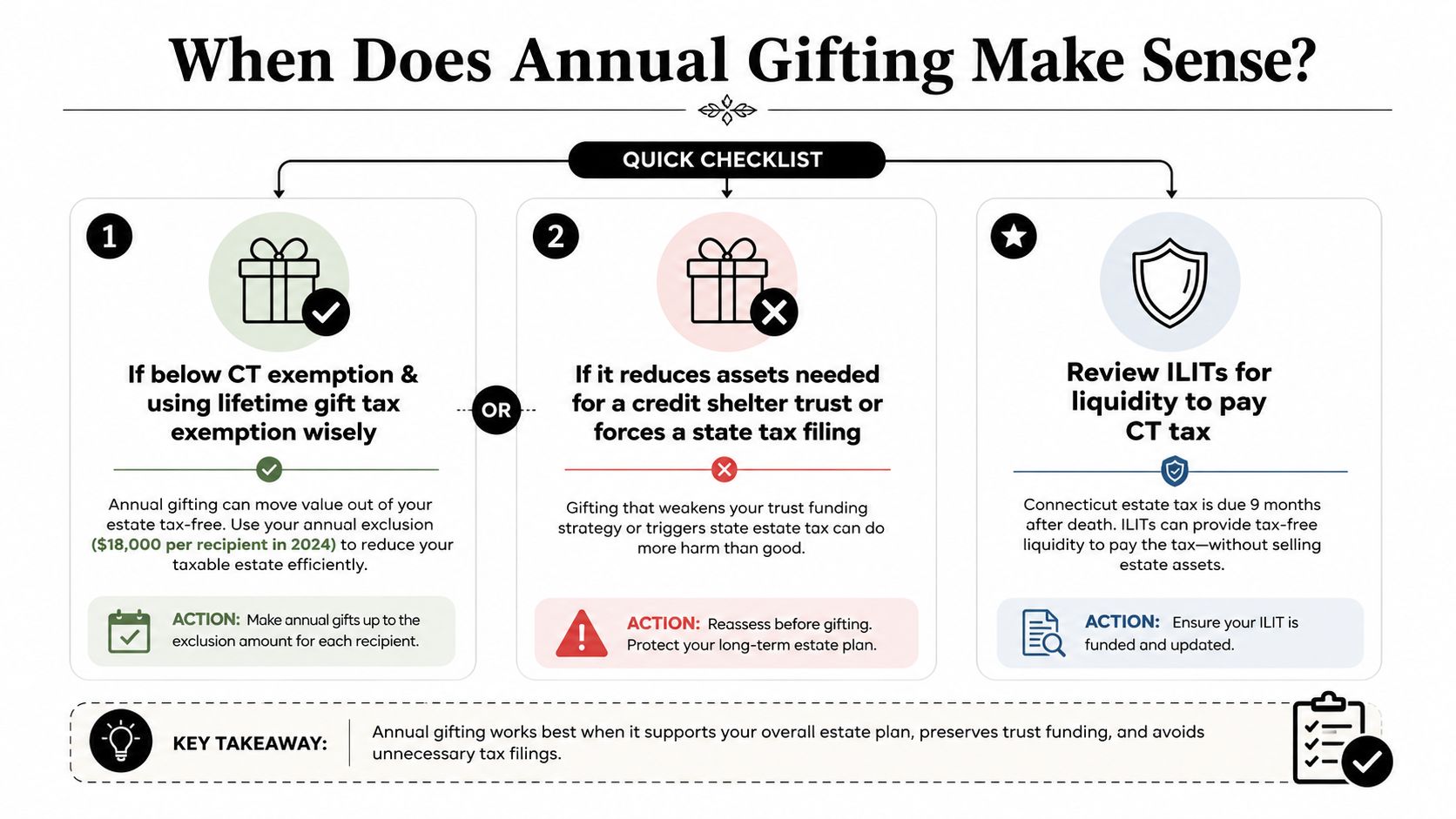
Annual exclusion gifting can work well when someone wants to move modest amounts over time without using too much of the exemption. The catch is that Connecticut's rule cuts both ways, because taxable lifetime gifts reduce the amount left at death. A gift that looks efficient on the surface can create a filing obligation, shrink the estate's remaining cushion, or disrupt a credit-shelter strategy. Families considering charitable giving should also understand the rules around charitable contributions carryover so the gift plan and the tax plan are working from the same playbook. For a separate perspective on transfer-tax reduction tools, these Texas death tax strategies show how other states' planning conversations can overlap with the same basic decision-making.
Irrevocable trusts remain the workhorse for larger estates because they remove future growth from the taxable estate while giving the family a structure for control and distribution. They do more than hold assets. They can also provide life insurance liquidity, support charitable planning, or create a framework for children or grandchildren who should not receive everything outright at once.
Married couples and residency planning
For married couples, the lack of state portability means the first spouse's unused Connecticut exemption can disappear unless the plan captures it some other way. Credit-shelter trusts and carefully drafted disclaimers still matter, because the state does not preserve that unused amount automatically. That detail is easy to miss if someone is reading only a federal estate-tax summary.
Residency moves deserve the same kind of care. A move to Florida or another no-estate-tax state does not change the result by itself. The family needs a clean domicile change, supported by records and consistent conduct, because Connecticut exposure does not disappear just because someone updates an address and gets a new car tag.
Two Worked Examples From Real Numbers
The cleanest way to understand Connecticut estate tax is to see it in motion. The same flat 12% rate can mean zero tax for one family and a meaningful bill for another, even when both families think of themselves as “well below federal estate-tax territory.”
A Guilford estate below the line
Take a Guilford couple with a $9 million estate and no unusual lifetime taxable gifts. Under the 2025 Connecticut exemption of $13.99 million, the estate is under the threshold, so no Connecticut estate tax is owed. The return question may still exist, though, because the state can require filing for administration or documentation purposes even when the tax itself is zero, and the executor still has to confirm the values and deductions that support that result.
If the couple had made Connecticut taxable gifts during life, those gifts would need to be folded back into the calculation. That's the part many families miss. A “small enough” estate can stop being small enough if earlier transfers ate into the available exemption.
A Greenwich estate above the line
Now take a Greenwich family with a $16 million estate and no added complexity. Using the 2025 exemption, roughly $2 million sits above the Connecticut threshold, and the flat 12% rate produces a Connecticut tax exposure of about $240,000 before any gift-tax pullback or other adjustments. If prior taxable gifts existed, the taxable base could grow, and the final state bill would rise with it.
That gap is why the state tax feels quiet for most households and sharp for the ones it touches. Connecticut doesn't nibble at the edges with a series of lower brackets anymore. It reaches only the larger estates, but when it applies, it applies on a meaningful base.
Pitfalls That Catch Connecticut Families Off Guard
Most estate-tax mistakes aren't complex tax errors. They're assumption errors. A family thinks the federal exemption solves the state issue, or assumes a lifetime transfer was too small to matter, and by the time someone checks the paperwork, the filing window is already closing.
The recurring problems
- Assuming federal planning covers Connecticut: The federal exemption does not automatically protect the state return, and Connecticut's rules have their own filing and tax logic.
- Ignoring gift reporting: Connecticut taxable gifts made during life can reduce the estate exemption later, so leaving gifts off the list creates a false sense of safety.
- Treating joint ownership as a shortcut: Jointly held property still has to be analyzed for its contribution to the Connecticut taxable estate.
- Missing the no-tax-due filing issue: Some estates still need a Connecticut return even when no tax is owed.
- Assuming a move changed domicile instantly: A Florida move without documentation, consistency, and intent can leave Connecticut exposure in place.
Valuation disputes are another pressure point. Closely held businesses and real estate often need extra time and extra support, and that can make a simple filing timeline more complicated than it first appears. Families who value assets casually often discover later that the numbers were never as settled as they seemed.
The families who avoid trouble usually aren't the ones with the biggest estates. They're the ones who tracked gifts, documented values, and asked the filing question early.
Your Next Steps and When to Bring in Help
A good first pass doesn't require a binder full of legal memos. It requires a clean snapshot. Start with the most recent federal Form 706 if one exists, a list of lifetime taxable gifts, current asset valuations, trust documents, and anything that shows where the decedent was domiciled. If the estate is near the threshold, those records tell you much more than a gut feeling ever will.
If you're sorting through the paperwork and want a practical checklist for organizing your estate affairs, that's a smart move before the deadline pressure builds. A CPA can help with valuation and filing mechanics, and an estate attorney becomes important when gifts, trusts, or marital planning need to be matched to the Connecticut rules. Most families don't need ongoing tax work forever, but they do need a one-time review that catches the state-specific issues before they harden into mistakes.
The key timing issue is simple. The threshold for owing Connecticut estate tax is high, but the threshold for needing a return is lower than many might assume. If you're even close, get a current net-worth statement, identify any lifetime taxable gifts, and schedule the conversation before year-end so you're not making decisions under a filing deadline.
If you want help pressure-testing a Connecticut estate-tax picture, Allied Tax Advisors can review the numbers, spot the filing issues, and coordinate the tax side with your broader plan. Visit Allied Tax Advisors to start a conversation about your estate, your lifetime gifts, and the next step that makes the most sense for your family.