
A lot of people search for 401k inheritance tax in the first few days after a loss. They’ve found a retirement account statement, a beneficiary form, or a call from the plan administrator, and now they’re trying to answer one urgent question: “How much of this am I allowed to keep?”
That question usually arrives at the worst time. You’re dealing with grief, paperwork, family conversations, and deadlines you didn’t ask for. Then someone mentions taxes, the SECURE Act, inherited IRAs, or a 10-year rule, and suddenly a gift from a loved one starts to feel like a tax trap.
The good news is that many individuals are worrying about the wrong tax. For most beneficiaries, the issue isn’t a special federal inheritance tax on a 401(k). It’s how and when withdrawals from the account will be taxed as income, plus whether your own state adds another layer. That distinction changes everything, because it means your choices matter.
This guide is written for the person who just inherited a 401(k) and needs straight answers in plain English. If that’s you, take a breath. The rules are manageable once you separate them into the right buckets.
Table of Contents
- An Unexpected Inheritance and Its Tax Surprises
- Untangling 401k Taxes Income Tax vs Estate Tax
- The SECURE Act and the Critical 10-Year Rule
- Your Path as a Beneficiary Spousal vs Non-Spousal Rules
- Strategies to Minimize Your Inherited 401k Tax Bill
- How Your State Can Change Your Tax Outcome
- When You Need a Tax Professional on Your Team
- Frequently Asked Questions on 401k Inheritance
An Unexpected Inheritance and Its Tax Surprises
You inherit your mother’s 401(k). The account is larger than you expected. For a moment, it feels like one less financial worry. Then the questions start.
Can you leave it alone? Do you need to cash it out? Will the IRS take a huge cut? Does the state where you live matter, or the state where your parent lived? If you have siblings listed as beneficiaries too, does that change anything?
A common assumption often creates confusion right away. Individuals think inheriting a 401(k) triggers a standalone tax just because they received it. In everyday conversation, that sounds reasonable. In tax law, it usually isn’t the right frame.
What usually matters is this:
- What kind of 401(k) it was. Traditional and Roth accounts don’t work the same way.
- Who inherited it. A surviving spouse has more flexibility than most other beneficiaries.
- When money comes out. The withdrawal schedule often drives the tax result.
- Where the beneficiary lives. State income tax can change the outcome more than people expect.
Most inherited 401(k) problems aren't caused by the account itself. They're caused by taking money out on the wrong schedule.
That’s why two beneficiaries can inherit similar accounts and end up with very different tax bills. One takes a lump sum because it seems simple. Another moves the funds into an inherited IRA, spreads withdrawals over time, and keeps better control over taxable income. Same inheritance. Different result.
If you’re overwhelmed, that reaction makes sense. The rules are technical, but the path forward usually starts with a few basic decisions made in the right order. First, you need to understand which tax is relevant.
Untangling 401k Taxes Income Tax vs Estate Tax

Why the phrase 401k inheritance tax causes confusion
When people say 401k inheritance tax, they’re usually mixing together two separate tax systems. That mix-up leads to bad decisions, especially when someone panics and pulls the whole account out at once.
The cleaner way to think about it is this: one tax applies to very large estates before assets are distributed, and another applies to beneficiaries when they withdraw money from inherited retirement accounts. Those are different events, different taxpayers, and different rules.
According to Common’s explanation of 401(k) inheritance tax rules, there is no specific federal inheritance tax on 401(k) accounts. Instead, beneficiaries generally face federal income tax on withdrawals from a traditional 401(k) at ordinary income tax rates. The same source explains that the federal estate tax applies only to estates exceeding $13.61 million in 2024, affects fewer than 0.2% of estates, and that 2,200 estates filed federal estate tax returns in 2022, representing 0.1% of all deaths.
For most families, that means the primary tax conversation is about income tax on distributions, not a federal tax for just receiving the account.
If you want a broader plain-English overview of inheritance and income taxes for beneficiaries, that resource is helpful for understanding how inherited assets can be treated differently depending on the asset type. For a related primer on the broader inheritance-tax subject, this guide on understanding inheritance tax and what to know gives useful background.
The two toll booths idea
Think of the system as two toll booths.
The first toll booth is estate tax. The estate pays that bill before assets pass out to heirs. The beneficiary doesn’t write that check personally just for inheriting the 401(k). This toll booth matters mainly for very large estates.
The second toll booth is income tax. You pay this one when you withdraw money from an inherited traditional 401(k). The amount added to your taxable income can raise your bracket for that year, which is why timing matters so much.
Practical rule: If you're not dealing with an ultra-high-net-worth estate, focus first on withdrawal planning, not estate-tax fear.
That distinction also helps with family conversations. If one sibling says, “We’ll owe inheritance tax on the 401(k),” what they often mean is, “We may owe income tax when we take distributions.”
Traditional vs Roth 401k treatment
A traditional 401(k) was generally funded with pre-tax dollars. That’s why distributions to beneficiaries are usually taxable as ordinary income when withdrawn.
A Roth 401(k) works differently. Qualified withdrawals can be tax-free if the five-year holding period is met, which creates a major planning advantage for beneficiaries who have flexibility on timing.
Here’s the short version:
| Account type | General tax treatment for beneficiary |
|---|---|
| Traditional 401(k) | Withdrawals are generally taxed as ordinary income |
| Roth 401(k) | Qualified withdrawals can be tax-free if the five-year holding period is met |
People often feel relief when they hear there’s no special federal inheritance tax on the account itself. That relief is warranted. But it doesn’t mean there’s no tax issue. It means the actual planning work sits in the withdrawal schedule, beneficiary category, and account type.
The SECURE Act and the Critical 10-Year Rule
What changed after 2020
The biggest modern shift in inherited retirement account planning came from the SECURE Act. Before that law, many non-spouse beneficiaries could stretch taxable distributions over life expectancy. That longer runway gave families more room to manage taxes gradually.
That changed on January 1, 2020. Fidelity’s summary of SECURE Act inherited IRA and 401(k) rules explains that the law eliminated the old stretch approach for most non-spouse beneficiaries and replaced it with a 10-year rule. Under that rule, most non-spouse beneficiaries must fully empty the inherited account by December 31 of the tenth year following the account owner’s death.
That sounds simple, but the tax effect is not simple. A shorter distribution window compresses taxable income into fewer years. If the beneficiary is already working, selling a business, exercising stock options, or dealing with other taxable events, those withdrawals can become much more expensive.
A current look at individual filing risks, IRA rules, and family tax traps can help frame how inherited-account decisions interact with broader tax planning.
Why timing matters as much as the tax rate
Many beneficiaries focus only on the account balance. The more important question is often, “What does this distribution do to my taxable income in each year I take it?”
The verified example is a strong warning. A $500,000 inherited 401(k) taken in one year could move a beneficiary from the 22% bracket into the 35% bracket, using the 2024 single filer thresholds of $105,701 to $201,775 for 24% and up to $609,350 for 35%, leading to over $150,000 in federal taxes versus $100,000 spread out according to the verified data above.
That doesn’t mean every beneficiary should divide distributions into equal slices automatically. It means delaying all withdrawals until the end can create a tax spike, and taking everything immediately can do the same.
Consider the practical contrast:
- One large withdrawal can stack inherited 401(k) income on top of wages, bonuses, business income, and investment gains.
- Planned withdrawals across the 10-year window can smooth taxable income and reduce bracket pressure.
- A low-income year can become an opportunity to take a larger portion more efficiently.
The 10-year rule is not just a deadline. It's a tax-timing problem.
That’s why people who say “I’ll deal with it later” often set themselves up for fewer options. The law gives flexibility within the window, but not unlimited flexibility. You want a distribution map early, even if you adjust it later.
Your Path as a Beneficiary Spousal vs Non-Spousal Rules
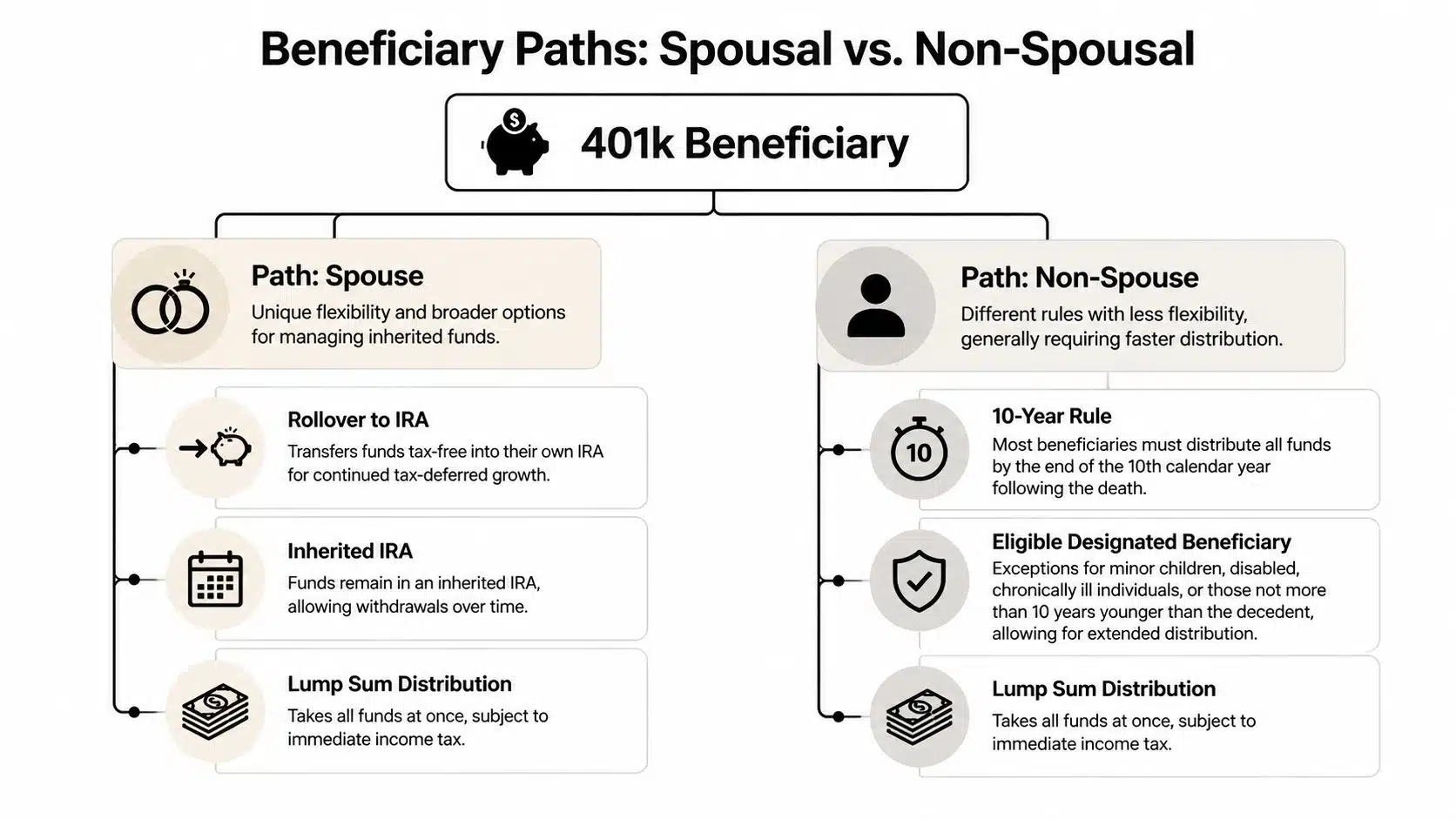
A quick comparison of your options
Your relationship to the person who died changes the rulebook. That’s why the first question I ask is not “How much is in the account?” It’s “Are you the surviving spouse, another individual beneficiary, or someone who may qualify for an exception?”
Here’s the side-by-side view.
| Feature | Surviving Spouse Beneficiary | Non-Spouse Beneficiary (Standard) | Eligible Designated Beneficiary (EDB) |
|---|---|---|---|
| Main flexibility level | Broadest | More limited | More favorable than standard non-spouse rules |
| Can often roll over to own IRA | Yes | No, generally uses inherited IRA structure | Depends on category and facts |
| Common payout framework | May defer more easily and choose among paths | Usually subject to the 10-year payout framework | May use life-expectancy-based approach in certain cases |
| Lump sum option | Available, but often tax-costly | Available, but often tax-costly | Available, but not always best |
| Planning complexity | Moderate | High | High, with exception-specific rules |
What spouses can often do
A surviving spouse usually has the best menu of options. In many cases, the spouse can roll the funds into their own IRA, keep them in an inherited IRA structure, or take a lump sum distribution.
That flexibility matters because it lets the spouse match the inherited account with their own retirement timeline. In many situations, a spouse can defer distributions longer and keep tax-deferred growth working. The verified data notes that spouse beneficiaries retain rollover flexibility and can defer distributions until age 72, which is one reason spousal inheritance is often more tax-efficient.
If the spouse is younger and wants maximum long-term retirement integration, treating the funds as part of their own retirement planning may be attractive. If access and timing are more important, the inherited structure may fit better.
What non-spouse beneficiaries need to watch
Most non-spouse beneficiaries don’t get that same freedom. The inherited account usually needs to stay in a properly titled inherited retirement arrangement, and planning revolves around the distribution window rather than permanent deferral.
The verified data also notes an important practical point. For non-spouse beneficiaries under age 59½, rolling inherited 401(k) funds into an inherited IRA can preserve tax deferral during the accumulation phase and avoid the 10% early withdrawal penalty that would otherwise apply, even though ordinary income tax still applies when distributions occur.
That’s why a direct cash-out from the employer plan is often the least flexible path. It may solve the paperwork problem fast, but it can create a much bigger tax problem.
The often-missed EDB exceptions
Some beneficiaries hear “all non-spouses must empty the account in ten years” and stop there. That’s too broad.
The verified data on exceptions to 401(k) inheritance taxes and the 10-year rule explains that certain eligible designated beneficiaries, often called EDBs, can use life-expectancy-based required distributions instead of the full-depletion rule that applies to many other non-spouse beneficiaries. This group can include minor children, disabled individuals, and chronically ill individuals. The same verified data notes that for minor children, the life-expectancy stretch applies until majority, and then the 10-year clock starts.
It also notes a useful administrative update. IRS Notice 2024-35 waived penalties for missed RMDs in 2021 through 2024 during the period of rule confusion.
A few situations deserve especially careful review:
- Minor child of the decedent. Special timing rules can apply, and the schedule can shift when the child reaches majority.
- Disabled or chronically ill beneficiary. Documentation and classification matter.
- Beneficiary not more than 10 years younger than the decedent. This category is often overlooked in general articles.
If you think you may be an EDB, don't rely on a generic summary. The exception may be the difference between a rushed payout and a longer, more manageable schedule.
Strategies to Minimize Your Inherited 401k Tax Bill

Start by improving your control
The first smart move is often administrative, not mathematical. If you’ve inherited a workplace 401(k), look closely at whether the plan’s rules are limiting your options. Many beneficiaries gain more control by moving the assets into an inherited IRA when permitted and appropriate.
Why does that matter? Because control makes planning possible. Employer plans often have narrower distribution procedures, fewer investment choices, or clunky beneficiary servicing. An inherited IRA usually gives you a cleaner platform for managing the timing of distributions inside the legal framework that applies to you.
For estate-minded families reviewing retirement accounts more broadly, this piece on critical IRA considerations for your estate is useful background. For retirement-focused tax planning, this guide on minimizing taxes in retirement also helps connect inherited-account decisions with your wider tax picture.
Spread distributions with purpose
The most common tax mistake is taking a lump sum because it feels final and easy. Easy paperwork can be expensive tax planning.
The verified data already gave the clearest cautionary example. A $500,000 inherited traditional 401(k) withdrawn in a single year could push a beneficiary from the 22% bracket into the 35% bracket and create over $150,000 in federal taxes versus $100,000 spread out. That doesn’t mean equal annual withdrawals are always optimal, but it shows why spacing matters.
A practical way to think about the choice:
- Map your current income for the year. Include wages, self-employment income, bonuses, and known gains.
- Estimate room before a higher bracket becomes painful. You don’t need perfection. You need direction.
- Use the full 10-year window intentionally if that rule applies to you.
- Revisit annually. A divorce, retirement, sabbatical, business loss, or job change can shift the best answer.
Here’s a simple comparison:
| Withdrawal approach | Likely effect |
|---|---|
| Lump sum now | Maximum simplicity, highest risk of bracket spike |
| Even withdrawals over time | Better income smoothing, easier planning |
| Back-loaded withdrawals | More tax risk if income stays strong or the account grows |
| Opportunistic larger withdrawals in low-income years | Can improve efficiency if timed carefully |
Use low-income years wisely
Some beneficiaries inherit an account during a year that’s unusually light on income. Maybe they retired midyear. Maybe they took time off. Maybe a business loss reduced taxable income. Those years can create room for larger inherited-account distributions at lower marginal rates.
That’s not about gaming the system. It’s about matching taxable withdrawals to years when they cost less.
This can also matter when you inherit both traditional and Roth retirement assets. In many cases, you’d rather preserve the tax-free character of Roth funds longer and draw taxable traditional funds in years where your income picture allows it. The right sequence depends on the full return, not just the inherited account.
Think carefully about charitable planning
Charitable planning can help in some inherited-retirement situations, but it needs to be handled carefully. People often hear about Qualified Charitable Distributions, or QCDs, and assume they apply broadly to any inherited retirement account.
The more useful takeaway for most readers is this: if charitable giving is part of your normal financial life, discuss it before taking large inherited-account distributions. The timing of gifts, deductions, and retirement withdrawals can interact in ways that either help or waste tax opportunities.
A few guardrails matter:
- Don’t assume every charitable technique applies to every inherited account type.
- Don’t wait until year-end if you’re considering a large distribution and sizable donations.
- Do coordinate the income side and the giving side together rather than treating them as separate decisions.
A good inherited 401(k) strategy is rarely about finding one magic trick. It's about lining up the account type, your beneficiary status, your income, and the calendar.
How Your State Can Change Your Tax Outcome
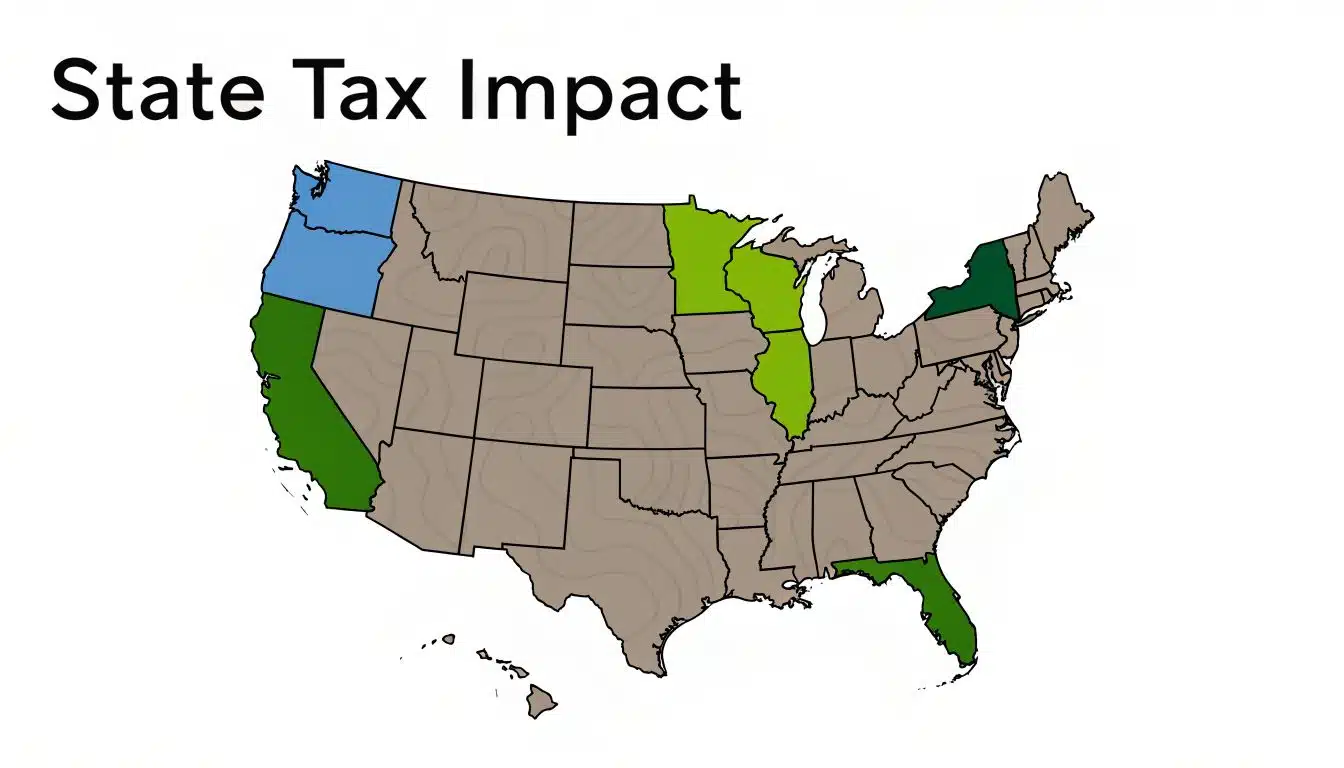
Your address matters more than most guides admit
Many national articles stop at federal rules. That leaves out one of the biggest variables in real-life 401k inheritance tax planning: state income tax at the beneficiary’s residence.
The verified data explains that state-specific income tax differences can be substantial. In this review of state taxation on inherited 401(k) distributions, California can impose up to 13.3% on top of federal rates, while Florida and Texas have no state income tax. The same source notes that California residents can face combined effective rates potentially exceeding 40% on large distributions, versus under 37% federally alone in zero-state-tax states.
That means two people can inherit the same type of account, take the same distribution amount, and keep materially different after-tax results based largely on where they live.
A practical state-tax decision lens
If you live in a high-tax state, don’t assume the federal strategy is enough. State tax can change the order and timing of withdrawals.
Ask these questions before you act:
- Where do I legally reside for state tax purposes? The beneficiary’s residence often matters more than the decedent’s.
- Am I planning a move soon? Timing may affect the state tax result.
- Does my state treat retirement distributions differently from wage income? State rules vary.
- Am I also in one of the states with inheritance-tax issues? Those rules are separate from income tax and deserve individual review.
This is one of the most overlooked parts of inherited 401(k) planning. People spend hours worrying about federal brackets and ignore the extra drag from state tax. In some cases, that oversight is far more expensive than a minor mistake in federal timing.
When You Need a Tax Professional on Your Team
Situations that deserve tailored advice
Some inherited 401(k) cases are straightforward enough to manage with good records and careful reading. Others look simple on the surface and turn complicated fast.
You should seriously consider professional help if any of these apply:
- You inherited a large traditional 401(k) and you’re still in your peak earning years.
- You may qualify as an eligible designated beneficiary, especially if disability or chronic illness documentation is involved.
- You inherited both traditional and Roth retirement assets and need to decide which to draw from first.
- There are multiple beneficiaries, separate shares, or family disagreements about timing.
- You live in a high-tax state or may relocate during the distribution window.
- You’re handling cross-border issues, non-citizen beneficiary questions, or foreign tax reporting concerns.
A tax professional doesn’t just fill in forms. They help you avoid avoidable income spikes, coordinate state and federal treatment, and catch technical details before they become penalties or amended returns.
This matters even more when grief is part of the picture. People make rushed decisions when they feel pressure to “do something” with the account. A short planning conversation can prevent a permanent tax mistake.
If you’re unsure whether your situation is simple or complex, that uncertainty is often the answer. It’s a sign to get a second set of eyes on the account before the distribution pattern gets locked in.
Frequently Asked Questions on 401k Inheritance
Can I disclaim an inherited 401k
Possibly, but a disclaimer has to be handled carefully and promptly under the applicable legal and tax rules. Once a beneficiary accepts or controls the asset in certain ways, the chance to disclaim may be lost. If you’re considering refusal because of tax reasons, family planning, or creditor concerns, get legal and tax advice before touching the funds.
What if I miss a deadline
The answer depends on which deadline you missed and what beneficiary category applies to you. The verified data noted earlier that IRS Notice 2024-35 provided relief for certain missed RMD penalties during the period of rule confusion for 2021 through 2024. That doesn’t mean future mistakes will be forgiven the same way. If you think you missed a required step, address it quickly instead of waiting for a notice.
How is a Roth 401k different from a traditional 401k
The main difference is tax treatment. A traditional inherited 401(k) generally produces ordinary income when distributed. A Roth 401(k) can allow tax-free qualified withdrawals if the five-year holding period is met, which can make withdrawal sequencing much more favorable.
That doesn’t mean Roth accounts have no rules. Beneficiaries still need to follow the applicable inherited-account timing framework. But when withdrawals are qualified, the income-tax impact is very different.
What if the beneficiary is a non-US citizen or has cross-border issues
That’s an area where general online articles are often too shallow. Cross-border tax rules, treaty questions, withholding, reporting, and residency tests can all affect the result. If the beneficiary lives outside the United States, holds dual status, or expects to move abroad during the distribution period, don’t rely on a standard inherited 401(k) checklist.
The same caution applies if the decedent, beneficiary, or account had ties to more than one country. Those cases need individualized review.
If you’ve inherited a 401(k) and want help turning confusing rules into a clear tax plan, Allied Tax Advisors can help. Their Clairemont, San Diego team works with individuals on tax planning, return preparation, inherited-account questions, and multi-layered state and federal issues, so you can make informed decisions and protect more of what you received.