
You download a tax form from your exchange, open it, and discover that it shows what you sold but not what you paid. Then you remember the assets moved through a hardware wallet, a DeFi platform, and a staking protocol. The exchange history is incomplete, the wallet export uses unfamiliar labels, and the cost basis for older holdings exists somewhere in an email attachment.
That year-end scramble is common, but it isn't unavoidable. The reliable approach to how to track crypto gains and losses starts with treating every wallet, exchange, reward, and disposal as part of one documented ledger. Broker forms can support that ledger, but they can't replace it.
Table of Contents
- Why Tracking Crypto Gains and Losses Matters Now
- What You Need to Record for Every Crypto Transaction
- How Cost Basis Methods Change Your Gains and Losses
- Building a Reliable Tracking System With Tools and Spreadsheets
- Handling Staking Rewards Airdrops Forks and DeFi Activity
- Staying Audit Ready and Reporting on Form 8949
Why Tracking Crypto Gains and Losses Matters Now
A 2025 Form 1099-DA can show $80,000 of proceeds from selling coins transferred from a hardware wallet, while offering no usable basis for those lots. If the original purchase records are buried in an exchange export or email, the form cannot establish the taxable gain. You must reconstruct the lot history before filing.
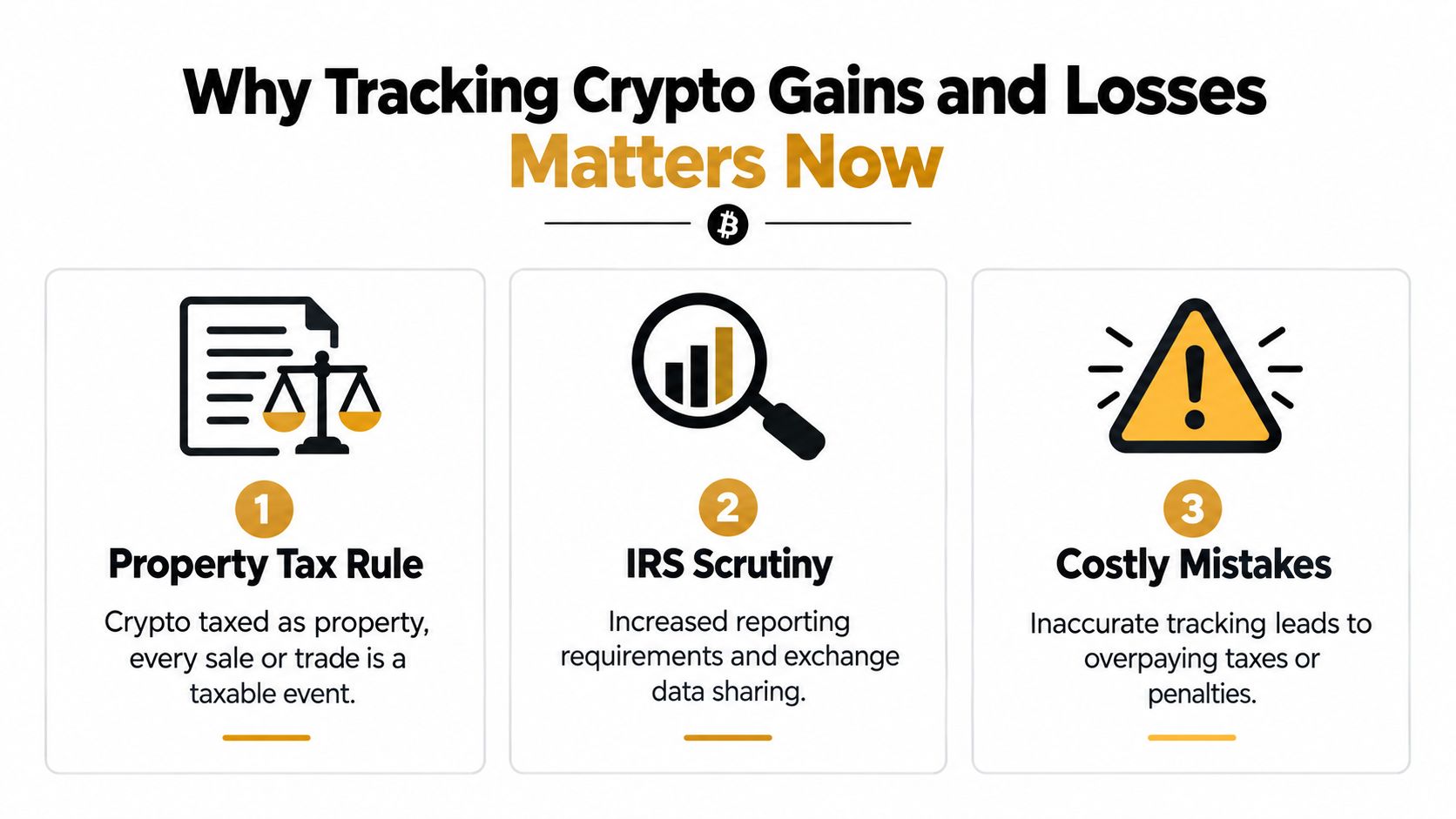
Digital assets are generally treated as property for tax purposes. A sale, exchange, or qualifying use is measured by comparing proceeds with adjusted basis. Crypto-to-crypto swaps count because one asset was disposed of and another was received, even when no dollars reached a bank account. Spending crypto can create the same issue. A transfer between wallets you control is generally recorded as a transfer, provided your records support that treatment.
Why the broker form isn't enough
For transactions on or after January 1, 2025, final IRS regulations expand broker reporting through Form 1099-DA, as described in the IRS regulations for digital-asset broker reporting. In tax year 2025, the form generally reports gross proceeds rather than the complete cost basis needed to calculate the result.
Basis reporting begins in 2026 for certain covered assets purchased on or after January 1, 2026 and held on the same platform. That does not resolve older holdings, transfers between platforms, or activity outside broker systems. DeFi swaps, staking receipts, and cross-wallet movements still require your own records and classifications.
Practical rule: Treat Form 1099-DA as a reconciliation document, not as your complete crypto tax record.
Reconcile the form against wallet and exchange data. For example, match its proceeds to the transaction hash, identify the transferred lot, document its acquisition cost, and explain any difference caused by fees or missing broker history. A clean file should let you trace each reported disposal from the form to the source transaction and selected lot.
International reporting is also becoming more connected. In November 2023, the OECD said 48 countries and jurisdictions had pledged to implement its crypto-asset tax transparency framework by 2027. The OECD announcement describes a framework intended to support information exchange between tax authorities, making fragmented records harder to defend.
Good tracking prevents two costly errors: overstating basis and understating taxable income, or losing basis records and paying tax on gains that were calculated incorrectly. An audit-ready file connects every disposal to proceeds, fees, lot selection, and the history showing where the asset came from.
What You Need to Record for Every Crypto Transaction
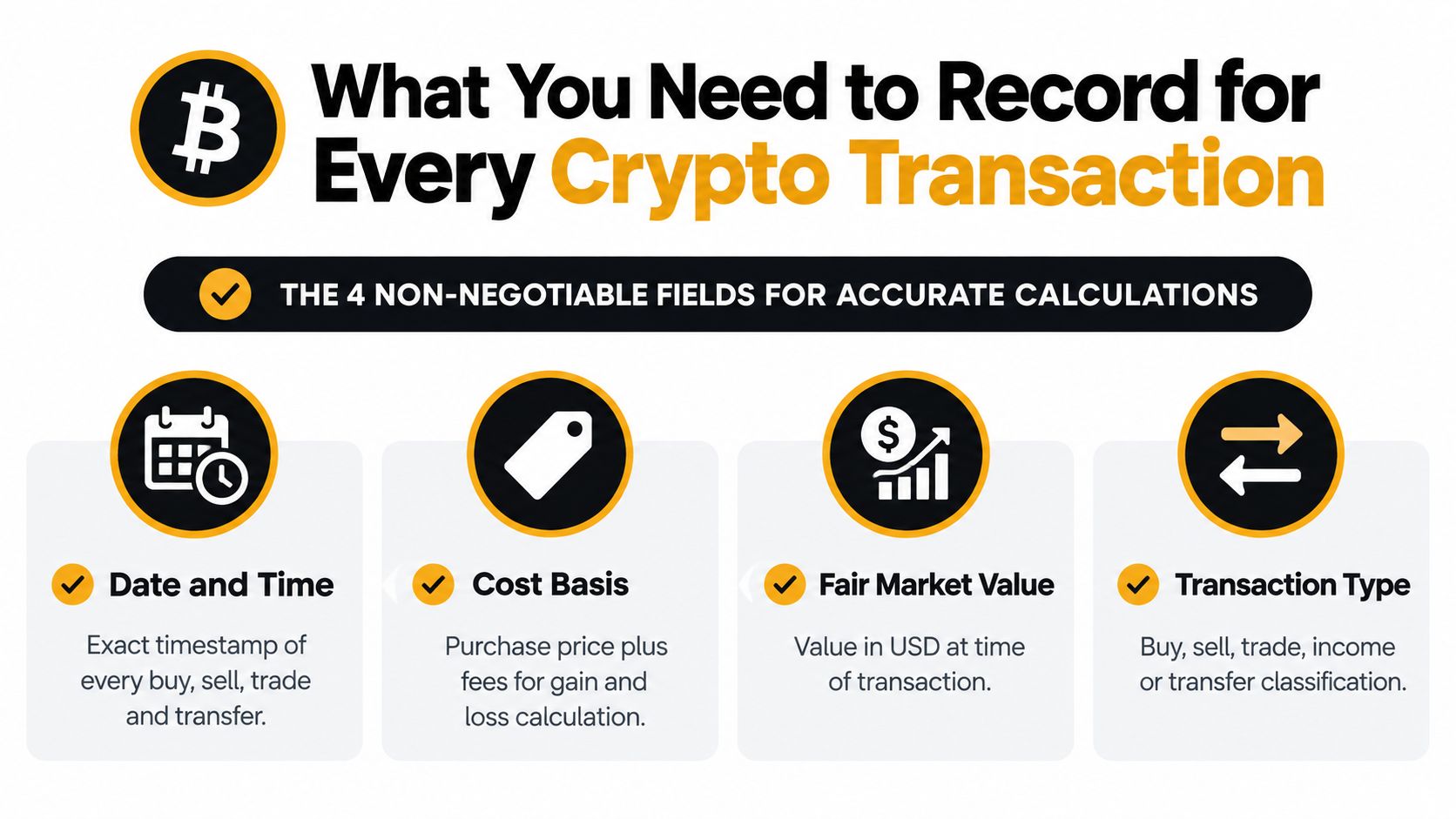
A broker export rarely explains the whole tax result. During the 2025 to 2026 reporting gap, Form 1099-DA may show proceeds while leaving basis for you to reconstruct. That problem grows with DeFi, staking, and transfers between wallets that no broker can see. Build a record for each event using the date and time, number of units, fair market value in U.S. dollars, and asset basis. The IRS digital-asset recordkeeping guidance covers purchases, receipts, sales, exchanges, and other dispositions.
Record the event first, then preserve the details that support its tax treatment:
- Date and time: Save the exchange, wallet, protocol, or blockchain timestamp. Closely timed purchases can belong to different lots.
- Asset and units: Identify the token, network, quantity, and transaction hash when available. A ticker alone may not distinguish wrapped or bridged assets.
- Transaction type: Label the event as a purchase, sale, exchange, income receipt, staking reward, airdrop, fee, gift, or transfer. The label determines which records and tax treatment follow.
- Fair market value: Record the U.S.-dollar value when the asset was received, disposed of, or treated as income. This field matters for crypto received as income or business payment.
- Proceeds and fees: Save the disposal value and list fees separately. Depending on the transaction and accounting treatment, a fee may affect proceeds or basis. Apply the same treatment throughout the file.
- Basis and holding period: Record the acquisition cost, related costs, and the date the specific lot entered your holdings. Preserve the lot reference rather than only a portfolio total.
A lot-level record should be specific enough for another preparer to reproduce the entry. For example, a disposal record might show a purchase timestamp from the exchange, the quantity and network, the acquisition fee added under your documented method, the later disposal timestamp, the fee deducted from proceeds, and the transaction hash for each blockchain event. If the asset moved through another wallet before sale, include the sending and receiving addresses and the transfer hash. That evidence explains how you connected the reported proceeds to the lot and why the basis differs from an exchange-generated figure.
Build the record when the transaction happens
Reconstructing activity later creates avoidable gaps. You may remember the exchange but not whether the asset came from a purchase, transfer, reward, or earlier swap. Save the source transaction ID, wallet address, platform, and supporting export while each record remains available.
A spreadsheet row can include:
| Field | Example entry |
|---|---|
| Date and time | Exchange or blockchain timestamp |
| Asset and quantity | Token, network, and units |
| Event type | Purchase, trade, sale, reward, or transfer |
| Value | Fair market value in U.S. dollars |
| Basis | Lot cost plus consistently treated fees |
| Proceeds | Value received on disposition |
| Evidence | CSV, statement, wallet export, or transaction hash |
Keep original CSV files, statements, and wallet exports beside the working spreadsheet. The summary supports preparation, while the source record shows how you handled an unusual entry, a missing broker field, or activity that occurred outside the broker's system.
How Cost Basis Methods Change Your Gains and Losses
A Form 1099-DA may show proceeds while leaving basis for you to determine. That gap matters when your crypto activity spans several exchanges, self-custody wallets, staking accounts, or DeFi applications. Lot selection determines which acquisition lot is matched with a sale or exchange, affecting basis, holding period, and the reported gain or loss even when the portfolio's overall value is unchanged.
FIFO, or first in, first out, matches the oldest available lot first. It is straightforward, but older lots may have a lower basis and create a larger gain after appreciation. LIFO, or last in, first out, matches the newest lot first. A recent lot may have a higher basis, although the resulting holding period can be shorter.
HIFO, or highest in, first out, selects the lot with the highest basis. That can reduce a current gain or increase a current loss, but only when lot-level records are complete. Specific Identification gives you more control by selecting a particular lot before the disposition. The exchange or wallet records must support that selection, and the documentation should show when it was made.
The practical choice is the method you can support across every source. Apply it consistently, retain the acquisition and disposal records, and preserve evidence that the lot was identified before the sale or trade. The IRS digital-asset FAQ explains the need to calculate gain or loss from basis and proceeds. Readers comparing the mechanics can also review crypto gain calculation methods.
| Method | How It Works | Best For | Watch Out For |
|---|---|---|---|
| FIFO | Matches the oldest available lot first | Straightforward records and simple portfolios | Older low-basis lots can create larger gains |
| LIFO | Matches the newest available lot first | Portfolios with clear recent acquisition records | May produce a shorter holding period |
| HIFO | Matches the highest-basis lot first | Managing current gains when lot data is complete | Requires disciplined lot tracking |
| Specific Identification | Selects an identified lot before disposal | Investors who control lot selection and documentation | Unsupported or retroactive selections create risk |
A decision should reflect the whole portfolio
A method that helps with one sale can leave an unfavorable lot for a later disposition. For example, selecting a high-basis lot may reduce the current gain while leaving a low-basis lot outstanding. That can be a sound decision, but it should reflect the year's transactions and your tax plan rather than an unexplained software default.
Review the platform's lot-selection features, wallet history, transfer matching, and reporting output before adopting a method. Your records should identify the acquisition date, unit count, basis, selected lot, and disposal date. The crypto tax calculation guide offers another reference for connecting sale proceeds with cost basis.
Choose the method you can document across every source, not merely the method that produces the most favorable single transaction.
Do not change methods just because a preliminary result looks better. A post-facto switch can disrupt reconciliation when assets moved between exchanges or wallets, particularly where the broker never received the original basis. If software output changes, retain the original report, record the reason for the correction, and confirm that the final lot assignments agree with your transaction history.
Building a Reliable Tracking System With Tools and Spreadsheets
A broker import can show proceeds without proving basis. That gap is especially important for 2025 Form 1099-DA reporting and the 2026 transition, because older lots, transferred assets, DeFi activity, staking, and self-custody transactions may remain outside the broker's records. A reliable system uses tax software for volume, then a spreadsheet and source documents for control.
Begin with an inventory of every place digital assets moved: centralized exchanges, self-custody and hardware wallets, DeFi applications, staking services, NFT marketplaces, and bank accounts used for purchases or proceeds. Record the account or wallet address, the period covered, and the export available. Starting with the activity sources exposes gaps that a software dashboard can hide.
Use software to process, not to decide
Connect supported exchanges through read-only API access where appropriate, then download independent CSV backups. For wallets, save transaction-history exports and relevant blockchain explorer records. Imports can duplicate deposits, miss older records, misclassify transfers, or reduce a DeFi interaction to a simple trade. Keep the raw files unchanged in a separate folder.
Use this working sequence:
- Connect each source: Add exchanges and wallets separately so missing history remains visible.
- Import complete histories: Pull trades, deposits, withdrawals, rewards, fees, and transfers. Save the original files before editing.
- Match transfers: Pair a withdrawal with the deposit into another wallet you control. An unimported receiving wallet should not turn a transfer into a sale.
- Review classifications: Check swaps, bridges, staking receipts, liquidity activity, NFTs, and unidentified deposits individually.
- Reconcile reports: Compare software totals with exchange statements, wallet balances, and your spreadsheet. Resolve duplicates and missing basis before using the output.
Software should organize evidence, not make unexplained decisions. For a practical crypto tax software comparison, check whether each platform supports the sources and transaction types in your portfolio, rather than choosing from headline features.
Keep a spreadsheet as a verification layer
The spreadsheet does not need to reproduce every calculation. Track opening balances, source accounts, unmatched transfers, missing basis, unusual income events, manual adjustments, and the evidence location for each correction. Link each entry to a CSV, statement, or transaction hash.
Legacy holdings need particular care. Since tax year 2025 Form 1099-DA generally shows proceeds without basis, the broker statement cannot establish what you paid. The 2026 basis-reporting transition applies only to certain covered assets purchased on or after January 1, 2026 and held on the same platform. Older and transferred lots still depend on your own records.
Review the system monthly. Download fresh source files, resolve unmatched transfers, and flag unusual activity while the transaction history remains understandable. Retain corrected reports alongside the original output, with a brief reason for each manual change. Readers handling UK reporting can review guidance to simplify UK HMRC crypto filings. U.S. taxpayers should align the final records with the applicable IRS forms and classifications.
Handling Staking Rewards Airdrops Forks and DeFi Activity
A 2025 Form 1099-DA may show proceeds from a broker sale while leaving you to prove the basis. It also says little about DeFi swaps, staking rewards, airdrops, forks, NFT activity, or transfers between wallets. Those gaps continue into 2026 for assets and activity outside the broker's covered records. Build your file from wallet, protocol, and exchange evidence rather than treating the form as a complete transaction history.
Each receipt and later disposal requires separate treatment. Record whether an asset arrived as staking income, an airdrop, a fork-related receipt, or another event. If you later sell, swap, or otherwise dispose of it, calculate the separate gain or loss from the basis established at receipt. Combining both events can erase the original income value and distort the disposal calculation.

Record income at receipt
For staking rewards, mining proceeds, business payments, and similar income events, capture the receipt date, time, units, asset, wallet, protocol, and fair market value in U.S. dollars. Save the transaction hash and any reward statement supplied by the platform. That recorded value generally starts the later basis trail, subject to the applicable tax treatment.
Airdrops need a fact-based review. An unexpected token is not automatically income, yet it should not remain an unidentified deposit. Document when you gained control, whether the asset had an ascertainable value, how it reached the wallet, and what occurred when you sold or exchanged it.
Record forks and newly received assets separately. Include the date, network, quantity, valuation evidence, and connection to the original asset. Keep uncertain tax conclusions separate from the underlying facts, then obtain qualified tax advice before final classification.
DeFi requires on-chain evidence
A single DeFi transaction can combine a swap, protocol fee, liquidity position, token receipt, and withdrawal. Export protocol history when available, then reconcile it to the on-chain transaction and decoded event data. Wallet-to-wallet movements also need matching sender and recipient records so an internal transfer is not mistaken for a disposal.
Use labels that describe the actual activity:
- Swap: Asset disposed of, asset received, values, fees, and selected lot.
- Staking reward: Reward receipt, value at receipt, protocol, and wallet.
- Liquidity activity: Deposit, receipt token, withdrawal, and returned underlying assets.
- Bridge movement: Sending chain, receiving chain, matched amounts, fees, and destination wallet.
- NFT transaction: Purchase, sale, marketplace fee, royalty, and asset identifiers.
Congress repealed the DeFi-specific broker rule in April 2025, but the taxpayer still reports the underlying activity. Form 1099-DA instructions also recognize that some digital-asset gains or losses may be ordinary rather than capital. Clear labels, source evidence, and professional review matter more than a clean broker dashboard.
Staying Audit Ready and Reporting on Form 8949
A broker statement can show proceeds while leaving basis unresolved. That gap matters as Form 1099-DA reporting expands through 2025 and 2026. It is especially common when your activity includes DeFi, staking, or wallets that never report to a broker.
For U.S. taxpayers, a digital asset held as a capital asset and sold, exchanged, or transferred is generally reported on Form 8949, with totals carried to Schedule D. The form is only as reliable as the transaction history behind it.
Start the year-end review with exceptions. Filter for missing basis, unidentified deposits, unmatched withdrawals, duplicate entries, implausible prices, and dispositions without a confirmed lot. Then compare the software report with every Form 1099-DA. A proceeds mismatch needs an explanation. Matching proceeds still does not establish correct basis.
Keep a defensible file
Your records should include:
- Source histories: Exchange CSVs, account statements, wallet exports, and downloaded tax forms.
- Transaction evidence: Hashes, wallet addresses, protocol records, and screenshots when no platform export exists.
- Lot decisions: Cost-basis method, selected lot, acquisition date, basis, proceeds, and fee treatment.
- Classification notes: Explanations for staking, airdrops, forks, DeFi, NFT activity, gifts, and internal transfers.
- Filing support: Final Form 8949 details, Schedule D totals, income records, and reconciliation notes.
Crypto loss harvesting needs a documented process. The IRS filing guidance for digital assets supports keeping records of purchases, receipts, sales, exchanges, and other dispositions. Crypto is not automatically covered by the same securities wash-sale deferral framework, but a loss sale still requires lot identification, transaction records, and review of the intended tax treatment.
Use an audit workflow that preserves source evidence, assigns review responsibility, logs corrections, and retains the final filing version. A crypto operations audit guide offers a practical framework for that process. If wallets, missing basis, business activity, or an IRS notice complicate the reconciliation, a crypto tax accountant near you can connect the records to the return.
The target is a traceable calculation, not a polished dashboard. Every material entry should have support, including activity no broker reported.
Allied Tax Advisors helps taxpayers reconcile crypto gains, losses, income, missing basis, and mixed wallet activity for IRS reporting. Visit Allied Tax Advisors to discuss transaction history, year-end records, and support for an accurate, defensible filing.