
You open an IRS notice expecting a routine balance, then see separate charges for filing late and paying late. The underlying tax may be manageable, but the penalties make the account look far worse. That's when IRS penalty abatement becomes a practical financial decision, not a technical exercise.
The rules changed in an important way for 2026. The IRS says it will begin phasing in automatic penalty relief in summer 2026 for eligible taxpayers with covered penalties on 2025 and later returns, which means many people won't need to call or submit a request. But automatic relief won't eliminate every problem. Notices issued before system updates, transcript discrepancies, unpaid balances, and business payroll penalties can still require careful follow-up.
Table of Contents
- Understanding IRS Penalties and Why Abatement Matters
- Determining Your Eligibility for Penalty Relief
- Preparing and Submitting Your Abatement Request
- Navigating the 2026 Automatic Relief Changes
- When to Handle It Yourself Versus Hiring Allied Tax Advisors
- Maximizing Your Chances and Planning Ahead
Understanding IRS Penalties and Why Abatement Matters
A client once described an IRS notice as “a small tax bill wearing a much larger costume.” That's a fair reaction. The notice often separates the original tax from penalties and interest, so an amount that began as a filing problem can become a collection problem.
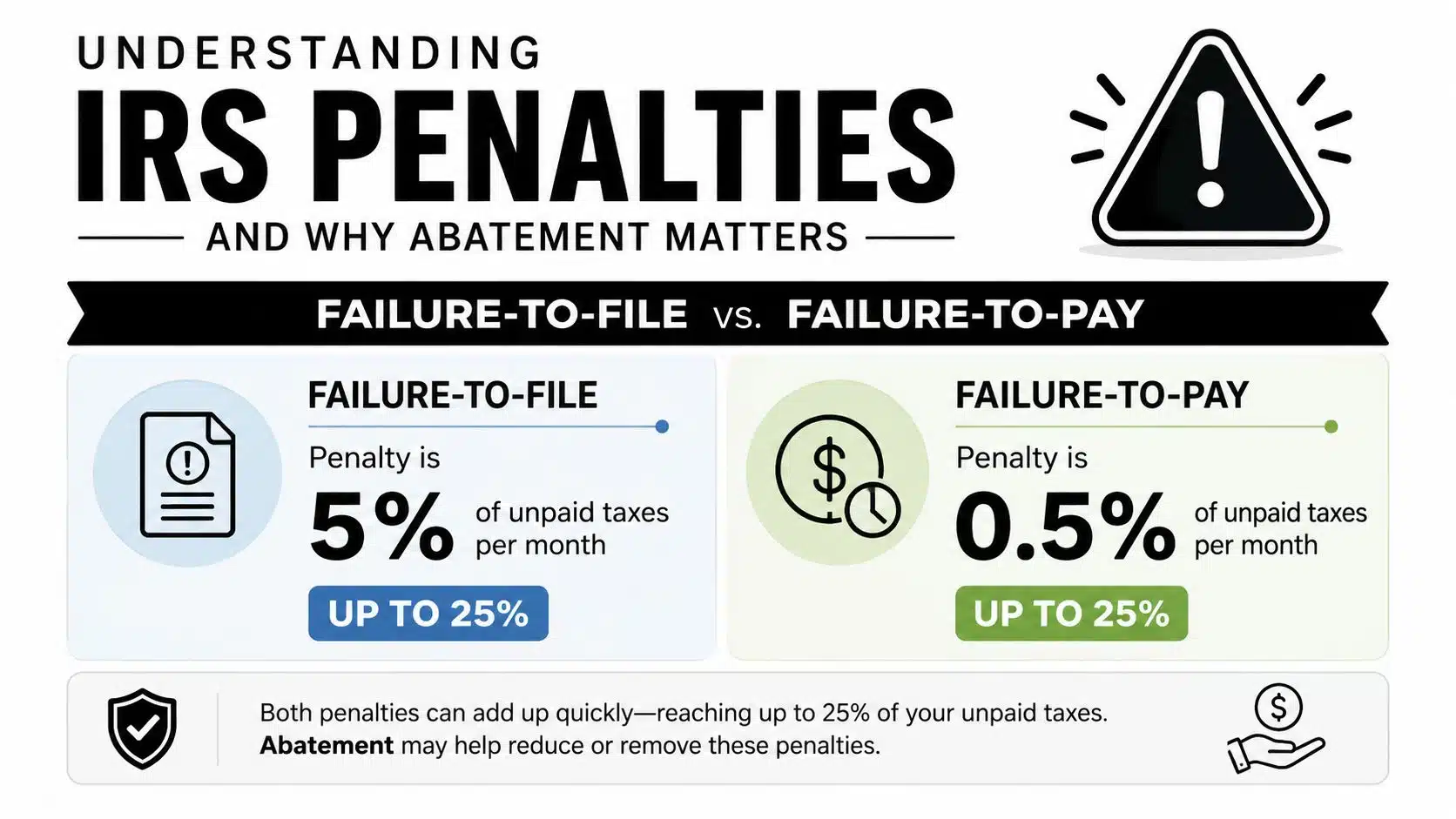
The two penalties most taxpayers encounter are failure to file and failure to pay. The IRS states that failure to file starts at 5% of unpaid tax for each month or part of a month, subject to a 25% maximum. Failure to pay starts at 0.5% of unpaid tax per month, also subject to a 25% maximum. The IRS explains these rules in its guidance on collection procedural questions.
When both penalties apply to the same return, the IRS reduces the failure-to-file charge by the failure-to-pay amount. The combined monthly rate doesn't exceed 5%, but that still creates a serious exposure for someone who files late and leaves the tax unpaid.
Why the notice deserves immediate attention
The 25% ceiling can arrive much faster than taxpayers expect, particularly when a return is filed late and the balance remains unpaid. Waiting for the IRS to correct the account on its own is usually a poor strategy. You need to identify which penalty was assessed, the tax period involved, and whether the IRS calculated the charge correctly.
The IRS says taxpayers may ask for abatement when they believe a penalty was assessed in error. Relief can be requested by phone, through a written explanation, or with Form 843, depending on the circumstances. A request should address the actual penalty shown on the notice, not just the taxpayer's general financial hardship.
Practical rule: Separate the tax liability from the penalty issue. Paying or resolving the tax doesn't automatically prove that the penalty was proper, and disputing a penalty doesn't erase the underlying tax.
People researching late-payment consequences sometimes also need broader planning guidance, especially when retirement funds could be involved. A separate 2026 guide to IRA rollover taxes can help explain the tax consequences of moving retirement assets, but it shouldn't replace a review of the IRS notice itself.
Determining Your Eligibility for Penalty Relief
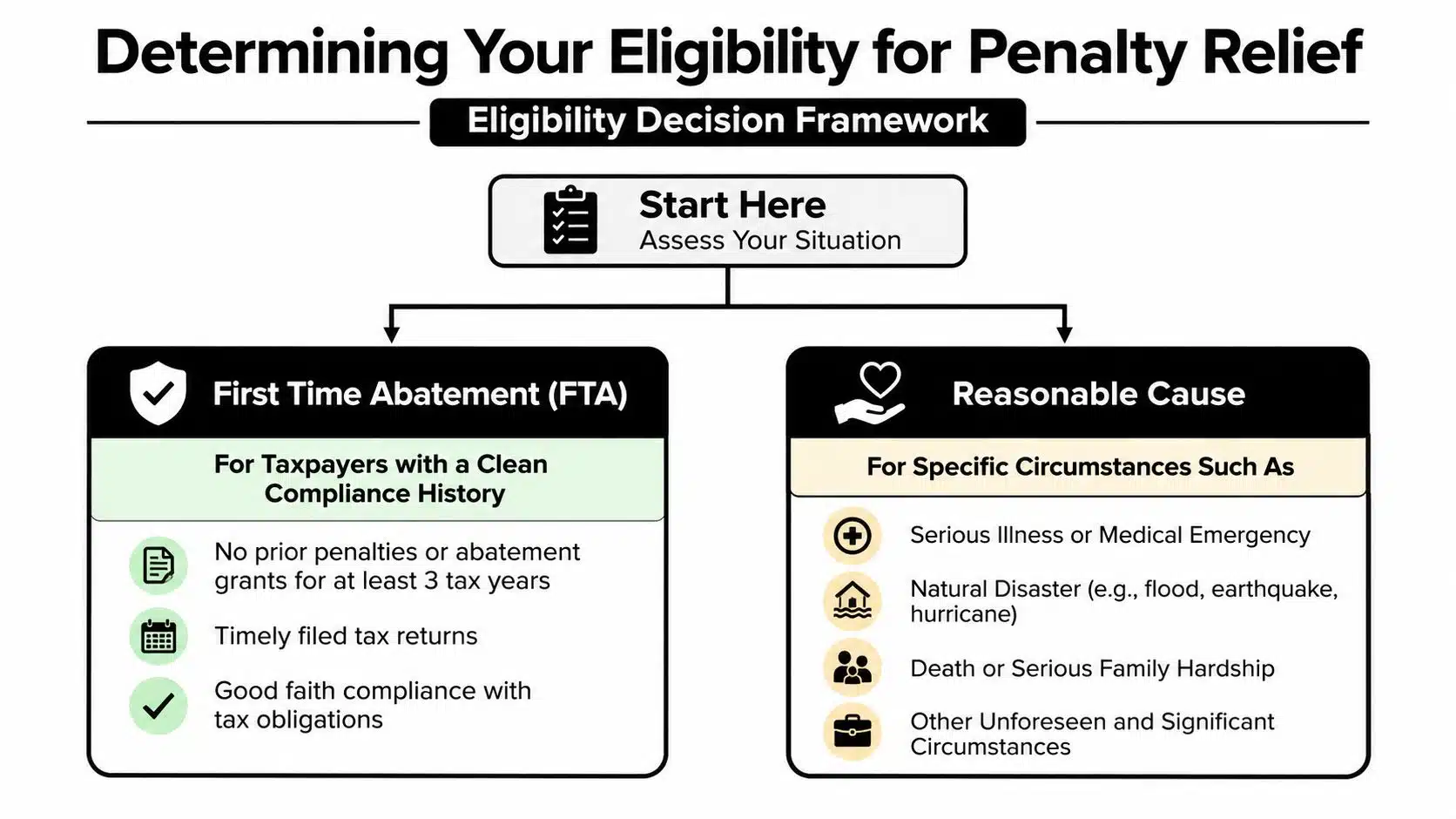
Start with the relief category, not the letter. The IRS decision tree generally asks whether you qualify for First Time Abate, then whether you can establish reasonable cause under the applicable penalty rules. Choosing the wrong path wastes time and can produce a weak explanation.
First Time Abate comes first
First Time Abate, or FTA, is administrative relief for taxpayers with a qualifying compliance history. Current IRS guidance says the taxpayer generally needs a clean history of timely compliance over the prior three years. In practice, that means reviewing whether required returns were filed on time, required payments were made appropriately, and earlier penalties remain on the account.
A clean-looking account can still contain a mismatch. An IRS notice may reflect one filing date while a transcript reflects another, or a payment may have been applied to an unexpected period. Pull the relevant account transcripts before making a confident eligibility assessment. The First Time Penalty Abatement resource provides additional detail on the basic qualification process.
FTA is usually the cleanest argument because it doesn't require you to prove illness, disaster, reliance on a professional, or another extraordinary event. If the taxpayer qualifies, lead with FTA rather than submitting a long emotional explanation.
Reasonable cause requires evidence
If FTA doesn't apply, evaluate reasonable cause. The IRS looks for ordinary business care and prudence despite the failure to file or pay on time. The question isn't whether the taxpayer had a difficult experience. The question is whether the taxpayer acted responsibly under the circumstances and whether those circumstances prevented timely compliance.
Potential facts can include a serious medical event, a natural disaster, unavoidable records loss, or another documented circumstance that directly affected filing or payment. The explanation must connect the event to the missed obligation. “I was overwhelmed” is weak. “A documented medical emergency prevented access to the records needed to complete the return, and the return was filed promptly after access was restored” is more useful, assuming the facts are accurate.
Use this sequence:
- Confirm the penalty: Identify the notice, tax period, penalty type, and assessment date.
- Check FTA first: Review the prior three years of compliance and account transcripts.
- Build reasonable cause only if needed: Gather records showing what happened, when it happened, and how it affected compliance.
- Check for overlap: A taxpayer may have multiple penalties or years requiring separate analysis.
The IRS Internal Revenue Manual explains this framework and addresses how reasonable cause applies when tax remains unpaid. Its penalty relief procedures should guide the technical review.
Preparing and Submitting Your Abatement Request
The IRS accepts more than one route for penalty relief, and the right method depends on the account. A straightforward FTA request may be handled by phone. A complicated reasonable-cause claim should usually be documented in writing, particularly when the account includes several periods, business obligations, or disputed facts.
Choose the submission method carefully
For a simple case, call the IRS using the number on the notice. Have the notice, tax identification information, filing details, and payment history available. Ask the representative to review the specific penalty and explain whether administrative relief can be applied. Record the date of the call, the representative's identifying information if provided, and any confirmation details.
A written request works better when the facts need explanation. Your letter should identify the taxpayer, tax period, notice number, penalty type, requested relief, and supporting documents. Keep the tone factual. The IRS doesn't need a dramatic story. It needs a clear timeline and evidence.
Form 843 is the formal route for a claim for refund or request for abatement. Use the form when the circumstances require a formal claim, when penalties have already been paid, or when the IRS directs you to use it. Follow the form's instructions and retain a complete copy of everything submitted.
Build a persuasive file
A useful reasonable-cause package normally contains:
- A precise timeline: State when the problem began, what prevented compliance, and when corrective action occurred.
- Supporting records: Include medical documentation, disaster records, correspondence, payment evidence, or other documents that prove the circumstances.
- Compliance actions: Show that the taxpayer filed, paid, contacted the IRS, or corrected the issue once the obstacle ended.
- A narrow request: Identify the exact penalty and period you want removed instead of asking the IRS to “fix the account.”
For example, a strong letter might explain that a documented event disrupted access to essential records, that the taxpayer took reasonable steps to reconstruct the information, and that the return was submitted as soon as those steps were complete. Don't claim facts you can't prove, and don't attach irrelevant documents that bury the important evidence.
The IRS generally expects failure-to-pay penalties to be addressed after the underlying tax is paid in full. However, the Internal Revenue Manual also says a request can't be denied solely because the tax remains unpaid when reasonable cause exists and the taxpayer didn't act with willful neglect. That distinction matters for taxpayers who are working through a balance.
The word “abatement” can also appear in property-tax and other contexts, so a general abatement definition for property owners may clarify the broader term. For IRS work, however, focus on the penalty notice, the applicable relief category, and the evidence supporting your request.
For a focused review of facts and documentation, see this guide to reasonable cause penalty abatement. Send requests using the IRS instructions for the notice or form, and keep proof of mailing for paper submissions.
Navigating the 2026 Automatic Relief Changes
The 2026 change is significant because eligible taxpayers may no longer need to request certain First Time Abate relief manually. The IRS says it will begin phasing in automatic penalty relief in summer 2026, and eligible taxpayers generally shouldn't need to call or respond for covered penalties on 2025 and later returns. The agency's automatic penalty relief guidance explains the announced process.
This doesn't mean every notice will immediately show a zero penalty. IRS notices can be issued before the account system applies an automatic adjustment. A taxpayer may receive a notice showing a penalty, then see the account corrected later. The practical mistake is treating either document as conclusive without comparing the notice with the account transcript.

What to do when the notice and transcript disagree
First, preserve the notice. Then review the account transcript for the penalty transaction, reversal, adjustment, and current balance. If the notice predates the system update, monitor the account rather than immediately sending a duplicate request. If the penalty remains after the system should have processed the relief, contact the IRS and explain that the account appears eligible for automatic treatment.
Don't ignore a collection deadline while waiting for an update. If the notice demands action, determine whether the balance is still active and whether a payment arrangement or other protective step is needed. Automatic relief addresses eligible penalties. It doesn't resolve unrelated tax, interest, filing, or collection issues.
Businesses need a separate review. The IRS says automatic FTA relief also covers certain failure-to-deposit payroll tax penalties, but that doesn't mean every payroll penalty qualifies. Check the form, tax period, penalty code, filing history, and deposit history. A payroll account can have multiple penalty types, and one may qualify while another doesn't.
The Taxpayer Advocate has highlighted the gap between manual relief and what an automated process could identify. Its report states that the IRS granted FTA to about 200,000 taxpayers in tax year 2021, while the Taxpayer Advocate Service estimated that a systemic process could have waived penalties for about 4.5 million taxpayers and that the manual policy abated about 2% of relevant penalties compared with an estimated 50% under automation. The same report notes that roughly 220,000 taxpayers received manual FTA relief in fiscal year 2025. These figures come from the Taxpayer Advocate Service report.
The lesson is straightforward. Automatic relief reduces the need to ask, but it doesn't eliminate the need to verify.
When to Handle It Yourself Versus Hiring Allied Tax Advisors
A simple account doesn't need a complicated strategy. If the penalty is isolated, the taxpayer has a clean compliance history, the notice is clear, and the requested relief fits First Time Abate, a phone request or concise written request may be enough.
DIY handling makes sense when:
- The facts are simple: One tax period, one clear penalty, and no dispute over the underlying tax.
- The records are available: You can prove filing dates, payments, and the circumstances behind any delay.
- The account is current: There aren't multiple unresolved notices, missing returns, or collection actions.
- The request is administrative: You're asking for straightforward FTA treatment rather than arguing a complex reasonable-cause position.
Professional help becomes more valuable when the account has layers. Multiple tax years can produce overlapping penalties and inconsistent IRS records. Business payroll penalties require attention to employment tax filings and deposits. A prior denial means the next submission must address why the original reasoning was insufficient, not merely repeat the same request.
Situations that justify representation
Hire an experienced tax professional when the IRS has already rejected relief, when the reasonable-cause facts are difficult to document, or when the penalties are part of a larger compliance problem. The same applies when the taxpayer is facing active collection, has unfiled returns, or needs transcript analysis across individual and business accounts.
Allied Tax Advisors offers IRS and state resolution services, including assistance with penalty relief based on reasonable cause or First Time Abate. Its team includes CPAs and enrolled agents who can review transcripts, organize supporting evidence, and communicate with tax authorities. The firm's guide to resolving IRS issues with a professional tax accountant explains the broader role of representation.
Don't choose a representative solely because a website promises removal of every penalty. Ask who will review the transcripts, whether the firm handles business payroll accounts, how it documents reasonable cause, and what happens if the IRS denies the request. If you're also comparing professional costs in an unrelated legal matter, a guide to comparing Utah bankruptcy lawyer fees illustrates why scope and service details matter before you sign an engagement.
Maximizing Your Chances and Planning Ahead
Penalty relief is only one part of account cleanup. After the IRS adjusts the penalty, verify the remaining balance, interest, and payment application. Abating a penalty doesn't automatically remove every related charge, and partial relief can leave an account that still needs reconciliation.
First Time Abate isn't necessarily a once-in-a-lifetime opportunity. IRS guidance and related administrative materials recognize that relief may be available again after the taxpayer establishes another clean compliance period over the prior three years, subject to the applicable rules and penalty type. Don't assume a prior approval permanently disqualifies you, but don't assume eligibility without checking the account.
Keep a permanent penalty file containing:
- IRS notices and transcripts: Save the original notice and later account records.
- Proof of filing and payment: Retain submission confirmations, payment receipts, and correspondence.
- Event documentation: Preserve records supporting illness, disaster, records loss, or other reasonable-cause facts.
- Resolution history: Record calls, letters, forms, dates, and IRS responses.
If the IRS denies your request, read the explanation carefully and determine whether the problem was eligibility, missing evidence, timing, or an incorrect account record. A denial isn't a reason to send the same letter again. Correct the weakness, request further review when available, or obtain representation if the account involves collection or multiple periods.
The strongest long-term strategy is boring and effective: file every required return, pay what you can by the deadline, monitor notices promptly, and reconcile IRS transcripts when the account matters. That discipline protects access to administrative relief and keeps a manageable tax issue from becoming a larger enforcement problem.
Allied Tax Advisors helps individuals and businesses review IRS notices, analyze transcripts, prepare First Time Abate or reasonable-cause requests, and address related tax resolution issues. Visit Allied Tax Advisors to request help evaluating your penalty account and choosing the next practical step.