
So, you got a state tax refund. Great! Now for the big question: do you have to pay federal taxes on it? The answer, like so many things in the tax world, is a classic: it depends.
Your refund is only taxable if you itemized deductions on last year's federal return and took a deduction for the state income taxes you paid. If you took the standard deduction, you can breathe a sigh of relief—your refund is tax-free.
Understanding When State Refunds Become Taxable Income
The reason behind this rule comes down to a simple IRS principle called the "tax benefit rule." Think of it this way: you can't get a tax break twice on the same dollar.
When you itemize and deduct your state tax payments, you effectively lower your federally taxable income for that year. So, if your state turns around and gives you some of that money back as a refund, the IRS sees it as you recovering money you already got a tax benefit for. To make things fair, you have to "repay" that benefit by reporting the refund as income in the year you get it.
It's a common situation—around 30 million taxpayers get state tax refunds each year. Whether that refund is taxable all comes down to how you filed last year. If you took the standard deduction or chose to deduct state sales tax instead of income tax, you didn't get a federal tax benefit for the state income taxes you paid. In that case, your refund is all yours, no strings attached.
Your state will send you a Form 1099-G that shows the refund amount in Box 2, which is your official record for tax purposes.
State Refund Taxability At a Glance
This whole "itemized vs. standard" thing can get a little confusing. Here’s a quick table to help you figure out where you stand based on last year's tax return.
| Did You Itemize Deductions Last Year? | Did You Deduct State Income Taxes? | Is Your State Refund Taxable? |
|---|---|---|
| No (You took the standard deduction) | N/A | No |
| Yes | No (You deducted sales tax instead) | No |
| Yes | Yes | Yes (Potentially, subject to the tax benefit rule) |
As you can see, the only scenario where your refund might be taxable is if you answered "Yes" to both questions.
Your Quick Decision Guide
Here’s a visual breakdown of the process to help you see the logic in action.
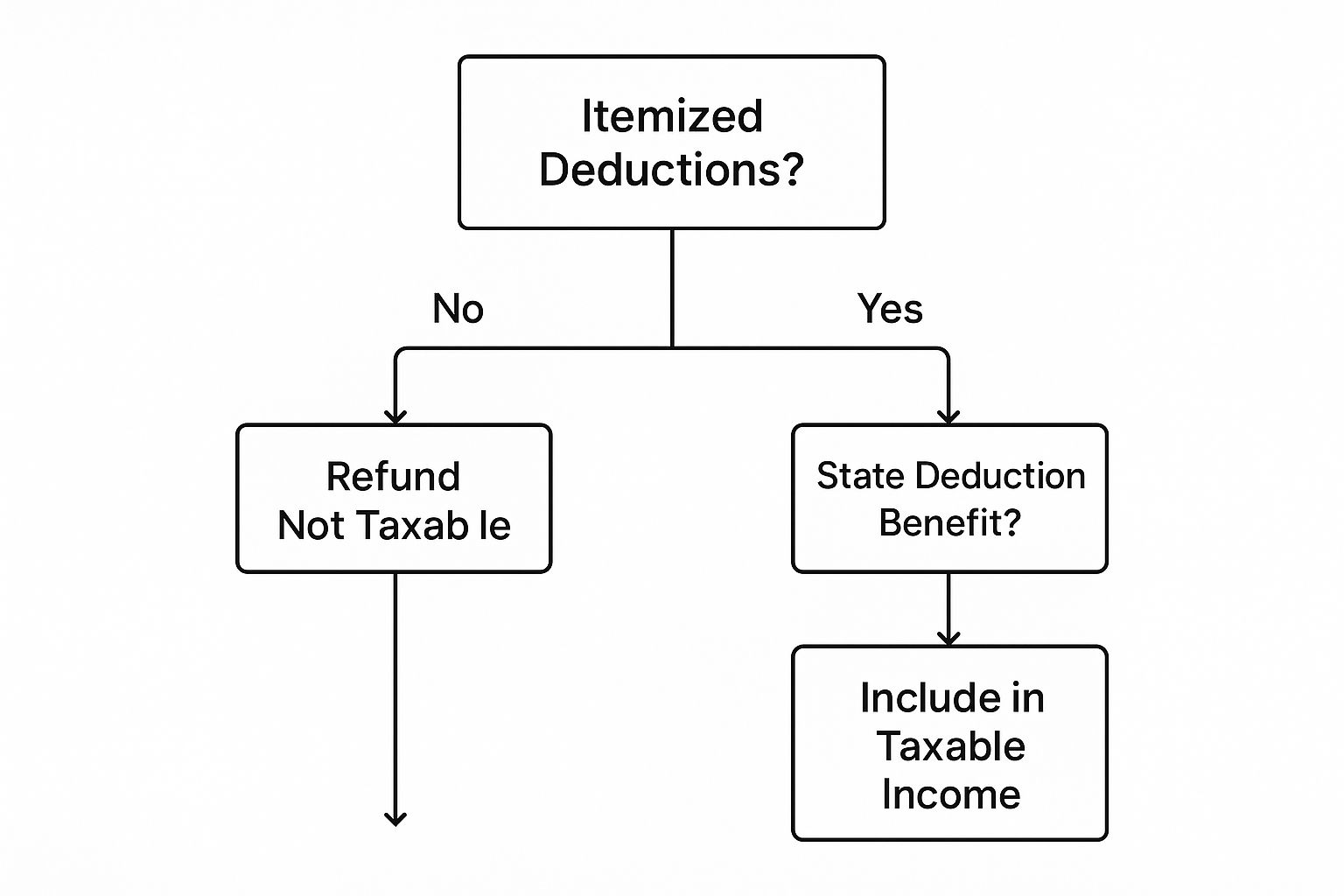
This chart really drives the point home: itemizing is the crucial first step. If you didn't itemize, you're in the clear. Now, let's dig a little deeper into the tax benefit rule to see exactly why this works the way it does.
Decoding the Tax Benefit Rule
To figure out if your state income tax refund is taxable, you first need to get familiar with something called the tax benefit rule. It might sound like a stuffy bit of tax jargon, but the idea behind it is actually pretty simple and fair. At its core, it just prevents you from getting two tax breaks for the same dollar.

Think about it this way. Let's say you buy a jacket for $100 but you have a $20 coupon, so you only spend $80. If you decide to return it a week later, the store isn't going to give you back the full $100. They're going to refund the $80 you actually paid.
The tax benefit rule works on the exact same logic. When you itemize your deductions on your federal return and you include the state income taxes you paid, you're essentially using a "coupon" to lower your federal taxable income. That reduction is your tax benefit.
So, when your state sends you a refund for some of those taxes later on, the IRS sees it as getting your money back—the same money you already told them you'd paid. To make things right, you have to report that refund as income.
How a Deduction Can Create Taxable Income
It all comes down to the direct link between what you do on your federal return one year and the refund you get the next. The deduction you take is what sets the stage.
Here's how it plays out, step-by-step:
- Year 1 Action: You file your federal tax return and choose to itemize deductions. You deduct every dollar of state and local income tax you paid throughout the year.
- Year 1 Result: That deduction lowers your adjusted gross income (AGI), which means you pay less in federal taxes. You've officially received a tax benefit.
- Year 2 Action: You get around to filing your state tax return and find out you overpaid. Your state sends you a refund.
- Year 2 Result: Because you already got a tax break on that overpaid amount, the IRS says you have to include the refund as income on your federal return for Year 2.
This whole process just ensures that your taxable income ultimately reflects the actual amount of state tax you paid after everything was said and done. It’s the IRS's way of making sure the books balance out over the two years.
The tax benefit rule is an accounting principle that prevents taxpayers from benefiting twice from the same expense. If a deduction in a prior year resulted in a tax savings, the recovery of that expense in a later year must be included in income.
This isn't a niche rule; it’s applied nationwide. Take Colorado, for example. In 2020, about 114,000 Colorado taxpayers got a state income tax refund from the prior year. The state's tax laws are set up to align with the federal approach, which really shows how intertwined these tax systems are. You can find more detail on this in Colorado's legislative analysis.
When Your State Refund Is Not Taxable

While the tax benefit rule can turn a state refund into taxable income, many people find their refund is completely tax-free. It all comes down to one simple question: did you get a federal tax break for paying those state taxes in the first place? If the answer is no, the IRS has no reason to claim a piece of your refund.
The most common reason your refund is tax-free is also the simplest. If you took the standard deduction on your federal tax return last year, your state refund is not taxable. Period.
Why? Because you never deducted your state tax payments in the first place. You didn't itemize, so you never received a "tax benefit" for those payments. That means there's nothing for the IRS to take back. For the millions of Americans who take the standard deduction, it’s a clean and simple rule.
Exceptions for Itemizers
Now, even if you did itemize your deductions, don't assume your state refund is automatically taxable. There are a few important exceptions to the rule, and they hinge on which state and local taxes you chose to deduct.
One major exception comes into play if you elected to deduct state and local sales taxes instead of state and local income taxes on your Schedule A. This is a popular move for people in states with no income tax, or for anyone who made a huge purchase (like a car) during the year. Since your refund is for income taxes—a deduction you never actually took—it isn’t considered taxable income.
This distinction is everything. The IRS is only interested in recouping the specific benefit you received. If you didn’t get a tax break for deducting state income taxes, there's no benefit to tax. This is especially relevant for taxpayers in states like California, where navigating the specific deductions can make a real difference. For a deeper dive, check out our guide on the 2024 California tax brackets explained.
The other big factor is the State and Local Tax (SALT) deduction limit. This is a major one. Federal law caps the amount you can deduct for all state and local taxes—property, income, and sales combined—at $10,000 per household.
If your total state tax payments were well over the $10,000 SALT cap, a portion of your refund is likely tax-free. You only got a tax benefit on the first $10,000 you paid, so any refund related to the amount you paid above that cap isn't taxable.
Let's say you paid $12,000 in state income taxes last year. Because of the SALT cap, you could only deduct $10,000 on your federal return. That extra $2,000 gave you zero tax benefit. So, if you get a state refund, the first $2,000 of it would be completely tax-free. You only have to worry about the part of the refund that came from the amount you actually got to deduct.
How to Report Your Taxable State Refund
So, you’ve figured out your state refund is taxable. Now what? The good news is that reporting it on your federal return is actually pretty straightforward once you know where to look.
Every January, your state’s tax agency will send you a document called Form 1099-G, Certain Government Payments. Think of this as the official record of the refund you received last year. The number you need to pay attention to is in Box 2—that's the total refund amount.
Finding the Right Spot on Your Federal Return
You won’t plug this number into the main page of your Form 1040. Instead, you’ll need to find Schedule 1, Additional Income and Adjustments to Income.
Look for Line 1, which is specifically labeled "Taxable refunds, credits, or offsets of state and local income taxes." That's where the amount from Box 2 of your 1099-G goes. From there, the total from Schedule 1 gets carried over to your main Form 1040, becoming part of your Adjusted Gross Income (AGI).
This little form plays a big role in the national tax system. In a recent tax season alone, the IRS handled over 128 million individual returns, sending out a staggering $268 billion in refunds. The 1099-G is the mechanism that helps keep all those state-level refunds accounted for at the federal level. You can find more fascinating tax return statistics on efile.com.
What If You Never Got a Form 1099-G?
Don't assume you're off the hook just because a 1099-G didn't show up in your mailbox. Your state sends a copy directly to the IRS, so they already know about the refund. It’s up to you to report it.
If your form is missing, here’s what to do:
- Check online. Most state tax agency websites have a secure portal where you can find and download a digital copy of your tax documents.
- Give them a call. If you can’t locate it online, a quick call to your state’s department of revenue is the next best step.
Key Takeaway: Even without the paper form, the IRS expects you to report any taxable refund. It's far better to track down the information yourself than to get a notice from the IRS later, which can come with added penalties and interest.
Getting the details right is the cornerstone of a smooth tax season. For more ideas on improving your tax outcome, check out our essential tips on how to maximize your tax refund.
Real-World Scenarios of State Refund Taxation

Tax rules can feel a bit abstract. The best way to really get a handle on them is to see how they play out in the real world. Let's walk through three common scenarios to see how different filing choices can change whether or not your state tax refund is taxable on your federal return.
These examples will help you connect the dots between the tax benefit rule and your own financial situation, so you can avoid making a costly mistake.
Scenario 1: Alex Took the Standard Deduction
First up is Alex. Last year, Alex decided to take the standard deduction on his federal tax return. It was just the simpler route, and it ended up giving him a better result than if he had gone through the trouble of itemizing all his expenses.
Throughout the year, his employer withheld $4,000 for state income taxes from his paychecks. When he filed his state return, he found out he’d overpaid and was getting a $500 refund.
So, does Alex have to report that $500 refund as federal income?
The answer is a simple and resounding no. Because Alex took the standard deduction, he never actually deducted the $4,000 in state taxes he paid on his federal return. Since he didn't get a specific "tax benefit" for that payment, the IRS doesn't consider the $500 he got back to be taxable income.
Scenario 2: Maria Itemized and Deducted Her State Taxes
Next, let’s look at Maria. Maria chose to itemize her deductions last year. It made perfect sense for her because she had significant expenses like mortgage interest and charitable giving that added up to more than the standard deduction.
On her Schedule A, she listed the $8,000 she paid in state income taxes as one of her deductions. This move lowered her federal taxable income, which ultimately saved her money. This spring, she filed her state return and got a $750 refund.
Is Maria's $750 state refund taxable?
You bet it is. The entire $750 is taxable on her federal return this year. Why? Because Maria received a direct tax benefit by deducting the full $8,000 in state taxes she thought she paid. The refund shows she actually only paid $7,250 in the end. The IRS sees that $750 difference as an extra benefit she received, so she has to report it as income to even things out.
Scenario 3: Ben Was Limited by the SALT Cap
Finally, let’s untangle Ben’s more complicated situation. Like Maria, Ben itemized his deductions. He paid a hefty $12,000 in state income taxes and another $5,000 in property taxes, totaling $17,000 in state and local taxes.
Here’s the catch: the SALT cap limited his deduction to just $10,000 on his federal return. This means the other $7,000 he paid gave him zero federal tax benefit. A few months later, he received a $1,500 state income tax refund.
Is Ben's $1,500 refund taxable? This is where the tax benefit rule really shows its nuance. Only a portion of his refund—if any—is taxable.
Ben paid $2,000 more in state income taxes ($12,000 paid minus the $10,000 he claimed) than he could deduct. Since he never received a tax benefit for that extra $2,000, the first $2,000 of any state refund he gets is completely tax-free.
His $1,500 refund is less than that non-beneficial amount. Therefore, $0 of Ben’s refund is taxable. If his refund had been, say, $2,500, then $2,000 would still be tax-free, and he would only have to report the remaining $500 as taxable income.
To bring it all together, this table summarizes how the same state refund can have very different federal tax outcomes depending on your filing choices.
Taxability Scenarios Compared
| Taxpayer Scenario | Prior Year Deduction Type | State Refund Amount | Taxable Portion of Refund |
|---|---|---|---|
| Alex | Standard Deduction | $500 | $0 (No tax benefit received) |
| Maria | Itemized Deduction | $750 | $750 (Full tax benefit received) |
| Ben | Itemized (SALT Capped) | $1,500 | $0 (Refund was less than non-deducted amount) |
As you can see, the key isn't just whether you got a refund, but whether you benefited from the overpayment on last year's federal return.
Wrapping It Up: What to Remember About Your State Refund
So, is your state income tax refund considered taxable by the feds? It all comes down to a single, simple principle: the tax benefit rule.
Think of it this way: your refund is only taxable if you itemized your deductions on last year's federal tax return and you took a deduction for the state income taxes you paid. If you took the standard deduction instead, you're in the clear. Your refund is not considered federal income.
Why the distinction? When you itemize and deduct state taxes, you lower your federal tax bill. You received a direct financial "benefit." Getting a refund is essentially the state giving you some of that money back, so the IRS wants to even the score by taxing that returned amount. You'll get a Form 1099-G from your state, which is the official record of this.
The bottom line: When in doubt, pull out last year's tax return. A quick glance at your Schedule A will show you if you itemized and deducted state and local taxes. That’s your definitive answer.
Knowing this one rule helps you file an accurate return and, more importantly, avoid paying more tax than you owe. Keep in mind that while this federal rule is consistent, state-specific tax laws can get tricky. Getting a handle on your state's system, like learning about understanding the California income tax brackets, is always a smart move.
Got More Questions? We've Got Answers
Even after you get the hang of the main rules, real-life tax situations can still leave you scratching your head. Let's tackle some of the most common questions people have about how their state income tax refund affects their federal return.
What If I Applied My Refund to Next Year's Taxes?
It's a smart move for managing cash flow, but it doesn't change a thing in the eyes of the IRS. Choosing to credit your state refund toward your next year's estimated taxes, instead of getting a check in the mail, is still considered a refund for the prior year.
The taxability follows the exact same logic we've discussed. Did you itemize last year? Did you get a tax benefit from that state tax deduction? If so, you still have to report the refund amount shown on your Form 1099-G as income. How you "received" it—as cash or a credit—is irrelevant to its tax treatment.
My State Has No Income Tax. Does This Matter?
If you live in a state without a personal income tax—like Florida, Texas, or Nevada—you can breathe easy. This entire topic is a non-issue for you.
Since you never pay state income taxes in the first place, you'll never receive a state income tax refund. That means you'll never have one to worry about reporting on your federal tax return. Feel free to skip this section of the tax code!
Heads Up: Forgetting to report a taxable state refund is one of the easiest mistakes for the IRS to catch. Your state sends a copy of Form 1099-G directly to them, and their computer systems are built to flag a mismatch if that income is missing from your return.
What Happens If I Don't Report a Taxable Refund?
You'll almost certainly get a letter from the IRS. Their automated systems are incredibly efficient at cross-referencing the information they get from states with what you put on your tax return.
When their system finds a discrepancy, you'll likely receive a CP2000 notice. This isn't an audit, but it's a letter proposing changes to your return. It will detail the additional tax you owe on the unreported refund, plus any penalties and interest that have piled up. It's a headache you can easily avoid just by reporting it correctly from the start.
Trying to make sense of all the tax rules can feel overwhelming. The team at Allied Tax Advisors is here to bring clarity to the complexity so you can file with total confidence. Visit us at https://alliedtax.com to learn how our personalized tax services can help you achieve your financial goals.