
You close the quarter, open your bank balance, and the number feels wrong.
Revenue looked solid. Clients paid. Occupancy was good. Projects moved forward. But cash still feels tighter than expected, and now you're trying to reconstruct what happened from transactions that were recorded correctly but never turned into a real plan.
That gap is where many small businesses stall. The books are clean enough for tax time, yet the owner still makes decisions from instinct. S Corp shareholders guess at distributions. LLC owners wait too long to plan for estimated taxes. Real estate investors see repairs spike without knowing whether the variance is normal, deferred maintenance, or a sign that one property is dragging on the portfolio.
QuickBooks can do much more than categorize expenses and print reports. Used well, it becomes a budgeting system that helps you set targets, monitor variance, and tie operating decisions back to tax impact. That matters because a budget isn't just a management tool. It's one of the clearest ways to prevent cash flow surprises, spot weak assumptions early, and make tax planning part of the year instead of a scramble at filing time.
Why Your Business Needs More Than Just Bookkeeping
A lot of owners think they have a budgeting problem when they have a visibility problem.
Bookkeeping tells you what happened. It records rent, payroll, software, repairs, merchant fees, and revenue. That's necessary, but it doesn't answer the harder question: was this month supposed to look like this? Without a budget, every review starts from zero. You see activity, not context.

Construction firms run into this constantly. They may estimate jobs carefully in a field tool like Exayard construction estimating software, then lose clarity once the work moves into the accounting system. The estimate governs the project. The QuickBooks file governs the company. If those two worlds never connect through a budget, owners can win bids and still miss margin targets.
The same pattern shows up in service businesses and rental portfolios. The books may be current. The tax return may be filed. Yet no one has mapped expected payroll, owner compensation, recurring repairs, debt service pressure, or quarterly tax obligations against actual performance. That's when "we're busy" turns into "why is cash short?"
Bookkeeping records history
Clean books are the foundation. They support reconciliations, sales tax filings, payroll, and year-end tax prep. But they are backward-looking by design.
A budget changes the role of QuickBooks from ledger to management tool. Instead of asking where money went after the fact, you start asking whether spending and income are tracking with the plan.
Practical rule: If your monthly review doesn't include budget-to-actual variance, you're still doing compliance accounting, not financial management.
Budgets create decision points
Once a budget is in place, routine questions get easier to answer:
- Hiring decisions: Can the business absorb a new salary in Q3 without pressuring cash?
- Distribution timing: Is an S Corp distribution consistent with profit, payroll, and tax reserves?
- Property performance: Are repairs for one rental materially above plan, or just unevenly timed?
- Price pressure: Did margins narrow because direct costs increased, or because administrative overhead drifted?
A current bookkeeping file helps answer those eventually. A budget helps answer them while you can still act.
For businesses that already outsource data entry or reconciliations, the next step is to connect those books to planning. That's where a stronger accounting and bookkeeping workflow starts paying for itself. The value isn't only cleaner records. It's better decisions from those records.
The stress usually starts at quarter end
Owners rarely complain that budgeting feels too strategic. They complain because they waited too long.
Quarter end arrives. Payroll tax deposits are due. Insurance renews. A big repair invoice lands. Estimated taxes weren't reserved. Then someone opens QuickBooks and hopes the reports will explain everything. They usually don't, because no baseline was ever established.
That isn't a QuickBooks problem. It's a process problem. Budgeting in QuickBooks fixes that by forcing a standard for what the business expected to do, not just what it happened to spend.
Foundational Budgeting Concepts for QuickBooks Users
The biggest mistake in budgeting in QuickBooks happens before anyone clicks Create New Budget. It starts with the assumption that last year's numbers should automatically roll forward.
That approach feels efficient, but it often hardwires old waste into the new year. Lucrum Consulting's guidance on budgeting in QuickBooks recommends a zero-based methodology built from historical analysis instead of auto-copying prior budgets, and it warns that over-reliance on last year's data can create 20-30% inaccuracy without a zero-based reset.
Zero-based beats lazy roll-forwards
Incremental budgeting asks, "What did we spend last year, and what should we change?"
Zero-based budgeting asks, "If we were approving this expense today, would we still budget for it, and at this level?"
That second question is far more useful for:
- S Corps deciding whether current payroll, contractor spend, and owner benefits still make sense
- LLCs trying to separate fixed overhead from growth spending
- Rental owners reviewing repairs, management fees, supplies, and property-specific costs
- Businesses with multiple classes or locations that shouldn't hide weak performance inside consolidated totals
A prior-year budget can still inform the process. It just shouldn't dictate it.
A budget should reflect current assumptions, not memorialize old habits.
Start in Excel before you build in QuickBooks
QuickBooks is where the budget lives. Excel is where the budget gets tested.
That distinction matters. In Excel, it's easy to model hiring changes, seasonality, rent increases, debt payments, one-time purchases, and tax reserves without cluttering your accounting file. You can sketch alternatives, compare assumptions, and pressure-test a draft before anyone imports or enters numbers into QuickBooks.
This is also where many owners learn whether they need a fixed budget or a more adaptive framework. If your revenue swings with volume, projects, or occupancy, reading about understanding flexible budgets can help you choose a structure that tracks reality more closely than a static annual plan.
Historical data is useful, but only if you read it correctly
Use the last twelve months of financial activity as evidence, not as instructions.
Look for patterns such as:
| Review area | What to ask |
|---|---|
| Revenue mix | Which customers, properties, or service lines drive most of the income? |
| Fixed costs | Which expenses recur regardless of sales volume? |
| Variable costs | Which expenses rise when activity rises? |
| Timing issues | Which costs hit annually, quarterly, or seasonally rather than monthly? |
| Tax-sensitive categories | Which accounts affect deductions, owner compensation, or estimated payments? |
This review usually exposes distortions. A business may have one unusually high repair month, a delayed insurance payment, or a temporary labor spike that shouldn't become the default budget. Without that analysis, an owner can build a technically neat budget that is strategically wrong.
The budget needs subdivisions if the business has moving parts
Many QuickBooks files are too aggregated. Revenue sits in broad buckets. Expenses are pooled. Owners look at total net income and miss the fact that one segment performs well while another leaks margin.
Class, location, or customer subdivisions solve that. They let you budget by line of business, property group, program, or operating unit. That isn't a cosmetic detail. It's often the difference between a useful budget and a report nobody trusts.
A good budget also gets reviewed monthly, shared with the right people, and revised when assumptions change. If it lives untouched after January, it isn't a budget anymore. It's a spreadsheet memorial.
Creating Your Budget in QuickBooks Online vs Desktop
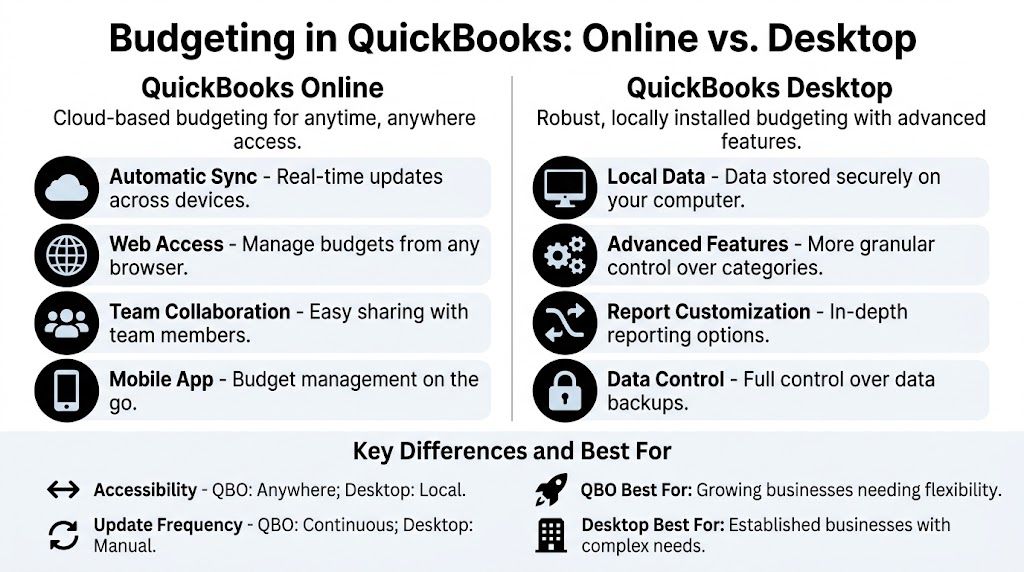
QuickBooks gives you two workable paths for budgeting in QuickBooks, but the workflow feels different depending on whether you're in Online or Desktop. The best choice depends less on marketing language and more on how your business operates, how often you revise budgets, and whether you need cloud access or prefer local control.
What both versions can do
QuickBooks budgeting functionality lets users create profit and loss or balance sheet budgets on a monthly, quarterly, or yearly basis, with the option to prefill totals using the previous year's actual data, according to Kaufman Rossin's QuickBooks budget guide.
That shared foundation matters because the core budgeting questions remain the same on both platforms:
- What period are you budgeting for?
- Is this a P&L budget or balance sheet budget?
- Should you divide the budget by class, customer, or location?
- Are prior-year actuals useful as a starting point?
- Will the budget be updated regularly, or only reviewed at month end?
QuickBooks Online workflow
In QuickBooks Online, go to Reports > Financial planning > Budgets and choose Create New Budget. From there, pick the fiscal year, choose the budget type, and decide whether you want to subdivide the budget by customer, class, or location.
For many growing businesses, QBO is easier to maintain because the budget lives in the same cloud environment where daily bookkeeping happens. If multiple people review results, that convenience matters. Managers, bookkeepers, and owners don't have to pass around local files or wait for one workstation to become available.
A practical QBO workflow looks like this:
- Select the fiscal year that matches your tax and operating calendar.
- Choose the budget type based on what you want to control. Most operating businesses start with profit and loss.
- Turn on subdivisions if the business has distinct activities. Contractors may budget by class for construction versus remodel work. Real estate investors may separate properties or portfolios.
- Prefill from prior-year actuals if the data is reasonably clean.
- Edit each line based on current assumptions, not habit.
If you're considering a platform change before you build budgets, it's worth reviewing what a QuickBooks Desktop to Online conversion affects. Budget structure, account mapping, and class tracking deserve a close look before migrating.
QuickBooks Desktop workflow
In QuickBooks Desktop, go to the Company menu and create a new budget from the budgeting area there. The sequence is familiar to long-time Desktop users and often feels more direct if the accounting team already works inside a locally managed file.
Desktop remains a strong fit for businesses that want tight internal control, deeper comfort with installed software, or established accounting procedures built around that environment. The budgeting screens are straightforward, and many seasoned bookkeepers still prefer Desktop's feel for structured accounting work.
The process is usually:
- Choose the year
- Select profit and loss or balance sheet
- Decide whether to create a budget for the whole company or a subdivided version
- Use historical actuals if that helps
- Enter or revise amounts by period
The trade-off is operational rather than technical. Desktop can work very well, but businesses need discipline around file access, backups, and consistency if more than one person influences the budgeting process.
Online versus Desktop in practice
Here is the practical comparison most owners care about:
| Question | QuickBooks Online | QuickBooks Desktop |
|---|---|---|
| Access | Better for browser-based, shared access | Better for firms committed to local software |
| Collaboration | Easier for owners and staff in different places | Stronger when one accounting team controls the file |
| Budget maintenance | Convenient for frequent updates | Comfortable for established internal workflows |
| Fit | Growing, mobile, or distributed operations | Mature setups with stable processes |
Neither version creates a smart budget by itself. The software only reflects the quality of the assumptions entered into it.
The wrong budget in the right software is still the wrong budget.
Subdivided budgets are where QuickBooks gets useful
The strongest budgeting work in QuickBooks usually comes from subdivisions. A single company-wide budget is easy to create, but often too broad to diagnose anything.
Use subdivisions when you need answers like these:
- Class budgeting: Which service line or project type is producing margin?
- Location budgeting: Is one branch consuming overhead faster than expected?
- Customer budgeting: Does a major account justify the staffing and support it requires?
For a real estate owner, this can mean separating rental activity by class so recurring repairs don't disappear inside a single repairs and maintenance total. For an S Corp, it can reveal whether one revenue stream is carrying administrative costs for the whole company.
That level of detail takes longer up front, but it produces reports you can act on.
Importing Exporting and Advanced Budget Management
Manual budget entry is fine when the chart of accounts is simple and the budget is short. It becomes painful when the business has multiple classes, many accounts, or a planning model already built outside QuickBooks.
That's why import and export workflows matter so much in budgeting in QuickBooks.
When importing makes sense
The most practical use case is this: the owner or advisor builds the first version in Excel, reviews assumptions, then imports the final structure into QuickBooks rather than retyping every line.
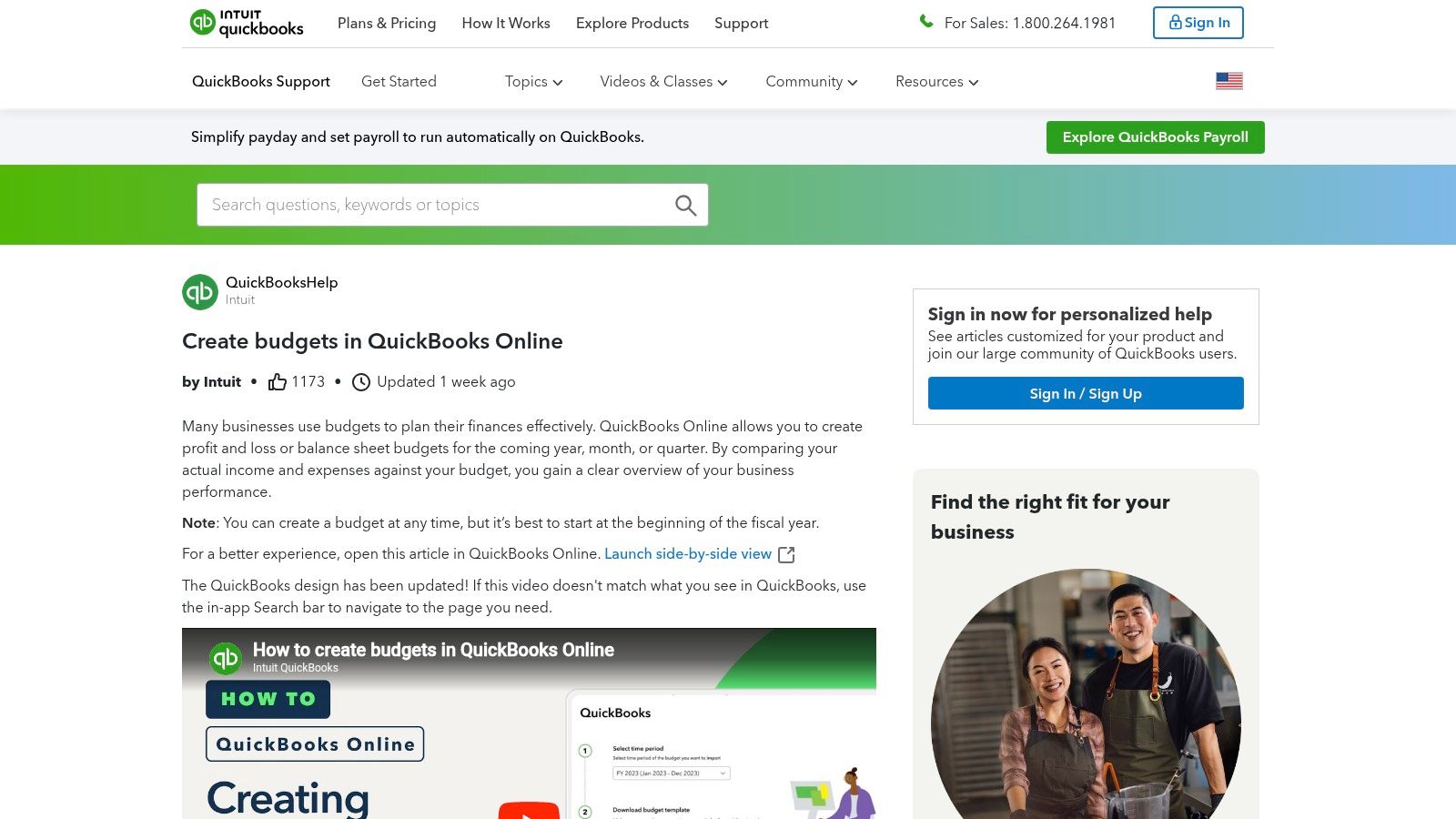
QuickBooks Online Advanced added AI-powered import tools in 2023+ for uploading Excel or CSV budgets into P&L frameworks, and Intuit notes that this can reduce setup time by an estimated 40-50% for complex enterprises. That import capability is available in Plus and Advanced, not Essentials, according to Intuit's QuickBooks Online budget import documentation.
That matters for businesses with:
- several departments or classes
- budgets prepared by an outside advisor
- planning models that start in Excel
- frequent revisions during the year
A clean chart of accounts makes imports easier
Budget imports fail or become messy when the file structure is inconsistent. Account names need to match. Categories need to be used consistently. Class and location logic needs to be thought through before data is uploaded.
That's why budget work often exposes structural issues in the ledger itself. If your accounts are bloated, duplicated, or too vague, the budget will inherit those problems. Cleaning the chart of accounts in QuickBooks first usually saves time later.
A practical import workflow
A strong process usually follows this order:
- Draft in Excel first. Build assumptions where it's easy to model changes.
- Check account mapping. Make sure each budget line ties to the correct QuickBooks account.
- Confirm subdivisions. If you're budgeting by class or location, set that structure before import.
- Import into QBO. Use the platform's import process for supported budget types.
- Run reports immediately. Verify that values landed where you expected.
This is not just administrative housekeeping. It protects the analytical value of the budget. A budget with bad mapping creates bad variance reports, which leads to bad decisions.
If the account structure is weak, imported budgets only make the weakness faster.
Exporting is just as important
A lot of owners think of export as an afterthought. It isn't.
Exporting a budget or budget report back to Excel is useful when you need to:
- prepare lender packages
- share financial planning with a partner or manager
- test revised assumptions outside QuickBooks
- annotate a review copy before making system changes
Excel remains the better environment for advanced modeling. QuickBooks remains the better environment for storing the approved budget and comparing it to live actuals. The handoff between the two is what makes the workflow efficient.
Budgets should change when the business changes
A budget set in January should not remain frozen if the business changed materially by May.
If payroll rises because you hired sooner than expected, revise the budget. If a property begins requiring more maintenance than planned, revise the budget. If one revenue stream weakens while another strengthens, revise the budget. QuickBooks supports editing budgets, and that flexibility is what keeps them relevant.
Owners sometimes resist updates because they think changing the budget means admitting the original was wrong. That's not the right standard. A better question is whether the current budget still helps you make decisions. If it doesn't, revise it.
From Data to Decisions Using Budget Reports
The most valuable report in budgeting in QuickBooks is usually Budget vs. Actuals. With this report, the planning work starts to matter.
A budget sitting in the file has no value by itself. The value appears when actual activity begins to diverge from plan and someone has to decide whether the variance is harmless, temporary, or important.

What the report is really telling you
Most owners first look at whether they are over or under budget. That's useful, but incomplete.
The stronger questions are:
- Is the variance timing-related or structural?
- Is the issue isolated to one class, property, or cost center?
- Does the variance affect taxable income, cash flow, or both?
- Does this require a bookkeeping fix, an operating change, or a tax adjustment?
A rental property example makes this clear. Suppose maintenance costs come in above plan early in the year. That could mean deferred repairs were finally addressed. It could mean one unit turnover was more expensive than expected. Or it could mean the property's operating profile has changed and the annual budget is no longer realistic. The report shows the variance. The analysis determines what to do next.
Use the report to ask better questions
A useful monthly review often sounds like this:
| Report line | Weak response | Better response |
|---|---|---|
| Repairs are over budget | "We'll see if it evens out" | "Which property or class caused the variance, and is it deductible repair or capital work?" |
| Payroll is under budget | "Good news" | "Did we delay hiring, or are payroll allocations missing?" |
| Revenue is ahead of plan | "Great month" | "Is that sustainable, and have tax reserves been adjusted?" |
| Software is above plan | "Minor issue" | "Did new subscriptions get added without approval?" |
Tax planning enters the budgeting conversation. Not every overage is equally important. Some affect current deductions. Some may need capitalization analysis. Some create cash pressure without much tax benefit. QuickBooks won't make those judgments for you, but the report points you to the accounts that need review.
Audit-proofing matters more than many owners think
There is a popular rule of thumb that says you should overestimate expenses. That's not always the right move.
A more tax-focused approach is to use zero-based justification for deductible expenses rather than generic padding. That matters even more because 2025 saw a 12% rise in small business audits according to the perspective summarized by Cloud 5 Accounting's QuickBooks budgeting discussion. If an expense category is routinely significant, a business should be able to explain why it belongs in the budget and how it ties to ordinary operations.
Budgeting for tax-sensitive expenses should support documentation, not camouflage weak assumptions.
Three variance patterns that deserve immediate attention
Owner pay and distributions drift apart from profit
S Corp owners often focus on cash available rather than the relationship between wages, business profit, and distributions. A budget variance can signal that compensation planning needs attention before year end.Repairs and capital spending get mixed together
Real estate owners and project-based businesses often code all large outlays to one broad category. A Budget vs. Actuals review can flag the issue before tax treatment becomes harder to unwind.Overhead is pooled too broadly
If administrative costs are reviewed only at the company level, one line of business may subsidize another without anyone seeing it. A class-level budget exposes that quickly.
Read trends, not just single months
One bad month doesn't always justify a reaction. Three months of the same variance usually do.
That distinction keeps owners from overcorrecting. It also helps separate normal timing swings from real deterioration. The point of the report isn't to punish every difference from budget. The point is to identify patterns early enough to make a smart adjustment.
Common Errors and Tax-Smart Budgeting Practices
The most common budgeting failures in QuickBooks are not software failures. They are judgment failures.
Owners build a budget that doesn't match the chart of accounts. They forget annual expenses. They budget revenue but ignore the tax consequences of the profit they hope to earn. Then they rely on the budget anyway, which is worse than not having one.
Errors that weaken the whole budget
Some problems show up repeatedly.
- Accounts are too broad: If "office expense" or "miscellaneous" absorbs too much activity, the budget loses diagnostic value.
- Irregular costs are omitted: Insurance renewals, licenses, maintenance events, or annual subscriptions need a place in the budget even if they don't occur monthly.
- Classes aren't used where they should be: Multi-activity businesses often need class or location budgeting to avoid misleading company-wide totals.
- Personal and business spending aren't fully separated: A tax return can still get filed with sloppy distinctions, but the budget becomes unreliable.
One area that often gets overlooked is class-based budgeting for organizations with multiple programs or operating streams. A discussion of nonprofit and multi-program budgeting notes that 68% of nonprofits struggle with class-based budgeting, and poor shared-cost allocation can leave overhead 20-30% underestimated, as highlighted in this QuickBooks budgeting video discussion. Even if you're not a nonprofit, the lesson carries over. Shared costs need deliberate allocation.
Tax-smart budgeting changes how you set categories
A standard operating budget asks whether the business can afford something. A tax-smart budget asks two questions at once:
- Does this spending make operational sense?
- How will this affect taxable income, deductions, and cash required for taxes?
That second question is where many QuickBooks guides stop short.
For S Corps, budgeting should account for payroll, shareholder distributions, and the practical need to reserve cash for taxes generated by passthrough profit. For LLCs, the budget should distinguish owner draws from deductible operating expenses so the books don't blur the line. For real estate investors, the budget should separate recurring maintenance, improvements, debt-related obligations, and property-level operating categories that affect tax treatment.
A tax-smart budget doesn't just forecast spending. It protects classification.
Practices that work better in the real world
Here are the habits that usually produce cleaner year-end outcomes:
- Budget estimated tax reserves intentionally: Don't assume cash left in the bank means cash available to spend.
- Use classes for tax-relevant segmentation: Rental versus business activity, program versus administrative expense, or one operating unit versus another.
- Review large recurring categories for documentation quality: If a category is material, support it with a clear business purpose and consistent coding.
- Track owner-related activity separately: Compensation, draws, distributions, and reimbursements should not disappear inside generic expense lines.
For property owners, this often means reviewing repairs and improvements as separate planning decisions, not one blended number. For service businesses, it means making sure contractor costs, payroll, software, travel, and owner expenses are not all competing inside broad administrative buckets.
Budgeting should reduce tax-season rework
When a budget is aligned with the way the business should be taxed, year-end cleanup drops sharply.
The books are easier to review. Variances are easier to explain. Estimated tax planning improves. Audit questions, if they come, are easier to answer because the business can show that expense categories were tracked intentionally throughout the year rather than reconstructed at the end.
That is the payoff. Budgeting in QuickBooks becomes part of compliance, cash management, and tax strategy at the same time.
Frequently Asked Questions about Budgeting in QuickBooks
How should a brand-new business budget without historical data
Start with expected revenue drivers and fixed commitments. Rent, payroll, software, insurance, debt service, and owner compensation assumptions are usually easier to estimate than sales.
Keep the first budget simple. Build it in Excel, then enter it into QuickBooks once the categories make sense. As actual data comes in, revise aggressively. New businesses learn fastest from monthly variance review because the first draft is rarely precise.
Should I build a profit and loss budget or a balance sheet budget first
Most small businesses should begin with a profit and loss budget because it is easier to use operationally. It helps owners monitor revenue, direct costs, overhead, and margin.
A balance sheet budget becomes more valuable when working capital, debt levels, inventory, receivables, or owner equity planning need tighter control. Businesses with more complex financing or asset activity often benefit from both.
How often should I update my QuickBooks budget
Review monthly. Update when assumptions materially change.
If pricing changes, staffing shifts, a property begins requiring heavier repairs, or one line of business diverges sharply from plan, the budget should reflect that. An untouched budget becomes less useful each month.
Can I budget by class or location
Yes, and many businesses should. Class or location budgeting is often what turns a broad annual budget into a practical management tool.
This is especially helpful for contractors, professional service firms with multiple departments, real estate owners tracking groups of properties, and any business that wants to see whether one segment is supporting another.
Is it better to enter the budget manually or import it
Manual entry works for smaller, straightforward budgets. Importing is usually better when the budget was built in Excel, involves many accounts, or needs structured review before loading into QuickBooks.
The best workflow is often hybrid. Model in Excel. Approve assumptions. Then import or enter the final version into QuickBooks for live reporting.
What's the biggest mistake owners make with budgeting in QuickBooks
They confuse setup with use.
Creating the budget feels productive, but the primary benefit comes from monthly comparison, variance analysis, and making decisions from those reports. A budget that's never reviewed is just a static plan stored in accounting software.
If you want help turning QuickBooks from a bookkeeping file into a tax-aware budgeting system, Allied Tax Advisors can help you align your books, budget categories, and year-round tax planning. That includes support for S Corps, LLCs, rental properties, payroll coordination, sales tax, and the reporting discipline that keeps cash flow surprises from turning into tax-season problems.