
Building Your Tax Planning Foundation From The Ground Up

Too many business owners treat business tax planning like a last-minute chore, frantically gathering documents in December and hoping their accountant can work some magic. But what if you saw things differently? The most successful entrepreneurs I know don’t see tax planning as a yearly headache; it’s a strategic tool they use all year long. This change from reactive tax filing to proactive tax planning is what often separates businesses that are just getting by from those that are truly flourishing.
Let’s say you’re about to buy a new piece of equipment for $50,000. A reactive owner buys it whenever the need arises. A proactive owner, on the other hand, thinks about the timing. By purchasing and putting that equipment into service before the end of the year, you could potentially use Section 179 or bonus depreciation to write off the entire cost against that year’s income. That’s not some complex loophole; it’s just smart business.
Aligning Business Goals with Tax Strategy
A solid business tax plan starts by tying your financial goals directly to your tax strategy. These two things should never be in separate buckets. Are you planning to expand into a new state next year? Hire five new team members? Invest in new software? Every one of these decisions carries significant tax consequences.
I once worked with a marketing agency owner who planned to bring on three new designers. At first, she was only thinking about their salaries. We sat down and mapped out the differences between hiring them as W-2 employees versus independent contractors. We looked at everything from payroll taxes and potential for work opportunity tax credits to the day-to-day administrative load. This forward-thinking approach allowed her to structure the new positions in a way that not only supported her company’s growth but also optimized her tax situation right from the start, saving her thousands.
Building Your Professional and Technological Team
You don’t have to figure all this out on your own. In fact, going it alone is one of the most expensive mistakes you can make. A strong foundation requires having the right experts and tools on your side. This means a trusted accountant or tax advisor and reliable software to keep your financial records organized. This combination is what turns a pile of receipts and statements into clear insights you can use to make strategic moves.
This approach isn’t just a niche idea; it’s becoming standard practice. A recent Deloitte survey shows that smart business tax planning increasingly relies on outside help and technology. An incredible 86% of tax professionals reported outsourcing at least one tax process, citing cost reduction and improved efficiency as key benefits. You can explore more about these tax transformation trends to see how modern businesses get ahead. Relying on experts lets you do what you do best—run your business—while they find the savings and manage the complexities. For a deeper dive into these topics, check out our guide on the fundamentals of business taxation.
Staying Ahead Of The Compliance Game Without Losing Sleep

Let’s be honest, the rules of the tax game have changed. Strategies that were perfectly fine a few years ago can now create major headaches, thanks to a global push for greater financial transparency and digital reporting. Tax authorities have more data at their fingertips than ever before, which means business tax planning must now be as much about solid compliance as it is about finding savings. This isn’t something to fear; it’s a reality to prepare for.
This shift toward transparency is a big deal. A recent Deloitte survey revealed that around 70% of companies are facing increased obligations due to evolving global tax policies and stricter reporting standards. This isn’t just a concern for massive corporations; the ripple effect is felt by smaller businesses, too. You can read the full survey findings on global tax policy to get the bigger picture. The key takeaway is that having your records straight isn’t just good practice—it’s your best defense.
Tailoring Compliance To Your Business Structure
Your specific compliance roadmap heavily depends on your business entity type. A sole proprietor’s requirements look very different from an S-corporation’s, and mixing them up can lead to costly penalties for missed deadlines or incorrect filings.
- Sole Proprietors: For tax purposes, you and the business are one and the same. Your biggest compliance challenge is meticulously separating business from personal expenses. A dedicated business bank account and credit card are non-negotiable. This simple step makes tracking income and deductions for your Schedule C infinitely easier and more defensible.
- LLCs & Partnerships: Here, you have to file a separate informational return (Form 1065) by March 15th, and profits “pass-through” to the owners’ personal returns. A common pitfall is failing to properly track each partner’s basis—their investment in the business—which is critical for determining the taxability of distributions.
- S-Corporations & C-Corporations: These structures involve more formal requirements, like paying owners a “reasonable salary” before taking distributions. The IRS heavily scrutinizes this. Failing to pay a fair market wage and instead taking all profits as distributions can be a huge red flag, potentially leading to the reclassification of those distributions as wages subject to payroll taxes.
To help clarify these differences, here’s a quick comparison of the main compliance duties for each business type.
Business Structure Tax Compliance Requirements
Comparison of key compliance obligations and deadlines across different business entity types
| Business Type | Filing Deadline | Key Requirements | Common Penalties |
|---|---|---|---|
| Sole Proprietor | April 15 | File Schedule C with personal Form 1040; Pay quarterly estimated taxes | Failure to pay estimated taxes; Commingling personal and business funds |
| LLC/Partnership | March 15 | File Form 1065 (informational return); Issue Schedule K-1 to each partner | Late filing of Form 1065; Incorrectly calculating a partner’s basis |
| S-Corporation | March 15 | File Form 1120-S; Pay owners a “reasonable salary”; Issue Schedule K-1 to each shareholder | Failure to pay a reasonable salary; Late filing of Form 1120-S |
| C-Corporation | April 15 | File Form 1120; Pay corporate income tax; Pay quarterly estimated taxes | Failure to pay corporate tax; Late filing of Form 1120; Double taxation issues |
As you can see, the deadlines and forms vary significantly. Knowing which rules apply to you is the first step toward staying out of trouble.
Documentation That Works For You (Not Just The IRS)
The best documentation system doesn’t just satisfy auditors; it streamlines your day-to-day operations. Instead of thinking of it as a chore, view it as a tool for real-time business insight. Using accounting software like QuickBooks is a great start, but the real magic is in the habits you build around it.
For instance, don’t just categorize an expense as “Office Supplies.” Add a note: “New ergonomic chairs for design team – purchased 11/15.” This detail is invaluable months later when you’re trying to remember what a large purchase was for. Likewise, for every meal or travel expense, get into the habit of using your accounting app to snap a picture of the receipt and add a note about the business purpose and who attended. This practice turns a dreaded year-end task into a simple, ongoing process.
Strong documentation and a clear understanding of your entity’s specific rules are the cornerstones of stress-free compliance. It’s how you shift from nervously looking over your shoulder to confidently focusing on growth.
Creating Your Strategic Tax Calendar That Actually Gets Used
The real difference between smart business tax planning and a frantic, year-end scramble often boils down to a single, powerful tool: a strategic tax calendar. I’m not talking about a simple list of IRS deadlines you pull off the internet. I mean a living, breathing document that weaves your tax strategy directly into the fabric of your business operations. A generic calendar just won’t do the job because your business has its own unique pulse.
Think of it this way: a seasonal retail shop has a completely different financial rhythm than a B2B software company. The retailer might schedule big equipment purchases or store upgrades during their slow summer season to manage cash flow. The software company, on the other hand, might tie employee bonuses to a huge Q4 sales drive. Your calendar needs to mirror your business reality, turning tax compliance from a chore into a strategic advantage.
Mapping Out Your Financial Year
Instead of just circling tax payment dates, let’s build your calendar around your key business milestones. This forward-thinking approach helps you make smarter decisions when they count the most. For example, if you know you need to invest in new manufacturing equipment, your calendar can prompt you to research options in Q2, make the purchase in Q3, and get it fully operational before the year ends. This timing allows you to maximize potential deductions like Section 179.
This visual timeline lays out the core federal estimated tax deadlines, which will be the backbone of your more detailed strategic calendar.
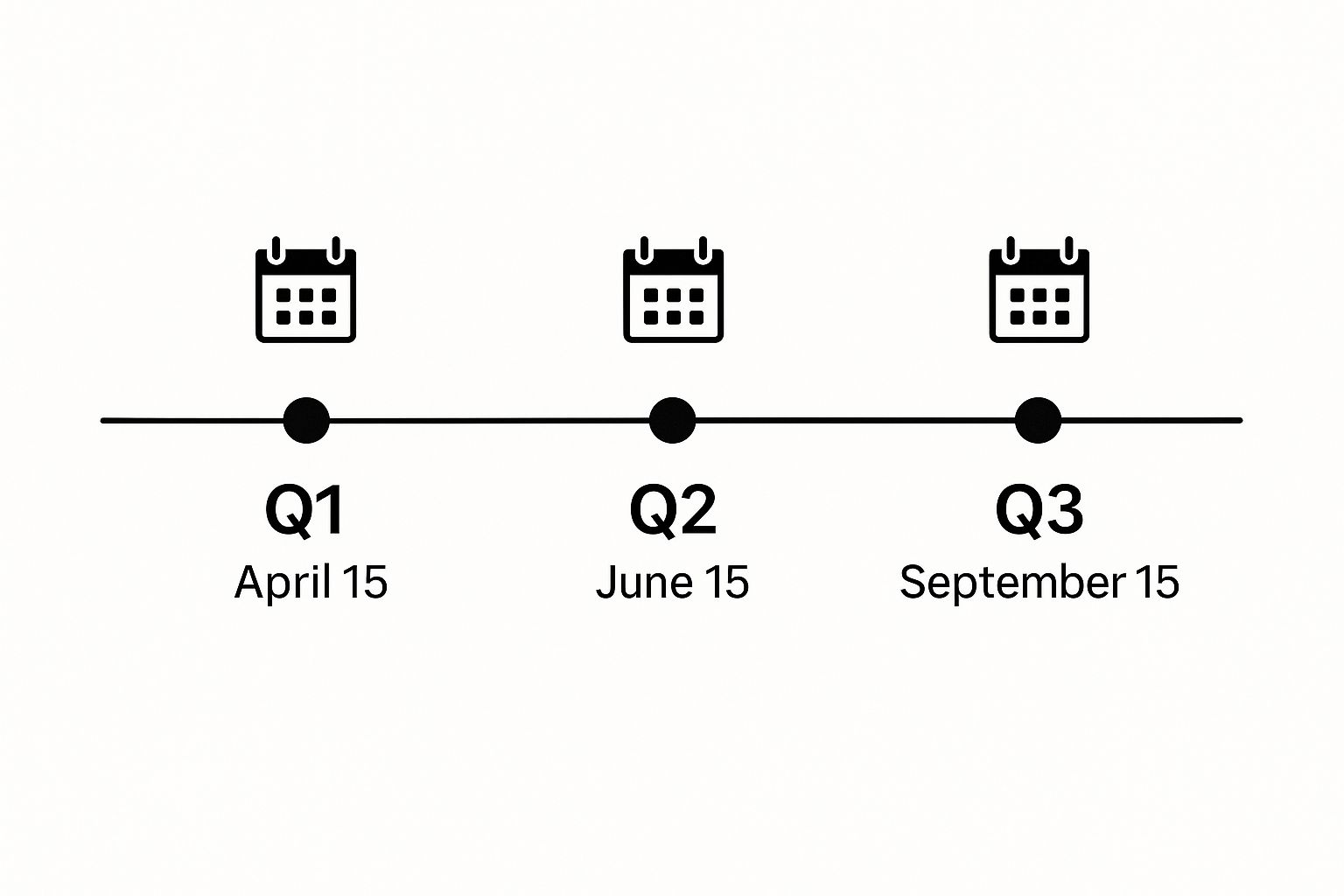
These quarterly dates aren’t just deadlines for payments. They are your built-in opportunities to pause, review your progress, adjust your course, and optimize your plan for the months ahead.
From Deadlines to Action Items
A calendar becomes truly effective when it connects these deadlines to actionable quarterly reviews. These are your scheduled pit stops to see how your real-world finances are stacking up against your initial goals. Did that new marketing campaign bring in way more revenue than you projected? Is a new service line costing more to run than you budgeted for? These check-ins are essential for keeping your strategy on track.
To help you build this rhythm, here is a monthly breakdown of key activities you can incorporate into your own calendar.
| Month | Key Activities | Deadlines | Planning Opportunities |
|---|---|---|---|
| January | Finalize prior year books. Issue 1099s/W-2s. | Jan 31: 1099/W-2 Filing | Review prior year performance to set new year’s budget. |
| February | Review YTD performance vs. budget. | – | Plan for Q1 estimated tax payments. |
| March | File business tax returns (S-Corps/Partnerships). | Mar 15: S-Corp/Partnership Returns | Assess eligibility for extensions if needed. |
| April | File C-Corp/Sole Prop returns. Pay Q1 estimated tax. | Apr 15: Corporate/Individual Returns & Q1 Payments | Review Q1 results to adjust Q2 financial forecasts. |
| May | Mid-quarter financial health check. | – | Explore mid-year tax-saving strategies (e.g., retirement contributions). |
| June | Pay Q2 estimated tax. | Jun 15: Q2 Estimated Tax | Conduct a half-year strategic review. Is it time to hire or invest? |
| July | Review Q2 financials and update forecasts. | – | Plan for major Q3/Q4 capital expenditures to maximize deductions. |
| August | Deep dive into expense management. | – | Identify potential cost savings and reallocate budget. |
| September | Pay Q3 estimated tax. File extended returns. | Sep 15: Q3 Estimated Tax & Extended Returns | Make adjustments based on YTD performance to avoid penalties. |
| October | Begin year-end tax planning projections. | – | Identify opportunities for tax-loss harvesting or accelerating expenses. |
| November | Finalize major purchase decisions for Section 179. | – | Confirm retirement plan contributions and employee bonus structures. |
| December | Make final equipment purchases. Pay year-end bonuses. | Dec 31: End of Tax Year | Execute last-minute tax strategies before the deadline. |
This table provides a framework for turning your calendar into an active planning tool. The key is consistency and using these moments to make informed choices.
Here’s a more practical look at what to do during your reviews:
- Quarterly Financial Review: Get together with your bookkeeper or tax pro. Pull up your Profit & Loss statement and cash flow report. Are your revenue and expense numbers where they should be?
- Estimated Tax Adjustment: Use the insights from your review to tweak your next estimated tax payment. If you had a fantastic quarter, you might need to send a bigger check to the IRS to avoid penalties. If things were a bit slow, you could potentially reduce the payment and keep more cash in the business.
- Strategic Decision Check-in: Look at your big-picture goals again. Is now still the right time to bring on a new sales director? Should you delay that office expansion until next year? Answering these questions with current data keeps your business tax planning perfectly aligned with your actual growth trajectory.
Uncovering Deductions And Credits You’re Already Entitled To

This is where so many businesses leave a surprising amount of cash on the table. It’s not through some complex, risky scheme, but by simply missing out on legitimate deductions and credits they have every right to claim. Good business tax planning is less about finding secret loopholes and more about a solid understanding of the everyday expenses that qualify as write-offs.
The fear of an audit can make business owners overly cautious, causing them to skip perfectly legal savings. But the IRS actually expects you to deduct your legitimate business costs. The secret isn’t avoiding deductions—it’s documenting them properly. With clear, organized records, you can confidently claim every dollar you deserve. To make sure you’re not leaving money behind, check out our guide on the top deductions and credits you might be missing.
The Low-Hanging Fruit: Commonly Missed Deductions
Let’s look past the obvious things like rent and payroll. Countless valuable deductions are hiding in plain sight, often brushed aside as being too small or complicated to bother with. But these “small” items can easily add up to thousands in savings over a year.
Here are a few of the most frequently overlooked opportunities:
- Bank Fees: It might seem minor, but those monthly service charges on your business bank account, plus any fees for things like wire transfers, are 100% deductible.
- Business Insurance: You probably remembered to deduct your general liability insurance, but what about your other policies? Professional liability, business interruption, and even the business-use portion of your auto insurance are also fair game.
- Education and Training: Did you go to an industry conference? Buy business books? Pay for an online course to sharpen your skills? These are all expenses for maintaining and improving your professional expertise.
- Software and Subscriptions: Think about all those monthly charges for tools like your CRM, project management software, and even professional publications. They are all considered ordinary and necessary business expenses.
The IRS provides clear guidance on what makes a business expense, stating it must be both “ordinary” and “necessary” for your line of work.
This screenshot from the IRS website offers a great overview of the types of expenses businesses can typically deduct. The guidance confirms that costs of goods sold, capital expenses, and personal expenses are all treated differently, which is why proper categorization is so important for effective tax planning.
From Deductions to Direct Savings With Tax Credits
While deductions reduce your taxable income, tax credits are much more powerful. They cut your actual tax bill dollar-for-dollar. A $1,000 credit saves you a full $1,000 in taxes owed, no matter what your tax bracket is. Many business owners think credits are just for giant corporations doing major research, but several are designed for everyday business activities.
For example, the Work Opportunity Tax Credit (WOTC) gives you a credit for hiring people from certain groups, like military veterans or individuals who have faced employment challenges. If you’re hiring, it’s definitely worth checking the requirements. Another one is the credit for small employer health insurance premiums, which can help lower the cost of offering healthcare to your team. Finding these credits is a key part of any solid business tax plan.
Navigating International Tax Without The Headaches
The moment you hear “international tax,” it’s easy to picture massive corporations with offices on every continent. But in today’s connected world, you don’t need a skyscraper in Tokyo to run into cross-border tax rules. If you sell products to customers overseas, hire a talented developer from Europe, or even use a foreign software-as-a-service (SaaS) platform, you’re already in the international business game. This makes a basic grasp of global tax essential for modern business tax planning.
Even transactions that feel simple on the surface can come with complex reporting requirements. If you’re not paying attention, you could face some nasty, unexpected penalties. The trick is to know what to look for so you can stay compliant without slowing down your growth.
The New Reality of Digital and Cross-Border Commerce
The digital marketplace may have erased physical borders, but it definitely hasn’t erased tax jurisdictions. Many countries now have rules to tax digital goods and services sold to their residents, no matter where the business is located. For example, an American e-commerce shop selling digital art to customers in the European Union might have to register for, collect, and send in Value-Added Tax (VAT) to the EU. This isn’t just for the big fish; the sales thresholds for these rules can be surprisingly low.
Working with international contractors is another area to watch. It’s not as simple as just sending a payment. You need the right paperwork, like a Form W-8BEN from foreign contractors. This form proves they aren’t a U.S. person for tax purposes, which is crucial. Without it, you could be on the hook to withhold a chunk of their payment for the IRS, protecting your business from a serious liability.
Understanding Transfer Pricing in Simple Terms
Another concept that often trips up growing businesses is transfer pricing. In a nutshell, transfer pricing is about the prices charged for goods, services, or assets moving between related business entities in different countries. Let’s say your U.S. company has a Canadian subsidiary that handles customer support. The fee your U.S. business pays the Canadian one for those services must be at “arm’s length”—meaning, it should be the same price an unrelated company would charge for the same work.
Why does this matter? Tax authorities want to make sure companies aren’t just shifting profits around to countries with lower tax rates. Global tax rules are tightening up, thanks to increased cooperation between governments worldwide. Initiatives like the OECD’s Base Erosion and Profit Shifting (BEPS) project have put a huge spotlight on how companies move their money. To dig deeper into this, you can learn more about the international tax planning guide from weConnect Global. This added scrutiny means even smaller businesses with cross-border activities need to be smart about their pricing structures.
You probably don’t need a formal, complex transfer pricing study right now. However, just knowing when these issues could pop up is a key part of strategic business tax planning. If you’re thinking about setting up a foreign entity or have a lot of transactions between your related companies, that’s your cue to get some specialized professional advice and save yourself from future headaches.
Leveraging Technology To Transform Your Tax Planning
The days of drowning in shoeboxes full of receipts and facing a frantic, end-of-year data entry marathon are quickly becoming a thing of the past. Today, technology is fundamentally changing how business tax planning works, giving smart business owners a serious advantage in both strategy and compliance. By bringing the right tools into your workflow, you can shift from a reactive, once-a-year scramble to a proactive, real-time approach that finds savings and cuts down on stress.
Think of it this way: old-school tax prep was like developing a roll of film. You had no idea if you captured a masterpiece or a blurry mess until weeks after the moment was gone. Modern tax technology is the screen on your digital camera—it provides instant feedback, letting you adjust on the fly to get the perfect shot before it’s too late.
Automation and AI: Your New Tax Assistants
The biggest game-changer is the rise of automation and artificial intelligence (AI). These aren’t just fancy toys for huge corporations anymore; they are now accessible and incredibly useful for small and mid-sized businesses. This tech takes over the repetitive, time-consuming tasks, freeing you up to focus on making smart, strategic decisions.
Here’s a look at how these tools can support your business:
- Automated Bookkeeping: Cloud accounting platforms like QuickBooks or Xero connect directly to your business bank accounts. They automatically pull in and categorize transactions as they happen, giving you a live, up-to-the-minute look at your company’s financial health.
- Receipt and Document Scanning: Forget manual entry. Apps such as Dext or Hubdoc use optical character recognition (OCR) to scan a receipt, pull out the key information (like the vendor, date, and amount), and file it digitally. This creates an organized, searchable, and audit-ready record of all your expenses.
- Predictive Analytics: Some advanced tools use AI to look at your financial data and forecast the tax implications of future business moves. For example, before you pull the trigger on a big equipment purchase, the software can model the depreciation benefits and show you exactly how it will affect your estimated tax payments.
This tech-focused approach is becoming a standard practice. A recent Deloitte study highlighted this shift, revealing that 57% of tax leaders now consider AI skills essential for their teams to handle the growing demands of data analysis. This statistic alone shows how central technology has become. You can discover more insights on these tax transformation trends to see where the industry is moving.
Cloud-Based Software and Seamless Integration
The true magic of modern tax tools is how they integrate with each other. When your accounting software can “talk” to your payroll system, your e-commerce platform, and your CRM, you get a single, unified view of your entire financial world. This smooth flow of data is what makes real-time business tax planning a reality.
Government agencies are also moving toward digital-first interactions, as seen with platforms like the IRS’s Modernized e-File (MeF) system.
This diagram from the IRS website shows the complex system that processes billions of tax records each year. It highlights how data flows from preparers through different channels, proving why accurate, digitally formatted information is so important for smooth compliance. When your business uses compatible technology, you ensure you can work efficiently within these evolving government frameworks.
Your Practical Roadmap To Tax Planning Success
Alright, let’s turn all this theory into a practical action plan you can start using right away. A smart business tax plan isn’t a rigid template; it’s a living strategy that grows with your company. This roadmap will give you clear, prioritized steps, whether you’re a one-person show or leading a growing team.
The idea here is to shift from just worrying about taxes to taking deliberate, effective actions. It’s about knowing what to tackle first, how to build on that foundation, and when it’s smart to bring in a professional. Let’s get those insights working for you and turn tax stress into real savings.
Your Starting Point: The Solopreneur or New Business
If you’re just getting started, your main job is to build a rock-solid financial foundation. Don’t let complex strategies bog you down; focus on getting the basics right first.
- Create a Separate Financial Identity: The very first thing you should do is open a dedicated business bank account and credit card. This is the most critical step for simplifying your bookkeeping and creating a clean audit trail. Mixing personal and business funds is the quickest route to a tax-season headache.
- Set Up a Simple Bookkeeping System: You don’t need a massive enterprise system at this stage. A tool like QuickBooks Self-Employed or Wave is perfect for tracking your income and categorizing expenses as you go. Make it a weekly ritual to log in and keep things tidy.
- Get a Handle on Estimated Taxes: A good rule of thumb is to set aside 25-30% of every single payment you receive. Put this into a separate savings account just for taxes. This habit prevents the sticker shock of a huge bill and ensures you have the cash to make your quarterly payments to the IRS without stressing your operations.
Once you’ve nailed these fundamentals, you can start looking at more advanced moves. For a closer look at these foundational ideas, our article on tax-saving strategies for freelancers and small business owners is a great next read.
Scaling Up: The Growing Business with Employees
As your business expands, so do your tax planning needs. Your focus will naturally shift from just staying compliant to actively optimizing your tax situation.
- Schedule Quarterly Strategic Reviews: Block out time on your calendar for regular meetings with your bookkeeper or tax advisor. These sessions are for more than just looking at past numbers; they’re for making proactive choices. Use this time to adjust your estimated tax payments based on real-time performance and to plan for big purchases to maximize deductions like Section 179.
- Optimize Your Business Structure: The entity you chose when you started might not be the most tax-friendly one for your current situation. For instance, a profitable sole proprietorship could see significant savings on self-employment taxes by electing to be taxed as an S-Corporation. This is a vital conversation to have with a tax pro.
- Look into Retirement Plans: A powerful tax planning tool is a business-sponsored retirement plan, like a SEP IRA or a SIMPLE IRA. The contributions you make for yourself and your employees are typically tax-deductible for the business, which directly reduces your taxable income.
When to Seek Professional Help
Knowing when to call for backup is a strategic move in itself. Certain business milestones should be an automatic trigger to get a professional on the line.
| Warning Sign / Trigger Event | Why You Need a Pro | Potential Outcome |
|---|---|---|
| Hiring your first W-2 employee | Payroll taxes are notoriously complex, and the penalties for mistakes are severe. | Ensures you handle withholding, filing, and state labor laws correctly from day one. |
| Planning a major asset purchase | A pro can help structure the purchase for the biggest tax benefit (like bonus depreciation). | You could potentially write off the entire cost of the asset in the year you buy it. |
| Expanding to another state | You’re about to enter a new world of state-specific tax laws, including sales tax and income tax nexus. | Avoids costly penalties for not complying with another state’s tax rules. |
| Receiving an IRS notice or audit letter | You should never try to handle an audit by yourself. | An expert can manage the process, protect your rights, and negotiate for you. |
By taking these steps, you change your relationship with taxes. It stops being a defensive chore and becomes a powerful way to fuel your business’s growth.
A forward-thinking and well-organized tax plan is one of the most valuable assets your business can possess. It shields you from liability, frees up your cash flow, and gives you the confidence to make bigger, better strategic decisions. If you’re ready to stop leaving money on the table and build a tax strategy that truly supports your goals, the team at Allied Tax Advisors is here to help. Schedule a consultation today to create your personalized roadmap to financial success.