
This is where California really stands apart from the federal system—and not in a good way for investors. While the IRS offers a discounted tax rate for long-term capital gains, California gives you no such break.
In the Golden State, every dollar of profit from selling an asset is taxed as ordinary income. It doesn't matter if you held that stock for two years or two days. The gain gets stacked right on top of your regular earnings and is taxed at your marginal rate, which can climb as high as 13.3%.
The Foundation of California Capital Gains Tax
When you sell an asset in California—be it stocks, a piece of real estate, or even cryptocurrency—the state’s approach is brutally simple. The profit you make is treated just like your salary or business income.
This is a world away from the federal system, which is designed to reward long-term investors by taxing gains on assets held for more than a year at much lower rates (0%, 15%, or 20%).

The impact of this rule can be massive. A large one-time capital gain can easily shove you into a higher tax bracket, which means not only is the gain itself taxed at a higher rate, but so is a portion of your other income. Think of it like pouring a big jug of water into a glass that's already nearly full—it's going to spill over the top.
That "spillover" can dramatically increase your overall tax bill. We break down exactly how this works in our guide to the 2024 California tax brackets.
How California's Approach Compares
Let's put this into perspective. At 13.3%, California has the highest state-level capital gains tax rate in the entire country. When you add that to the top federal rate, a high-earning Californian could see a combined tax hit of over 37% on their investment profits.
To illustrate just how different the two systems are, let's compare them side-by-side.
California vs Federal Capital Gains Tax at a Glance
This table breaks down the fundamental differences between how California and the federal government handle long-term capital gains.
| Feature | Federal Tax Treatment | California Tax Treatment |
|---|---|---|
| Long-Term Rate | Preferential rates of 0%, 15%, or 20% for assets held over one year. | No special rate. Taxed as ordinary income at your marginal rate (up to 13.3%). |
| Holding Period | Critically important. Distinguishes between lower long-term and higher short-term rates. | Irrelevant. All gains are treated the same, regardless of how long you held the asset. |
| Tax Bracket Impact | Gains are taxed at their own specific rates, separate from ordinary income brackets. | Gains are added directly to your income, potentially pushing you into a higher bracket. |
As you can see, the state's progressive income tax structure makes no distinction, treating all capital gains equally.
The Single Most Important Thing to Remember: For California state taxes, the idea of "long-term" versus "short-term" capital gains simply doesn't exist. It's all just income.
Grasping this core concept is the essential first step for anyone planning to sell an asset in California. It’s the reason why tax planning isn't just a good idea here—it's absolutely critical. Without a solid strategy, you could be blindsided by a tax bill that eats up a much larger chunk of your profits than you ever anticipated. The rest of this guide is dedicated to showing you how to build that strategy.
How Progressive Tax Brbrackets Can Inflate Your Tax Bill
So, we've established that California treats your capital gains just like your regular paycheck. But that's only half the story. The real kicker is how the state's progressive tax brackets come into play, and it’s a detail that trips up a lot of people.
Think of it less like a flat fee and more like a ladder. The more you earn in a year—including that big capital gain—the higher you climb, and each new rung you reach has a steeper tax rate.
A major capital gain isn't taxed at one simple rate. It gets stacked right on top of all your other income for the year. This is where a manageable tax situation can suddenly become a much bigger problem.
The "Spillover Effect": A Painful Surprise
Imagine your tax brackets are a series of buckets, each one bigger than the last. Your salary fills up the first few buckets. When you realize a capital gain, you’re pouring a new wave of income into the system.
This new money first tops off whatever space is left in your current tax bracket. But what happens when that bucket is full? The rest of the money spills over into the next, more expensive bucket. And if that one fills up, it keeps spilling into the next, and the next.
This is the critical takeaway: a single capital gain can end up being taxed at several different rates. The first part might get hit at 9.3%, but the rest could easily be pushed into the 10.3%, 11.3%, or even the top 12.3% bracket.
Ignoring this dynamic is how people get hit with surprisingly high tax bills.
A Real-World Example
Let's make this crystal clear with an example. Meet Alex, a single filer in California whose job brings in a taxable income of $300,000. Under the 2024 tax brackets, Alex’s marginal tax rate is 9.3%.
This year, Alex sells a rental property and nets a $200,000 long-term capital gain. It’s easy to assume that gain will also be taxed at 9.3%, but that's a costly mistake.
Here’s what really happens:
- Topping Off the Current Bracket: The first $88,740 of the gain fills up the remaining space in Alex's 9.3% bracket.
- Spilling into a Higher Bracket: The remaining $111,260 of the gain spills over into the next tax bracket, where the rate jumps to 10.3%.
Suddenly, the tax rate on that gain isn't the simple 9.3% Alex was planning for. It’s a blend of two different rates, weighted heavily toward the higher one.
Calculating the True Tax Impact
Let’s run the numbers for Alex's situation. The state doesn't look at the gain as a single lump sum; it slices it up based on the brackets it fills.
- Portion 1: $88,740 taxed @ 9.3% = $8,252.82
- Portion 2: $111,260 taxed @ 10.3% = $11,459.78
The total California tax on that $200,000 gain adds up to $19,712.60. This works out to an effective state tax rate of almost 9.9% on the gain itself—a far cry from the 9.3% marginal rate Alex started with.
This is a perfect illustration of why just knowing your current tax bracket isn't enough. You have to account for the spillover. It's also worth noting how different this is from the federal system. You can learn more by reading our guide comparing short-term vs. long-term capital gains.
Key Tax Strategies for Real Estate Investors
If you’re a real estate investor in California, the state’s aggressive approach to capital gains makes smart tax planning absolutely essential. While the rules can feel punishing, there are two powerful federal provisions—fully recognized by California—that can provide major relief. Getting these right can be the difference between handing over a huge chunk of your profits to the Franchise Tax Board and successfully protecting your investment returns.
Your Primary Residence: The Home Sale Exclusion
One of the most valuable tools in your tax-planning arsenal is the Section 121 exclusion, often just called the home sale exclusion. This is designed specifically for your primary residence, and it allows you to completely shield a huge amount of profit from both federal and state taxes. It’s not a deferral; the gain is simply erased.
To qualify, you need to pass two simple tests: the ownership test and the use test. You must have owned the home and lived in it as your main residence for at least two of the five years just before you sell it. If you meet that standard, you can exclude up to $250,000 of your gain as a single filer. For those married filing jointly, that number doubles to a massive $500,000.
This flowchart really drives home how any capital gain inflates your income, pushing you into a higher tax bracket and increasing your overall liability.
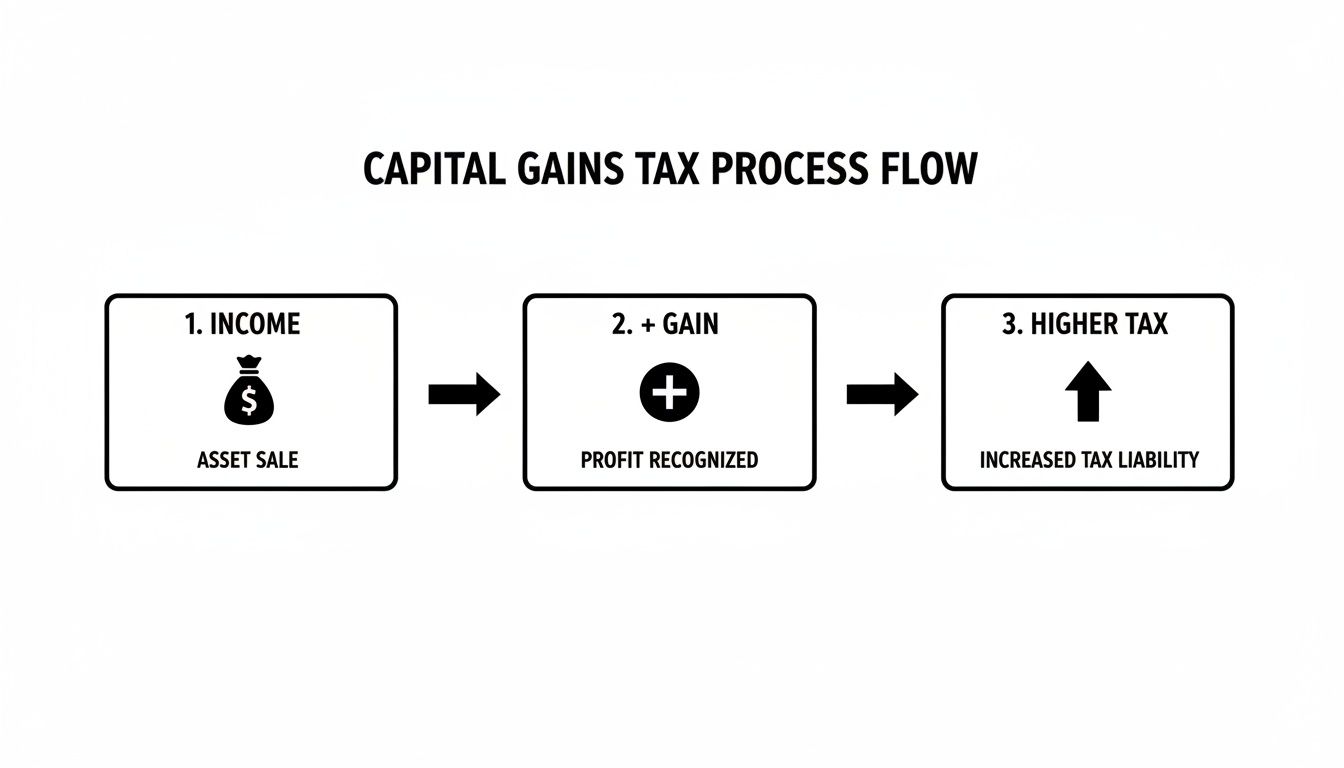
As you can see, that profit doesn't get special treatment. It gets stacked right on top of your other earnings, making strategies that reduce that number incredibly valuable.
Your Investment Properties: The Power of the 1031 Exchange
While the Section 121 exclusion is for the home you live in, the 1031 exchange is the MVP for investment properties. This isn't about avoiding taxes forever; it's about deferring them. Think of it less like a sale and more like a strategic "swap." It allows you to sell one investment property and roll the entire proceeds into a new, "like-kind" property without paying a dime in capital gains tax at that time.
This powerful move lets you keep your capital working for you, growing your real estate portfolio without taking a major tax hit after every transaction. The rules, however, are incredibly strict and demand careful execution.
Key Takeaway: A 1031 exchange allows you to kick your tax liability down the road, potentially indefinitely, as long as you keep exchanging one property for another. The deferred tax bill only comes due when you finally sell a property for cash and don't roll it into a new investment.
For a deeper dive, check out this excellent guide to deferring capital gains through a 1031 exchange.
Navigating the Strict 1031 Exchange Timelines
Pulling off a successful 1031 exchange comes down to hitting two deadlines that are set in stone. Miss either one, and the whole deal falls apart, leaving you with an immediate and often painful tax bill.
- The 45-Day Identification Period: The clock starts the day you close the sale of your original property. From that moment, you have exactly 45 days to formally identify potential replacement properties in writing. No exceptions.
- The 180-Day Closing Window: You must close on the purchase of one or more of the properties you identified within 180 days of the original sale date.
It's important to remember these two timeframes run at the same time. Another non-negotiable rule is the use of a Qualified Intermediary (QI). You are legally forbidden from touching the proceeds from your sale. The QI holds the funds in escrow between the sale and the new purchase, which is what makes the transaction a true "exchange." Finding a reputable QI is one of the most critical first steps.
To learn more about the specific mechanics, see our post on what is a 1031 exchange. California's unwavering stance—treating gains as ordinary income—is a sharp break from decades of federal tax history, which has seen everything from 50% exclusions to special low rates, culminating in the current system. The Golden State simply ignores it all.
Navigating Crypto and Stock Investments
When it comes to stocks and digital assets, California's tax rules can feel a bit relentless. Whether you're day-trading stocks or diving into the wild west of crypto, the state’s approach is straightforward: your profit is treated as ordinary income. Period.
This means there's no special, lower tax rate just because your gains came from an NFT flip instead of selling a small business. That profit gets added right on top of your other income and is taxed at your marginal rate. It’s a level playing field that puts the pressure on investors to keep meticulous records and think strategically, no matter what's in their portfolio.

The Unique Headaches of Crypto Taxation
For crypto investors, figuring out the California capital gains tax is a whole different level of complexity. The biggest challenge? Nailing down your cost basis—what you originally paid for an asset—for every single transaction. It can be a nightmare.
Unlike stock trading, where your broker hands you a neat Form 1099-B at the end of the year, the crypto world is decentralized. You’re often on your own to track every move, and almost everything you do can trigger a taxable event.
Here are just a few common crypto activities you have to track carefully:
- Frequent Trading: Swapping one coin for another? That’s a taxable event. Selling a coin for cash? Also a taxable event. Each one creates a gain or loss.
- Staking Rewards: Those rewards you earn for helping secure a network are considered income the moment you receive them. That value also becomes the cost basis for those new coins.
- Airdrops: Getting free tokens from an airdrop feels great, but the IRS (and the FTB) sees it as income equal to the fair market value on the day you got them.
- Paying with Crypto: Using your Ethereum to buy a pizza isn't just a purchase; it's a sale. You technically "sold" the crypto, and if it went up in value since you bought it, you have a capital gain to report.
To make sense of it all, most investors turn to an accounting method like FIFO (First-In, First-Out). This just means you assume the first coins you bought are the first ones you’re selling. It’s essential for figuring out your profit or loss on each trade.
A Hidden Gem for Stock Investors: QSBS
While crypto investors are busy wrangling spreadsheets, traditional stock investors might have access to a powerful, and often missed, tax break in California: the Qualified Small Business Stock (QSBS) exclusion. It’s one of the very few ways to potentially shield investment profits from the state’s high income tax rates.
California offers a major exclusion for gains on the sale of QSBS, but you have to follow the rules to the letter. Not just any small business stock will do.
Key Detail: For your stock to qualify for California's QSBS benefits, the C-corporation must have conducted at least 80% of its business in California while you held the stock. On top of that, you must have gotten the stock directly from the company when it was first issued.
Qualifying for the QSBS Exclusion
Knowing if your stock qualifies is everything. The business has to meet several strict criteria, both when you first acquired the stock and during the entire time you held it.
Key QSBS Requirements in California:
- Original Issuance: You had to get the stock straight from the company, not by buying it from another investor on a secondary market.
- C-Corporation Status: The business must be a domestic C-corp.
- Asset Limitation: The company’s gross assets couldn't have been more than $50 million right before and immediately after it issued your stock.
- Active Business: It needs to be a real, active business—not just a holding company or a passive investment fund.
As you explore different long-term investment ideas, remember that each strategy comes with its own tax implications. The QSBS exclusion is a perfect example of how California rewards investors who get in early with local businesses. Spotting these opportunities can lead to huge tax savings down the line, making it a crucial play for any savvy investor in the Golden State.
Smart Planning: Timing Your Sales and Managing Your Basis
Beyond specific rules for real estate or businesses, there are two powerful levers every California investor can pull to manage their capital gains tax bill: timing your sales and managing your cost basis. Getting a handle on these two concepts is the difference between reacting to a huge tax bill and proactively planning for a much smaller one.
The whole game hinges on a simple fact: California taxes your capital gains at the same rate as your regular income. This means your marginal tax rate in the year you sell an asset is everything. A big gain in a high-income year gets hit hard, while that same gain in a lower-income year could cost you significantly less.
This opens up some real strategic possibilities. If you know you’re heading into a year with lower income—maybe you're retiring, changing jobs, or even taking a sabbatical—that might just be the perfect window to cash in on some of your appreciated assets.
Selling Smart with Tax-Gain Harvesting
This brings us to a technique called tax-gain harvesting. It’s basically the art of intentionally selling winning investments during a year when your income is lower than usual. You’re "harvesting" those gains at a more favorable tax rate than you'd get in a typical high-earning year.
Think about it: say you’re taking a year off to travel, and your income drops enough to move you from the 11.3% tax bracket down to the 8% bracket. Selling that stock you’ve held for years during that year means you just saved a bundle on taxes. You can even buy the same asset right back if you still believe in it. Doing so resets your cost basis to the new, higher price, which shrinks your taxable gain on any future sale.
Using Losses to Your Advantage: Tax-Loss Harvesting
The other side of the coin is tax-loss harvesting. This is where you strategically sell investments that are down in value to generate a capital loss. Those losses are gold because they can wipe out your capital gains, dollar for dollar.
And if you have more losses than gains? You can use up to $3,000 of that excess loss to lower your regular taxable income each year. Any leftover losses don't disappear; you can carry them forward to offset gains in future years. It’s a fundamental move for anyone actively managing a portfolio.
Market swings are inevitable. But instead of just riding them out, you can use that volatility to your advantage. By timing your sales to harvest both gains and losses, you can smooth out your tax liability and avoid those painful, unexpected tax spikes.
This very volatility has a huge effect on California's finances. The state has seen capital gains revenue swing from a low of $2.3 billion after the Great Recession to a peak of $25 billion in 2021. You can see just how much the state budget relies on market performance by reading more about California's revenue estimates on ebudget.ca.gov.
Why Your Cost Basis is Everything
Both of these harvesting strategies rely completely on one crucial number: your cost basis. Simply put, your basis is what the asset originally cost you. The higher your basis, the smaller your taxable gain will be when you eventually sell.
This is where meticulous record-keeping becomes non-negotiable. The price you paid is just the starting point. You need to adjust your basis for things like:
- Property Improvements: That new roof on your rental property? The cost gets added to your basis.
- Reinvested Dividends: If you're in a dividend reinvestment plan (DRIP), every little reinvestment buys more shares and increases your total cost basis.
- Commissions and Fees: The fees you paid to buy an investment are part of its cost.
Forgetting to track these adjustments is one of the most common—and expensive—mistakes people make. It means you end up reporting a larger gain than you actually have and paying more California capital gains tax than you legally owe.
Developing Your Personal Tax Strategy
We've covered a lot of ground in this guide, and one thing should be crystal clear: if you have assets in California, you absolutely need a personal tax plan. It’s not a nice-to-have; it’s essential for protecting your wealth. We’ve seen firsthand how California’s unique system—treating capital gains just like any other income—can take a huge bite out of your profits.
Forget about a lower long-term rate you might get at the federal level. Here, gains from selling stocks, real estate, or even crypto get piled right on top of your salary or business income. It's a setup that can easily bump you into a much higher tax bracket, meaning the state takes a far bigger piece of the pie than you were probably planning for.
From Information to Action
Knowing the rules is one thing, but actually using that knowledge to your advantage is where the real work begins. Trying to navigate California capital gains tax alone is a risky game. It's incredibly easy to make a mistake, like miscalculating your cost basis or blowing past a strict deadline for a 1031 exchange, and those errors can be expensive.
This is why you have to be proactive. The time to think about tax strategy is before you sell, not scrambling for answers after the deal is done and your options have vanished.
The best tax strategy is never a one-size-fits-all template. It has to be built around your specific financial life, especially when you're up against California’s complex and high-stakes tax code.
To get this right, you need to work with someone who deals with these rules every single day. A skilled tax professional can look at everything—your income, your investments, your goals—and spot opportunities you might miss.
They can help you figure out the best time to sell, make sure your records are impeccable, and ensure you’re taking every legal deduction and credit you’re entitled to. This isn't just about filing taxes; it's about making smart decisions that support your financial future. Don't leave your hard-earned gains on the table. Find an expert and build a plan that works for you.
Common Questions About California Capital Gains
Let's be honest, figuring out California's capital gains rules can feel like a puzzle, especially since they're so different from federal law. Here are some plain-English answers to the questions we hear most often.
Does California have a one-year holding period for capital gains?
Nope. This is one of the biggest surprises for people. Unlike the IRS, California doesn't distinguish between short-term and long-term gains.
Whether you held an asset for two days or two decades, the profit is treated the same: it’s simply added to your other earnings and taxed as ordinary income at your marginal rate.
Can I use a 1031 exchange for investment property in California?
Yes, you absolutely can. This is a huge win for real estate investors. California fully follows the federal 1031 exchange rules, which lets you defer capital gains tax when you sell an investment property, as long as you roll the proceeds into a similar "like-kind" property.
The catch? You have to play by the IRS's very strict timelines. You have just 45 days to identify a replacement property and a total of 180 days to close the deal. It's a powerful tool, but it demands careful planning to pull off correctly.
How are my crypto gains taxed in California?
In California, profits from crypto are treated just like gains from selling stocks or any other asset. When you sell, trade, or even use your crypto to buy something, the profit is taxed as ordinary income. That means it gets tacked onto your other income and is subject to the state's progressive tax rates, which can climb as high as 13.3%.
For anyone in the crypto space, meticulous record-keeping is non-negotiable. You have to track your cost basis for every single transaction—buying, selling, or swapping—to calculate your gains and losses accurately. This is the only way to stay compliant.
What happens if I move out of California before I sell?
This is a fantastic question, and the answer can save you a lot of money. It all comes down to what you're selling.
- Intangible Assets (Stocks, Crypto): When it comes to things like stocks or cryptocurrency, the gain is typically taxed by the state where you live at the moment of the sale. So, if you officially move and become a resident of another state before you sell, you generally won't owe California tax on that gain.
- Real Estate in California: California real estate is a different story. The gain is always sourced back to the state, no matter where you live. If you sell a property located in California, you'll owe California tax on the profit, period.
Timing your move and your sales correctly can have a massive impact on your final tax bill.
Navigating California's tax landscape requires a clear strategy. The team at Allied Tax Advisors can help you build a personal plan to manage your capital gains, stay compliant, and reach your financial goals. Learn more about our individual tax services.