
California payroll tax isn't one tax, and the change most likely to disrupt your 2026 budget isn't the employer unemployment rate. California SDI is withheld at 1.3% on every dollar of wages, with no wage ceiling, while UI and ETT still stop after the first $7,000 of each employee's annual wages, according to the California Employment Development Department's 2026 rates. For a high-wage or remote-work team, that makes payroll tax a compensation-design issue, not merely a filing chore.
Table of Contents
- What California Payroll Tax Actually Covers in 2026
- Current Rates and How Each Tax Is Calculated
- Employer Registration and EDD Filing Obligations
- Deposit Schedules and Reporting Forms in Practice
- Why the SDI Change Matters for High-Wage Employers
- Penalties and Common Pitfalls to Avoid
- Implementation Checklist and Choosing Payroll Software
- When to Bring in a California Payroll Tax Specialist
What California Payroll Tax Actually Covers in 2026
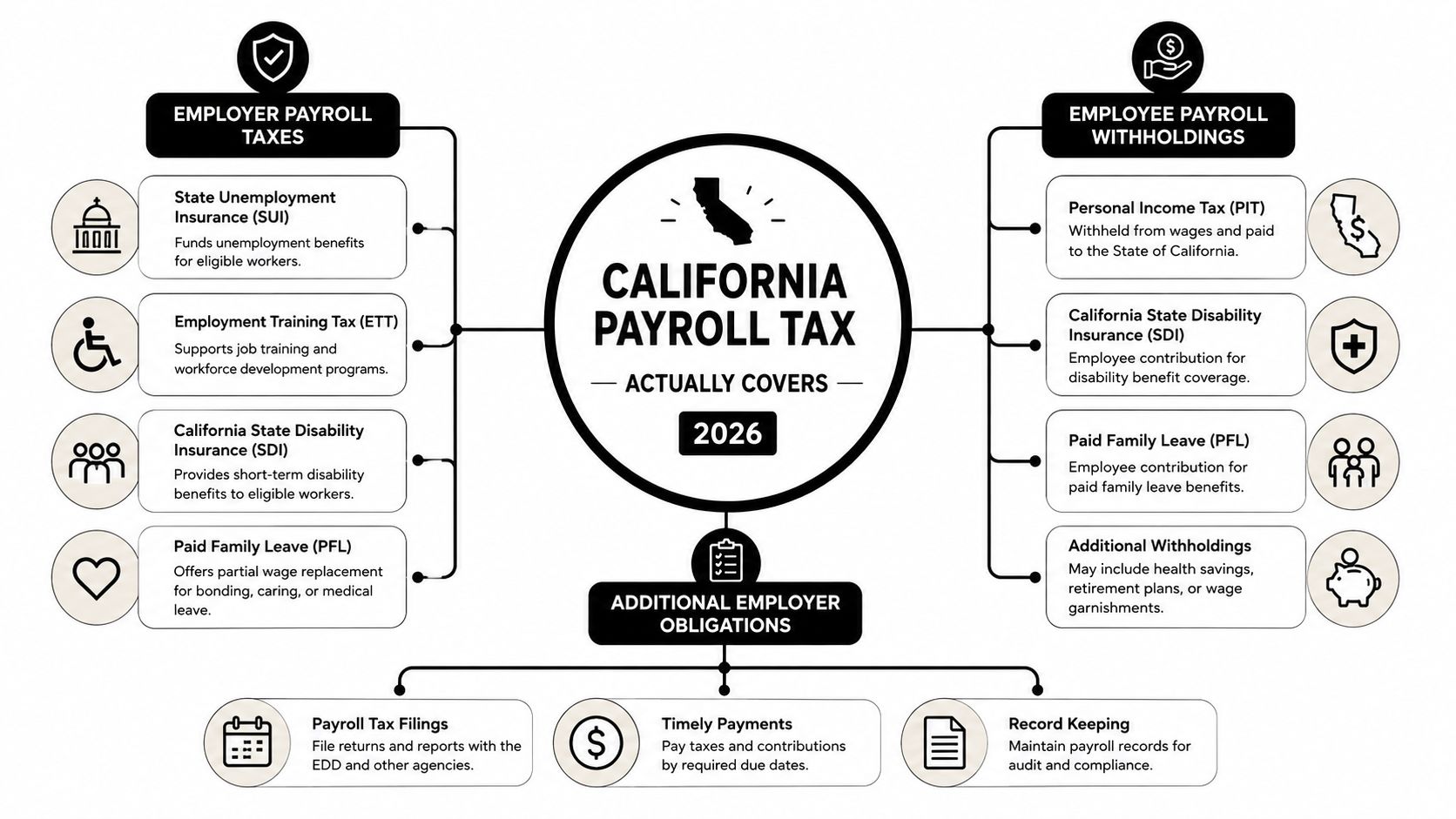
The first step is to separate taxes by who pays them. California payroll tax consists of employee withholdings and employer-paid contributions that move through different reporting processes.
Employee withholdings
State Personal Income Tax, or PIT, is withheld from an employee's wages and sent to the state. The employee bears the economic cost, while the employer acts as the withholding agent. The employee's California DE 4 information helps determine state withholding, alongside the federal W-4 and the applicable payroll tables.
State Disability Insurance, or SDI, is also withheld from employee wages. It supports disability and paid family leave programs. The key 2026 distinction is that SDI applies to all wages, unlike UI and ETT, which use a capped wage base. The EDD's employer tax guide explains the broader wage-base change that reshaped this calculation.
Employer contributions
Unemployment Insurance, or UI, is an employer-paid contribution. It funds benefits for eligible workers who lose employment through circumstances covered by the program. Your UI rate is experience-rated, so claims history and benefit charges can affect future cost.
Employment Training Tax, or ETT, is another employer-paid contribution. It applies on the same limited wage base as UI and supports employment training programs.
The reporting channel matters. The EDD handles UI, ETT, SDI, and PIT payroll reporting and payment activity, while California's tax agencies may have separate responsibilities for broader state tax administration. Don't treat every payroll line as if it were an ordinary business expense or an employee deduction.
Worker status and work location
W-2 employees create withholding and reporting obligations. A 1099 label doesn't automatically remove those obligations if the relationship reflects employment under California rules. Misclassification can shift the tax burden back to the business, along with wage and reporting exposure.
A remote employee's location also matters. An employee working in California generally creates California payroll considerations, and an employee who moves between states may require a fresh review of withholding, sourcing, registration, and reporting. Don't rely on the employee's mailing address alone. Track where services are performed, when the work location changes, and whether the worker remains a California employee for payroll purposes.
Advisor's rule: Classify the worker first, identify the work location second, and calculate the tax stack third. Reversing that order creates avoidable corrections.
Current Rates and How Each Tax Is Calculated
The four levies differ mainly by payer, rate, and wage base. The EDD rate and withholding reference provides the 2026 figures used below.
| Levy | Payer | 2026 Rate | Wage Base | Remit To |
|---|---|---|---|---|
| UI | Employer | 1.5% to 6.2% for tax-rated employers, generally 3.4% for new employers | First $7,000 per employee annually | EDD |
| ETT | Employer | 0.1% | First $7,000 per employee annually | EDD |
| SDI | Employee withholding | 1.3% | All wages, no ceiling | EDD |
| PIT | Employee withholding | Graduated brackets reaching 12.3%, plus a 1% surcharge above $1 million | No wage ceiling | EDD |
UI and ETT
UI is experience-rated. An established employer can fall within the 1.5% to 6.2% range, while a new employer generally starts at 3.4%, applied only to the first $7,000 of each employee's wages. The maximum annual UI cost therefore ranges from $105 to $434 per employee, depending on the assigned rate.
ETT is 0.1% on the same first $7,000 wage base. That produces a maximum ETT cost of $7 per employee annually. Once an employee's wages exceed the wage base, additional salary doesn't create more UI or ETT for that employee.
SDI and PIT
SDI works differently. The 1.3% employee withholding applies to all wages, with no wage ceiling. The employer withholds it from pay but doesn't absorb it as an employer contribution unless a separate compensation policy says otherwise.
PIT withholding follows California's graduated structure. Payroll teams use the employee's DE 4 and federal W-4 information, then update withholding when the employee changes or revokes the DE 4. Supplemental wages, including bonuses, require the payroll system to apply the appropriate withholding method rather than treating every payment like regular salary.
Worked examples
For an employee earning $60,000, UI and ETT apply only to the first $7,000. At the low UI rate, employer UI is $105, while the high rate produces $434. ETT adds $7, and employee SDI withholding at 1.3% of $60,000 is $780. PIT depends on the employee's withholding inputs and isn't a fixed percentage of gross pay.
For an employee earning $180,000, employer UI and ETT remain capped at the same wage base, so the employer-side amounts are still $105 to $434 for UI and $7 for ETT. Employee SDI withholding is $2,340, because the full salary is subject to the 1.3% rate. PIT remains dependent on the employee's tax profile and withholding form.
The practical conclusion is straightforward. Salary growth increases SDI and PIT withholding, but it doesn't increase UI or ETT after the $7,000 wage base is reached.
Employer Registration and EDD Filing Obligations
A first-time California employer should register before payroll becomes an afterthought. The process starts with the EDD, not with the payroll software's setup wizard.
Register the account correctly
Begin with e-Services for Business. Gather the federal employer identification number and the CDTFA seller's permit information, then complete Form DE 1 to establish the California employer payroll tax account. The EDD uses that registration to determine the account structure and issue the employer payroll tax account number.
That number belongs on your EDD filings and payment records. Keep the EDD rate notice with the account documentation because the assigned UI rate affects every applicable quarterly contribution calculation.
New employers shouldn't assume the first rate notice is a minor administrative detail. It establishes the rate used for the initial filing period, and the employer must review it promptly. If the notice appears inconsistent with the business structure or payroll facts, contact the EDD rather than using a different rate.
Build the filing routine
The recurring EDD process includes the quarterly contribution return, Form DE 9, and the quarterly wage detail report, Form DE 9C. DE 9 reports the contribution totals. DE 9C reports employee-level wage information. Those records need to reconcile, not merely look similar.
Employers should also monitor electronic filing requirements and use e-Services when required. Maintain payroll registers, wage records, withholding support, rate notices, payment confirmations, and employee information for the EDD retention period. A reliable document workflow helps, especially when payroll staff must combine signed forms, bank confirmations, and quarterly reports. An online PDF toolkit for accountants can help organize and prepare those records without replacing the underlying payroll review.
For a practical filing workflow, use this guide to filing payroll taxes alongside the EDD instructions. Software can prepare a form, but the employer remains responsible for accurate registration, timely submission, and correct payment.
Deposit Schedules and Reporting Forms in Practice
California employers juggle three separate rhythms: periodic withholding deposits, quarterly EDD reporting, and annual W-2 reconciliation. Confusing those rhythms is a common reason a payroll account appears current until an EDD notice says otherwise.
Deposits depend on the liability pattern
PIT and SDI withholdings are generally deposited on a monthly or semi-weekly schedule. The applicable schedule is determined by the employer's lookback liability, which combines the relevant payroll tax amounts rather than examining one employee or one withholding line in isolation.
A payroll spike can change the required deposit rhythm. Bonuses, equity compensation, hiring, and other high-dollar payroll events can move an employer into a more frequent schedule. The mistake is assuming the schedule stays unchanged through the year. Assign someone to review the deposit status whenever payroll composition changes materially.
DE 9 and DE 9C serve different purposes
DE 9 is the quarterly contribution return. It summarizes the employer's UI and ETT obligations and the employee withholdings reported for the quarter.
DE 9C is the wage detail report. It breaks wages down by employee and supplies the data used to support the quarterly totals. If the DE 9 says one amount and the DE 9C supports another, the EDD has a reason to question the filing.
| Form / Filing | Frequency | Due Date | What It Reports |
|---|---|---|---|
| Withholding deposit | Monthly or semi-weekly, based on lookback status | Schedule assigned to the employer | SDI and PIT amounts withheld, plus applicable payroll tax deposits |
| DE 9 | Quarterly | EDD quarterly deadline | Contribution and withholding totals |
| DE 9C | Quarterly | EDD quarterly deadline | Employee-level wage detail |
| W-2 reconciliation | Annual | Federal and state annual schedule | Annual wage and withholding information |
Use the employer's actual EDD notice and current instructions to confirm dates. The California payroll tax deposit schedule can help payroll staff map deposit responsibilities to the broader filing calendar.
Practical control: Reconcile the payroll register to the deposit ledger, then reconcile both to DE 9C before submitting DE 9. Don't wait for a notice to discover a mismatch.
Why the SDI Change Matters for High-Wage Employers
The SDI change belongs in total-rewards planning. It shouldn't sit only in the payroll administrator's checklist.
Because SDI is withheld at 1.3% on all wages without a ceiling in 2026, a high-wage employee produces proportionally more withholding as compensation rises. An engineer earning $300,000, a sales vice president earning $500,000, and an executive working remotely from Lake Tahoe all require the same basic analysis: identify California-source wages, apply the uncapped SDI rule, and reflect the result in payroll projections.
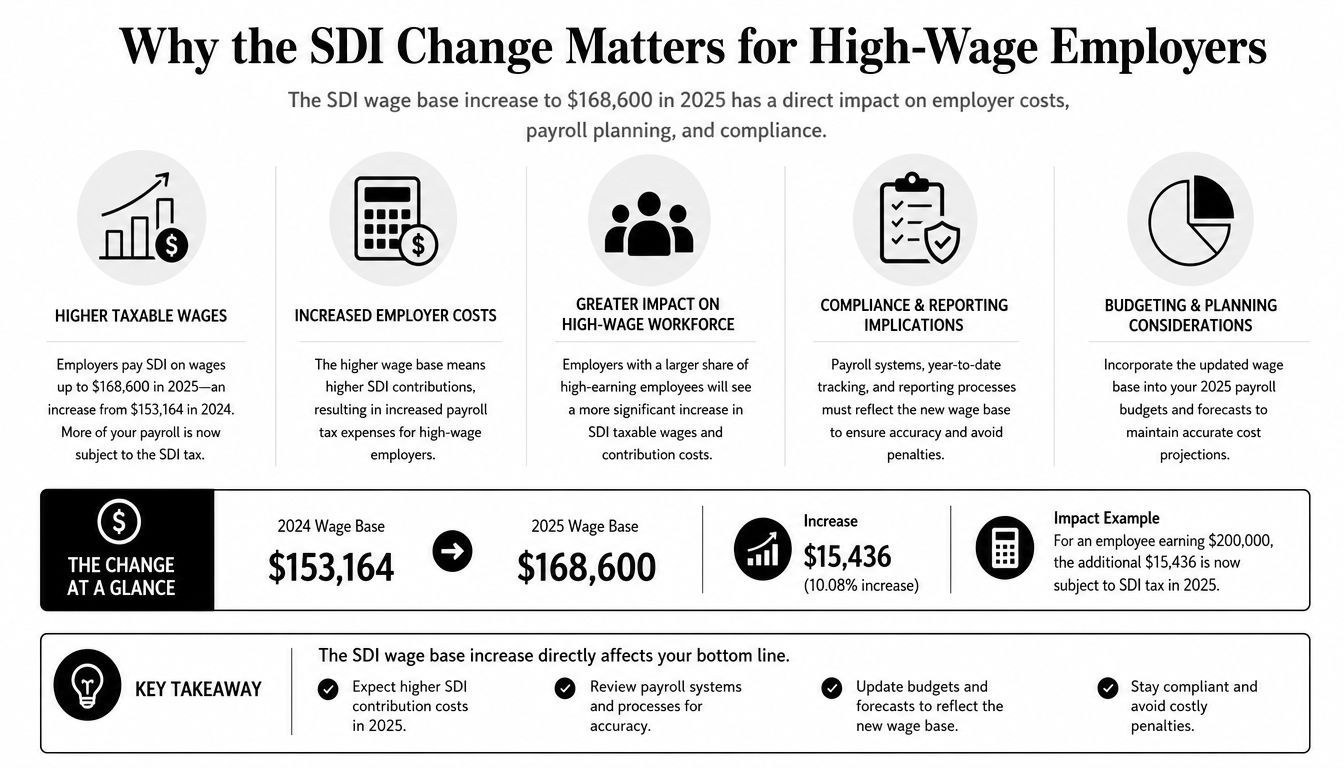
The employer needs to distinguish withholding from employer cost. SDI is an employee withholding, so the employee's net pay changes. But the change can still affect the employer when the company promises a net bonus, offers a tax gross-up, guarantees severance, or designs equity compensation around a target take-home amount.
What compensation teams should change
Payroll and finance should review:
- Offer letters: Clarify whether quoted compensation is gross or net of standard employee withholdings.
- Bonuses: Model SDI withholding on the entire payment instead of assuming the employee has already reached a cap.
- Equity and severance: Coordinate payroll treatment with the compensation plan before payment.
- Remote executives: Confirm work location and California sourcing before processing compensation.
- Headcount budgets: Separate employer UI and ETT costs from employee SDI and PIT withholding.
The important question isn't whether the employer “pays” SDI. The question is whether the company has promised compensation that absorbs the employee's withholding. For high-wage teams, that distinction belongs in the 2026 budget and the written compensation policy.
Penalties and Common Pitfalls to Avoid
California payroll errors become expensive when a business treats filing, payment, and wage detail as interchangeable. They aren't. A timely DE 9 with incorrect DE 9C data is still a problem, and a correct report filed after the deadline can still create exposure.
The research materials identify a 15% penalty on unpaid UI and ETT contributions for underpayment or late payment, plus interest, and a 15% penalty for failing to comply with required electronic payment rules. These figures come from the cited payroll-tax background source, so review the current EDD notice and applicable instructions before relying on them for a specific assessment. The California payroll tax reference guide provides that penalty overview.
Mistakes that deserve immediate attention
DE 9 and DE 9C do not reconcile. This often happens when terminated employees, amended payrolls, or off-cycle checks are handled outside the main payroll run. Compare employee-level wages to the quarterly register before filing.
The employer misses a deposit-schedule change. A larger payroll or a substantial bonus can alter the lookback calculation. If the business keeps using the old frequency, the late-payment exposure can begin before anyone notices.
Remote workers are assigned the wrong state. A California resident working elsewhere, or an employee moving into California, can create sourcing and withholding issues. Review work location changes as payroll events, not merely HR updates.
An employee's state withholding information is stale. When a DE 4 is updated or revoked, payroll must use the new information. Don't leave a former withholding election active indefinitely.
Personal exposure and protests
Responsible individuals can face personal liability for certain unpaid employment taxes. An EDD assessment should therefore go to an owner, controller, or designated tax professional immediately, not remain in a shared inbox.
Penalty relief is limited and documentation matters. Preserve payment confirmations, filing acknowledgments, payroll registers, correspondence, and evidence explaining the event. A protest based on a vague claim that the business was unaware rarely substitutes for a documented compliance failure analysis.
Implementation Checklist and Choosing Payroll Software
A new California employer can make the first payroll cycle far safer by treating setup as a controlled implementation rather than a form-filling exercise.
First 30 days
- Establish the EDD account. Obtain the employer payroll tax account number and verify that it appears correctly in the payroll platform.
- Confirm wage reporting. Configure employee-level wage reporting so DE 9C data comes from the same source as payroll registers.
- Configure SDI correctly. Use the 2026 1.3% rate on all wages, with no wage ceiling, as specified by the EDD rates reference.
- Enroll in e-Services. Give access to the people who approve filings and payments, not only the person who runs payroll.
- Set the deposit calendar. Determine whether the business follows a monthly or semi-weekly schedule under the lookback rule.
- Run parallel payroll. Compare gross pay, PIT, SDI, UI, ETT, net pay, and accounting entries before going live.
Select software for California, not just for payroll
Gusto and Rippling can suit small businesses that want automated California withholding and filing support. QuickBooks Payroll fits companies already operating their books in QuickBooks. ADP Workforce Now is more appropriate when multi-state administration, complex workforce structures, or larger employee populations demand a broader platform.
Look for:
- Current California tax tables: The system must handle uncapped SDI correctly.
- Remote-worker support: It should track multiple work locations and jurisdictions.
- EDD reporting: DE 9 and DE 9C preparation should draw from reconciled payroll data.
- Audit trails: Keep a clear record of approvals, changes, payments, and filings.
- Household-employer capability: If relevant, confirm support for DE 2320 reporting rather than assuming business payroll features cover it.
- Accounting integration: Payroll entries should post cleanly to the general ledger.
A small business payroll comparison guide can help frame the initial vendor review. For an operational checklist, use this payroll compliance checklist.
Software doesn't replace CPA review when the company has multi-state remote employees, acquisitions, equity compensation, worker classification questions, or unresolved EDD notices. Allied Tax Advisors offers payroll processing through IRIS software, but any provider still needs accurate employee data and informed oversight.
When to Bring in a California Payroll Tax Specialist
Use software for repeatable calculations. Bring in a specialist when the facts stop being repeatable.
An EDD assessment, tax lien, unreported DE 2320 wage file, incorrect SDI after the wage-base change, multi-state remote-worker allocation, worker classification dispute, acquisition, or entity restructuring deserves professional review. These events change the account, the data, or the legal interpretation. They're not routine payroll inputs.
A California-focused firm such as Allied Tax Advisors can support EDD audit representation, voluntary disclosure work, payroll tax health checks, retroactive DE 9C reconciliation, and monitoring of rate notices and taxable-wage updates. The value lies in connecting the payroll register, EDD account, compensation policy, and accounting records before the state does it for you.
Choose the right level of help
- Bookkeeper: Suitable for stable payroll with straightforward employee locations and no open notices.
- Payroll software vendor: Suitable for automated calculations, deposits, and recurring filings when the underlying data is clean.
- Specialist firm: Appropriate for assessments, amended filings, multi-state workers, classification issues, executive compensation, and entity changes.
Don't wait until a penalty notice forces the decision. Have an independent review when payroll is growing, compensation is becoming more complex, or the business can't explain why its DE 9, DE 9C, deposits, and general ledger agree.
Allied Tax Advisors can review your California payroll setup, process payroll through IRIS, reconcile EDD filings, and help address notices or broader state tax issues. Visit Allied Tax Advisors to request a payroll compliance review before your next filing cycle.