
Let's get right to the point: can you actually write off your home office? If you're self-employed, a freelancer, or run your own business, the answer is almost certainly yes. But if you're a remote employee getting a W-2, that powerful deduction is, unfortunately, off the table for your federal return.
Your Guide to the Home Office Deduction
The home office deduction is hands-down one of the best tax breaks available to the self-employed, but it’s also one that trips a lot of people up. It lets you turn a slice of your personal household costs—things you're already paying for like rent, mortgage interest, utilities, and insurance—into real business write-offs. This directly lowers your taxable income, which means more money stays with you.
Think of it this way: your home is an expense you can't avoid. When you claim this deduction, you’re simply telling the IRS that a portion of that home is your business’s headquarters, and you deserve a tax break for it. The trick is knowing if you qualify and then calculating it the right way.
Who Can Claim This Deduction Today?
The rules for the home office deduction changed significantly after the Tax Cuts and Jobs Act (TCJA) went into effect in 2017. Since then, remote employees who work for a company can no longer claim a home office deduction on their federal tax returns. This benefit is now reserved almost exclusively for self-employed folks.
This creates a pretty clear line in the sand. To deduct your home office expenses, you generally need to be one of the following:
- A freelancer or independent contractor who gets a 1099-NEC.
- A sole proprietor running a business out of a dedicated space in your home.
- A partner or LLC member who isn't treated as a W-2 employee.
The big idea here is that your home must serve a real business purpose. The IRS wants to see that your workspace is essential to your operations, not just a matter of convenience.
To give you a quick reference, here’s a simple breakdown of who typically qualifies under the current rules.
Home Office Deduction Eligibility at a Glance
| Taxpayer Type | Eligibility Status | Key Consideration |
|---|---|---|
| Sole Proprietor / Freelancer | Eligible | Must meet the "exclusive and regular use" and "principal place of business" tests. |
| S-Corp / C-Corp Owner | Eligible (via accountable plan) | The business must reimburse the owner; not a personal deduction on Form 1040. |
| Partner in a Partnership | Eligible (unreimbursed expenses) | The expenses must be a condition of the partnership agreement. |
| W-2 Employee | Not Eligible (Federal) | The TCJA suspended this deduction for employees from 2018 through 2025. |
This table makes it clear that your business structure is the first hurdle. If you're a W-2 employee, you're out of luck on your federal return for now, but if you're in business for yourself, it's time to dig into the details.
Setting Up for Success
Before you even think about the numbers, you need a workspace that meets the IRS's strict definition. This means more than just clearing a spot on the dining room table. While you're focused on the financial side, don't forget how important it is to properly organize a home office to keep yourself productive.
A well-organized space does more than just help you work better—it also visually defines your business area. This is a huge help in meeting the "exclusive use" test we’ll cover next. When your space looks like a business, it's that much easier to justify your claim if the IRS ever comes knocking.
Do You Actually Qualify for the Home Office Deduction?
Before you start measuring square footage or digging up old utility bills, we need to talk about eligibility. This is the first and most important step. The IRS has two main hurdles you have to clear, and they are not messing around. If you fail either one, the deduction is off the table, period.
The good news? The rules are actually pretty logical once you understand what the IRS is looking for. They just want to see that your home office is a real, necessary, and central part of your business—not just a corner of the couch where you answer a few emails.
This flowchart gives you a great visual starting point, breaking it down by your work status.
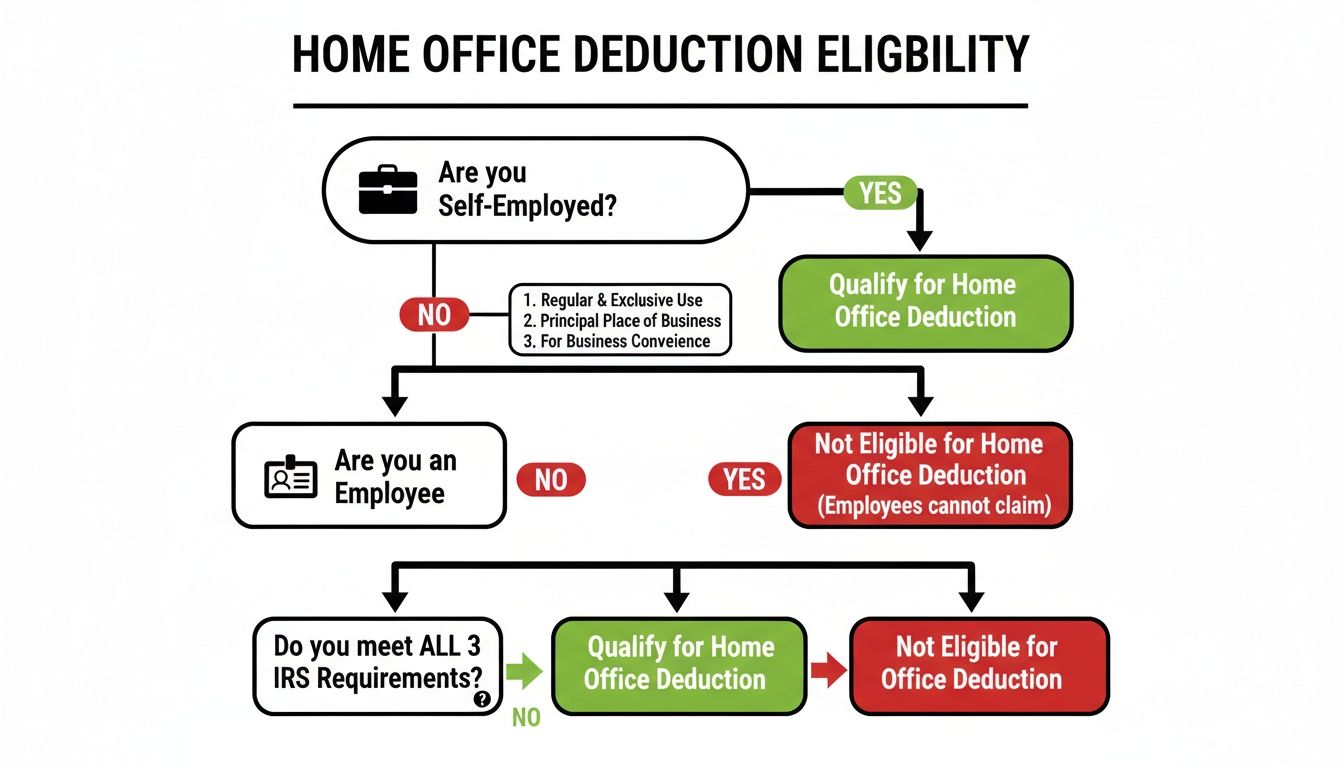
As you can see, being self-employed is the first gate you need to pass through. From there, it's all about nailing the two core tests.
The "Exclusive and Regular Use" Test
This first one is where most people get tripped up. It's a two-part rule that trips a lot of people up: the space has to be used exclusively for your business, and on a regular basis. Let's break that down.
Exclusive use is exactly what it sounds like. That specific area of your home is used for nothing but your trade or business. That guest room that doubles as your office? Fails the test. The dining room table you work at all day but clear off for dinner? That fails, too. Once it serves a personal purpose, it loses its exclusive status in the eyes of the IRS.
- Real-World Example: Imagine a graphic designer who sections off a 10×10 foot corner of their living room. They use a bookshelf and a rug to visually separate it. Inside this "zone," they have their desk, computer, and client project files. As long as that defined space is never used for personal activities (like the kids' homework or watching TV), it meets the exclusive use rule. It doesn't have to be a separate room with four walls.
Regular use simply means you consistently use the space. It has to be an integral part of your work routine, not just an occasional or incidental thing. If you're meeting clients there weekly or working at that desk daily, you're in the clear. But if you only pop in once a month to do some filing, your claim is on shaky ground.
The "Principal Place of Business" Test
Once you've cleared the first hurdle, you also have to show that your home office is your principal place of business. Now, this can be confusing, especially for people who spend most of their time out in the field or at client sites. It doesn't mean it's the only place you work.
The IRS gives us two main ways to satisfy this test:
- It's the place where you meet with clients or customers in the normal course of your business. If you're a therapist or a consultant with a dedicated meeting space in your home, you've likely met this requirement.
- It’s where you conduct the bulk of your administrative or management activities, and you don’t have another fixed location where you do that work.
That second point is a lifeline for so many modern businesses. Take a plumber, for example. They spend their days at customer homes. But if they use their home office every evening to schedule jobs, handle billing, order supplies, and update their books, it qualifies. Why? Because the core management of the enterprise happens right there.
Your home office doesn't need to be where you generate revenue; it needs to be the administrative command center for your business.
Getting these details right is critical. For a deeper look at how these rules apply in different scenarios, you can explore the tax implications of working from home in our detailed guide. Passing these two tests is the foundation for successfully—and safely—claiming this valuable deduction.
Simplified vs. Actual Expenses: Which Method Is Right for You?
So, you've confirmed you qualify for the home office deduction. Great! Now comes the next big decision: how to calculate it. The IRS gives you two ways to do this, and the one you pick can make a huge difference to your bottom line.
Think of it as choosing your path. One is a quick, paved road that's easy to navigate, while the other is a more detailed route that could lead to a much bigger tax break. The good news is you aren't locked in forever; you can switch between them from year to year to see what works best.
The Simplified Method: Quick and Easy
The simplified option is exactly what it sounds like. It was designed to cut down on the paperwork nightmare for small business owners. Instead of digging through a year's worth of utility bills and repair receipts, you just use a standard rate.
Here’s all you need to do the math:
- Find the square footage of your dedicated home office space.
- Multiply that by the IRS rate of $5 per square foot.
There is a catch, though. The IRS caps this at 300 square feet. That means the absolute most you can deduct with this method is $1,500 per year (300 sq. ft. x $5).
Here's a real-world example: A freelance writer uses a 120-square-foot spare bedroom exclusively for her business. Using the simplified method, her deduction is a simple calculation: 120 sq. ft. x $5 = $600. It takes two minutes, requires zero extra paperwork, and still gives her a nice deduction.
The Actual Expense Method: More Work, Bigger Payoff
This is where the real savings potential kicks in, especially if you have a larger office or live somewhere with a high cost of living. The actual expense method requires you to track all the real costs of running your home and then claim the business portion of those expenses.
It involves a bit more legwork. First, you calculate your business-use percentage by dividing your office's square footage by your home's total square footage. Then, you apply that percentage to your indirect home costs.
You can tally up two kinds of expenses:
Indirect Expenses: These are for the whole home—things like mortgage interest, property taxes, rent, utilities, homeowners insurance, and general home repairs (like fixing the roof). You deduct a percentage of these based on your business use. Our guide on deducting rent from taxes has some great related insights.
Direct Expenses: These are costs that are 100% for your office space. Think painting the office walls or repairing a window in that specific room.
Plus, if you own your home, you get a powerful write-off that the simplified method doesn't offer: depreciation on the business portion of your home.
Head-to-Head: A Comparison to Help You Decide
Your choice really comes down to your personal financial picture and how much time you're willing to spend on recordkeeping. Keeping your books in order is non-negotiable with the actual method. For many business owners, this is where it makes sense to outsource bookkeeping for small business to ensure every number is spot-on.
To make the decision easier, let's put the two methods side-by-side.
Simplified vs. Actual Expense Method Comparison
This table breaks down the core differences to help you see which approach fits your situation.
| Feature | Simplified Method | Actual Expense Method |
|---|---|---|
| Calculation | $5 per square foot | Business % of actual home costs |
| Maximum Deduction | Capped at $1,500 per year | Limited only by business income |
| Recordkeeping | Minimal; just need sq. footage | Extensive; must track all expenses |
| Depreciation | Not allowed | Allowed for homeowners |
| Best For | Simplicity, smaller spaces, renters | Maximizing savings, homeowners, larger offices |
The numbers tell the story. For some, the simplified method is a no-brainer. But for others, leaving the actual expense deduction on the table is like walking away from free money.
Let's look at an S-Corp owner: An S-Corp owner in a high-cost city has a 350-square-foot office in their 2,500-square-foot home. That gives them a business-use percentage of 14%. Their annual indirect home expenses (mortgage interest, taxes, utilities) total $40,000. Their deduction? A whopping $5,600 ($40,000 x 14%), and that's before adding in depreciation and direct expenses. The $1,500 simplified cap doesn't even come close.
Ultimately, you need to run the numbers both ways. If the actual expense method only nets you a couple hundred dollars more, the hassle of tracking everything might not be worth it. But if the difference is in the thousands—as it often is for homeowners—it's time to get friendly with your receipts.
A Hands-On Guide to the Simplified Method
Let's be honest: the idea of hoarding utility bills and repair receipts for tax season is enough to make anyone's head spin. If that sounds like you, then the simplified method for the home office deduction is going to be a lifesaver. It’s built for freelancers, gig workers, and any business owner who would rather spend their time on their work than on paperwork.
Instead of adding up every single home-related expense, you just use a standard rate the IRS gives you. The rate is a straightforward $5 per square foot for the part of your home you use for business. You can claim this for up to 300 square feet, which means the most you can deduct with this method is $1,500 a year. It's a hugely popular option for a reason. You can see how the numbers might play out for your specific space with this handy home office deduction guide.
The only real "work" you have to do is break out the tape measure.
Measuring Your Workspace Accurately
Don't worry, you don't need a degree in architecture for this part. Just get a rough but accurate measurement of the area you use only for your business.
- If you use a whole room: This is the easiest. Just measure the length and width and multiply them. A spare bedroom that’s 10 feet by 12 feet gives you 120 square feet of office space.
- If you use part of a room: Maybe you have a desk and chair set up in a clear corner of your living room. Just measure that specific zone. If your dedicated nook is 8 feet by 10 feet, that's 80 square feet.
The key thing to remember is that this space must still pass the "exclusive use" test. That means the area you measure has to be 100% dedicated to your business activities—no sharing with the family TV or a kids' play area.
Putting It All Together: A Real-World Example
Let's see this in action. We'll use Alex, a gig worker who drives for a rideshare company. During the day, Alex is on the road, but at night, a small desk in a dedicated corner of the apartment becomes mission control for managing the business—logging mileage, tracking earnings, and getting tax documents in order.
- Measure the Space: Alex's workspace is a compact 5 feet by 6 feet, which comes out to 30 square feet.
- Apply the IRS Rate: The standard rate is $5 per square foot.
- Calculate the Deduction: Just multiply the two numbers: 30 sq. ft. x $5 = $150.
And that's it. Alex can claim a $150 deduction for the year. No need to figure out what percentage of the electric bill went to the office. It’s clean, simple, and as long as the space genuinely qualifies, it’s solid.
Reporting the Deduction on Your Schedule C
Once you have your final number, where do you put it? This deduction goes directly on your Schedule C (Form 1040), Profit or Loss from Business.
When you get to the "Expenses" part of the form, you’ll find a specific line item for this—it's usually labeled "Simplified method for home office use." You'll just enter your office's square footage and your total deduction there. The IRS made it pretty hard to miss, which helps avoid any mix-ups with Form 8829, the more complex form required for the actual expense method.
The Big Trade-Off: The simplified method is all about convenience. You're trading a potentially larger deduction for sheer simplicity. By choosing this route, you can't also deduct actual expenses like mortgage interest, insurance, or repairs for your office, and you can't claim depreciation. For a lot of small business owners, that's a fair trade to skip the record-keeping headache.
Going Beyond the Basics: The Actual Expense Method
If the simplified method feels a bit too… well, simple—and you suspect you're leaving money on the table—it's time to roll up your sleeves and dig into the actual expense method. This approach takes more effort, no doubt about it. But for homeowners or anyone in a high-cost area, the payoff can be substantial.
This is the path for anyone serious about maximizing their tax savings by tracking what they actually spend.
The entire calculation hinges on one key figure: your business-use percentage. This is what determines how much of your total home expenses you can write off against your business income. Don't worry, the math is refreshingly simple.
How to Calculate Your Business-Use Percentage
You just need two numbers: the square footage of your dedicated office space and the total square footage of your home.
Divide the office square footage by the home's total square footage. That's it. That percentage is what you'll apply to all your shared household costs.
Let's say your office is a 200-square-foot room in a 2,000-square-foot house. Your business-use percentage is 10% (200 / 2,000). You'll be deducting 10% of all your eligible indirect home expenses for the year.
What Expenses Can You Actually Deduct?
Once you have your percentage, it's time to gather up all your qualifying home expenses. They fall into two buckets, and it's important to know the difference.
- Direct Expenses: These are costs that are 100% for your office. Think about painting just the office walls, buying a new light fixture for that specific room, or repairing a window solely in your workspace. You get to deduct the full cost of these.
- Indirect Expenses: This is where the real magic happens. These are the costs that benefit your entire home, and you can deduct a portion of them based on your business-use percentage.
The key is to be meticulous. When you deduct home office costs using this method, every receipt and bill becomes a potential tax-saving tool. Keeping detailed records isn't just a good idea—it's an absolute necessity.
Here’s a checklist of common indirect expenses you don't want to miss:
- Mortgage interest
- Real estate taxes
- Rent (if you're a renter)
- Homeowners or renters insurance
- Utilities (electricity, gas, water, internet)
- Trash removal
- General home repairs (like fixing the roof or a leaky pipe)
- HOA fees
- Home security system costs
A Real-World Example: Sarah the Investor
Let’s see how this works in the real world. Meet Sarah, a real estate investor who runs her business from a dedicated office in her home.
- Home Size: 2,500 square feet
- Office Size: 300 square feet
- Business-Use Percentage: 12% (300 / 2,500)
Here’s a breakdown of her annual indirect expenses:
| Expense | Annual Cost | Business Portion (12%) |
|---|---|---|
| Mortgage Interest | $15,000 | $1,800 |
| Property Taxes | $6,000 | $720 |
| Homeowners Insurance | $1,800 | $216 |
| Utilities | $4,200 | $504 |
| Security System | $600 | $72 |
| Total Indirect Deduction | $28,600 | $3,312 |
Right off the bat, Sarah’s deduction is $3,312. That’s more than double the simplified method’s $1,500 cap. But wait, there's more.
Don't Forget About Depreciation
For homeowners, the single biggest advantage of the actual expense method is depreciation. This is a non-cash deduction that allows you to write off a portion of your home's value over its useful life. You'll calculate this on IRS Form 8829, Expenses for Business Use of Your Home.
While the calculation is a bit more complex, it can add thousands to your deduction.
In Sarah’s case, the depreciable basis of her home is $400,000. The IRS allows residential property to be depreciated over 39 years. By applying her 12% business-use percentage, she gets to claim an additional depreciation deduction of roughly $1,230 for the year.
This brings her grand total home office deduction to $4,542—a massive difference from the simplified option.
In high-cost areas where utility bills are high and mortgage interest is substantial, the actual expense method almost always delivers a deduction that blows the $1,500 simplified maximum out of the water.
Of course, the trade-off for these major savings is the need for bulletproof records. Our guide on how to track business expenses gives you a great framework for staying organized and audit-ready.
Common Questions About the Home Office Deduction
Even after you've got the rules down, real-life situations always bring up new questions. It’s in these gray areas that myths and mistakes tend to pop up. Let's walk through some of the most common questions we get from clients to help you get this deduction right.
Think of this as a final check-in. Making sure you understand how the rules apply to your specific situation is the key to claiming the deduction with total confidence.
Can S-Corp Owners Deduct Home Office Costs?
Yes, absolutely—but the process is completely different from what a sole proprietor does. This is a critical point that trips up a lot of S-Corp owners. You cannot just claim the home office deduction on your personal Form 1040. Instead, your business needs to reimburse you through an accountable plan.
So, what’s an accountable plan? It’s basically a formal system for you, the employee, to get paid back by your company for business expenses.
Here’s how it works in practice:
- You track and calculate your home office expenses using the actual expense method.
- Then, you submit a formal expense report to your S-Corp for those costs.
- Your S-Corp cuts you a check to reimburse you for that exact amount.
- Finally, the S-Corp deducts the reimbursement as a business expense on its corporate tax return (Form 1120-S).
Following this process is non-negotiable. It keeps your personal and business finances separate, which is crucial for liability protection. The reimbursement is tax-free money in your pocket, and it’s a legitimate deduction for the business. It’s a win-win, but only if you do it by the book.
What if I Switch Calculation Methods?
The IRS is surprisingly flexible here. You can bounce between the simplified and actual expense methods from year to year. This can be a really smart move. For instance, if you had to replace your roof this year, using the actual expense method would likely give you a much bigger deduction than the simplified option.
But there's a major catch you need to be aware of: depreciation.
When you use the actual expense method, you’re claiming depreciation on a portion of your home. This reduces your home's cost basis. If you sell your house down the road, you may have to pay "recapture" tax on all the depreciation you claimed over the years.
It’s a classic trade-off: a larger deduction now could mean a bigger tax bill later. The simplified method sidesteps this problem entirely since you can't claim depreciation with it. Before you switch, always think about the long-term impact on a future home sale.
Will Claiming This Deduction Trigger an IRS Audit?
This is probably the biggest myth out there. The fear of an audit stops so many business owners from taking a deduction they've legitimately earned. But let’s be real: the IRS knows that millions of Americans run successful businesses from home. It's the norm now.
Claiming the deduction itself is not an audit trigger. What gets the IRS’s attention are claims that just don’t pass the smell test. An auditor is far more likely to dig into a return where someone claims 60% of a three-bedroom house as their office for a one-person consulting gig. Or when the home office expenses look way too high compared to the business’s income.
The secret to audit-proofing your deduction isn’t a secret at all.
- Be Honest: Only claim the space that you truly use exclusively and regularly for your business.
- Be Reasonable: Does your business-use percentage make sense for the size of your home and the nature of your work?
- Be Meticulous: Keep flawless records. This is especially true if you use the actual expense method. Your best defense is a folder full of photos, floor plans, receipts, and bank statements.
As long as your claim is legitimate and you have the paperwork to back it up, you should feel completely confident taking the deduction you deserve.
At Allied Tax Advisors, we help business owners navigate these complexities every day. If you're looking for expert guidance on the home office deduction or any other aspect of your business taxes, our team is here to provide the clarity you need. Visit us at https://alliedtax.com to learn how we can support your financial journey.