
You probably have documents scattered across QuickBooks, email, a shared drive, your phone, a filing cabinet, and maybe a shoebox that keeps getting “temporarily” reused every tax season. Then an IRS notice shows up, a lender asks for backup, or a lawyer wants records tied to a dispute you thought was over. At that point, the problem isn't taxes alone. The problem is that you can't prove your numbers quickly and cleanly.
That's why a document retention policy matters. It's not corporate fluff. It's the operating rule that tells you what to keep, where to keep it, who can access it, when to destroy it, and when destruction must stop. For a small business owner, landlord, or crypto investor, that policy protects deductions, reduces chaos, and keeps old files from becoming expensive liabilities.
A good policy does two things at once. It preserves the records you'll need when the IRS, a state agency, a bank, or a court asks questions. It also gets rid of stale clutter before that clutter becomes discoverable, breach-prone, or impossible to manage.
Table of Contents
- Why Your Document Retention Policy Matters
- The Core Components of a Retention Policy
- Decoding Legal and Tax Retention Periods
- Creating Your Retention Schedule Template
- Step-by-Step Policy Implementation and Governance
- Secure Storage Disposal and Audit Preparedness
- Conclusion Your Living Policy and Path Forward
Why Your Document Retention Policy Matters
Most owners think about recordkeeping only when something goes wrong. That's backwards. Your document retention policy should be built when things are calm, because once an audit, notice, insurance claim, partnership dispute, or legal demand arrives, your options narrow fast.
The practical purpose is simple. You need a written rule for keeping records long enough to defend tax positions, meet legal obligations, and support financial reporting. You also need a rule for deleting records that no longer serve a valid business purpose. Without both halves, you create risk from two directions. You either destroy key support too soon, or you keep everything forever and hand over a mountain of irrelevant material when someone starts asking questions.
For small businesses, the tax side is usually the right starting point. Taxes touch almost every record category. Income records, expense support, payroll files, contractor forms, fixed asset purchases, depreciation schedules, loan records, ownership documents, and prior returns all feed into your filings. If your tax records are incomplete, every other compliance process gets harder.
Practical rule: If a document supports income, deductions, basis, payroll, ownership, or a filed return, treat it as important until your written schedule says otherwise.
This matters even more if you own rental property or trade crypto. Rental owners need records that show purchase price, improvements, depreciation, loan activity, rental income, and repair versus capital improvement treatment. Crypto investors need transaction histories, wallet records, exchange exports, basis support, and proof tied to taxable events. These files tend to live across multiple platforms, which is exactly why a formal policy is better than relying on memory.
A document retention policy also forces discipline inside the business.
- It assigns ownership: Someone becomes responsible for records instead of everyone assuming someone else handled it.
- It reduces panic: You know where documents live and how long they stay there.
- It improves response time: You can produce support quickly when an agency, lender, or buyer asks.
- It limits exposure: Old junk stops piling up in inboxes and forgotten drives.
If you don't have a policy, you don't have a recordkeeping system. You have habits. Habits break under pressure.
The Core Components of a Retention Policy
A retention policy sets the rules before a problem tests your business. If an IRS notice arrives, a lender asks for support, or a former employee disputes payroll records, you should not be deciding where files belong or who can delete them. The policy should already answer those questions.
For small businesses, the best policy starts with tax exposure and builds outward. That means you organize records around the documents that support income, deductions, basis, payroll, ownership, rentals, and digital asset activity, then extend the same discipline to legal and operational records. If you store records in Microsoft 365, your filing and access rules should also align with the controls discussed in this Microsoft 365 financial compliance guide.
Start with clear rules
Your policy should tell staff what counts as an official record, where that record must be stored, how long it stays, how it is protected, what happens during a legal hold, and who can approve destruction. If any one of those answers is missing, people will fill in the gap with personal habits.
That is where retention policies fail.
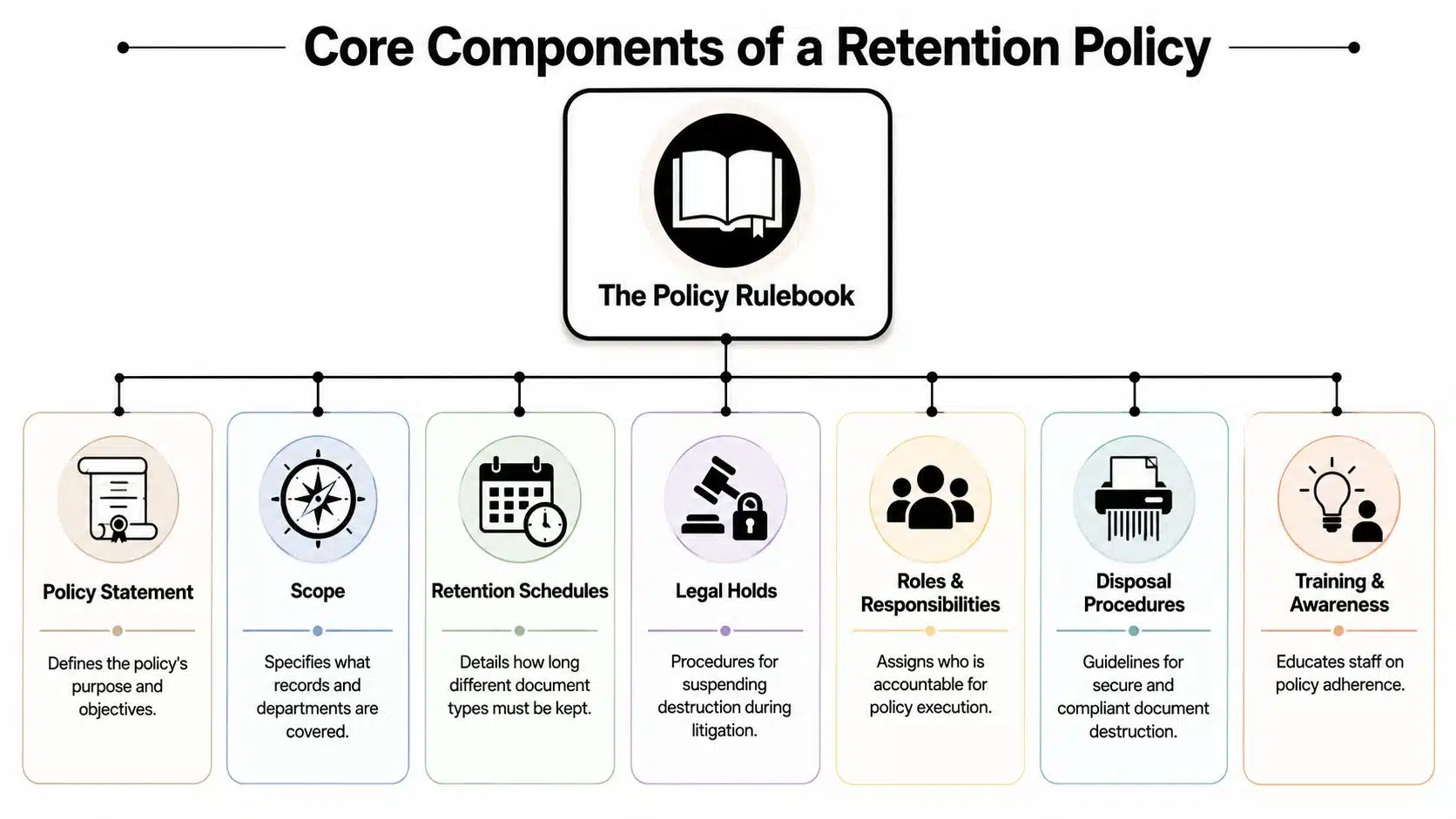
A useful policy usually has seven parts. Keep the writing plain. Precision matters more than legal-sounding language.
What each component actually does
Policy statement
This is the opening rule. It should explain why the policy exists and what the business expects people to do. State plainly that records are retained to satisfy tax, legal, regulatory, and operational requirements, and that destruction happens only under an approved schedule unless a hold applies.
Scope
Scope defines what is covered. Include paper files, PDFs, accounting reports, emails, payroll records, cloud folders, text-message screenshots that document a transaction, crypto exchange exports, wallet records, and files held by outside vendors.
Small businesses often get this wrong by writing scope around office files only. That misses how records are created and stored.
Retention schedules
This is the operating table of the policy. It lists each record category and the retention period that applies to it. Without it, the policy is just a statement with no enforcement value.
Group records in terms people already use in the business. Tax returns, payroll, bank records, contracts, ownership documents, rental property files, fixed assets, loan records, and policy documents are easier to follow than vague labels.
Legal holds
A normal schedule stops when litigation, an audit, an investigation, or a government inquiry affects relevant records. Your policy needs a written hold procedure that suspends deletion, identifies affected files, and tells staff who issues and clears the hold.
Deleting records after a hold should have started creates a bigger problem than the original dispute.
Roles and responsibilities
Someone has to own the system. In a small business, that may be the owner, controller, office manager, or outsourced finance lead. IT may control access and backups. Another person may approve destruction. Put each responsibility in writing.
Clear ownership matters even more for rental portfolios and crypto activity because records often sit across property managers, exchanges, wallets, bookkeeping platforms, and tax files.
Disposal procedures
Your policy should explain how paper is shredded, how electronic records are deleted, who approves destruction, and what proof the business keeps afterward. An effective policy includes a Records Destruction Log that documents what was destroyed, when it was destroyed, who approved it, and which method was used.
If you cannot prove orderly disposal, you do not have a defensible process.
Training and awareness
Policies fail when staff never see them after rollout. Give people short, practical training on where to save records, what belongs in the official file, what they cannot delete, and how to escalate a hold.
Use examples from business. A rental owner should know where invoices for improvements and appliance replacements go. A bookkeeper should know which reports become part of the final record set. A crypto investor should know that wallet activity, exchange exports, and basis support belong in the retained file, not scattered across apps and inboxes.
Decoding Legal and Tax Retention Periods
You get an IRS notice asking for support for a deduction from four years ago. Your bookkeeper has some of the records. Your payroll provider has others. A property manager has invoices for one rental, but not the capital improvement records that affect basis. Your crypto exchange no longer has the full transaction history you thought you could download later.
That is what a weak retention policy looks like in real life. The problem is not storage. The problem is keeping records for the right length of time, for the right tax reason, in a file you can produce.
Start with tax exposure, not office cleanup
Small businesses get bad retention advice because people mix legal rules, tax rules, and convenience. “Keep everything for seven years” is lazy advice. “Three years is enough” is also lazy advice.
Use a tax-first standard instead. Keep records based on how long they can affect a return, a payroll filing, an ownership position, or a future gain or loss calculation. If a document supports income, deductions, basis, depreciation, payroll tax compliance, or entity ownership, treat it as a tax record first and an admin record second.
That approach gives you a policy that makes sense across the whole business, not a pile of disconnected folder rules.
The practical rule most owners should follow
For many small businesses, seven years is the working rule for tax support and core financial records. It is long enough to cover the records that commonly matter in audits, amended returns, disputes over deductions, and questions about payroll treatment.
Do not turn that into a blanket rule for every file. Some records should be kept for a shorter period under your general business schedule. Others belong in your permanent file because they affect ownership, basis, depreciation, or legal rights well beyond one tax year.
Here is the clean way to decide:
- Short-term administrative records follow your general business schedule.
- Tax support and payroll records generally stay in the seven-year file.
- Permanent records stay until the asset is sold, the entity is dissolved, or the legal need ends.
If you need a starting point for what belongs in the tax file itself, use this tax document checklist for small businesses and investors.
Records that should usually stay much longer
Some documents outlive the return they first touched.
For a business owner, that includes formation documents, ownership ledgers, major contracts, fixed asset schedules, loan agreements, prior-year tax returns, and records tied to acquisitions or sales. For rental property owners, deeds, closing statements, refinance documents, depreciation schedules, and capital improvement invoices often matter until the property is sold and the final tax reporting is done. For crypto investors, basis records, wallet transfer support, trade exports, reconciliation files, and reports used to prepare returns should stay as long as they are needed to prove cost basis and transaction history.
If a record changes basis or supports depreciation, do not destroy it on a routine timetable just because the invoice is old.
Special cases deserve their own rule
Payroll records need their own retention period. So do employee benefit records, sales tax files, insurance claims, litigation-related documents, and any records subject to an agency rule or legal hold.
Keep those categories separate from ordinary business correspondence. If you mix everything into one broad “finance” folder and apply one destruction date, you create avoidable risk. Owners usually over-keep junk and under-keep the records that matter.
Use systems that match the policy
A retention rule fails if your records live across inboxes, desktop folders, property management software, cloud drives, exchanges, and tax prep portals with no single filing standard. If you store sensitive financial records in Microsoft 365, this Microsoft 365 financial compliance guide shows how retention, access control, and governance can work inside the tools your team already uses.
The standard I recommend is simple. Organize records by tax year, entity, and asset. Then separate permanent records from seven-year records and short-term admin files. That structure works for a main operating business, a rental portfolio, and digital asset activity.
A document retention policy should answer one question fast. If the IRS, a state agency, a lender, or a buyer asks for proof, can you produce the record that supports the number? If the answer is no, your retention period is wrong, your filing system is wrong, or both.
Creating Your Retention Schedule Template
A retention schedule is the part your team will use under pressure. An IRS notice arrives, a lender asks for backup, or your bookkeeper needs support for an old deduction. Nobody is pulling out a long policy memo in that moment. They need a short, clear table that tells them what to keep, where it belongs, and when it can be destroyed.
For small businesses, rental owners, and crypto investors, I recommend building the schedule around tax risk first. Start with the records that prove income, deductions, basis, ownership, payroll reporting, and asset history. Then add operational records around them. That approach keeps your policy tied to the records that matter most in an audit, amended return, sale, or dispute.
Start with categories that match real business activity
Bad schedules are built around random folders. Good schedules are built around record purpose.
Use categories such as tax returns and tax support, payroll and HR, bank and credit card records, entity and ownership records, contracts, fixed assets, rental property files, crypto transaction support, insurance, and legal matters. Then assign one retention period to each category and apply it consistently across paper files, PDFs, emails, and software exports.
If you need a practical starting point for your tax file structure, use this tax document checklist for small businesses.
Sample document retention schedule
The schedule below is a practical business template based on common tax, payroll, legal, and operational retention practices discussed earlier in this article. Treat it as a working model, then adjust it for your entity type, industry rules, state requirements, and any legal hold.
| Record Category | Document Example | Retention Period | Why this period makes sense |
|---|---|---|---|
| Tax returns and core tax support | Filed federal and state returns, workpapers, depreciation schedules, basis support, K-1 support | 7 years minimum | This covers the records the IRS is most likely to request when it tests income, deductions, basis, or carryforwards. |
| Payroll tax and employee pay records | Payroll registers, Forms W-2 and W-4, payroll tax filings, time records | 7 years | Payroll creates both tax and employment exposure. Keep one standard period that protects both. |
| Bank, credit card, and expense support | Statements, canceled checks, merchant statements, receipt images, expense reports | 7 years | These records support deductions and help tie your books to filed returns. |
| Entity and ownership records | Articles of organization, bylaws, operating agreement, stock ledger, EIN letter, major board consents | Permanent | These documents prove who owns the business and how it was formed and governed. |
| Fixed asset records | Purchase documents, invoices, titles, depreciation schedules, improvement records, sale documents | Life of asset plus 7 years after disposal | You need these records to prove basis, depreciation, gain, or loss. |
| Rental property files | Closing statements, lease agreements, repair records, capital improvement records, property tax records | Ownership period plus 7 years after sale | Rental owners need a clear trail for income, expenses, improvements, and final gain calculations. |
| Crypto tax records | Exchange exports, wallet records, transaction logs, cost basis reports, staking or mining income support | 7 years minimum | Crypto records are often fragmented across platforms. Keep a full tax-year file that supports basis and income reporting. |
| Contracts and loan files | Signed contracts, loan agreements, promissory notes, amendments, payoff records | 7 years after expiration or payoff | These files support deductions, obligations, and disputes tied to prior periods. |
| Insurance and claims files | Policies, claim forms, settlement records, incident documentation | 7 years after claim closure | Claims can affect deductions, reimbursements, and future disputes. |
| Routine administrative records | General correspondence, duplicate copies, scheduling emails, drafts with no legal or tax value | 3 years | Short-term admin records should not clog your system once they stop serving a business purpose. |
| Litigation or government inquiry records | Documents tied to a lawsuit, subpoena, audit notice, agency demand, or attorney instruction | Hold indefinitely until cleared | Destruction stops when a legal hold applies. No schedule overrides that rule. |
How to build a schedule that people will follow
Keep it simple enough to use without guessing.
- List the records you create. Include returns, invoices, payroll reports, loan files, lease files, closing statements, exchange exports, wallet reports, and ownership documents.
- Assign an owner to each category. One person should decide where the official copy lives.
- Use one trigger date. Examples include tax return filing date, employee termination date, contract expiration date, loan payoff date, or asset sale date.
- Mark permanent records clearly. Entity formation documents, ownership records, and key asset history should never sit in a generic purge queue.
- Add a legal hold rule at the bottom of the schedule. If litigation, an audit, or an agency request starts, destruction stops for affected records.
One warning. Do not build a giant schedule full of edge cases on day one. A small business usually needs a usable schedule, not an elaborate one. Start with the records that support tax filings, payroll, ownership, rentals, and crypto activity. Then add categories as your operations get more complex.
Step-by-Step Policy Implementation and Governance
A retention schedule on paper will not protect you in an IRS exam, a payroll dispute, or a property sale. Execution will. If your bookkeeper stores receipts in email, your property manager keeps leases in a portal, and your crypto CSV exports live on one laptop, you do not have a policy. You have scattered evidence.
Start with accountability. One person must own the policy, keep the schedule current, and decide where the official copy of each record lives. In a small business, that is usually the owner, controller, office manager, or outside accounting lead. Then assign three more roles. Someone manages storage access. Someone approves destruction. Someone can issue a legal hold when an audit, lawsuit, or agency notice arrives.
Next, find the records before you write more rules. Check accounting software attachments, payroll systems, tax organizers, email folders, shared drives, local desktops, e-signature platforms, lease management tools, exchange accounts, wallet reports, and vendor dashboards. Small businesses, rental owners, and crypto investors often miss records that never hit the main filing system. Those gaps create tax problems fast.
This image reflects the mindset you need. Retention has to be run like a process, not treated like a one-time project.

Clean up the daily habits next. Receipt capture is a good starting point because weak receipt handling usually signals bigger recordkeeping problems. If your team still leaves source documents in inboxes, cars, or text threads, use this process for how to organize business receipts and make it the standard.
Then implement the policy in a fixed order.
- Write the policy in plain English. Define who follows it, which records it covers, the retention periods, legal hold rules, storage requirements, and who can approve destruction.
- Assign one official home for each record category. Tax returns, payroll reports, leases, closing files, loan documents, and crypto transaction support should each have one authoritative location.
- Train by job function. Your bookkeeper needs examples for expense support and sales records. Your payroll contact needs rules for employee files. A rental property manager needs rules for leases, repairs, and deposit records. A crypto investor or advisor needs rules for exchange exports, wallet history, and basis support.
- Set file naming rules that support retrieval. Use dates, entity names, property addresses, account names, and document type. Fancy software will not fix bad naming.
- Run retrieval tests. Ask someone to produce support for a deduction, a payroll filing, a signed lease, a basis schedule, or a crypto sale. If they cannot find it quickly, the policy is not working.
- Document exceptions and holds. If a record is under audit review, tied to amended returns, or connected to a dispute, note it clearly so it does not enter a normal purge cycle.
A retention policy is only real when another person can follow it without calling the owner for help.
Governance matters just as much as rollout. Keep versioned copies of the policy, record who approved each revision, and track when the update was distributed to staff or vendors. Do not overwrite the old version and pretend history does not matter. If the IRS questions a filing position, or a tenant, employee, or agency challenges your process, the issue may turn on the policy that existed at that time.
Include outside vendors in that governance process. Payroll companies, IT providers, document storage vendors, and property management platforms may hold records that support your tax filings and legal obligations. Your policy should state what they keep, how you get records back, and who confirms deletion when the relationship ends. If you need a practical example of vendors and disposal controls working together, this guide to solving data compliance challenges is a useful reference.
Review the policy at least once a year and after major changes. New entity structures, a property purchase or sale, a payroll shift, new software, or crypto activity all change what you need to retain. A living policy keeps tax support intact and prevents old files from piling up without purpose.
Secure Storage Disposal and Audit Preparedness
An IRS notice lands in your inbox. Your bookkeeper can find the return, but the depreciation schedule is on an old laptop, the closing statement for the rental property is in a banker box, and the crypto transaction exports are trapped in a platform you no longer use. That is how small problems turn into expensive ones.
A retention policy has to do more than assign dates. It has to keep records readable, protected, and easy to produce from the day you create them until the day you destroy them. If you run a small business, own rentals, or trade crypto, that standard should start with tax support. The records that prove income, deductions, basis, payroll filings, and ownership history need the strongest controls.
Store records so they stay usable
Keep paper records only when they serve a clear purpose. Signed legal agreements, entity formation documents, property closing files, and other original records belong in labeled files, in a controlled location, with limited access. Do not scatter official files across home offices, cars, or storage closets with no index.
Digital records need a stricter system. Use encrypted storage, role based access, routine backups, and a set process for migrating files before software, formats, or devices become obsolete. A PDF you cannot open in five years is no better than a paper file lost in a flood. For tax purposes, that matters most with basis records, fixed asset schedules, prior year returns, payroll support, and wallet or exchange data used to report crypto gains and losses.
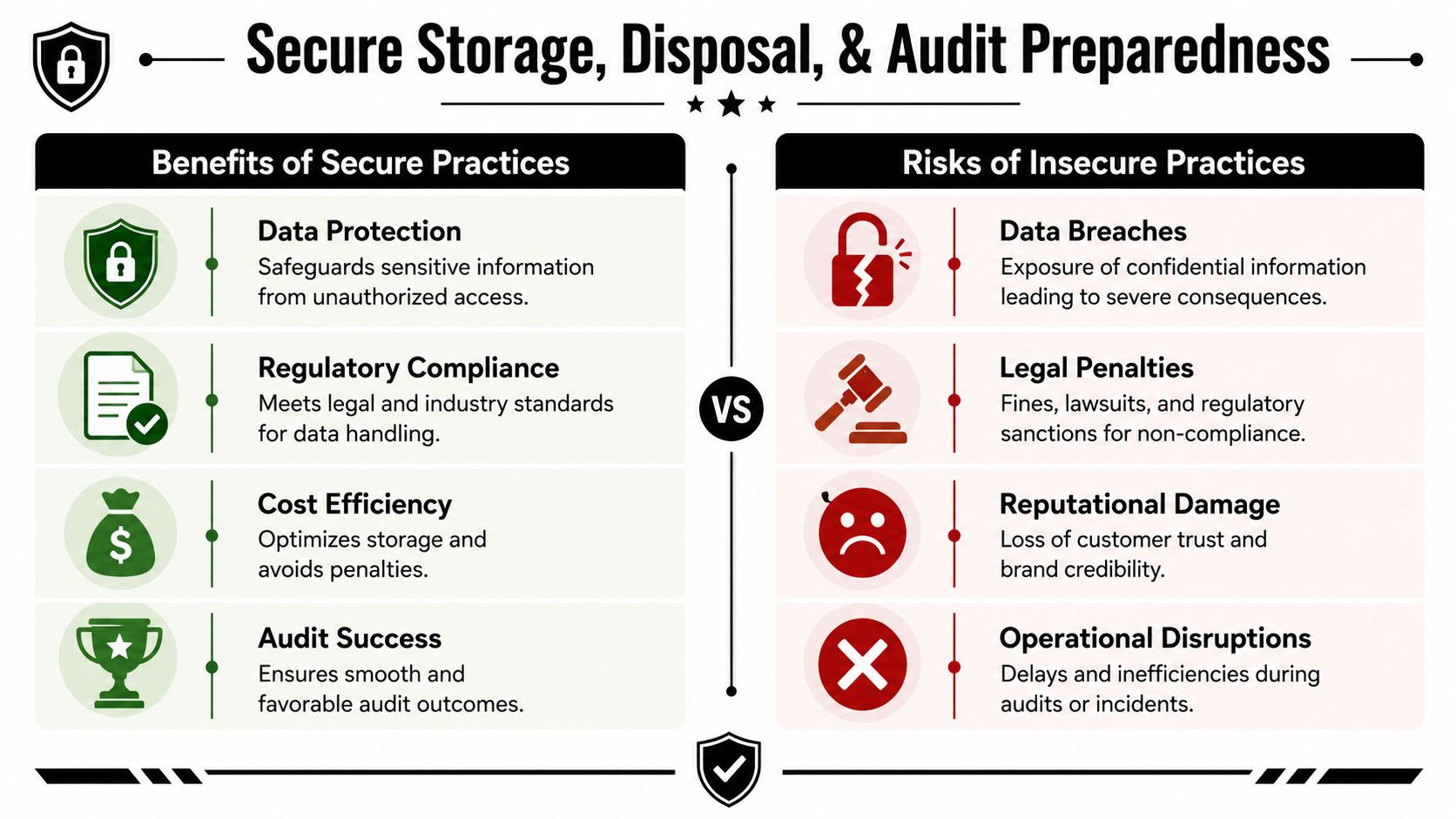
This comparison is useful when you're deciding how much rigor to build into your storage and destruction process:
Hardware disposal needs the same discipline. If you're dealing with retired devices, old drives, or office cleanouts, this guide on solving data compliance challenges gives useful operational context for handling hardware disposal without creating a new compliance problem.
Destroy records in a way you can prove
Deletion needs documentation. If you cannot show what was destroyed, when it was destroyed, and why it was eligible, you do not have a defensible disposal process.
Use a Records Destruction Log. Keep it simple and consistent. For each disposal event, record:
- What was destroyed: Record category and file reference
- When it happened: Destruction date
- How it happened: Shredded, securely deleted, or destroyed by a vendor
- Who approved it: Named employee or assigned role
- Why it qualified: Retention period expired and no legal, tax, insurance, or audit hold applied
Paper should go through secure shredding. Electronic records should be deleted using approved methods built into your systems or performed by a qualified vendor. Casual deletion creates risk, especially when the missing records support a tax position on payroll, property basis, contractor payments, or digital asset activity.
Prepare for audits before anyone asks
Audit readiness starts long before an examiner asks for documents. It shows up in how fast you can pull a signed lease, a 1099 support file, a purchase invoice for equipment, or a wallet transaction history that ties to a reported gain.
Build that test into your process. Periodically confirm where tax year files are stored, who can export bank and payroll reports, whether rental property basis records are complete, and whether destruction stops immediately when a notice, dispute, or amended filing appears. Use this audit readiness checklist for tax records and supporting documentation as a working control, not a file you save and ignore.
Good records do not stop an audit. They do shorten it, lower the cost, and give you a much stronger position when the IRS asks questions.
Conclusion Your Living Policy and Path Forward
A strong document retention policy is not a filing cabinet rule. It's a business control. It protects tax positions, preserves legal defenses, supports audits, and keeps your team from making inconsistent decisions about what to save or delete.
The key is to treat the policy as a living system. Businesses change software. Owners buy rental properties. Investors add crypto activity. Payroll providers change. Policies get revised. If your retention rules stay frozen while your records move across new platforms and new risks, the policy stops doing its job.
The smartest approach is simple. Start with tax-critical records, build a usable schedule, lock down storage, document destruction, and preserve exceptions when disputes or agency requests arise. Then review the policy regularly and keep the prior versions that prove what rule applied at the time.
If you need a practical example of end-of-life handling for physical media and devices, this overview of secure data destruction from Reworx Recycling is a helpful reference point for the disposal side of the lifecycle.
A lot of business owners wait until they get a notice to fix their records. That's late. The better move is to build the system before you need to defend it.
If you want help turning this into a workable policy for your business, rental portfolio, or crypto recordkeeping, talk with Allied Tax Advisors. They can help you identify which records matter for tax compliance, organize a retention schedule that fits your real operations, and tighten your audit readiness before a notice or dispute lands on your desk.