
You open your bank statement to check one charge, then spot a trail of small monthly payments. Adobe. QuickBooks. An industry newsletter. A chamber membership. A virtual community you joined for networking. None of them looked expensive on their own. Together, they can subtly become a real line item.
That matters for two reasons. First, recurring charges affect cash flow every month. Second, some of those costs may be deductible, while others clearly aren't. The tricky part is that dues and subscriptions sit in one of the more confusing corners of business tax rules. A professional association fee may be deductible. A golf club membership used to meet clients usually isn't. A software plan used for both work and personal projects falls into a gray area that needs careful handling.
That confusion is common. A 2025 C+R Research study on subscription spending found that consumers estimated their monthly subscription spend at $86, while the actual average came to $133, a $564 annual gap. If you're trying to clean up recurring charges before tax season, it helps to first reclaim your budget by reviewing what you're still paying for and whether each item really serves your business.
Table of Contents
- The Growing Cost of Staying Connected
- What the IRS Considers Dues and Subscriptions
- Deductible vs Nondeductible A Clear Breakdown
- Handling Hybrid Use and Digital Subscriptions
- How to Report and Document Your Expenses
- Common Mistakes and When to Get Professional Help
The Growing Cost of Staying Connected
Owning a business today means paying for access. Access to software. Access to education. Access to industry updates. Access to communities where you meet peers, vendors, and sometimes clients. Years ago, this category may have meant one trade magazine and a professional association. Today it often includes SaaS tools, digital libraries, premium research portals, and recurring memberships that renew before you remember signing up.
That pileup is easy to miss because each charge feels modest. One monthly fee lands on a business card. Another drafts through PayPal. A third renews annually and slips in between insurance payments and software invoices. By the end of the year, many owners realize they've been paying for more than they thought, including services they barely use.
Why these charges deserve a closer look
Some dues and subscriptions support revenue directly. A bookkeeper might rely on QuickBooks Online. A designer may need Adobe Creative Cloud. A contractor may belong to a trade association that provides licensing updates and technical guidance. These aren't luxury purchases. They're often part of staying competent and competitive.
Other recurring charges are fuzzier. Maybe you joined a private online group for “networking,” but most of the value is social chatter. Maybe you subscribed to a news service that helps a little with work and a lot with your personal interests. Those are the items that create tax questions.
Practical rule: If you can't explain how a charge connects to your work in one clear sentence, pause before deducting it.
Why small recurring fees become a tax issue
The tax side gets overlooked because people focus on whether the charge is useful, not whether it's deductible. Those aren't the same thing. Plenty of business owners keep paying for tools and memberships that help them indirectly, yet still fail the IRS standard for a deduction.
A clean review helps in three ways:
- You spot waste: Cancel the subscriptions that no longer serve your business.
- You classify correctly: Separate professional expenses from social or personal ones.
- You prepare for filing: Build a record now instead of scrambling during tax season.
This category also touches your bottom line more than many people expect. When recurring charges spread across multiple cards and apps, they can distort your picture of profit. That's one reason regular reviews matter, especially if you're self-employed or running a small company without a full accounting department.
What the IRS Considers Dues and Subscriptions
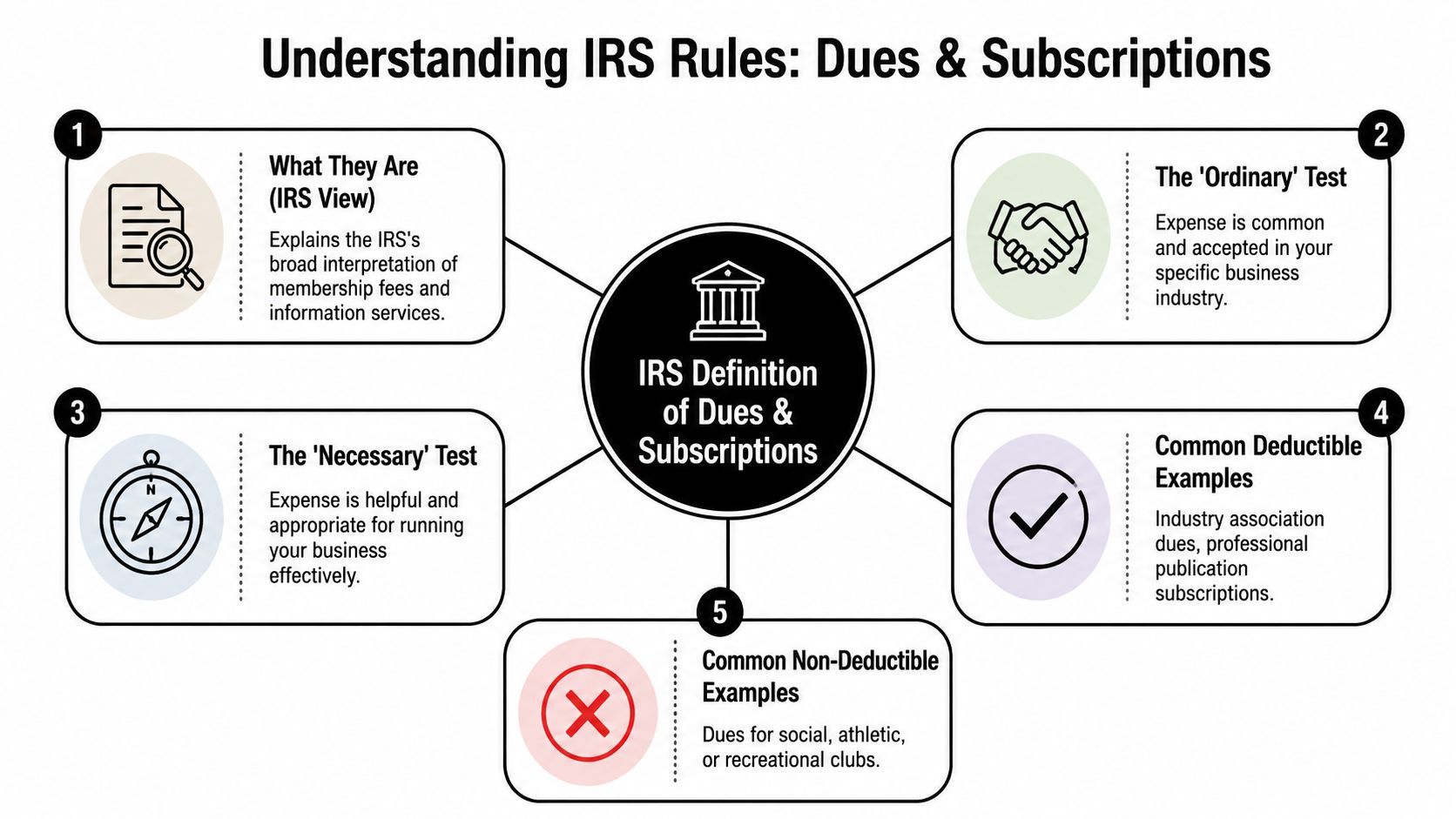
The IRS doesn't give every membership or subscription a free pass. The core rule comes from Section 162(a) of the Internal Revenue Code. A due or subscription is deductible only if it is ordinary and necessary and directly related to your trade or business.
A simple way to think about ordinary and necessary
Think of your business like a toolbox.
An expense is ordinary if it's common and accepted in your line of work. A CPA paying for a state society membership fits that idea. A real estate agent subscribing to MLS access or market data can also fit. The expense doesn't have to be required by law, but it should look normal for someone doing that kind of work.
An expense is necessary if it is helpful and appropriate for running the business. It doesn't have to be indispensable. It does need a real business purpose.
Here's where people get tripped up. “I got some business value from it” isn't always enough. The IRS looks for a direct connection between the expense and the business activity that produces income. That standard matters most when a purchase has mixed motives.
If the main benefit looks social, recreational, or personal, the deduction gets much harder to support.
What counts as dues or a subscription
This category is broader than many people think. It can include:
- Professional memberships: Trade groups, business leagues, professional societies, and unions related to your work
- Information services: Industry journals, paid newsletters, research databases, and technical publications
- Operational software: Recurring software fees for tools you use to run the business
- Digital access plans: Platforms that deliver education, compliance updates, or specialized business content
The hard part is not the label. It's the purpose.
A monthly software charge can belong in dues and subscriptions if it's a recurring fee essential to operations. A membership can look professional on paper but still cause problems if the actual benefit is entertainment or social access. That's one reason nonprofit leaders and clergy often need specialized guidance on organization-specific rules. If that's your world, a focused church law and tax guide can help you separate ministry administration issues from the general business expense rules.
Deductible vs Nondeductible A Clear Breakdown
Most business owners don't struggle with the phrase “ordinary and necessary.” They struggle with real-life examples. So let's make this practical.
For sole proprietors, the deductible portion of dues and subscriptions is reported on Schedule C Part II Line 27a as “Other expenses.” That makes classification important. If you lump everything into a generic bucket, you raise the odds of mixing valid deductions with items the IRS clearly treats as nondeductible.
Expenses that usually qualify
These are the items that generally fit well when they directly relate to your business.
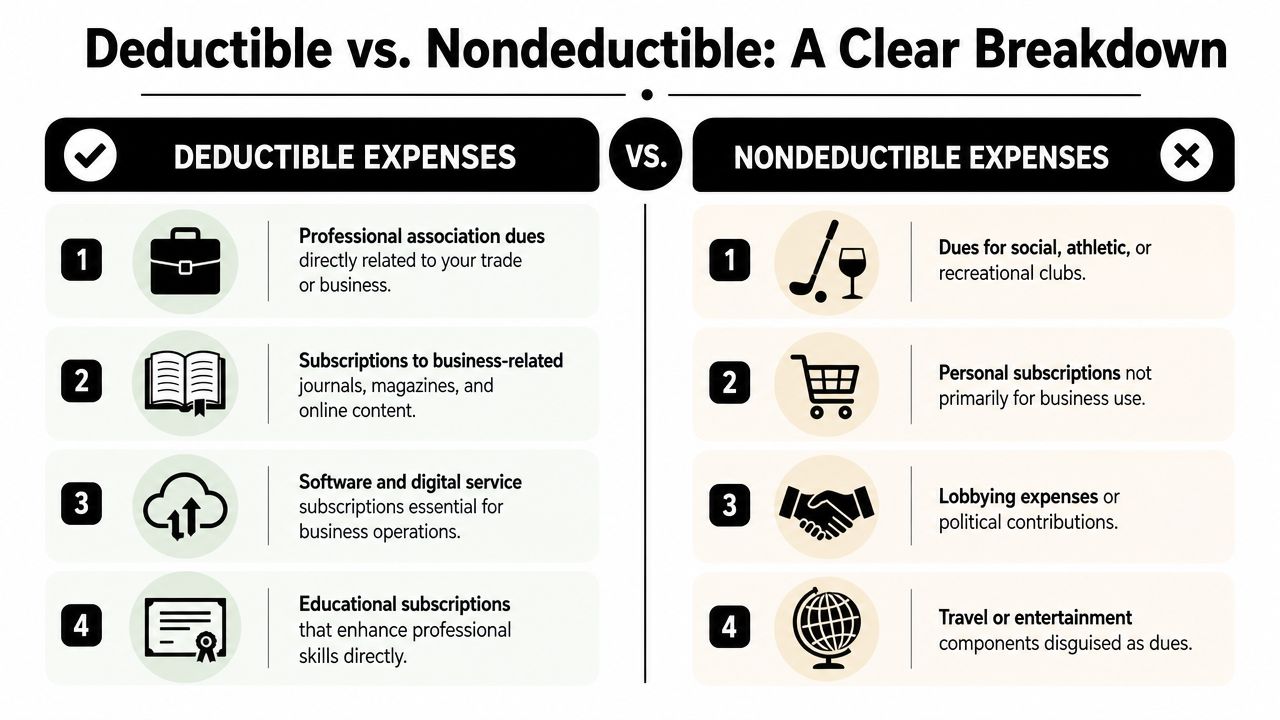
Professional association dues
Membership in a bar association, dental society, local builders exchange, or industry trade group can qualify if the group relates directly to your work.Trade journals and technical publications
A paid newsletter covering tax law updates for a CPA, or a construction code publication for a contractor, usually makes sense as a business subscription.Business software with a clear work purpose
Recurring fees for accounting software, design tools, appointment scheduling systems, payroll software, and CRM platforms often qualify when they are used for business operations.Education platforms tied to your trade
A subscription that gives you technical training, CE content, or industry-specific research may qualify if it supports your active business.
Expenses that usually do not
These are the common trouble spots.
Social club memberships
Country clubs, golf clubs, athletic clubs, and similar organizations are a classic no-go, even when you discuss business there.Recreational memberships dressed up as networking
If the actual draw is social access, leisure, or status, the deduction is weak.Personal subscriptions
General news, streaming services, broad-interest magazines, and other personal-use subscriptions don't become deductible just because you sometimes read or watch them with work in mind.Political or lobbying related charges
If a fee is tied to political activity or lobbying, it needs separate attention and often isn't deductible in the way people assume.
A quick side by side check
| If the charge is for… | It usually leans… |
|---|---|
| A trade organization tied to your profession | Deductible |
| A technical journal you use in your work | Deductible |
| Recurring software that runs part of your business | Deductible |
| A country club where you meet prospects | Nondeductible |
| A social or recreational membership | Nondeductible |
| A mixed personal and business subscription | Needs allocation and documentation |
One classic comparison helps. Chamber of Commerce dues often fit better than golf club dues because a chamber's purpose is business and civic activity, while a golf club is a social or recreational facility. Using the second one for networking doesn't override the underlying character of the expense.
If you're reviewing this category as part of a broader tax cleanup, this roundup of common tax deductions business owners often overlook can help you see where dues and subscriptions fit in the bigger picture.
Handling Hybrid Use and Digital Subscriptions
The clean rules begin to blur. A lot of modern subscriptions don't fall neatly into “business” or “personal.” You may use Canva for client work and family projects. You might subscribe to a medical education platform for your practice but also watch general-interest webinars on it. The charge is real. The business benefit is real. But the use is mixed.

A second gray area is the rise of digital-only memberships. Many online communities market themselves as professional networks. Some deliver technical education and job leads. Others mostly offer chat rooms, social events, and lifestyle content with a business label on top.
Recent TIGTA reports on audit issues show that miscellaneous business expenses, including software and subscriptions, are a top category for disallowed deductions when taxpayers can't document business-exclusive use. That doesn't mean every hybrid-use expense is barred. It does mean sloppy claims are vulnerable.
How to allocate a hybrid use subscription
Start with a conservative mindset. If a subscription serves both business and personal use, claiming the full amount is usually the most aggressive position.
A safer approach is to allocate the cost based on documented business use. In plain language, that means deciding what share of the subscription supports your business and keeping notes that explain how you reached that percentage.
Here's a workable method:
Identify the business function
Write down what business activity the subscription supports. Example: “Adobe Photoshop used to create client marketing materials.”Describe the personal use
Example: “Also used occasionally for family photo edits.”Choose a reasonable allocation method
You might use project hours, number of business files, user profiles, or another consistent measure that reflects actual use.Save support as you go
Keep invoices, screenshots, project logs, or calendar notes that show the subscription was used in the business.
A deduction is easier to defend when your notes were created during the year, not rebuilt from memory after an IRS notice arrives.
If separating business and personal activity has become messy across several cards or apps, this guide on how to separate business and personal expenses the right way can help you build a cleaner process.
Digital memberships need a business purpose
Digital-only dues deserve extra care because the name of the platform can be misleading. A “pro” tier, “community” label, or “member” badge doesn't automatically make the cost deductible.
Use this checklist before claiming the expense:
Look at the primary benefit
Does the membership provide technical content, compliance resources, research access, or professional tools?Read the invoice and plan description
If the fee is mainly for networking lounges, social access, entertainment content, or lifestyle perks, that weakens the deduction.Document what you actually used
Save proof of business webinars attended, research accessed, templates downloaded, or training completed.Separate bundled charges when possible
If a platform includes both business education and social perks, see whether the provider breaks those costs out.
A digital chamber membership that gives you legislative updates, member directory access, and business education may look very different from a paid online club built around casual networking and entertainment-style events. The IRS cares less about the branding and more about the business connection.
How to Report and Document Your Expenses
Good deductions fail all the time because the reporting and records are weak. The IRS doesn't just care what you paid for. It cares whether you can show why the expense belongs to the business.
According to IRS Publication 463, general membership dues in clubs organized for business, pleasure, recreation, or social purposes are explicitly nondeductible. That's why a dedicated account for qualifying dues and subscriptions matters. It helps you keep valid business costs separate from social memberships that should never land in the deduction bucket.
Where to report dues and subscriptions
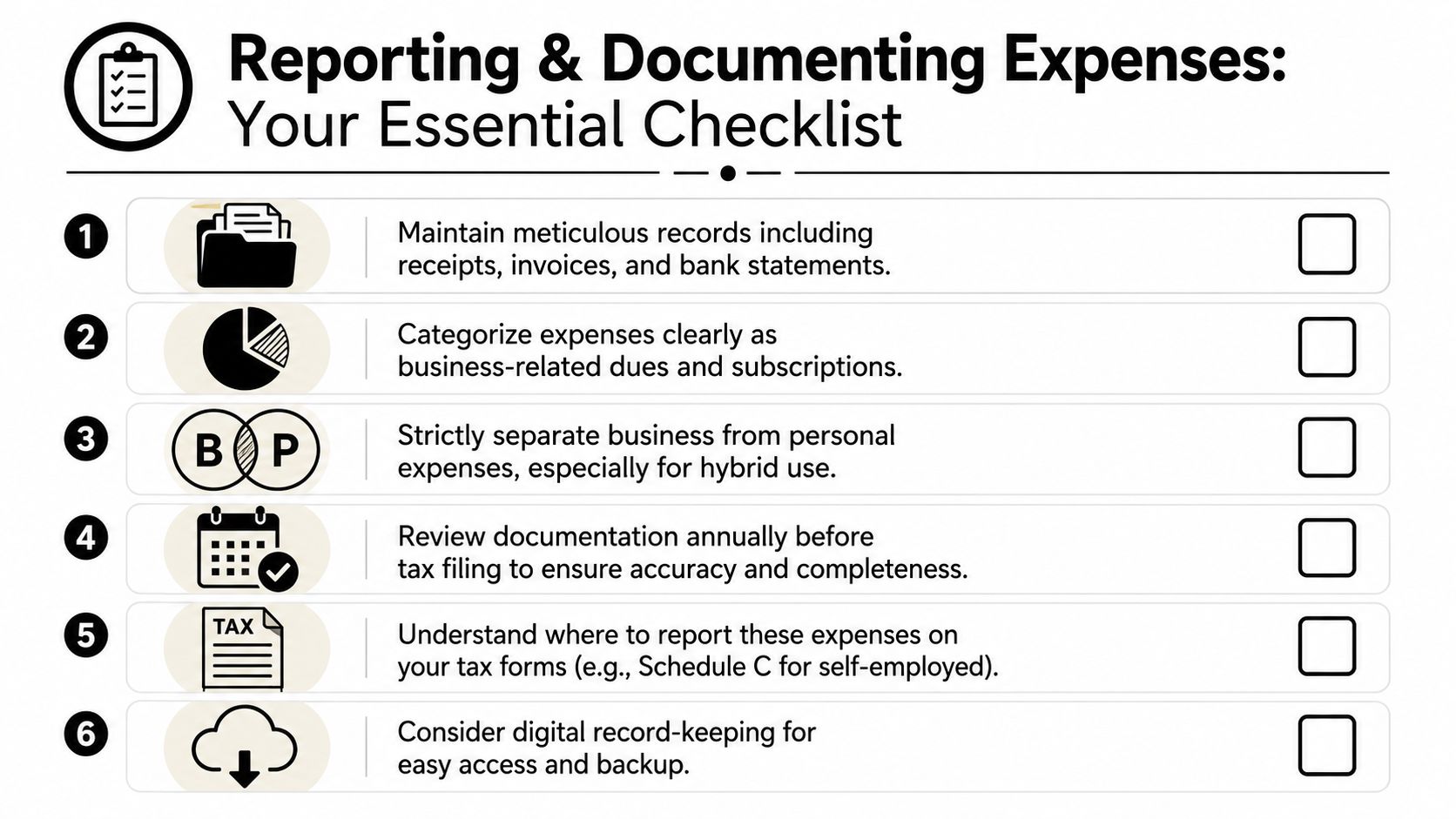
For sole proprietors, the deductible portion goes on Schedule C, Part II, Line 27a as “Other expenses.” Many bookkeeping systems also use a dedicated “Dues and Subscriptions” expense account internally, which makes year-end reporting cleaner.
For other entity types, reporting may appear in a different expense section on the return or in the business books, but the same logic applies. The payment still needs a clear business purpose and proper support.
A clean chart of accounts helps a lot. Instead of dumping every recurring fee into “Miscellaneous Expense,” break out categories such as:
- Professional dues
- Industry publications
- Software subscriptions
- Nondeductible club dues
- Mixed-use subscriptions pending allocation
Records that make your deduction easier to defend
You don't need a complicated system. You do need a consistent one.
Keep these items together for each charge:
- Invoice or receipt showing the vendor, amount, and date
- Bank or card statement proving payment
- Short note on business purpose such as “state licensing updates” or “client scheduling software”
- Usage support for mixed items like project logs, user history, or screenshots
- Renewal review notes showing whether the charge is still active and still business-related
"Track the purpose when you pay it, not when you file."
Digital storage usually works better than paper piles. If you've outgrown spreadsheets or receipts stuffed into folders, articles about ditching spreadsheets for real estate accounting offer useful ideas on creating a cleaner document flow, even if your business isn't in real estate.
If your current system makes it hard to see recurring charges by category, a practical expense workflow starts with a better tracking habit. This guide on how to track business expenses is a good place to tighten that process.
Common Mistakes and When to Get Professional Help
The biggest mistakes in dues and subscriptions aren't dramatic. They're ordinary habits repeated all year.
One common error is claiming 100 percent of a mixed-use subscription because the business use feels substantial. Another is treating a social or recreational membership as deductible because clients were present. A third is keeping only bank statements and assuming the charge description speaks for itself. Usually it doesn't.
Mistakes that cause trouble
Deducting the label instead of the purpose
A platform can call itself “professional” and still fail if the actual benefit is social or entertainment-based.Skipping allocation for hybrid use
If personal use exists, ignoring it can put the whole deduction at risk.Using one catch-all expense account
When every recurring payment goes into miscellaneous expenses, bad items hide next to good ones.Keeping weak records
A charge without a receipt, business explanation, or usage support is much harder to defend.
Signs it's time to call a tax professional
Some situations deserve a second set of eyes.
You should get professional help if you received an IRS notice, if your business has several mixed-use software subscriptions, if your memberships involve unusual digital platforms, or if you think past returns may have claimed nondeductible dues. It's also smart to ask for help when the business purpose is real but difficult to prove from ordinary records.
A tax advisor can help you classify the expense, decide whether allocation is reasonable, and clean up your bookkeeping so the same issue doesn't come back next year. That's especially valuable when recurring charges have piled up across multiple payment methods and no one has reviewed them carefully in a while.
If you want help sorting out dues and subscriptions, cleaning up your expense categories, or responding to questions from the IRS, Allied Tax Advisors can help. Their team works with individuals, business owners, and self-employed professionals who need practical tax guidance, accurate filings, and records that stand up under scrutiny.