
A U.S. person may have to file FinCEN Form 114 when the combined maximum value of qualifying foreign financial accounts exceeds $10,000 at any time during the calendar year, even if no individual account exceeds that amount. A temporary spike or several modest accounts can therefore create an FBAR filing obligation.
You may be dealing with this right now because you moved money through an overseas bank, kept a small account open after returning to the United States, helped a parent manage an account abroad, or received signature authority through your job. Many taxpayers check only the year-end balance and assume that an account they closed, barely used, or didn't own can't matter. FBAR reporting requirements don't work that way.
The practical questions are more precise: Are you a U.S. person for FBAR purposes? Did you have a financial interest or signature authority? Which foreign financial accounts belong in the review? What was each account's highest value during the year? Did the combined maximum exceed the threshold? Was the report filed separately through FinCEN by the applicable deadline?
Table of Contents
- Why FBAR Requirements Matter
- Understanding the Core Concepts
- Who Must File and What Counts
- Applying the Threshold and FATCA Rules
- Filing Through BSA E-Filing
- Penalties and Common Filing Mistakes
- Amendments and Late-Filing Relief
- Practical Examples and Final Checklist
Why FBAR Requirements Matter
A taxpayer may hold a checking account in one country, a brokerage account in another, and an inherited savings account elsewhere. Each balance may look minor on its own. During the year, funds move between the accounts, a business payment arrives, or one account is briefly funded for a property purchase. By December, the closing balances look modest, so the taxpayer assumes no report is needed.
That conclusion may overlook the highest value reached during the year. FBAR review focuses on the combined maximum values of qualifying foreign accounts, so a brief increase can affect the filing decision even when the year-end total is lower. The rule belongs to the U.S. anti-money-laundering disclosure framework enacted in 1970 under the Bank Secrecy Act.
The decision is broader than account ownership
Account ownership is only one starting point. Signature authority, trustee duties, family assistance, and workplace authorization may require further review even when the person is not the primary owner. Joint accounts and accounts held by an entity can create separate questions about the person's relationship to the funds and control over them.
The reporting question also differs from the tax question. FBAR is generally an informational disclosure, not a calculation of tax owed. Filing does not determine whether the account produced taxable interest, dividends, gains, or other income. Those amounts may raise separate federal or state tax issues, while the FBAR is submitted through FinCEN rather than attached to the ordinary income-tax return.
A practical review therefore follows the account, the person's connection to it, and the account's highest value during the year. This guide explains how to identify covered accounts, assess indirect interests and signature authority, calculate the combined maximum, distinguish FBAR from Form 8938, file through the BSA E-Filing System, and address an omitted account or missed deadline.
Understanding the Core Concepts
A foreign savings account receives a transfer in June, then drops to a lower balance by December. That change can affect the FBAR decision because the review considers each account's highest value during the calendar year, not only its year-end balance.
FBAR is the common name for the Report of Foreign Bank and Financial Accounts, filed electronically on FinCEN Form 114. It reports qualifying foreign financial accounts connected to a U.S. person when the relevant combined maximum value crosses the filing threshold.

The vocabulary that controls the decision
A U.S. person can include an individual or an entity covered by the applicable rules. A foreign financial account generally means a qualifying bank, securities, brokerage, or similar account maintained outside the United States. A financial interest usually involves ownership or a beneficial relationship. Signature authority addresses the ability to control or direct transactions, even when the person does not own the funds.
The core test applies when the aggregate value of qualifying accounts exceeds $10,000 at any time during the calendar year. The threshold concerns the combined maximum values, so reviewing only the largest account can produce the wrong result. An account held jointly, through a trust, or through another entity may require a closer look at both ownership and control.
| Term | Practical Meaning |
|---|---|
| FBAR | The informational report for qualifying foreign financial accounts |
| FinCEN Form 114 | The electronic form used to submit the FBAR |
| U.S. person | A person or entity subject to the applicable U.S. reporting rules |
| Financial interest | An ownership or beneficial connection to an account |
| Signature authority | Power to direct or authorize account transactions |
| Maximum account value | The highest value reached during the calendar year |
| Aggregate value | The combined maximum values used in the FBAR test |
The filing threshold answers whether an FBAR may be required. It does not determine how much account information must be reported. Once the filing obligation exists, each qualifying account and the person's relationship to it must be described accurately, including relevant ownership or authority details.
FBAR also remains separate from income-tax reporting. A foreign account may require disclosure even if it produced no taxable income. Foreign interest, dividends, gains, or other income may require attention on a tax return even when the account does not create an FBAR obligation. Review Schedule B reporting for foreign financial accounts separately, because one filing does not replace the other.
Who Must File and What Counts
The first review should identify people, entities, accounts, and access rights. Don't begin with the threshold. Begin with the account universe.
An individual may have a filing obligation through direct ownership, joint ownership, a beneficial interest, or signature authority. A business or other entity may also need to assess its foreign accounts and relationships. Trustees, beneficiaries, employees, family members, and people assisting with overseas banking can fall into fact-specific categories that require more than a simple ownership search.
The IRS recognizes that filing may arise from a financial interest, signature authority, or other authority when the aggregate account values exceed the threshold. It also describes exceptions for some bank employees and certain retirement or trust structures in its FBAR guidance.

Build an account inventory before calculating
Use statements, brokerage records, trust documents, payroll materials, and banking authorizations to identify:
- Bank accounts: Include foreign checking, savings, deposit, and similar accounts that may fall within the reporting rules.
- Investment accounts: Review foreign brokerage, securities, and other financial accounts, not just traditional bank accounts.
- Joint accounts: Record every owner and examine how each person's interest is treated.
- Access rights: Ask whether you could sign, transfer funds, approve payments, or otherwise direct activity.
- Entity connections: Check whether a company, partnership, trust, or other arrangement creates a direct or indirect reporting relationship.
- Account identifiers: Preserve the institution name, address, account number, ownership description, and annual maximum value.
Indirect interests require particular care. An account held by an entity may not be treated identically to an account held personally, and a trust arrangement may involve separate rules and exceptions. Don't assume that every beneficiary, shareholder, trustee, or employee receives the same result.
Foreign-currency accounts create a second practical issue. You'll need a consistent process for converting values into U.S. dollars and documenting the source and date used. For readers managing foreign-currency banking, Zaro's 2026 SA banking guide can provide useful background on how those accounts operate, but it doesn't replace a taxpayer-specific FBAR analysis.
Practical rule: Treat account access as a compliance fact, not an administrative detail. “I didn't own it” doesn't answer whether you could control it.
Applying the Threshold and FATCA Rules
The threshold becomes easier to apply once each account has its own annual high point. Suppose one qualifying foreign account rises above $10,000 briefly, then falls below it. That account's peak can be relevant even if the balance is lower at year-end. The same principle applies when several accounts remain below the threshold individually but their combined maximum values cross it.
The test is measured during the calendar year. A short-lived transfer, seasonal business receipt, inheritance deposit, or year-end movement can change the result. Keep the statements and calculation supporting each account's highest value, rather than relying on memory or a December snapshot.
FinCEN describes the rule as a combined maximum-value test, meaning a one-day spike above $10,000 can create a filing obligation for the year. The FinCEN foreign-account reporting page provides the government's filing information.
FBAR and Form 8938 answer different questions
FATCA reporting through Form 8938 is related to foreign-asset disclosure, but it isn't the same filing. The forms can use different filer categories, account and asset definitions, ownership concepts, and thresholds. A person may need one form, both forms, or neither, depending on the complete facts.
| Issue | FBAR | Form 8938 |
|---|---|---|
| Form | FinCEN Form 114 | IRS Form 8938 |
| Agency | FinCEN | IRS |
| Core focus | Qualifying foreign financial accounts | Specified foreign financial assets under FATCA |
| Filing location | Separate electronic FinCEN submission | Filed with the federal income-tax return when required |
| Threshold design | Combined maximum account value during the calendar year | Category-specific rules that depend on the filer and circumstances |
| Relationship between forms | May apply independently | May apply independently or alongside FBAR |
Don't use an FBAR filing as proof that Form 8938 is complete. Conversely, reporting an asset on Form 8938 doesn't automatically eliminate a separate FBAR obligation. Compare the account list, ownership, authority, values, and filing status for each form.
Filing Through BSA E-Filing
Once the account review is complete, filing becomes an information-assembly exercise. FBARs are submitted electronically through FinCEN's BSA E-Filing System, separately from the federal income-tax return. The general due date is April 15 following the report year, with an automatic extension to October 15, as explained in FinCEN's filing instructions.
Assemble the workpapers first
Collect the information before opening the electronic form:
- Identify the filer: Confirm the U.S. person or entity status and the relationship to each account.
- List every account: Include the institution, location, account number, ownership type, and authority relationship.
- Determine maximum values: Record the highest value reached by each account during the calendar year.
- Document conversions: Apply a consistent currency-conversion method and retain the supporting records.
- Review overlaps: Compare the FBAR account list with Form 8938 and relevant income-tax disclosures.
- Validate the submission: Recheck account identifiers, filer details, values, and authorization before transmitting.
Individuals may use FinCEN's no-registration filing option. Third-party preparers, including CPAs, attorneys, and enrolled agents, must use a registered filer account. If someone else submits the report, confirm who is responsible for gathering source records and approving the final information.
Save the submission confirmation, the completed report, account statements, conversion support, and notes explaining unusual transactions. A clear file lets you reconstruct why the reported maximum values and account classifications were chosen.
People comparing FBAR with other federal information returns may also find this overview of Kalshi tax reporting forms useful for understanding why separate forms can serve different reporting purposes. It isn't a substitute for FinCEN instructions, but it can help frame the broader reporting environment.
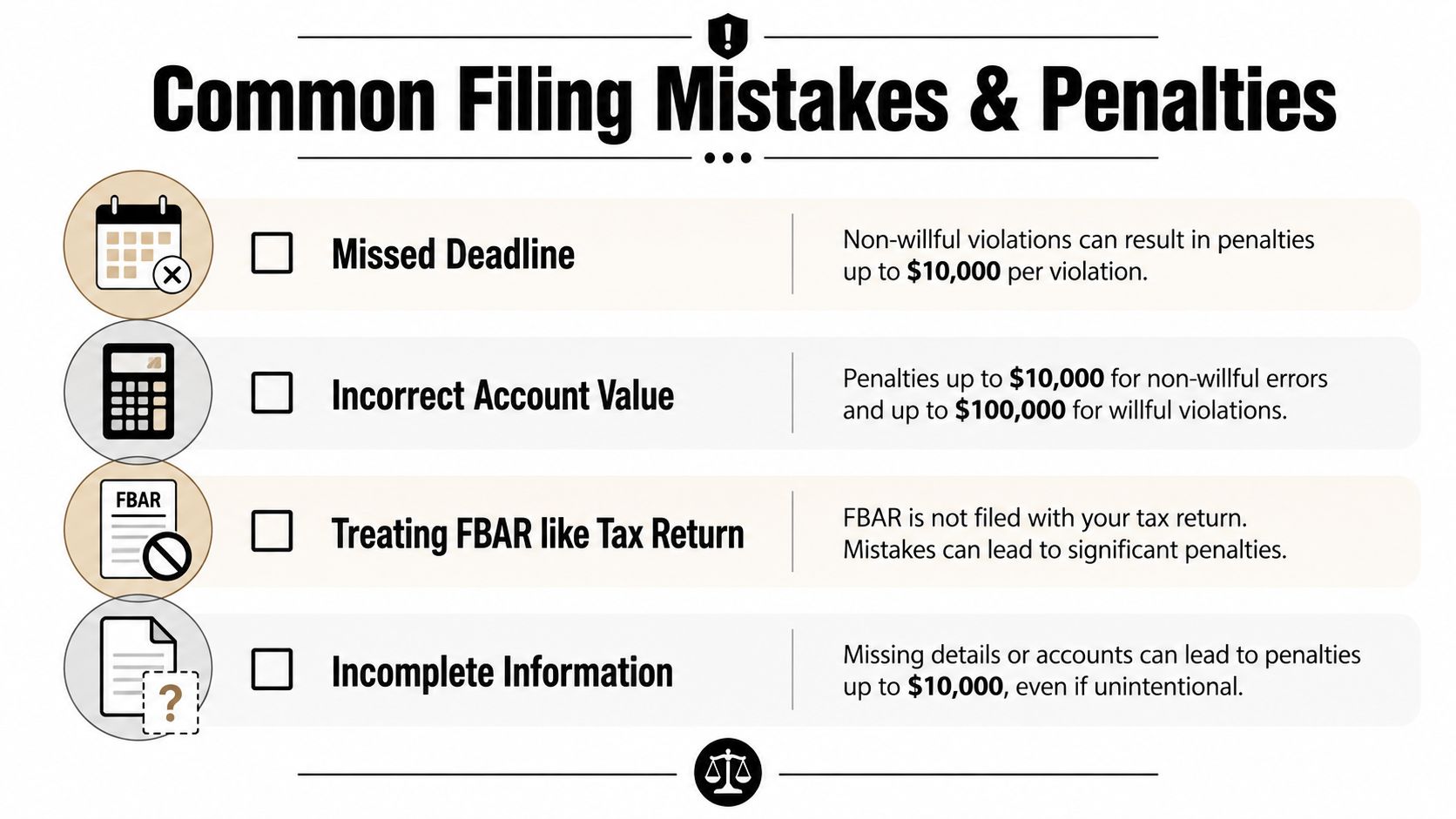
Penalties and Common Filing Mistakes
A taxpayer may discover an omitted foreign account after filing the income-tax return. The account was closed before year-end and held little money for much of the year, so the taxpayer assumes closure ended the reporting question. That assumption can be wrong. FBAR review concerns account activity during the reporting year, including periods before closure.
FBAR also works differently from an income-tax return. It identifies foreign accounts and reports their maximum values. Interest, dividends, gains, and other taxable items still belong in the appropriate tax filings. A missing FBAR and unreported foreign income create separate compliance issues, and state obligations may require their own review.
Why precision matters
FinCEN moved filers from value ranges to the exact maximum dollar amount held during the year in 2009. The change makes reliable statements, transaction records, and documented calculations more important.
Common mistakes include:
- Year-end bias: Reporting the closing balance instead of finding the account's highest value.
- Account splitting: Reviewing accounts one at a time while overlooking the combined threshold.
- Ownership tunnel vision: Missing joint, indirect, inherited, trustee, or signature-authority interests.
- Wrong form assumption: Treating Form 8938 and FBAR as interchangeable, even though they serve different reporting systems.
- Incomplete identifiers: Omitting account numbers, institution details, or information about signing authority.
- Unreviewed conversions: Reporting a converted value without keeping the method and supporting records.
- Deadline confusion: Completing the income-tax return while overlooking the separate FinCEN filing.
The account's current balance does not determine whether an earlier omission matters. The review should consider ownership, control, maximum value, filing history, and whether another form reported related information. A penalty assessment depends on the facts and applicable rules, so prompt correction and qualified advice are safer than guessing.
Don't guess at relief. A missed filing needs a documented review, not a conclusion based only on the account's present balance.
If FinCEN or the IRS has already sent correspondence, preserve the notice and response deadlines. Taxpayers with an unresolved issue can review the IRS Taxpayer Advocate Service process while seeking professional guidance.
Amendments and Late-Filing Relief
A missed or inaccurate FBAR needs a fact-based review. Begin with records for each potentially affected calendar year, including statements, account-opening and closing documents, ownership records, authorization forms, and support for the highest account values.
Next, define the defect. An omitted account, an incorrect annual maximum, an incomplete filer category, a missed deadline, or disclosure on another form can lead to different correction steps. Reporting an account on Form 8938 does not automatically replace a separate FBAR filing.
A practical correction sequence
- Reconstruct the account universe: Review direct ownership, joint interests, indirect connections, and signature authority.
- Recalculate annual highs: Use the strongest available records and document reasonable assumptions when records are incomplete.
- Compare reporting systems: Check whether the same facts affect Form 8938 or the federal income-tax return.
- Explain the history: Keep the reason for the late or inaccurate filing, along with the actions taken to correct it.
- Choose the filing path: Confirm current FinCEN and IRS procedures before submitting a delinquent or amended report.
A filed FBAR should not be replaced automatically. First determine what changed and which correction process applies. The general FBAR deadline is April 15, with an automatic extension to October 15. The report is filed separately through FinCEN, not with the federal income-tax return.
The present balance of an account does not settle whether an earlier omission matters. The review should consider the relevant year, ownership or authority, maximum value, filing history, and related tax reporting.
There is no universal cure for every late filing. The appropriate response can depend on the taxpayer's circumstances, the error, the years involved, prior disclosures, and the completeness of related tax reporting. A tax professional can assess whether an amended filing, delinquent submission, reasonable-cause explanation, or another route fits the facts. Taxpayers considering a penalty argument may also review IRS reasonable-cause penalty abatement guidance for issues to discuss with their adviser.
Practical Examples and Final Checklist
A taxpayer has three foreign accounts. Each remains below the threshold at certain points, but the accounts' highest values combine above $10,000 during the calendar year. The taxpayer must evaluate the accounts together, preserve each annual maximum, and determine whether an FBAR is required. Looking at only the largest account would produce an incomplete answer.
An employee can authorize transfers from a foreign company account but has no ownership interest. That person shouldn't stop the review at “the company owns it.” Signature authority may create a filing question, although exceptions and the exact scope of authority require careful analysis. The employee should document what the authorization permits and whether it was active during the relevant year.
A third taxpayer reports foreign financial assets on Form 8938 with the federal income-tax return. That filing doesn't automatically resolve the FBAR analysis. The taxpayer must separately evaluate whether qualifying foreign accounts, combined maximum values, ownership, or authority create a FinCEN filing obligation.
Final review before submission
Use this checklist to close the gaps:
- U.S.-person status: Confirm whether the individual or entity falls within the applicable category.
- Complete account list: Include bank, brokerage, joint, inherited, trust-related, and entity-connected accounts for review.
- Relationships: Record financial interest, ownership, beneficial interest, signature authority, and other control rights.
- Annual maximums: Determine the highest value for each qualifying account during the calendar year.
- Currency support: Preserve the conversion method and records used for U.S.-dollar values.
- Account identifiers: Verify institution names, addresses, account numbers, and ownership details.
- Separate filing: Use FinCEN's BSA E-Filing System rather than treating FBAR as an attachment to the tax return.
- Deadline control: Calendar April 15 and the automatic extension to October 15.
- FATCA coordination: Compare the FBAR analysis with Form 8938 and related income reporting.
- Professional review: Seek individualized advice for trusts, entities, joint accounts, inherited assets, unusual authority, or prior noncompliance.
Document your assumptions, not just your final numbers. That record can make a future review far easier and can help a qualified tax professional identify whether additional filings or corrections are needed.
Allied Tax Advisors helps individuals and businesses review foreign-account disclosures, coordinate FBAR with income-tax and Form 8938 reporting, and address late or incomplete filings. Visit Allied Tax Advisors to request support with your cross-border compliance questions and next steps.