
The home office simplified method uses $5 per square foot for qualified business use of the home, capped at 300 square feet, so the maximum deduction is $1,500 per tax year. It also skips depreciation tracking, which makes it much easier to use than the regular method.
That's the short answer, but the core question many have is whether the simplified method is the best move for their office, their rent, and the amount of paperwork they're willing to keep. If you're staring at receipts, floor measurements, and a tax return that already feels crowded, you're exactly the kind of taxpayer this rule was meant to help.
Table of Contents
- The Home Office Deduction Problem Most Taxpayers Face
- Understanding the Home Office Simplified Method
- Calculating Your Home Office Deduction Step by Step
- Simplified Method vs Regular Method Which Saves More
- Required Forms and Recordkeeping Best Practices
- When to Use the Simplified Method and When to Call a Pro
The Home Office Deduction Problem Most Taxpayers Face
By the time many self-employed people reach the home office section of their return, the problem isn't understanding that the deduction exists. The problem is that the regular method asks them to become part-time bookkeepers for a room in their own house. Mortgage interest, rent, utilities, insurance, repairs, and depreciation all have to be sorted, measured, and allocated with care, and that's before anyone asks whether the space meets the IRS use tests.
A lot of taxpayers don't mind paying tax on business income. They mind losing hours of their life to paperwork that may or may not increase the deduction enough to justify the effort. That's where the home office simplified method earns its place. It was introduced by the IRS as an optional alternative to tracking actual home-office expenses, and the whole point was to reduce recordkeeping while still requiring a qualified business space.
The real frustration isn't the deduction itself, it's the administrative drag that comes with proving it.
A good example is the freelance designer who works from a spare bedroom and only wants to know whether the deduction is worth claiming at all. For that person, a clean calculation can be the difference between taking the deduction confidently and avoiding it out of stress. If you want a broader bookkeeping companion to this topic, the Snyp guide for freelancers is a useful place to compare home-office recordkeeping with the rest of your business systems.
The bigger point is simple. The IRS built a lower-paperwork option because home office deductions were already common enough to matter at scale, and the simplified method gives taxpayers a clearer starting point. You still have to qualify, but you don't have to turn every utility bill into a worksheet.
Understanding the Home Office Simplified Method
The home office simplified method is easier to calculate, but it isn't a free pass. The IRS still expects the space to meet the regular and exclusive-use rules for qualified business use of the home, which means the area has to be used for business on a regular basis and not for personal life at the same time. A dining room table that doubles as the family dinner spot won't do the job.

The calculation itself is straightforward. The IRS uses a flat $5 per square foot rate for qualified business use, up to 300 square feet. That means the maximum deduction under the simplified option is $1,500 per tax year, and it also avoids depreciation tracking and later depreciation recapture on the sale of the home.
The structure in plain English
Think of the method as a three-part filter:
- Qualified space, the area has to be used for business under the IRS rules.
- Square footage cap, the method only counts up to 300 square feet.
- Flat rate, the IRS multiplies the approved space by $5.
Practical rule: if you can't comfortably defend that the space is dedicated to business use, the simplified math won't save you.
The reason taxpayers like this method is that it removes the hardest part of the regular method, which is not the math, but the tracking. There's no need to allocate actual home expenses, and there's no depreciation schedule to carry forward. That makes it especially appealing to smaller offices and people who prefer certainty over optimization.
If you like clean mental models, this is the easiest one to remember. Measure the space, confirm it qualifies, apply the rate, and stop at the cap. Everything else is compliance detail, not calculation complexity.
Calculating Your Home Office Deduction Step by Step
A deduction only helps if you can compute it without second-guessing yourself. The simplified method gives you a short list of inputs, and that's the whole appeal. For a taxpayer with a dedicated workspace, the process is usually faster than gathering a year's worth of household receipts.
Measure first, then do the math
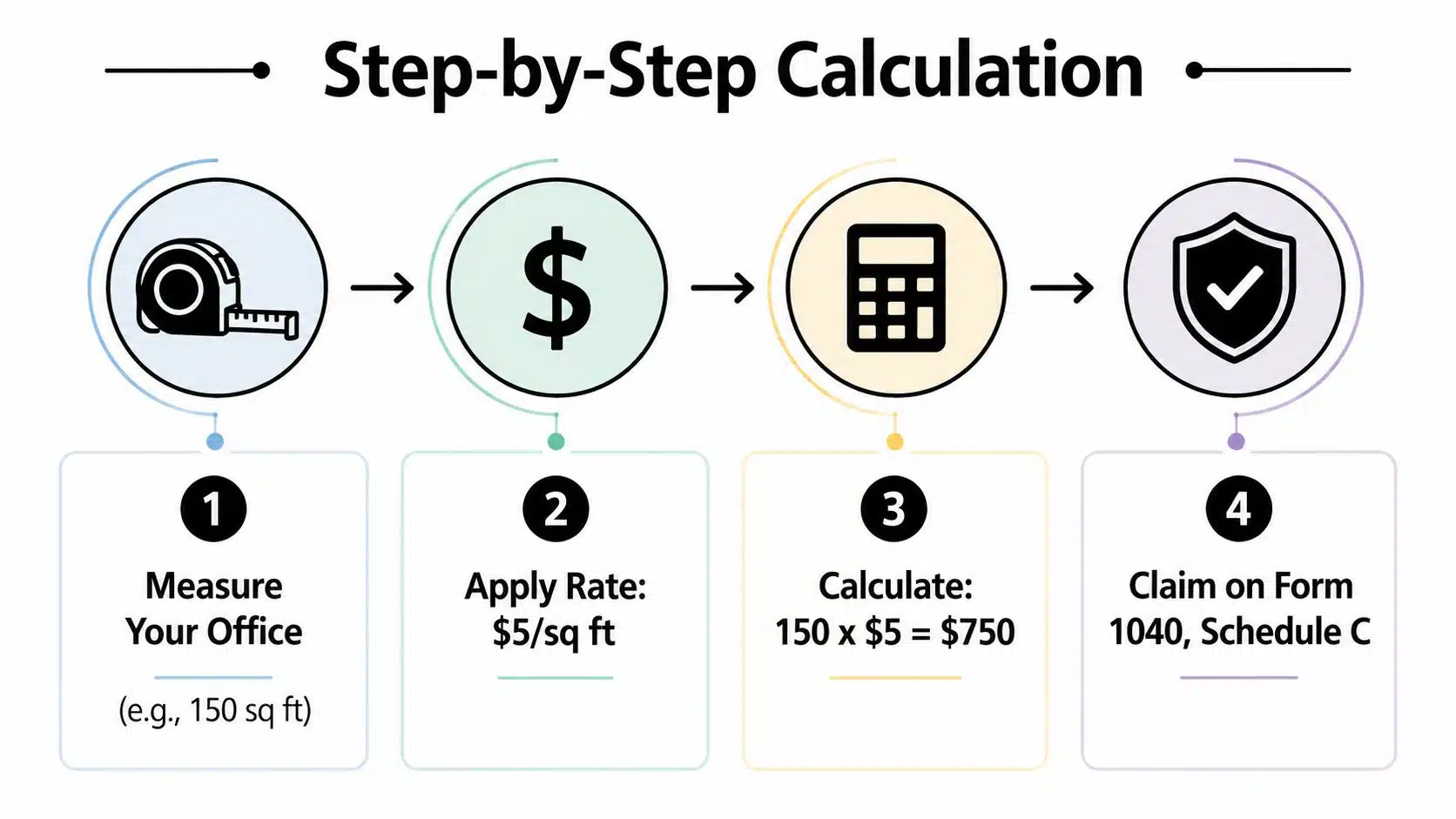
Start with the exact square footage of the business area. If the office measures 150 square feet, that number becomes your base. Multiply it by $5, and the deduction is $750 before any cap check even matters.
That's the same logic taxpayers use whether they work from a spare bedroom, a finished basement corner, or a separate enclosed room. The math stays simple because the IRS designed the method to be formula-driven rather than expense-driven.
If the office is used only part of the year, the IRS requires proration using the average monthly allowable square footage, so the deduction still follows a formal measurement rule.
Where it lands on the return
The deduction is claimed through the business return path, not as a household write-off floating by itself. If you want to see how that connects to a sole proprietor return, the SwiftNet Wifi mobile office guide is a practical companion for people who run part of their business from flexible workspaces and want to understand the broader setup.
A simple way to sanity-check your own numbers is to ask three questions:
- Is the space clearly business-only?
- Does the square footage stay within the allowed limit?
- Does the flat-rate deduction make sense compared with my actual home costs?
If the answer to the last question is no, that doesn't mean you did the simplified method wrong. It may just mean the regular method is more valuable for your situation. The key is to calculate before you choose, not after.
Simplified Method vs Regular Method Which Saves More
This is the question that matters. A lower-paperwork method sounds great until you realize it may cap your deduction far below what the regular method would allow. The IRS simplified option is $5 per square foot with no depreciation or depreciation recapture, while the regular method lets you allocate home-related expenses and itemized deductions on Schedule A, which can produce a much larger number in the right housing setup.

The real-world comparison
Take a 150-square-foot office in a $2,500-per-month rental. Under the simplified method, the deduction is $750. Independent tax analysis shows that the actual-expense method could yield $4,375 in that example, which is a very different outcome for the same space. The gap is large because the regular method is built to capture a share of real housing costs, while the simplified method is built for speed and ease.
That's why the method choice shouldn't be made by habit. It should be made by comparing your office size and your housing costs, then deciding which one serves you better. For some taxpayers, the simplified route is a relief. For others, it's an unnecessarily small number.
The scale of the home office deduction is part of why this decision matters. In tax year 2012, nearly 3.4 million taxpayers claimed more than $10 billion in deductions for business use of a home, according to IRS-reported figures as summarized by Tax Notes. That volume explains why a lower-paperwork option was useful, but it doesn't change the core choice each taxpayer faces.
How to think about the trade-off
The simplified method usually wins when the office is small and the tax prep file is already crowded. The regular method tends to win when rent or other home costs are substantial and the office takes up a meaningful part of the home. If you're comparing the two methods for other 1099 income decisions, the list of 1099 tax deductions can also help you see how this deduction fits into the rest of your Schedule C picture.
Bottom line: pick the method that fits your numbers, not the one that sounds easiest in the moment.
Required Forms and Recordkeeping Best Practices
Choosing the simplified method doesn't mean you can file casually. The IRS may have removed some of the math, but it didn't remove the need to prove that the space qualifies. That means the smartest filers keep a small file with measurements, proof of exclusive use, and enough documentation to explain the deduction if anyone asks later.
What to keep in your file
A practical home office file should include:
- Office measurements, the length and width of the workspace.
- Total home square footage, so the space can be validated.
- Proof of exclusive business use, such as dated photos or a clear workspace layout.
- Return copies, so the deduction can be traced on the filing you submitted.
The IRS simplified option is still $5 per square foot capped at 300 square feet with no depreciation or depreciation recapture, while the regular method allows full allocation of home-related expenses and itemized deductions on Schedule A. That difference is exactly why the simplified method is easier to support, but it's not why you can skip documentation.
Simplicity in calculation doesn't mean simplicity in compliance.
Common mistakes that cause trouble
One of the easiest mistakes is claiming a room that clearly serves mixed purposes. Another is changing square footage figures from one year to the next without a clean reason. A third is assuming that because the method is simplified, the IRS won't care what space you used.
If you track business costs across the year, your records also stay more coherent overall. The how to track business expenses guide is helpful for building a system that supports this deduction without creating extra chaos at tax time.
A good rule is to keep the file as if you'll need to explain the deduction later, because sometimes you will. If your records are clean, the simplified method stays simple. If they're messy, even the easy method starts to feel complicated.
When to Use the Simplified Method and When to Call a Pro
The simplified method makes the most sense when the office is modest, the housing costs are not especially high, and you value speed over squeezing out every possible dollar. It's also a good fit when you want a clean return and don't want to deal with depreciation records or long-term recapture concerns. In those situations, the deduction may be smaller, but the process is often worth it.
Good times to use it
Use the simplified method when:
- Your office is small, so the cap doesn't cut off much value.
- Your home expenses are light, so the regular method would take more work than it returns.
- You want predictable filing, especially if you prepare your own return.
- You're early in business, and paperwork discipline matters more than maximizing every line item.
When a professional review helps
Call a tax professional when the picture gets more layered. That includes larger offices, high housing costs, mixed business structures, rental-property overlap, or S corporation issues that may affect where the deduction belongs. California taxpayers also benefit from a close review because state conformity and IRS resolution questions can change how a return should be handled in practice.
If your return already involves entity-level filings or special reporting, the home office deduction is rarely the only moving piece. A service page like what is a Schedule C form can help you see how this deduction fits into a broader self-employment return, but the final call usually depends on the details of your numbers and entity structure.
The cleanest way to decide is to compare the simplified result against what your actual expenses would likely support, then ask whether the paperwork burden is worth the difference. If it isn't, the simplified method is probably enough. If it is, the regular method deserves a closer look.
If you want help deciding whether the home office simplified method is the right fit for your return, Allied Tax Advisors can review your numbers, compare both methods, and flag the filing issues that matter before you submit. Visit Allied Tax Advisors to get practical guidance on home office deductions, Schedule C reporting, and tax planning that fits your business.