
You're probably here because something has already gone sideways.
A notice showed up and it's written in IRS language, not plain English. Your refund hasn't landed. A payment posted wrong. Or you searched for the IRS tax help phone number and got buried in a mess of lookalike numbers, forum advice, and stories about hold times that eat half a day.
I've spent enough time dealing with IRS phone lines to tell you this plainly: success usually comes down to three things. Call the right number, call prepared, and know when the phone call is no longer the right tool. Most taxpayers lose time on the first two and money on the third.
Table of Contents
- The Labyrinth of IRS Communication
- The Official IRS Phone Number Directory
- Your Pre-Call Preparation Checklist
- Navigating the Call and Speaking with an Agent
- Smarter Alternatives to Calling the IRS
- When to Hang Up and Call a Tax Professional
The Labyrinth of IRS Communication
Taxpayers don't call the IRS because they're curious. They call because they're stuck.
A common pattern looks like this: someone gets a letter, tries to solve it through tax software, can't find a clear answer, searches for the IRS tax help phone number, and then discovers there isn't one simple universal line for every problem. There are different numbers for individuals, businesses, refunds, appointments, and language support. If you pick the wrong one, the call often turns into a transfer loop.
That's where frustration builds. You're already anxious about the tax issue itself, and now the contact process feels like another problem to solve.
Practical rule: The IRS phone system works better when you treat it like triage, not customer service. Your first job is routing. Your second is clarity.
I've seen taxpayers spend more energy trying to “reach a person” than preparing what they need to say once they get there. That's backwards. The agent can only help if you can identify the tax year, the notice, the return involved, and the exact action you want taken.
The good news is that this process gets easier when you stop thinking of it as one phone call and start thinking of it as a short strategy. The strategy is simple. Match the issue to the right line, prepare the file before dialing, keep your explanation tight, and know when the call has reached the point of diminishing returns.
The Official IRS Phone Number Directory
The fastest way to waste a morning is calling the wrong IRS line.
The IRS uses a tiered phone structure. That's not bureaucracy for its own sake. It's how the agency routes individual taxpayers, businesses, refund questions, appointment requests, and language help to different channels. The main individual line is 800-829-1040, and it's open Monday through Friday, 7 a.m. to 7 p.m. local time according to the IRS help page. That same IRS page also shows this phone channel has been around for a long time. An IRS Tax Tip from 2001 already referenced 1-800-829-1040.
Individuals
If you're an individual taxpayer dealing with a notice, balance question, identity verification issue, return processing concern, or a refund matter that needs a live person, start here.
| Taxpayer Type / Issue | Phone Number | Hours of Operation (Local Time) |
|---|---|---|
| Individual tax help | 800-829-1040 | Monday through Friday, 7 a.m. to 7 p.m. |
| Non-Spanish language support | 833-553-9895 | Check IRS routing when connected |
| Non-profit tax help | 877-829-5500 | Monday through Friday, 8 a.m. to 5 p.m. |
Two time-zone details matter more than people expect. The IRS says Hawaii and Alaska should follow Pacific time, and Puerto Rico lines run 8 a.m. to 8 p.m. local time on the IRS help page linked above.
Businesses
Business tax issues belong on the business line, not the individual line. If you're calling about payroll deposits, an EIN-related issue, business return questions, or a notice tied to a company account, use the business number.
| Taxpayer Type / Issue | Phone Number | Hours of Operation (Local Time) |
|---|---|---|
| Business tax help | 800-829-4933 | Monday through Friday, 7 a.m. to 7 p.m. |
Calling as a business owner on the individual line often leads to a transfer or a dead end. If the matter involves a separate business tax account, the agent on the wrong line may not be able to touch it.
Refunds appointments and language help
Some issues have dedicated channels, and using them saves time.
| Taxpayer Type / Issue | Phone Number | Hours of Operation (Local Time) |
|---|---|---|
| Automated refund hotline | 800-829-1954 | Automated service |
| Taxpayer Assistance Center appointments | 844-545-5640 | Call to schedule an appointment |
| Non-Spanish language help | 833-553-9895 | Check IRS routing when connected |
The automated refund hotline 800-829-1954 and the Taxpayer Assistance Center appointment line 844-545-5640 were highlighted in the Treasury's filing-season update on IRS customer service improvements in filing season 2024. That same Treasury update reported that IRS assistors handled 9 million calls and automated lines handled approximately 8.9 million calls during the 2024 filing season.
That volume explains a lot. If you're looking for the right IRS tax help phone number, think less about “the IRS number” and more about the correct lane.
Your Pre-Call Preparation Checklist
A bad IRS call usually starts the same way. The letter is open, the deadline feels close, and the person calling hopes the agent can sort out the facts in real time.
That approach burns time.
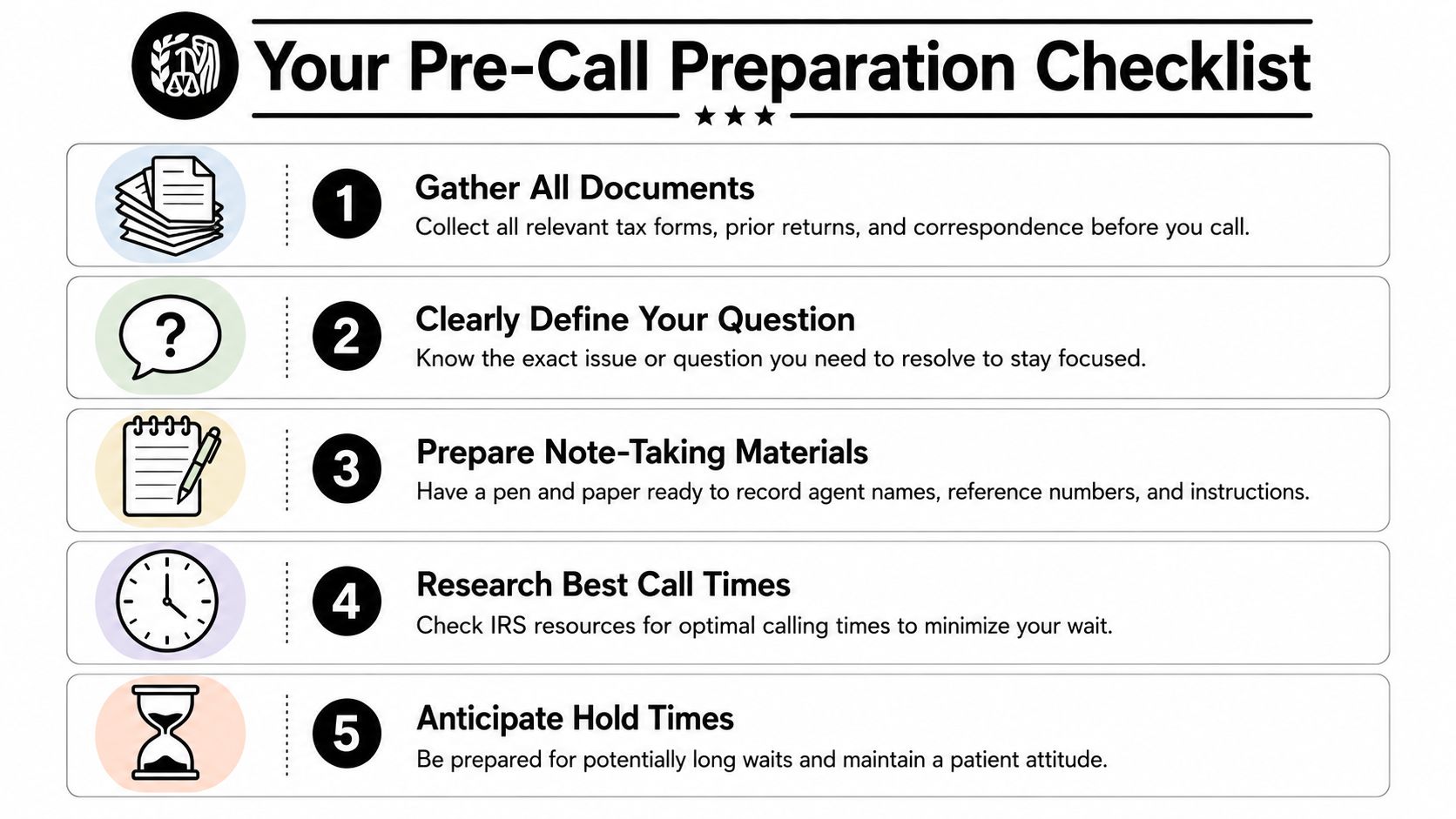
The callers who get the most done usually do two things before they dial. They gather the exact documents tied to the problem, and they decide what one answer or action they want from the call. If you skip that work, the call turns into a long verification exercise followed by a vague conversation that goes nowhere.
What to have in front of you
Set everything on the desk before you call. Do not assume you will remember dates, payment amounts, or notice codes once the hold music stops.
- Your identifying information. Have your Social Security Number or ITIN, date of birth, and filing status ready.
- The exact IRS notice. Keep the full notice in front of you, with the notice number visible.
- The tax return at issue. Pull the return for the year involved, plus any amended return if one was filed.
- Any payment proof. Keep bank confirmations, canceled check details, EFTPS records, or other payment references nearby if the problem involves a balance due or a payment that posted wrong.
- Your IRS account records, if you have them. Transcripts often answer part of the question before you ever reach an agent. If you need those first, this guide to getting your IRS transcript online can help you pull the right records before you spend an hour on hold.
- A copy of any prior correspondence. If you already mailed a response, faxed documents, or spoke with the IRS before, have those notes ready too.
One missing page can stall the whole call. An agent can verify the account. The agent cannot guess which notice you received or which payment you mean.
What to write down before you dial
This step saves more calls than people expect.
Write out three short points on paper:
- What happened
- What tax year is involved
- What you want the IRS to do or confirm
Here is the kind of wording that works:
“I received a balance due notice for 2023. I made the payment on April 12, but the notice suggests it did not post correctly. I need to confirm where the payment was applied and what I need to do next.”
That keeps the call tight. It also helps the agent decide faster whether the problem is a payment posting issue, a notice explanation, an identity verification matter, or something that belongs in another IRS channel.
Keep a pen and paper next to you. Write down the agent's name or ID number, the date and time, any requested forms, mailing or fax instructions, and any deadline you are given.
Timing matters
I have seen the same issue take 18 minutes on one day and 2 hours on another.
What usually improves your odds:
- Call as close to opening as you can
- Avoid Mondays if you have a choice
- Stay away from deadline weeks and heavy filing-season traffic
- Block enough uninterrupted time to finish the call
What usually makes things worse:
- Calling during a lunch break with a complicated issue
- Calling without the notice in hand
- Trying to solve three tax years in one call
- Assuming the first person who answers can fix every type of problem
That last point matters. Some calls are handled best by the department that issued the notice. Others turn into a transfer chain. If the issue involves collections, identity verification, an amended return, or a business account, the fastest strategy is often to narrow the question first and deal with one account problem at a time.
Know your stopping point
Preparation helps, but it does not solve every case.
If you cannot tell whether the notice is right, if the account involves multiple years, if payments were applied to the wrong period, or if penalties and collection notices are stacking up, the call may reach a point of diminishing returns. At that stage, more hold time does not mean more progress. It usually means you need someone who can review the transcript history, match it to the filed returns, and decide what response will fix the account instead of creating another round of notices.
Navigating the Call and Speaking with an Agent
Once the call starts, your job changes. Preparation gets you in position. Communication gets the result.

How the call usually unfolds
First comes the automated routing. Then identity verification. Then the narrow window where you either explain the issue clearly or lose control of the call.
If your issue is refund-related, be especially careful about whether you should stay in automation or ask for a representative. The federal contact guidance at USA.gov's IRS contact page says the fastest refund workflow is to check Where's My Refund first, then use 800-829-1954 for the automated refund hotline, or 800-829-1040 if a trace is needed. It also notes that if you filed married filing jointly, you cannot initiate a refund trace through automated systems and must speak with a representative or file Form 3911.
That's the kind of detail that saves an hour. If you know the automated path can't solve your issue, stop trying to force it.
A script that keeps the call on track
When a live agent picks up, don't open with your whole tax history. Use a compact version of this:
“I'm calling about a notice on my return. The tax year is [year]. I have the notice in front of me. I need help understanding [specific problem] and what I need to do next.”
Then answer only what's asked. If the issue is a delayed refund tied to direct deposit, say so directly. The IRS notes on the USA.gov page above that delays can come from incorrect bank routing or account numbers, using an account type the financial institution won't accept for direct deposit, and math or other return errors. Clear facts help the agent narrow the account history faster.
A few practical habits help:
- Be precise, not emotional. Frustration is normal, but clarity moves the call.
- Use the notice language. Read the notice number and wording if asked.
- Ask one issue at a time. If you stack three unrelated problems into one opening statement, resolution slows down.
- Stay politely persistent. If you don't understand an instruction, ask the agent to repeat it in plain language.
What to document before you hang up
Before the call ends, write down:
- The date and time of the call
- The name of the agent
- Any badge or identification number they provide
- What they said happened on the account
- What they told you to do next
- Any deadline, mailing instruction, or form number mentioned
If you can't summarize the outcome in two or three sentences after the call, the conversation was too vague. Call notes are your protection on the follow-up.
Smarter Alternatives to Calling the IRS
Some IRS problems belong on the phone. Many don't.
If you're only checking status, confirming a routine account detail, or trying to track a refund, the phone can be the slowest option. That's especially true when a self-service tool already handles the task cleanly.
When online tools are faster
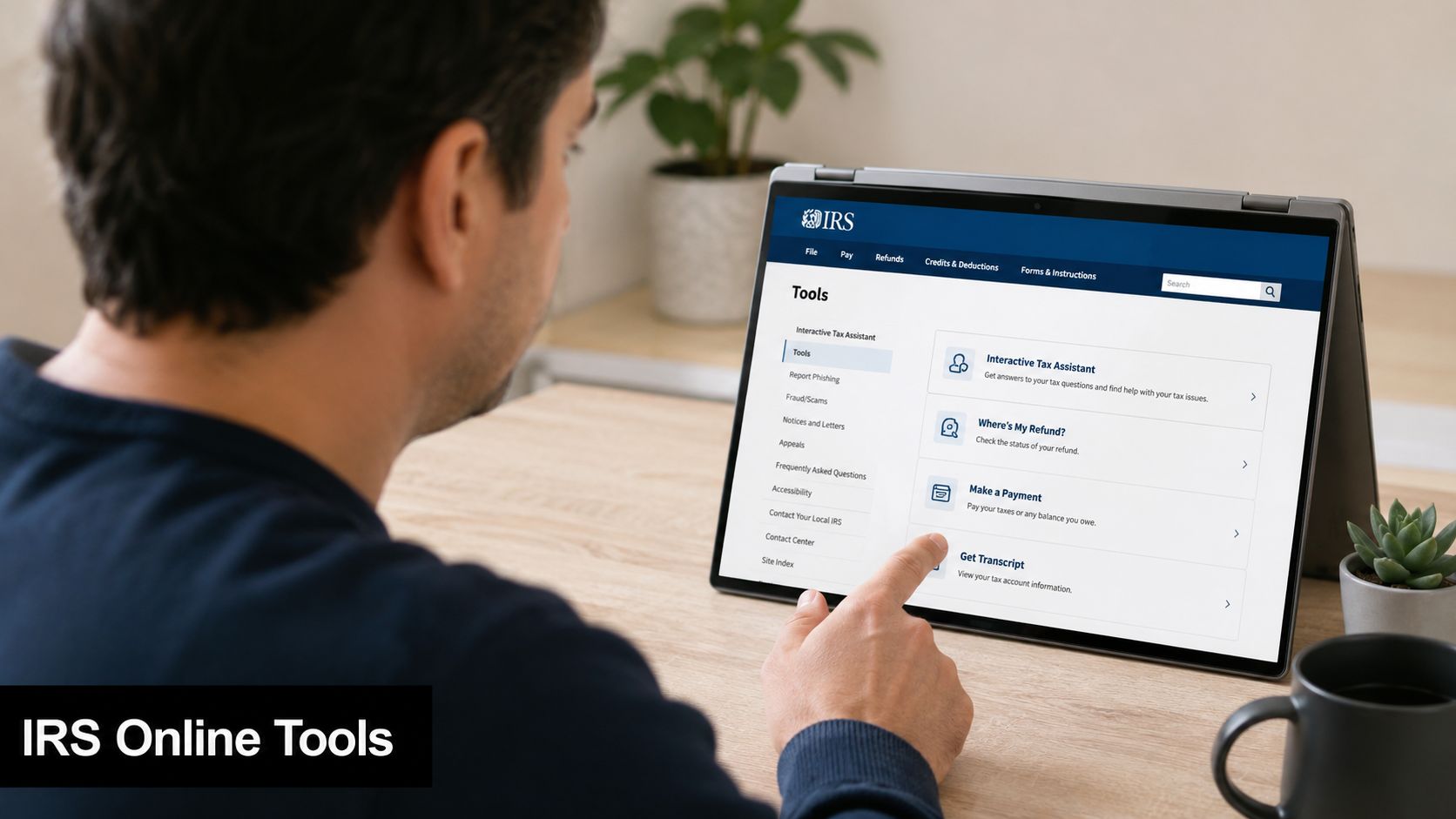
Where's My Refund should be your first stop for a refund question. If the issue is simple, the tool usually gets you where you need to go faster than a live queue.
An IRS Online Account is also worth using before you pick up the phone. It can help you review balances, payment history, and tax records without waiting on hold. For many notice questions, seeing the account history first makes the eventual phone call shorter and more focused.
A written response is often better than a phone call when the issue needs documentation. If the IRS has sent a notice and the answer requires explanation plus attachments, a letter may create a cleaner paper trail than a rushed conversation. If you need help framing that response, this guide on how to write a letter to the IRS is a practical starting point.
The best IRS contact method is the one that matches the task. Status checks belong online. Document-heavy disputes often belong in writing. Complex account problems may still require a call.
When in-person help makes more sense
Some taxpayers do better face to face, especially when identity, paperwork, or multiple unresolved notices are involved. A Taxpayer Assistance Center appointment can make sense when you need structured, in-person help and don't want to manage a long phone call.
The trade-off is speed versus certainty. Online tools are fastest for routine questions. Phone calls are better when you need account-specific answers in real time. In-person meetings take more planning, but they can reduce confusion when the file is messy.
If you're deciding between the three, use this simple filter:
| Method | Best for | Main drawback |
|---|---|---|
| Online tools | Status checks, account review, basic updates | Limited for complex disputes |
| Phone call | Live clarification, account-specific questions | Hold times and routing issues |
| In-person appointment | Paperwork-heavy or confusing situations | Requires scheduling and travel |
When to Hang Up and Call a Tax Professional
There's a point where another call to the IRS doesn't solve the problem. It just extends it.
If the issue is narrow, one tax year, one notice, one clean question, self-representation can work. If the issue starts branching into multiple notices, disputed balances, business payroll exposure, or missing returns, the risk changes. At that stage, the problem isn't just getting information. It's making the right move with that information.
Red flags that change the equation
These situations usually justify professional help:
- An audit notice arrived. You need a response strategy, not just a phone explanation.
- You received a proposed change notice such as a CP2000. Those cases can look simple and still have downstream effects.
- You owe back taxes and can't tell what the IRS expects next.
- Multiple years are unfiled. Phone agents can identify gaps, but they won't build the filing plan for you.
- The issue involves business taxes or payroll taxes. Mistakes here can snowball quickly.
- You own rentals or other more complicated assets. If that's your situation, a plain-English landlord's guide to rental income taxes is a useful refresher before you decide whether the issue is routine or something larger.
What professional representation actually does
A tax professional doesn't just “call for you.” They organize the facts, identify what matters, prepare the response, and deal with the IRS in a way that's tied to a strategy.
That may mean reconstructing missing filings, answering a notice with support, handling collections communication, or representing you directly before the IRS. If you're already at that stage, working with a professional tax accountant to resolve IRS issues is often more efficient than trying to manage repeated calls on your own. Allied Tax Advisors is one example of a firm that handles IRS and state resolution matters, including notices, audits, and debt-related cases.
The practical test is simple. If each call leaves you with more paper but less certainty, it's time to stop treating the phone line as the solution.
If your IRS issue has moved beyond a simple phone call, Allied Tax Advisors can step in to review the notice, explain your options, and handle IRS communication as part of a resolution plan. That's often the better move when the file is complex, the potential impact is substantial, or you're done spending hours trying to get a straight answer on your own.