
You're likely here because a transaction is sitting in front of you right now, and the tax answer isn't clean. Maybe you're restructuring an S corporation, unwinding a family ownership arrangement, moving appreciated property, or planning an estate or charitable transfer with unusual facts. The dollars at risk are real, but the bigger problem is uncertainty. If you guess wrong, you don't just file a bad return. You create exposure that can follow the transaction for years.
That's when clients start asking about a letter ruling IRS request. They want certainty before they act, not an argument after the return is filed. That instinct is right. The IRS ruling process exists for exactly that kind of high-stakes ambiguity.
Most articles stop at the textbook definition. That's not enough. The practical danger is this: taxpayers often see a favorable ruling issued to someone else and assume it gives them cover. It doesn't. That mistake leads people to move ahead with false confidence, and false confidence is expensive in tax planning.
Table of Contents
- Navigating Tax Uncertainty Before You File
- What Exactly Is an IRS Letter Ruling
- The Letter Ruling Submission and Review Process
- Understanding the Costs and Timelines
- Pros Cons and Critical Misconceptions
- When to Request a Letter Ruling vs Other Options
- How Allied Tax Advisors Can Secure Your Ruling
- Frequently Asked Questions About Letter Rulings
Navigating Tax Uncertainty Before You File
A business owner is preparing to close a deal. The documents are nearly final. The attorneys are aligned on the transaction. Then the tax question lands: how will the IRS treat this structure given the way ownership, basis, or entity classification evolved over time?
That's the moment when casual advice becomes dangerous.
For routine issues, your CPA can usually apply published law and move on. But some transactions don't fit neatly inside the examples everyone uses. A partnership interest may have changed hands informally inside a family. An S corporation may be trying to restructure around an unusual capital event. A trust distribution may interact with income tax rules in a way that isn't obvious. In those cases, filing first and hoping later is a poor strategy.
Why pre-filing certainty matters
A private letter ruling can turn uncertainty into an answer you can plan around. It gives you the chance to ask the IRS, in writing, how federal tax law applies to your specific facts before you finalize the transaction or file the return.
That matters because tax risk isn't just about the amount due. It affects timing, deal structure, reporting positions, disclosure choices, and whether you should proceed at all.
Practical rule: If the tax treatment controls whether the transaction makes sense, you shouldn't rely on assumptions.
Good compliance habits help, but compliance alone won't resolve a genuinely unclear legal issue. If you want a solid framework for keeping records, controls, and review procedures in order while you work through uncertain tax treatment, Everglow Prosperity's audit and compliance guide is a useful companion resource.
What sophisticated taxpayers do differently
Experienced taxpayers don't ask only, “Can we defend this later?” They ask, “Should we get clarity now?”
That's the right question. A letter ruling IRS request is not for ordinary filings. It's for unusual situations where uncertainty is material and the downside of being wrong is too large to ignore.
Here's the practical takeaway:
- If the issue is routine: use normal tax research and filing judgment.
- If the issue is unusual but manageable: consider a written tax opinion.
- If the issue is unusually important and unclear: a ruling may be the cleanest way to control the risk before it turns into a dispute.
What Exactly Is an IRS Letter Ruling
You are about to close a transaction, the tax treatment drives the economics, and someone on the team says they found a favorable PLR in an online database. That is exactly where taxpayers make expensive mistakes.
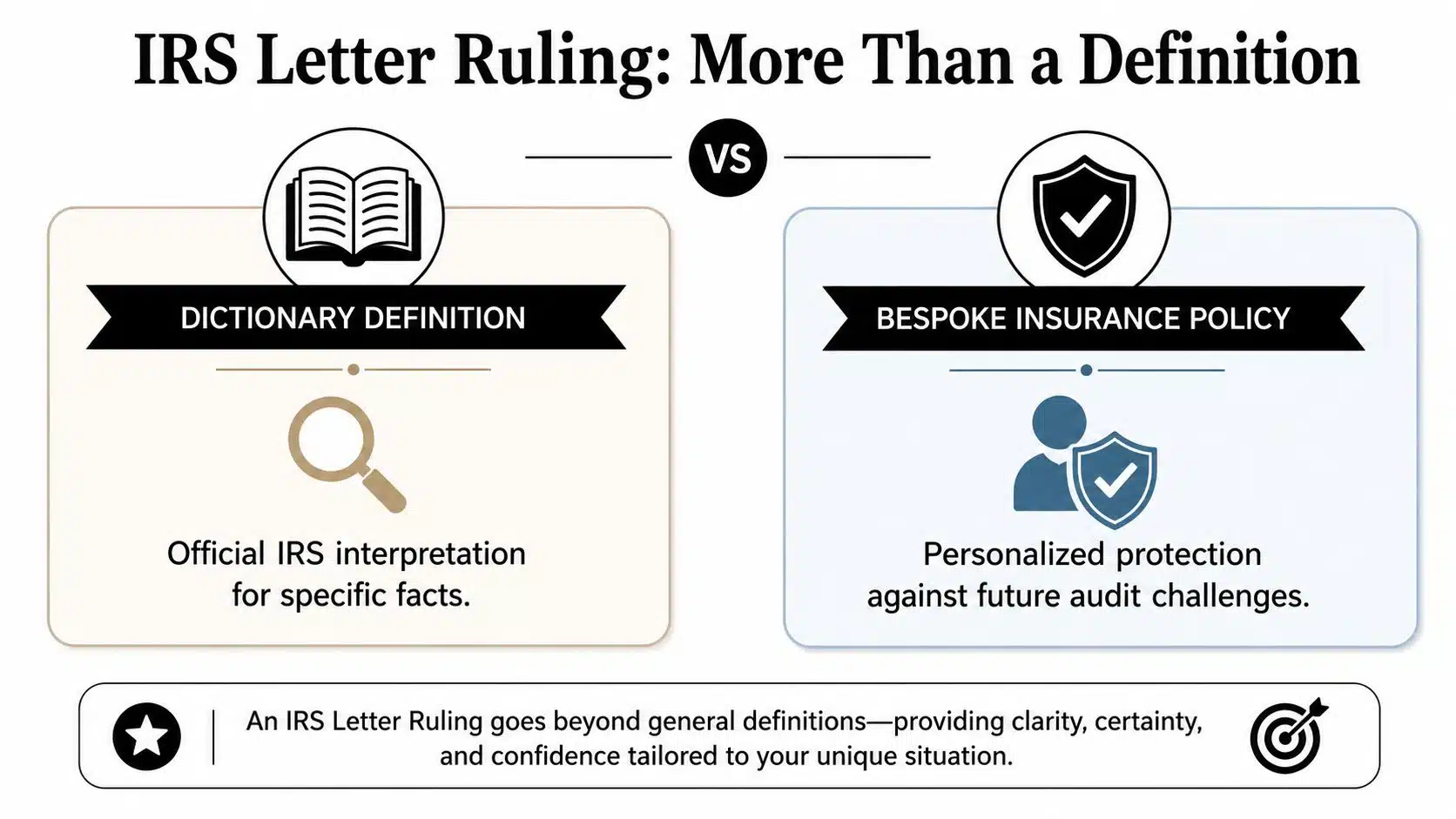
A Private Letter Ruling, or PLR, is a written IRS response to a taxpayer's own request about how federal tax law applies to that taxpayer's specific facts. It is specific to the requesting party and the transaction as presented to the IRS. It is not public guidance for everyone else.
A ruling is a custom answer to your facts
A PLR works like advance clearance. You present the facts, the proposed steps, and the tax question. The IRS then states how it would apply the law if those facts are complete and the transaction happens exactly as described.
That last point matters. Change the facts, omit a detail, or implement the deal differently, and the comfort you thought you bought can disappear.
PLRs are typically used for unusual, high-stakes questions where ordinary tax research leaves real uncertainty. If your team is still at the stage of preparing the IRS submission itself, this guide on how to write a letter to the IRS for a formal tax request helps explain the level of precision the agency expects.
How a PLR differs from other IRS guidance
The practical distinction is simple. A PLR protects the taxpayer who asked for it, assuming the facts are accurate and complete. It does not create a rule that the rest of the market can rely on.
Under 26 USC 6110(k)(3), private letter rulings may not be used or cited as precedent, as summarized by NYU Law's overview of private letter rulings. That is the trap many articles mention only in passing. You should treat it as a major risk point.
Why? Because taxpayers and even experienced deal teams often read another taxpayer's favorable PLR and assume the IRS has shown its hand. That assumption is weak. A prior PLR can be useful research. It can show how the IRS analyzed a similar issue. It does not bind the IRS in your case, and it gives you no direct protection on audit.
The bigger mistake is expecting a favorable PLR trend to turn into binding published guidance. That almost never happens in a way you can plan around. If you need certainty, wait-and-see is a poor strategy.
| IRS item | What it does | Who it helps most |
|---|---|---|
| Private Letter Ruling | Applies tax law to one taxpayer's proposed facts | Taxpayer facing an unusual, high-value unresolved issue |
| Determination Letter | Confirms IRS positions in limited procedural areas | Taxpayers seeking confirmation in those specific programs |
| Technical Advice Memorandum | Gives IRS exam teams legal advice on an issue already under review | Taxpayer already in examination |
| Information Letter | Provides general background on the law | Taxpayer seeking explanation, not binding certainty |
A favorable PLR for someone else is research material, not audit protection.
That is the practical takeaway experienced taxpayers act on. If the issue matters enough to search other people's PLRs for comfort, it may matter enough to decide whether you need your own ruling, a formal opinion, or a different transaction structure altogether.
The Letter Ruling Submission and Review Process
You are about to close a transaction, someone on the deal team found a favorable PLR online, and the room starts treating that document like a roadmap. That is the trap. If you want protection, you need your own ruling built on your facts, your documents, and your proposed transaction. A favorable ruling issued to another taxpayer does not carry your file through IRS review.
What has to go into the request
A PLR request is a legal package, not ordinary correspondence. The IRS expects a full factual record, the governing documents, the relevant tax authorities, and sworn verification that the facts are accurate and complete. If the facts are incomplete, the ruling is weak. If the facts change, the ruling can lose value fast.
A strong submission usually includes:
- Transaction story: all material facts, including details that complicate your position
- The taxpayer profile: entity structure, ownership, accounting method, tax year, and business purpose
- Core documents: agreements, organizational records, wills, financial statements, and related materials
- Legal analysis: the authorities that support your position and the authorities the IRS could use against it
- Penalty of perjury statement: signed verification that the submission is true, complete, and accurate to the best of the taxpayer's knowledge
Many requests break down at this point. The legal argument may be sound, but the factual presentation is too thin, too polished, or internally inconsistent. IRS counsel will notice. They are testing whether the law applies to a specific set of facts, not grading a law school memo.
If you want a basic model for formal IRS correspondence, this guide on how to write a letter to the IRS is useful for tone and structure. A PLR request is much more technical, but the same discipline applies. Clear facts. Clean organization. No ambiguity.
How the review usually unfolds
The process works best when you treat it like a controlled legal project.
Screen the issue first
Start by deciding whether the IRS will rule on the issue at all. Some matters are excluded, some are poor candidates, and some are better handled through planning or a legal opinion.Set up a pre-submission conference
This step is often worth doing. It lets counsel test the issue, hear the IRS reaction, and decide whether a formal request is worth the cost and delay.File the request with the user fee
The submission must be complete on day one. Sloppy filings create delays, follow-up questions, and credibility problems that are hard to fix later.Respond to IRS questions
Expect requests for clarification, revised facts, and additional documents. The IRS may push on assumptions, challenge the framing, or narrow the issue it is willing to rule on.Receive the ruling, or withdraw before an adverse result
If the IRS agrees, the ruling binds the Service for that taxpayer and that fact pattern, assuming the facts were fully disclosed and the transaction occurs as presented. If the discussion turns against you, counsel may decide withdrawal is the better risk move.
The practical point is simple. The process rewards disciplined fact development and careful procedural handling.
It also exposes the trap that many articles skip. Taxpayers sometimes assume that a line of favorable PLRs means the IRS is inching toward published guidance they can rely on without filing their own request. That is poor planning. The odds of a favorable PLR trend turning into a binding Revenue Ruling that arrives on your timeline are extremely low. If the tax issue is large enough to matter, protect your position now instead of waiting for the IRS to make someone else's ruling useful to you.
Understanding the Costs and Timelines
Clients usually ask two questions first. How much will it cost, and how long will it take?
The first answer is simple. It will cost more than anticipated.
The government fee is only the starting point
According to IRS Revenue Procedure 2026-1, Appendix A, the user fee for a Private Letter Ruling ranges from $3,000 to $43,700, not including the professional fees required to prepare the request, as summarized in PG Calc's discussion of private letter ruling fees.
That range tells you two things immediately.
- First, this is not built for routine questions. The IRS doesn't price PLRs like ordinary taxpayer service because they aren't ordinary.
- Second, the filing fee is only part of the budget. The heavy lift is in assembling facts, analyzing law, drafting the request, revising it, and managing follow-up.
For high-value transactions, that cost can still be rational. If a ruling resolves a major uncertainty before you close a deal, the fee may be minor compared with the cost of a bad structure, amended filings, or a prolonged dispute.
Timing requires patience and planning
There is no smart reason to seek a ruling at the last minute. The process is deliberate. The IRS reviews the facts, the legal analysis, and the requested ruling language. Then it often asks for more information.
That means you should treat timing as a transaction issue, not an afterthought. If closing, restructuring, or reporting deadlines are tight, the ruling process may not fit your window. In that case, you need another risk-management path.
A realistic mindset helps:
- Use a ruling when certainty matters more than speed
- Don't build a transaction calendar on wishful timing
- Budget for professional work from the start, not after the IRS asks questions
The strongest ruling requests are planned early enough that the tax process can influence the transaction, not chase it.
Pros Cons and Critical Misconceptions
A Private Letter Ruling can be one of the strongest tools available in tax planning. It can also be a waste of money if you use it for the wrong problem.
Where a ruling earns its value
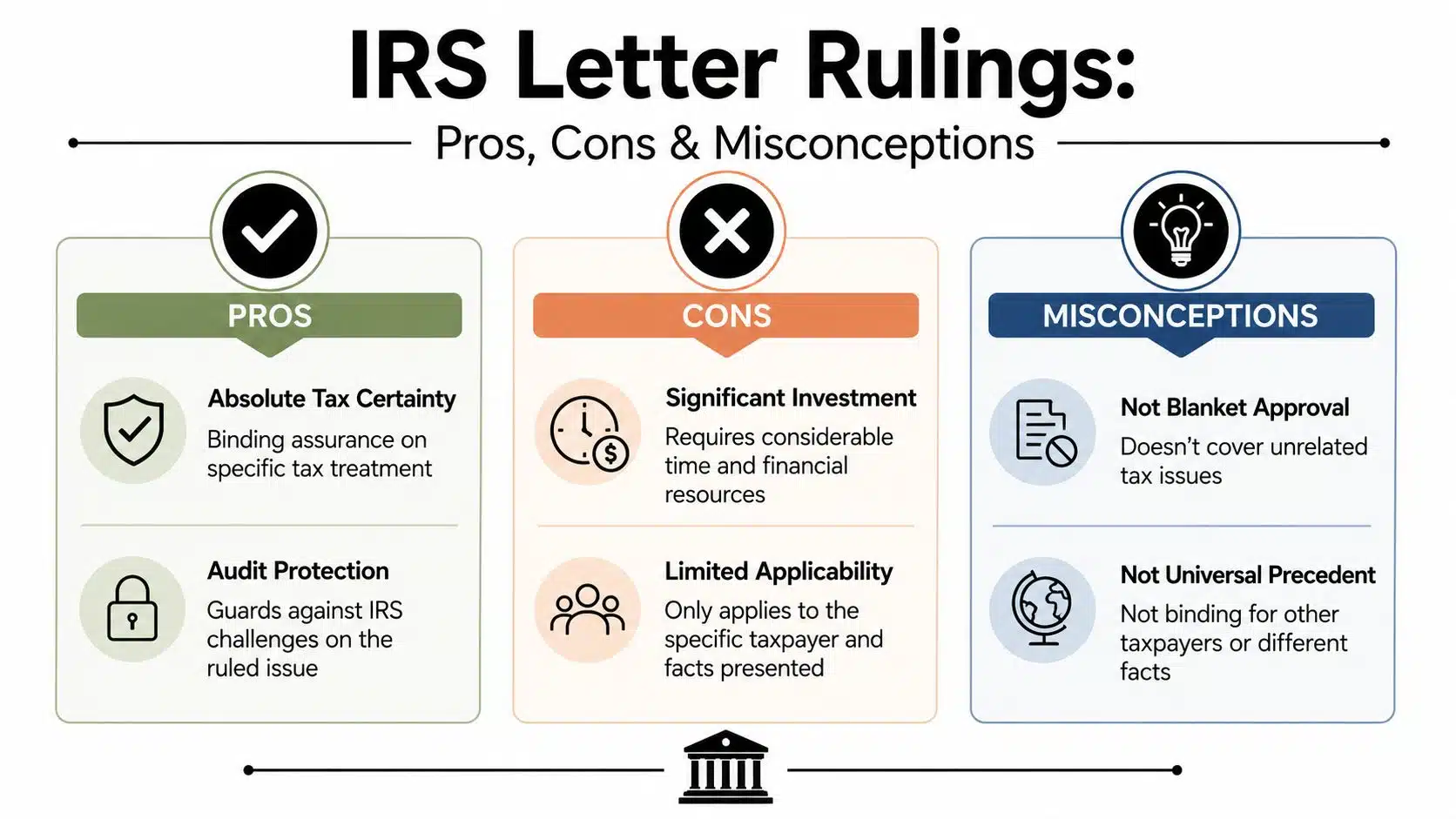
A good ruling does three things that matter in real life.
- It creates certainty before action. You stop structuring around guesses.
- It narrows audit risk on the ruled issue. If the facts and execution match the request, the IRS is bound as to that taxpayer and that issue.
- It improves decision quality. Sometimes the best value of a ruling is discovering that the intended structure isn't worth pursuing.
Those are serious benefits. For a transaction with meaningful tax stakes, certainty has real value.
The drawbacks are also serious.
| Factor | Why it matters |
|---|---|
| Cost | You pay the IRS user fee and the professional cost of building a rigorous request |
| Time | The process takes planning and follow-up. It doesn't fit rushed deals well |
| Public release in redacted form | The IRS may release the ruling publicly after removing identifying details |
| Narrow reach | The ruling protects only the taxpayer and facts actually presented |
The trap most taxpayers miss
Here's the misconception that causes the most trouble: taxpayers believe a favorable PLR issued to someone else is a reliable shield if their facts look close enough.
It isn't.
According to Bradford Tax Institute's discussion of PLR precedent limits, a common misconception is that a PLR issued to another taxpayer can be used as precedent. In reality, the conversion rate of a non-precedential PLR into a binding Revenue Ruling for the public is extremely low, and relying on another taxpayer's PLR is a frequent but dangerous mistake because of the no-precedent rule.
That's the practical trap most articles barely mention. They say, correctly, that PLRs are non-precedential. Then they move on. But the practical consequence is what matters. Taxpayers still read another person's PLR and think, “This is close enough.” That logic fails for three reasons:
- Facts that look similar often aren't legally identical
- A PLR is written for one taxpayer's specific record and representations
- The odds of that private ruling becoming a binding public rule are extremely low
If you need certainty for your transaction, get certainty for your transaction.
Searching PLRs is still useful. It helps your advisors understand IRS reasoning patterns and identify issues the Service has considered before. But it is research material, not legal cover.
When to Request a Letter Ruling vs Other Options
The right question isn't whether a PLR is powerful. It is. The right question is whether it's the right tool for your issue.
Use a ruling when uncertainty is central and material
A ruling usually makes sense when the tax issue is both unusual and decisive. The transaction's economics may change depending on how the IRS answers one unresolved legal question.
Common examples include:
- Major business restructurings: especially where ownership, basis, or entity relationships create unusual tax consequences.
- Complex trust and estate transactions: when the tax result turns on specific drafting language or a nonstandard sequence of events.
- High-value planned transactions: when proceeding without clarity would be reckless.
The IRS publishes annual procedures for letter rulings, and the current request framework and user fee schedule are addressed in the IRS page covering revenue procedures, regulations, and letter rulings. That same IRS page also notes that the agency expanded the scope of its PLR program for spin-offs in January 2024 by eliminating certain historic no-rule policies, which matters for some corporate transactions.
Use another path when the law is already clear enough
Many taxpayers ask for a ruling when what they really need is a strong tax opinion, cleaner documentation, or a better decision framework.
A formal written opinion may be enough if published law is reasonably clear and the primary issue is applying it carefully. That can preserve privacy, reduce cost, and move faster. If the matter has already turned into an IRS dispute rather than a planning question, your path may be procedural rather than prospective. In that setting, this guide to appealing an IRS tax decision is more relevant than a PLR.
A blunt decision test helps:
- Get a PLR when uncertainty is exceptional and the transaction shouldn't proceed without IRS confirmation.
- Get a tax opinion when the law is sufficiently developed and you need defensible analysis, not agency-specific preclearance.
- Use controversy procedures when the issue is already attached to a filed return, an audit, or an IRS determination.
How Allied Tax Advisors Can Secure Your Ruling
A Private Letter Ruling request is not a form-filing exercise. It is a strategy project with procedural, factual, and legal failure points.

The value of experienced guidance is simple. Someone has to decide whether a ruling is worth pursuing, frame the issue correctly, build a factual record that can withstand scrutiny, and draft a request that doesn't create avoidable weaknesses. That work is specialized. It isn't the same as annual tax preparation, and it isn't the same as general legal writing.
Clients dealing with unresolved IRS matters often need broader support around the ruling question as well. This overview of resolving IRS issues with a professional tax accountant is a useful reminder that technical tax uncertainty and procedural tax exposure often overlap.
A strong advisor does more than write. The advisor pressure-tests the facts, finds the weak points before the IRS does, and keeps the transaction team aligned so the final execution matches the facts described in the request. That's what protects the ruling's value.
Frequently Asked Questions About Letter Rulings
A common mistake is assuming a favorable IRS letter ruling creates a broader safety net than it provides. It does not. A Private Letter Ruling protects the taxpayer who requested it, on the facts presented, and little more. That limitation matters because many taxpayers read PLRs as if they were reliable signals of general IRS policy. They are not, and the odds of a PLR later becoming a binding Revenue Ruling are extremely low. Treating one as a market-wide answer is how expensive tax positions get built on false confidence.
Can I request a ruling for a return I already filed
Usually no. A PLR is generally designed for a proposed transaction or an issue raised before the return is filed. Once the return is already on file, the path usually changes.
At that point, you may be dealing with an examination issue, an accounting method problem, an amended return question, or a request that belongs in a different IRS procedure. In some audit situations, the matter may be addressed through a Technical Advice Memorandum instead of a PLR. The practical point is simple. If you wait too long, you lose options.
What if my facts change after the ruling
Assume the ruling is only as strong as factual compliance. If a material fact changes, the protection can disappear with it.
That includes changes taxpayers often dismiss as minor. Deal structure, ownership percentages, timing, cash flows, side agreements, implementation steps, and post-closing conduct all matter. If the transaction you execute is not the transaction you described, the ruling may not help when it matters most. Use the ruling request as an execution document, not just a filing package.
Small factual changes can erase the protection of an otherwise favorable ruling.
Will my financial details become public
Your name and identifying details are generally removed before the IRS releases a redacted version of the ruling. Even so, astute readers can sometimes infer more than taxpayers expect from the facts, structure, and timing described in the released text.
That is why the drafting stage matters. A good request does more than argue the law. It controls how much sensitive business context is unnecessarily exposed while still giving the IRS the facts it needs to rule.
If you are weighing a letter ruling IRS request, do not make the decision by skimming old rulings and assuming they give you a dependable roadmap. They do not. Allied Tax Advisors helps individuals, families, and business owners decide whether a ruling is worth the cost, define the facts with precision, and prepare a submission that holds up under scrutiny.