
Trump’s 2025 Tax Blueprint: Deep Cuts, SALT Cap Relief, and Economic Ripples
Donald Trump’s proposed 2025 tax plans, focusing on extending 2017 tax reductions and modifying the SALT cap, are set to considerably alter the American economic framework. These proposals, currently a central topic in congressional discussions, aim to provide substantial tax relief while managing complex issues.
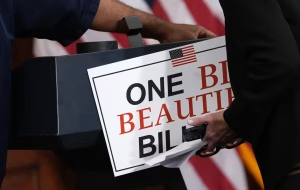
On July 3, 2025, the House approved the Senate’s version of the One Big Beautiful Bill Act, following its Senate approval on July 1 after Vice President JD Vance cast a decisive vote. The bill now awaits President Trump’s signature, expected over the July 4 weekend. The approval followed intense activity in both chambers, characterized by extended debates, unprecedented voting sessions, and numerous negotiations to secure passage in the narrowly divided House and Senate.
One of the last-minute changes to the bill before its passage involved removing its name due to Senate reconciliation rules, so it is not officially called the One Big Beautiful Bill Act. This practice has been applied to other recent reconciliation bills, such as the Inflation Reduction Act of 2022 and the Tax Cuts and Jobs Act of 2017.
The bill includes various tax modifications, such as permanent and temporary changes to many soon-to-expire tax provisions, new measures promised by President Trump during his 2024 campaign, the removal or adjustment of most green energy provisions, and several other changes affecting individuals and businesses. There are significant differences outside the tax provisions that have caused internal disagreements within the GOP majority, although dissenting members appear to have accepted these changes to ensure the bill’s passage.
The Tax Cuts and Jobs Act of 2017 (TCJA) included expiration dates for many provisions to meet budgetary constraints. Lower individual rate brackets, higher standard deductions, the elimination of the personal exemption, the SALT cap, changes to the alternative minimum tax, and other measures are all set to expire at the end of 2025. Without new legislation, the federal tax system would largely revert to the 2017 rules.
Throughout the 2024 campaign, Trump, along with many GOP lawmakers, advocated for making these soon-to-expire provisions a permanent part of the tax code. The bill achieves this, though it carries a significant cost (estimated at $5 trillion over ten years). Much of this expense is offset by reduced spending in various government programs unrelated to taxation and by eliminating many “green” tax provisions from the Inflation Reduction Act.
This CCH Tax Briefing is intended to highlight the key provisions from the approximately 400-page tax sections of the bill. For comprehensive coverage, see CCH® AnswerConnect.
Extended Individual Provisions
Many TCJA provisions affecting individuals are set to expire at the end of 2025, including various tax brackets, the elimination of personal exemptions, increased alternative minimum tax exemptions, lower mortgage interest deduction limits, casualty loss deduction limitations, and the termination of miscellaneous itemized deductions. The bill makes these provisions permanent with some adjustments, such as treating mortgage insurance premiums as deductible qualified residence interest and allowing unreimbursed educator expenses to be deducted as a miscellaneous itemized deduction. The bill also removes the last seven years of inflation adjustments from the AMT exemption phase-out threshold for joint filers, reverting it to the 2018 level.
Between 2008 and 2021, mortgage insurance premiums could be deducted as qualified residence interest. Currently, teachers can claim an above-the-line deduction for up to $300 in classroom expenses for 2024 and 2025, but the bill extends this beyond the dollar limit.
The bill permanently eliminates the personal exemption amount but introduces a $6,000 deduction for seniors aged 65 and older after 2024 and before 2029, phased out for individuals with a modified adjusted gross income exceeding $75,000 ($150,000 for joint filers).
A similar provision in the House-passed bill expanded the standard deduction, capped at $4,000.
Standard Deduction
The TCJA nearly doubled the standard deduction for tax years after 2017. For 2025, before the bill, the inflation-adjusted amounts were $30,000 for joint filers, $22,500 for heads of households, and $15,000 for single taxpayers and married taxpayers filing separately. These higher amounts were set to expire after 2025.
The bill increases the standard deduction for tax years starting in 2025 and subject to inflation adjustments afterward. The amounts for 2025 are $31,500 for joint filers, $23,625 for heads of households, and $15,750 for single taxpayers and married taxpayers filing separately.
The House bill proposed a temporary increase for tax years 2025 through 2028 by $2,000, $1,500, and $1,000, respectively. The Senate’s original proposal also increased the deduction by those amounts but made them permanent and subject to inflation. The lower amounts ultimately passed reflect an effort to reduce costs.
SALT Deduction
One of the most contentious provisions of the TCJA was the $10,000 cap on the SALT deduction. Lawmakers from high-tax states, known as the “SALT Caucus,” have consistently sought to increase or repeal the cap.
The bill raises the cap to $40,000 for 2025, with a 1% annual increase through 2029 before reverting to $10,000 in 2030. The cap is reduced by 30% of the amount by which the taxpayer’s modified adjusted gross income exceeds a threshold amount of $500,000 for 2025, with a 1% increase each year through 2029.
This issue was a major sticking point for legislators in both the House and Senate. Although SALT Caucus members were dissatisfied with the $40,000 limit in the House bill, they eventually supported it. The Senate initially proposed no cap increase but later matched the House bill. In the lead-up to the Senate vote, SALT Caucus members seemed to accept this final framework.
Child Tax Credit
The TCJA increased the child tax credit from $1,000 to $2,000 for 2018 through 2025 and substantially raised the phaseout thresholds to $400,000 for joint filers and $200,000 for other filers.
The bill permanently raises the base credit to $2,200, subject to annual inflation adjustments. The refundable portion, known as the “additional child tax credit,” is capped at $1,400. To claim the credit, the taxpayer, their spouse (if married), and the child must have Social Security numbers.
Estate Taxes
The TCJA doubled the estate tax basic exclusion amount for decedents through 2025 (inflation-adjusted to $13.99 million in 2025). It would revert to 2017 levels if the TCJA expires.
The bill increases the basic exclusion amount to $15 million for decedents in 2026, adjusted for inflation afterward.
The $15 million amount is close to where inflation would have taken the exclusion for 2026 if the TCJA wasn’t set to expire.
New Individual Provisions
No Tax on Tips
During his campaign, President Trump advocated for eliminating taxes on tip income. Initially, tip income wasn’t taxed until the early 1980s when legislation under the Reagan administration treated it like regular income.
The bill doesn’t exclude tips from income but provides a deduction for amounts received as tips. Taxpayers aren’t required to itemize deductions to claim this deduction, but a Social Security number is needed. The deduction is capped at $25,000 and begins to phase out when the taxpayer’s modified adjusted gross income exceeds $150,000 ($300,000 for joint filers). It isn’t allowed for tax years after 2028.
The bill extends the employer credit for Social Security taxes on employee cash tips to the beauty service industry (currently only for the food and beverage industry).
No Tax on Overtime
President Trump also proposed making overtime compensation tax-free. The bill allows taxpayers to claim a deduction for overtime pay required under section 7 of the Fair Labor Standards Act of 1938. Like the tip income deduction, taxpayers don’t need to itemize to claim it, but a Social Security number is required. The deduction is capped at $12,500 and phases out when the taxpayer’s modified adjusted gross income exceeds $100,000 ($200,000 for joint filers). It’s not allowed for tax years after 2028.
The bill doesn’t extensively outline the rules for this provision, leaving them to be determined by Treasury Regulations.
Social Security Income
Although President Trump proposed making Social Security income tax-free, neither the Senate bill nor the House-passed version includes a provision to eliminate taxes on or provide a deduction for Social Security income.
It’s possible that the special personal exemption for seniors aims to achieve the same goal as making Social Security income tax-free.
Itemized Deduction Limitation
Before the TCJA, the itemized deduction limitation phased out at higher incomes (the “Pease” limitation). The bill reinstates this limitation for taxpayers in the 37 percent income tax bracket, effective after 2025.
Automobile Loan Interest
Previously, interest on an individual’s automobile loan was nondeductible personal interest. The bill allows a deduction of up to $10,000 for interest paid on an automobile loan from 2025 to 2028 for a car purchased after 2024. This deduction is available for both itemizers and non-itemizers.
Trump Accounts
The bill introduces tax-favored accounts for newborn children, called “Trump Accounts,” seeded with $1,000. Tax-wise, they operate similarly to individual retirement accounts but are available to children.
Additional Provisions
The Senate bill also includes:
- A tax credit for contributions to scholarship-granting organizations
- An expansion of 529 programs to cover elementary, secondary, and home schooling expenses
- The reinstatement of a charitable contribution deduction for non-itemizers, similar to the COVID-era allowance
Business Provisions
Bonus Depreciation
The TCJA allowed 100 percent expensing of certain business property through 2022, with a 20 percent stepdown each year after, reaching 0 percent in 2027 (currently 40% in 2025). The bill makes 100 percent bonus depreciation permanent for property acquired after January 19, 2025.
Research and Experimental Expenditures
Under current law, taxpayers must amortize research and experimental expenditures. Before 2022, a direct expense election was available.
The bill permanently reinstates the deduction for domestic research and experimental expenditure costs incurred after 2024. Taxpayers can choose to deduct or amortize expenditures, with the current law’s amortization requirement suspended while the deduction is available. Small businesses with average annual gross receipts of $31 million or less can elect to claim the deduction retroactively to 2022.
Qualified Business Income Deduction
The TCJA’s qualified business income deduction under Code Sec. 199A is set to expire for tax years after 2025.
The bill makes the qualified business income deduction permanent and expands qualification for it.
Additional Provisions
The bill also includes:
- An increase in the 179 deduction limits after 2024
- An exclusion of interest received by qualified lenders secured by rural or agricultural real property
- Modifications to the low-income housing credit
International Extensions
The bill makes permanent many international and foreign-related provisions under the TCJA, including the:
- Deduction for foreign-derived intangible income (FDII) and global intangible low-taxed income (GILTI)
- Base erosion minimum tax amount
However, the bill changes the FDII rate to 33.34 percent (currently 37.5 percent) and the GILTI rate to 40 percent (currently 50 percent) after 2025.
Under TCJA, these rates were set to drop to 21.875 percent and 37.5 percent, respectively, after 2025, actually representing a tax increase for 2026 and beyond.
The bill also changes the base erosion minimum tax amount to 10.5 percent from its current 10 percent rate after 2025.
Under TCJA, this rate was set to increase to 12.5 percent after 2025, representing a tax decrease for 2026 and beyond.
The bill also modifies the treatment of “tested” CFC income and the foreign tax credit.
Green Energy Terminations
The Inflation Reduction Act of 2022 introduced numerous tax credits to encourage the production and adoption of alternative energy sources. The removal of these credits by the One Big Beautiful Bill Act is a key financing method for many of the new taxpayer-friendly provisions. However, the termination timing was a contentious issue throughout negotiations, with Senate amendments prompting House leaders to advocate for a more House-like approach.
The major disagreement between the chambers centered on when credits for “clean” energy producers would end. The House proposed that credits for producers who have already invested in construction costs terminate in 2026 or later. The Senate initially took a more aggressive stance, with some credits ending immediately and nearly all terminating before the end of 2025.
Ultimately, the Senate conceded, allowing for a longer period for energy producers to claim credits, in some cases permitting construction to begin in 2026.
Where the Senate bill aligned with the House was on the termination of many consumer-side green energy credits. Under the bill, affected credits include the following (termination generally after 2025):
- Previously owned clean vehicle credit
- Clean vehicle credit
- Qualified commercial clean vehicle credit
- Alternative fuel refueling property credit
- Energy-efficient home improvement credit
- Residential clean energy credit
- New energy-efficient home credit
IRS Procedural Provisions
Perhaps the most widely applicable operations provision of the bill is the termination of the IRS Direct File program. The bill mandates the program’s termination within 30 days of passage and allocates funding for the IRS to explore a public-private partnership to replace the current “free file” program.
The bill specifies penalties for fraudulent promoters of retention credit schemes, but at a lower limit of $1,000 per failure to comply with due diligence requirements (without a cumulative limit). The bill also includes the termination of the Direct File program.
Sources
- Watch These Key Players in Congress During the 2025 Tax Talks, Bloomberg Law.
- Trump Turns to Hill Vet’s Deep Lobbying Ties to Boost Tax Deal, Bloomberg Law.
- SALT Talks Gain Steam in Congress With Trump’s Pledge on Tax Break, Bloomberg.com.
- Trump’s Tax Bill Takes Center Stage as GOP Debates Scope of Cuts, Bloomberg.com.
- Watch Musk Seeks to ‘Kill’ Tax Bill as Trump, Senate Talk SALT, Bloomberg.