
If you're a landlord, you know that things break. It's just part of the deal. But what many don't fully grasp is how those necessary repair costs can become a powerful tool for saving money at tax time.
Rental property repair deductions are a landlord's best friend. They allow you to write off the full cost of keeping your property in good shape in the same year you spend the money. Getting this right is key to boosting your investment's bottom line.
Turning Expenses Into Tax Savings

Let's walk through a classic landlord dilemma. Your tenant calls—the water heater is on the fritz. You're now at a financial fork in the road. Do you call a plumber to fix the existing unit, or do you spring for a brand-new, high-efficiency model?
Your decision has major tax consequences. The first option is a repair, which means you can deduct 100% of that cost from your rental income this year. The second is an improvement, a capital expense you have to depreciate slowly over many years.
Understanding this difference isn't just tax jargon; it's the foundation of smart rental property management. It’s about choosing between an immediate tax break and a slow trickle of savings over time. This guide will give you the clarity to make these calls with confidence.
Why This Distinction Matters
The IRS is very clear about the line between a repair and an improvement. Getting it wrong is one of the most common and expensive errors landlords make. At best, you miss out on savings. At worst, you could trigger an audit.
Here’s what we’ll cover to help you stay on the right side of that line:
- The Core Difference: We'll dig into the IRS definitions that separate a repair (keeping things running) from an improvement (making things better).
- Audit-Proof Recordkeeping: You'll get simple, practical tips for documenting everything—receipts, invoices, even photos—to create a rock-solid paper trail.
- Claiming with Confidence: We’ll show you exactly how to report these expenses on your tax return so you can claim every single dollar you're entitled to.
The goal is simple: to transform necessary property upkeep into a strategic financial advantage. By correctly identifying and documenting your rental property repair deductions, you keep more of your hard-earned rental income.
Of course, repairs are just one piece of the puzzle. To truly maximize your returns, you need to see the full financial picture. You can explore a wider range of write-offs in our complete guide to rental property tax deductions. Understanding all your options is the best way to make sure no money is left on the table.
Repairs vs Improvements The Deciding Factor for Your Taxes
Getting a handle on the difference between a repair and an improvement isn't just for accountants. It's probably the single most important detail that determines how much you can immediately write off on your taxes for your rental property. Getting this wrong is a common, and frankly, expensive mistake that can either supercharge your tax savings or lock them away for decades.
I like to use a car analogy. If you get a flat tire and fix it, that’s a repair. It just gets the car back to how it was before. But if you swap out the old engine for a brand-new, high-performance one, that's an improvement. You've fundamentally made the car better and more valuable. The IRS looks at your rental property in much the same way.
A repair is simply what you spend to keep your property in good, working order. It's maintenance. It doesn't add any real value or significantly extend the property's life. These costs are a landlord’s best friend come tax time because they are 100% deductible in the year you pay for them.
The Core of a Deductible Repair
So, what counts as a simple, deductible repair in the eyes of the IRS? Think of anything you do to restore something to its original condition or just keep it running smoothly. These are the everyday (and sometimes not-so-everyday) costs of doing business as a landlord.
Here are some classic examples of fully deductible repairs:
- Fixing Leaks: Whether it's a nagging drip under the kitchen sink or replacing a few shingles blown off in a storm, patching up leaks is a textbook repair.
- Painting Interior Walls: Slapping a fresh coat of paint on the walls between tenants is considered routine maintenance to keep the place presentable, not an improvement.
- Repairing Broken Appliances: If the dishwasher gives up and you call a technician to fix the motor, you’ve made a repair. You’re just getting it working again, not upgrading the whole unit.
- Replacing a Broken Window Pane: When a baseball meets a window, swapping out that single cracked pane of glass just maintains the window as it was.
The IRS puts it this way: an expense that "results in a betterment to your property, restores your property, or adapts your property to a new or different use" is generally an improvement, not a repair. Getting this distinction right is central to your tax strategy.
This is where meticulous records become your best defense. You need the paperwork to back up your classifications.
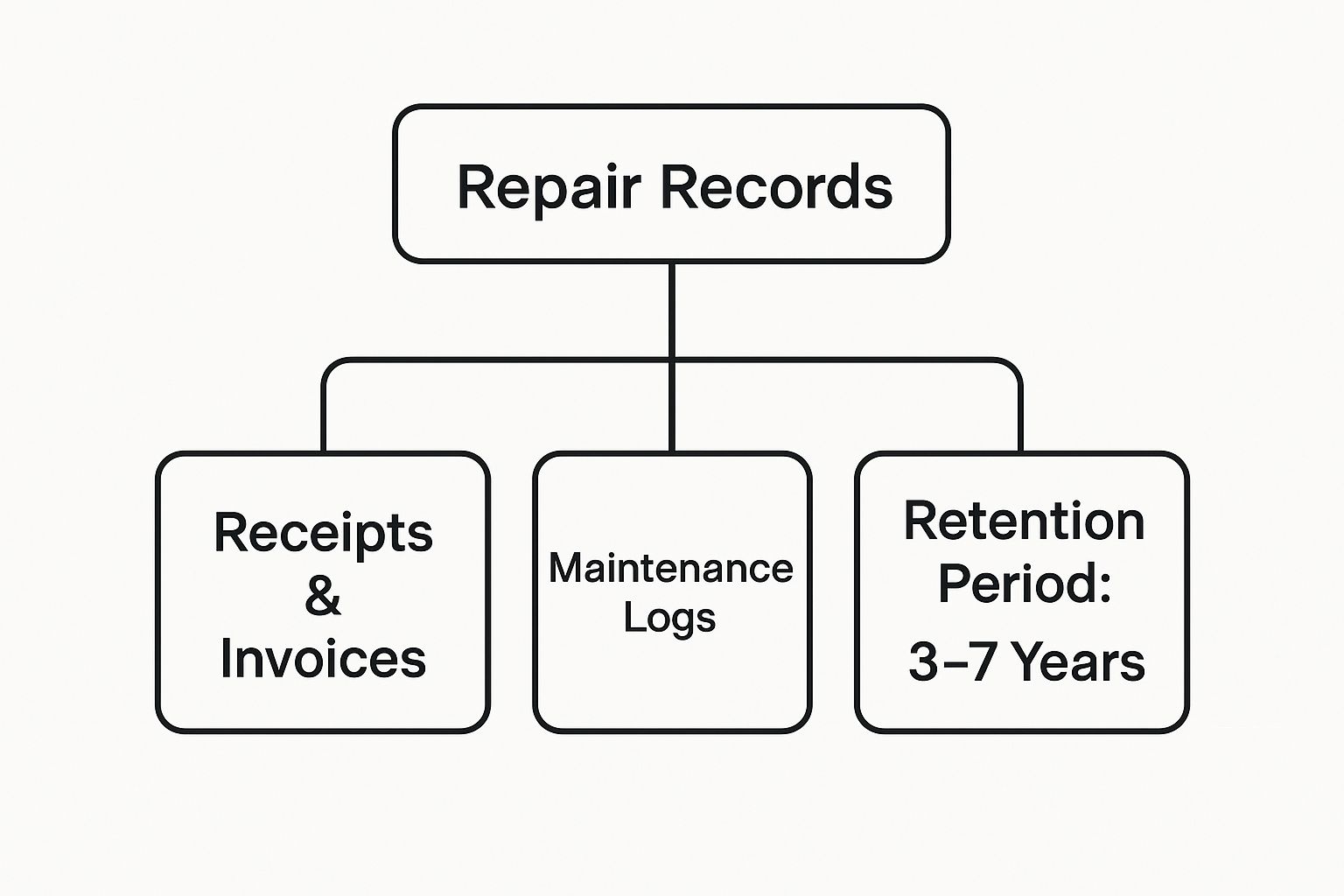
As you can see, solid recordkeeping is built on a foundation of detailed receipts, good maintenance logs, and knowing how long the IRS expects you to hold onto everything.
When a Repair Becomes an Improvement
The line starts to get a little fuzzy when a simple fix turns into a major upgrade. An improvement is any cost that adds real value to your property, extends its useful life, or adapts it for a new purpose. These expenses are not immediately deductible. Instead, you have to capitalize and depreciate them.
This means that while fixing a leaky roof or patching a wall is a repair you can deduct this year, putting on an entirely new roof or remodeling a bathroom is an improvement. The IRS sees these as long-term benefits, so you have to spread out the tax deduction over time through depreciation. For a major project like a new roof on a residential rental, that depreciation period is typically 27.5 years.
That’s a huge difference—a tax benefit spread out over nearly three decades versus one you get right away. When you're budgeting for major work, a square footage cost estimator can be a handy tool to help you gauge the financial scope and decide whether it falls into the repair or improvement camp.
Repairs vs Improvements At a Glance
To make this distinction as clear as possible, let’s look at a few common scenarios side-by-side.
| Expense Example | Classification | Tax Treatment | IRS Guideline |
|---|---|---|---|
| Replacing a few damaged roof shingles | Repair | Fully deductible in the current year. | This maintains the roof's current condition. |
| Installing a completely new roof | Improvement | Capitalized and depreciated over 27.5 years. | This is a betterment that extends the asset's life. |
| Fixing a broken garbage disposal | Repair | Fully deductible in the current year. | This restores the appliance to its working state. |
| Remodeling the entire kitchen | Improvement | Capitalized and depreciated over 27.5 years. | This significantly adds to the property's value. |
| Repainting a single room | Repair | Fully deductible in the current year. | This is considered routine maintenance. |
| Adding a new deck to the backyard | Improvement | Capitalized and depreciated over 27.5 years. | This adapts the property to a new use and adds value. |
Ultimately, knowing the difference empowers you to be more strategic. A well-timed repair can give your bottom line an immediate boost, while a planned improvement becomes a long-term investment in both your property's value and your future tax savings.
Navigating Depreciation and Capital Expenditures

While you can't write off a major improvement in a single year like you can with a simple repair, you get a different, powerful long-term tax benefit: depreciation. This is the IRS's way of letting you recover the cost of those big-ticket upgrades over time, recognizing that these assets wear out as you use them to make money.
Think of it this way: a quick repair gives you a quick, one-time tax deduction. A major improvement is an investment in your property's future, so the tax benefit is spread out to match that long-term value. It’s a marathon, not a sprint, and it chips away at your taxable income year after year.
The IRS has a very specific system for this to make sure the cost is deducted fairly over the asset's lifespan.
Understanding Useful Life and MACRS
For residential rentals, the IRS sets the "useful life" of the building and any major structural improvements at 27.5 years. This is the standard timeframe you'll use to depreciate these costs. The whole process is managed by a system called the Modified Accelerated Cost Recovery System (MACRS), which is the standard playbook for depreciating rental property assets.
This system is all about acknowledging the slow, steady wear and tear on your property. You can dive deeper into the nitty-gritty of how to calculate depreciation on rental property to see exactly how the rules play out. While 27.5 years sounds like a long time, it creates a consistent, predictable deduction you can count on every single year.
Calculating your annual deduction is pretty straightforward. You just divide the total cost of the improvement by its useful life.
Let's walk through an example:
- Improvement: You install a brand-new HVAC system.
- Total Cost: $15,000
- Useful Life (per IRS): 27.5 years
- Calculation: $15,000 / 27.5 years = $545.45
That means you get to deduct $545.45 from your rental income every year for the next two and a half decades. That one capital expense keeps on giving back.
Simplifying Deductions with Safe Harbor Rules
I know, depreciation schedules can feel a bit complicated. The good news is the IRS has created a few "safe harbor" provisions to make life easier for landlords. These rules let you immediately deduct certain expenses that might otherwise have to be depreciated over many years.
One of the most useful is the De Minimis Safe Harbor Election.
This rule lets you deduct smaller-cost items in the year you buy them. If you have what the IRS calls an "applicable financial statement," you can deduct items costing up to $5,000 each. For most independent landlords who don't, the limit is a still-generous $2,500 per item or invoice.
This is a complete game-changer for those mid-range purchases. Instead of going through the hassle of depreciating a new $1,200 refrigerator over several years, this election lets you write off the entire cost right away. It keeps your books simpler and gets the tax savings in your pocket faster.
How to Use the De Minimis Safe Harbor
This isn't automatic—you have to actively choose to use it. You make the election each year by attaching a simple statement to your tax return when you file it on time.
Here’s a practical look at how it helps:
- Scenario: The old dishwasher finally gives out, and you buy a new one for $700.
- Without Safe Harbor: This might be considered an improvement, forcing you to depreciate that $700 over years.
- With Safe Harbor: Since $700 is well under the $2,500 threshold, you can elect to deduct the full amount as a current business expense. Easy.
By getting comfortable with tools like depreciation and safe harbors, you can turn your capital expenditures from a financial drain into a smart part of your long-term tax strategy.
Rules for Foreign Rental Property Deductions
So, you’ve ventured into international real estate. Owning a rental property abroad is a fantastic move, but it definitely throws a few new curveballs into your tax planning. While the basics of deducting repairs are the same for a U.S. taxpayer—you can still write off expenses to keep your property in good shape—there are some crucial differences you have to get right.
The good news is that the core logic of what separates a repair from an improvement doesn't change with the address. Fixing a clogged drain in your Florence flat is a repair, and you can deduct the full cost right away. But putting in a brand-new kitchen in your Bali villa? That's a capital improvement, and you’ll have to depreciate that cost over time.
Currency Conversion and Reporting
The first challenge is a practical one: money. The IRS only speaks one language, and it's U.S. dollars. That means every euro of rent you collect and every peso you spend on a handyman has to be translated.
You'll need to use a consistent, recognized exchange rate for everything. Most people use the yearly average rate published by the IRS or another reliable source like a major bank. The key here is consistency—you can't cherry-pick daily rates to try and get a more favorable number. Every single receipt and invoice for your rental property repair deductions needs to be converted to its USD equivalent to report it correctly on your Schedule E.
A Different Depreciation Clock
This is where things get really different. If you own a rental in the U.S., you're used to depreciating it over 27.5 years. For properties outside the country, the IRS has a different set of rules. You're required to use the Alternative Depreciation System (ADS).
Under ADS, the depreciation period for a residential rental property located outside the U.S. is stretched to 30 years. This makes your annual depreciation deduction for any major improvements a bit smaller, but you get to claim it for a longer period.
This isn't just a suggestion; it's a mandatory rule that can significantly affect your long-term financial strategy. For example, a tax guide for U.S. expats notes this 30-year schedule is non-negotiable. An expat who owns a rental building abroad valued at roughly $608,402 USD could claim about $20,280 USD in annual depreciation, calculated over this longer 30-year lifespan. This change directly impacts how you recover the costs of those big-ticket improvements.
Calculating Deductions: An International Example
Let's walk through how this works with a real-world scenario. Say you own a small rental house in Mexico and had a busy year with maintenance.
- Repair 1: A plumber fixed a burst pipe. Cost: 5,000 MXN.
- Repair 2: You had a broken window replaced. Cost: 3,000 MXN.
- Improvement: You installed a new, high-efficiency air conditioning system. Cost: 50,000 MXN.
Let's assume the average exchange rate for the year was 20 Mexican pesos to 1 U.S. dollar. Here’s how you’d handle it on your U.S. tax return:
- Convert Repair Costs: Your total repair costs come to 8,000 MXN. In U.S. dollars, that’s $400 (8,000 / 20). You can deduct that full $400 from your rental income this year.
- Convert and Depreciate the Improvement: The new AC system cost 50,000 MXN, or $2,500 USD. Because this is an improvement on a foreign property, you have to depreciate it over 30 years.
- Calculate Annual Depreciation: Your depreciation deduction for the AC unit this year would be $83.33 ($2,500 / 30).
By carefully converting your numbers and using the right 30-year depreciation schedule, you can make sure you’re claiming every deduction you're entitled to while staying on the right side of the IRS.
Mastering Recordkeeping for Audit-Proof Deductions

Claiming a deduction is the easy part. Proving it to the IRS, if they ask, is where the real work comes in. Your deductions for rental property repairs are only as solid as the records you keep to back them up. Think of your documentation as the foundation of your tax strategy—a shaky foundation can bring the whole thing down under scrutiny.
Right off the bat, you need to separate your finances. Mixing your personal and rental business expenses is a recipe for disaster. It’s a huge red flag for auditors and makes your own life a nightmare come tax season. Do yourself a favor and open a dedicated business bank account for all rental income and expenses. This one move creates a clean, undeniable financial trail.
Next, you need a system to track every dollar coming in and going out. This doesn’t have to be some complex, expensive setup. A well-organized spreadsheet can work just as well as specialized landlord accounting software. The specific tool you choose is less important than your consistency in using it.
Building Your Audit-Proof File
For every single repair you deduct, you need to create a complete paper trail. A vague line item on a credit card statement just isn't going to convince an auditor. Your goal is to build a complete story for each transaction, leaving no room for interpretation.
A rock-solid documentation file for any given repair should include these key pieces:
- Detailed Invoices and Receipts: These are your bread and butter. A proper invoice needs to show who did the work, when they did it, a clear description of the service, and a cost breakdown. If you bought materials yourself, hang on to that itemized receipt.
- Proof of Payment: You have to show you actually paid the bill. Match every invoice with a canceled check, a specific transaction on your bank statement, or a credit card statement showing the payment cleared.
- Before-and-After Photos: A picture is truly worth a thousand words here. For any significant repair, photos provide visual evidence that you were restoring the property to its previous condition, not making a major upgrade.
- Contracts and Work Orders: Any formal agreements with contractors are crucial. Keep them to document the exact scope of work that was agreed upon and completed.
The IRS isn’t just looking for a number on your tax return; it's looking for the proof behind that number. Records that clearly separate labor costs from material costs are especially powerful because they tell a detailed story of what was fixed and what was purchased.
How Long to Keep Your Records
So, you've got all this great documentation. How long do you have to keep it? The IRS has clear rules, but it always pays to be a little cautious.
The general rule is to keep records for three years from the date you filed your tax return. However, there are situations where that window can be extended. That’s why most tax pros will tell you to hang onto everything for at least seven years, just to be on the safe side.
Thankfully, digital storage makes this a breeze. Scan your receipts and invoices and save them to a secure cloud service. This protects them from fading, getting lost, or being destroyed in a fire or flood. For a deeper dive into making your records bulletproof, check out our guide on how to prepare for an audit.
By creating a simple, organized recordkeeping system and sticking with it, you turn tax time from a frantic scramble into a straightforward process. That diligence is your best defense, ensuring every deduction you claim is secure and fully substantiated.
Reporting Your Deductions and Staying Compliant
Knowing the difference between a repair and an improvement is half the battle. The other half? Reporting it all correctly to the IRS. This is where your careful record-keeping throughout the year really pays off, turning that knowledge into actual money saved on your tax bill.
All the financial activity for your rental properties—from the rent you collect to the money you spend—gets reported on IRS Schedule E (Supplemental Income and Loss). Think of this form as the final scorecard for your investment. It’s where you lay out the entire financial story of your rental for the year, detailing every expense you’re claiming.
What About Security Deposits?
Here’s a common trip-up for landlords: security deposits. A security deposit isn't typically considered income because, well, you're supposed to give it back. But that all changes the moment you keep some of it to pay for repairs.
If you withhold a portion of a tenant's deposit to fix damages they caused, that amount officially becomes income in your books for that year. You must report it. Why? Because you’re also deducting the cost of that same repair. The IRS sees it as a balanced transaction: the deposit you kept (income) offsets the repair cost you paid (expense).
It's a critical detail that prevents you from getting a tax break for an expense you didn't actually pay for out-of-pocket. For a deeper dive into how rental income is taxed, check out our complete guide on tax on rental income.
By claiming the retained deposit as income in the same year you deduct the repair, you create a transparent and accurate financial record. This small detail is a hallmark of a compliant and savvy landlord.
Filing with Accuracy and Confidence
When it comes to taxes, accuracy is everything. To make sure your numbers are precise and compliant, it’s smart to follow established financial reporting best practices. This isn't just about filling out a form correctly in April; it’s about having a solid system for your finances all year long.
Beyond the usual deductions, some landlords have extra reporting duties. For instance, if you have foreign rental properties and keep that income in an overseas bank account, you might need to file a Foreign Bank Account Report (FBAR). This applies if the total value of your foreign accounts hits more than $10,000 at any point during the year.
Staying on top of these administrative details is what separates a prepared investor from one who risks audits and penalties. It ensures every legitimate repair deduction is claimed, backed up with proof, and reported correctly, solidifying your investment’s financial health.
Got Questions About Rental Repair Deductions? We've Got Answers.
Even when you know the basics, the real world of being a landlord throws curveballs. Certain situations always seem to fall into a gray area, and it's these tricky spots that often trip people up. Let's tackle some of the most common questions we hear from property owners.
Can I Pay Myself for My Own Repair Work?
It's a great question, and probably the one we get asked the most. The short answer from the IRS is a firm no. You can't deduct the value of your own time or labor when you do the work yourself. The deduction is strictly for money that actually leaves your pocket, not the potential income you gave up to fix that leaky faucet.
But don't toss out your receipts just yet. While your sweat equity isn't deductible, 100% of the material costs are. Let's say you spend your weekend repainting a unit after a tenant moves out.
- What you CAN'T deduct: The value of the hours you spent taping, rolling, and cleaning up.
- What you CAN deduct: Every penny you spent on paint, brushes, rollers, drop cloths, and painter's tape.
So, make sure you keep meticulous records of every purchase. Those small expenses add up to a significant deduction.
How Do Deductions Work for a Vacation or Part-Time Rental?
When you use a property for both personal getaways and as a rental, the IRS requires you to split the expenses. You can only deduct the portion of repair costs that directly relates to its time as a rental business. This is a classic scenario for vacation homes.
You'll need to do a little math. The calculation is usually based on the number of days the property was rented out versus the days you used it yourself.
Think of it like this: If you rented your beach house for 90 days and used it for a 30-day family vacation, that’s 120 total days of use. You can deduct 75% of your eligible repair costs for that year (90 rental days / 120 total days). The other 25% is considered a personal expense and can't be written off.
Is a New Appliance a Repair or an Improvement?
This one really comes down to "why" you bought it. Replacing a broken appliance to keep the property in its current working order is almost always just a repair.
If a tenant's basic, mid-range refrigerator dies and you replace it with a similar, new model, that’s a deductible repair. You’re not upgrading the property; you're simply restoring it to its original, functional state. It’s part of the cost of doing business.
However, if you decide to gut the kitchen and replace all the standard appliances with a suite of high-end, commercial-grade units, you've crossed into improvement territory. This kind of major upgrade adds significant value and has to be capitalized, meaning you'll depreciate the cost over several years instead of deducting it all at once.
At Allied Tax Advisors, we know that every landlord's financial picture is different. If you need a hand making sure you're getting every deduction you deserve while keeping your investment compliant, we're here to help. See our full range of tax and accounting solutions at Allied Tax Advisors.