
Many San Diego business owners I meet have the same two anxieties. They're making money for the first time and realize no one is setting aside taxes for them, or they've been running for months with a folder full of receipts and no clear system.
Both problems get expensive fast.
In San Diego, tax stress usually is not about one form. It is the pileup. Federal estimated payments, California entity rules, CDTFA sales tax requirements, payroll filings, and local district tax rates can all hit at once. A business owner can be doing good work, bringing in revenue, and still fall behind because nobody explained how the pieces fit together in California.
My advice is simple. Do not try to memorize tax law. Set up a system early, and make sure it fits how a San Diego business operates. If you sell taxable goods, know the sales tax rate you need to collect. If you hire help, get payroll set up correctly before the first paycheck. If your business structure no longer matches your profit or risk, fix it before tax season turns that mistake into a bigger bill.
That is the point of this guide. It gives you practical San Diego small business tax guidance that covers local tax rules and deduction planning so you can stop guessing, stay compliant, and make decisions with confidence.
Table of Contents
- Your Guide to Navigating San Diego Small Business Taxes
- Choosing the Right Business Structure in California
- Identifying Common Tax Deductions and Credits
- The Rhythm of Compliance Estimated Taxes and Payroll
- Strategic Tax Planning Beyond Annual Filing
- Bulletproof Recordkeeping for Audit Readiness
- When to Hire a San Diego CPA or Enrolled Agent
Your Guide to Navigating San Diego Small Business Taxes
A lot of new owners think taxes become urgent in March. That's backward. Taxes start the day you collect your first dollar, buy your first laptop, hire your first helper, or sell your first taxable product in California.
In San Diego, the confusion gets worse because your business doesn't live in just one tax world. You've got federal rules, California filing obligations, local operational realities, and, depending on what you sell, sales tax handling that can trip you up fast. A coffee roaster in North Park, a consultant in Clairemont, and an online retailer shipping out of Miramar do not face the exact same tax issues, even if their revenue looks similar.

Here's the practical shift I want you to make. Stop thinking of taxes as a once-a-year filing event. Start treating them as part of operating the business cleanly. When owners do that, decisions get better. Cash flow gets more predictable. Tax season stops feeling like an ambush.
Practical rule: If you wait until year-end to “figure out taxes,” you're already late.
San Diego owners also need advice that reflects California reality, not generic national content. California tends to punish sloppy administration. If your bookkeeping is weak, your payroll setup is casual, or your sales tax treatment is inconsistent, the mess spreads quickly.
If you want a local overview of how these moving pieces fit together, this San Diego tax services guide covering local tax laws and deductions is a useful starting point. Then you need to make decisions in the right order. Structure first. Deduction tracking second. Compliance rhythm third. Strategy after that.
Choosing the Right Business Structure in California
You launch a San Diego business, file an LLC online in 20 minutes, and feel productive. Three months later, you are staring at state filing notices, wondering why California wants fees, statements, and clean separation between business and personal activity before the company has even found its footing.
That is why entity choice matters early. Your structure affects liability, taxes, payroll, paperwork, and how much administrative drag you carry every month. Pick based on risk, profit pattern, and your willingness to keep the books clean. Do not pick based on what a friend formed after watching two YouTube videos.
Start with the real question: what are you protecting, and what can you maintain?
If you are freelancing part-time, have low legal risk, no employees, and very simple operations, a sole proprietorship can work for a while. It is simple. It is also exposed. The minute you sign bigger contracts, take deposits, hire workers, or create meaningful liability, you need to get more serious.
California owners usually compare four structures:
- Sole proprietorship for low-cost simplicity and minimal setup
- Single-member LLC for liability separation with flexible tax treatment
- S-Corporation for owners whose profit supports payroll and added compliance
- C-Corporation for investor-backed growth, multiple shareholders, or specific corporate tax planning goals
For San Diego owners, California rules often drive the decision as much as federal tax treatment. An LLC may look simple on paper, but California adds ongoing filing obligations and annual costs that many new owners underestimate. An S-Corp can reduce taxes in the right fact pattern, but only if payroll is set up correctly and maintained consistently. If you are casual about bookkeeping, the S-Corp is usually the wrong move.
Business Entity Tax Comparison California Focus
| Feature | Sole Proprietorship | LLC (Single-Member) | S-Corporation | C-Corporation |
|---|---|---|---|---|
| Federal tax treatment | Reported on owner's return | Often taxed as disregarded entity unless another election is made | Pass-through entity | Corporate tax treatment |
| Liability protection | None | Yes, if maintained properly | Yes | Yes |
| Owner compensation rules | Owner draws | Owner draws unless tax election changes treatment | Payroll required for shareholder-employees | Wages and corporate distributions follow corporate rules |
| Admin burden | Low | Moderate | Higher | Higher |
| California reality | Simple to start, easy to outgrow | Common choice for legal separation, but state compliance still matters | Useful once profit and payroll discipline are both present | Usually fits a narrow set of growth and ownership goals |
A table helps, but it does not replace judgment.
Here is my practical rule. Start with the simplest structure that protects you from the risk you have today, then revisit it as profit, staffing, and contract exposure change. A North Park consultant with no staff does not need the same setup as a Miramar ecommerce company with inventory, taxable sales, and warehouse help.
San Diego adds another wrinkle. If you sell taxable goods, certain digital products, or bundled transactions, your entity choice will not change your sales tax duty. You still need the right seller's permit, correct sourcing, and a clean process for collecting and reporting California sales tax. Owners get distracted by the LLC versus S-Corp debate and ignore sales tax setup, which is often the faster way to create a real problem.
The most common mistake I see
Owners either form too early or wait too long.
One group creates an entity before the business model is stable, then pays California compliance costs for a company that barely operates. Another group stays a sole proprietor long after the business has real liability exposure. Both mistakes are expensive. One wastes cash. The other leaves the owner exposed.
If you are stuck between an LLC and S-Corp, slow down and run the numbers with someone who understands California compliance, reasonable compensation, and how your San Diego business earns money. This business structure guide for small businesses is a good place to start before you file formation documents or make a tax election you do not fully understand.
One more point for rental owners and mixed-use operators. If your business activity overlaps with real estate income, keep those records and strategies separate. This guide to essential landlord deductions is useful for the rental side, but do not let rental write-offs blur your operating business structure decision.
Identifying Common Tax Deductions and Credits
A San Diego owner can do solid work all year, make decent money, and still overpay taxes because expenses were dumped into one messy bucket. I see it every season. The problem usually is not a missed form. It is bad classification.
Clean books create deductions. Guessing does not.
Start with the expenses that actually show up in San Diego businesses
Look at your real operating costs and sort them correctly from day one.
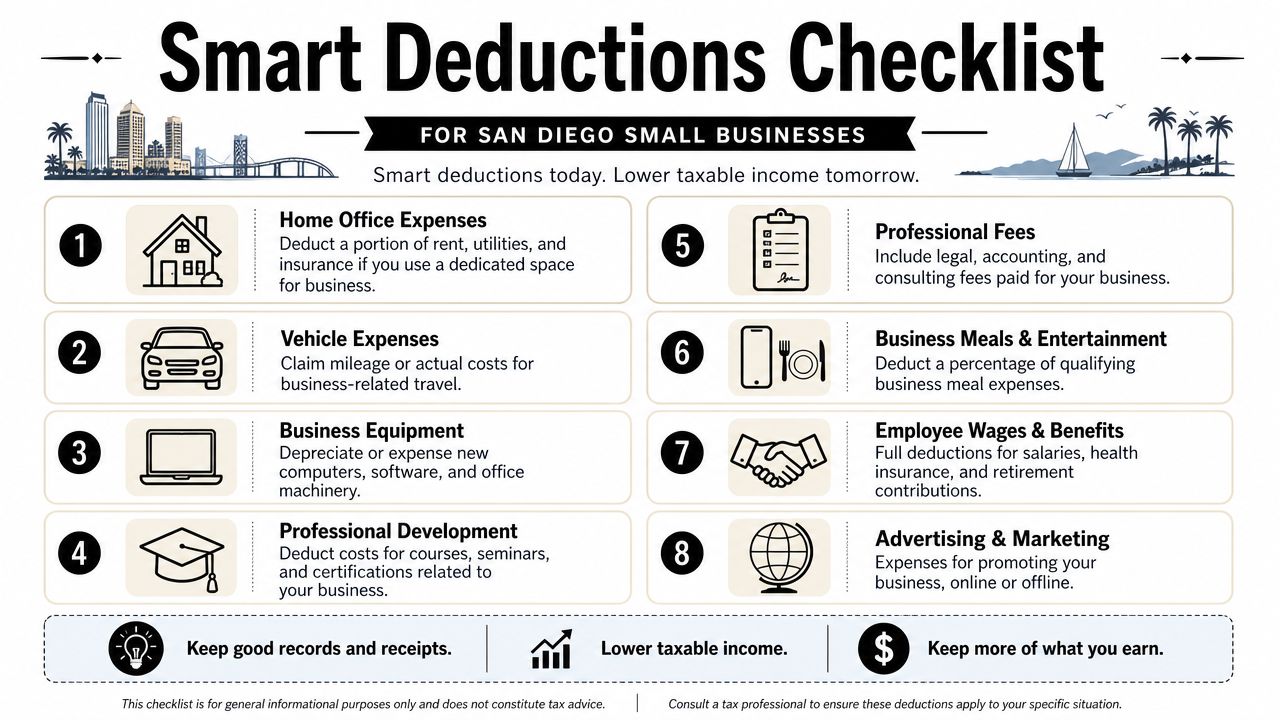
- Home office costs apply if you use a dedicated space at home for admin work, client calls, scheduling, bookkeeping, or management.
- Vehicle use matters if you drive to client meetings, job sites, supply houses, or delivery stops. Keep a mileage log as you go.
- Equipment and software includes laptops, monitors, printers, POS systems, scheduling platforms, design tools, and industry-specific subscriptions.
- Professional fees covers bookkeeping, legal work, tax preparation, payroll support, and business consulting.
- Advertising and marketing includes website work, Google ads, local mailers, photography, signage, sponsorships, and email platforms.
San Diego owners should also be careful with mixed-use spending. If you grab lunch in North Park after a client meeting, the meal is not automatically deductible just because business came up. If you use your car for both family errands and service calls, only the business portion belongs in the books. California and the IRS both expect a clean line between personal life and business activity.
If you own rentals or manage property-related expenses alongside another business, this guide to essential landlord deductions is a helpful resource because it shows how property owners should think about expenses in categories, not just at filing time.
Startup costs need their own bucket
New owners regularly mix startup costs with equipment purchases, inventory, and normal operating expenses. That creates cleanup work, and cleanup work costs money.
The IRS explains that you may deduct up to $5,000 of startup costs in the first year if your total startup costs do not exceed $50,000. If you go over that threshold, the immediate deduction is reduced, and the remaining amount is generally amortized over 15 years under the federal startup cost rules. See the IRS discussion of business startup and organizational costs.
Label these expenses when they happen. Use clear notes. Pre-opening legal fees, market research, training, and launch planning do not belong in the same bucket as inventory or a new computer.
Credits are different, and owners miss them
A deduction reduces taxable income. A credit reduces the tax you owe.
That difference matters.
California business owners often focus only on write-offs and ignore credits that may apply to hiring, energy improvements, or industry-specific activity. You need to review both federal and California opportunities together, because a credit that helps on one return may not carry over the same way on the other.
Use this checklist with your bookkeeper or CPA:
- Confirm the expense was ordinary and necessary for your business.
- Post it to the right category in your accounting system, not just to a debit card feed.
- Separate startup spending from operating spending before year-end.
- Review possible credits early so you have time to document eligibility.
- Watch California-specific treatment if the federal deduction or credit does not flow through the same way on the state return.
My advice is simple. Stop treating deductions like a scavenger hunt in March or April. Build categories now, document the business purpose now, and make your tax return the final step instead of a reconstruction project.
The Rhythm of Compliance Estimated Taxes and Payroll
You finish a strong month, pay vendors, cover rent, take a draw, and then remember taxes after the cash is already gone.
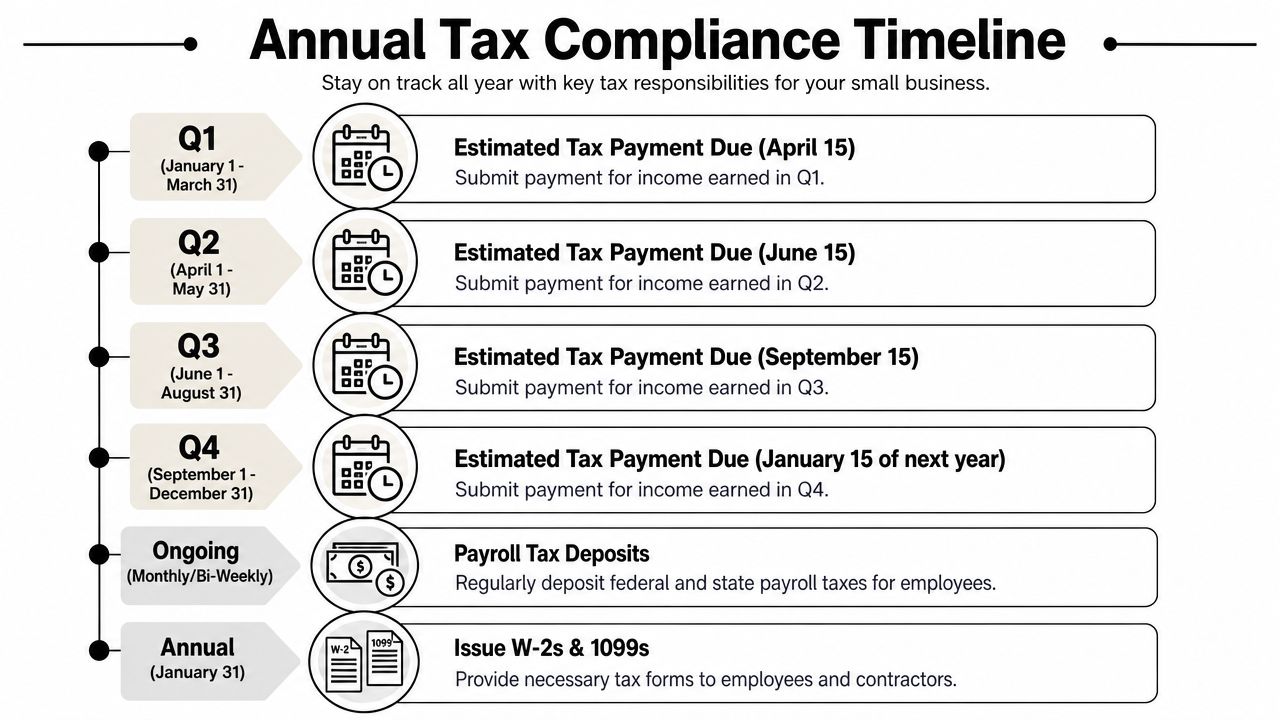
That is how small business owners in San Diego end up stressed by deadlines that were predictable from the start. If you run a sole proprietorship, LLC, partnership, or S corporation with pass-through income, tax payments need to happen during the year. Nobody is withholding enough for you behind the scenes.
Build a payment routine
Federal estimated taxes usually follow the standard quarterly schedule through Form 1040-ES. California has its own estimated tax expectations too. Treat both as part of your monthly cash management, not a surprise bill.
My recommendation is simple. Every month, review profit, move a set percentage into a tax savings account, and adjust fast if revenue jumps. A good summer in San Diego, a new wholesale account, or a few large invoices can change your tax picture quickly.
Keep the routine practical:
- Review year-to-date profit monthly so you can spot changes before a deadline hits.
- Transfer tax money out of operating cash right away when customer payments come in.
- Track federal and California payments separately so you do not lose sight of one while paying the other.
- Recalculate after major changes like new staff, bigger owner draws, or a sharp increase in sales.
Late or low estimated payments can trigger penalties. More important, they wreck cash flow because you are forced to catch up while still running the business.
San Diego sales tax and payroll reality
San Diego businesses selling taxable goods need to pay close attention to California sales tax rules and local district tax application. Your customer is in San Diego County, your shop is in North Park, your inventory ships from Chula Vista, or you sell at events around the county. Those details can affect how sales tax applies and how you report it to the California Department of Tax and Fee Administration.
Do not trust your point-of-sale system blindly. I see plenty of setups with the wrong taxability rules, bad product mapping, or location settings that do not match how the business conducts sales. Restaurants, boutiques, ecommerce sellers, contractors supplying materials, and mixed service businesses are the usual trouble spots.
Payroll adds another layer. Once you hire employees, you are responsible for withholdings, payroll tax deposits, state employer registrations, and year-end forms. California is stricter than many owners expect, and errors around new hire reporting, state disability insurance, unemployment insurance, and payroll timing can get expensive fast.
If unemployment insurance is new to you, this guide for SMB leaders on SUI tax gives a practical overview of how that piece fits into payroll compliance.
My advice. Put estimated taxes and payroll on a calendar now, before the business gets busier. Owners who do that stay in control. Owners who wait until deadlines show up usually pay more and sleep less.
Strategic Tax Planning Beyond Annual Filing
You get to November, profits are up, cash is tight, and you finally ask what taxes will look like. At that point, your options are smaller and your stress is higher. Good tax planning starts months earlier, especially in California, where state taxes, franchise fees, and owner compensation decisions can turn a decent year into an expensive surprise.
Annual filing reports what already happened. Planning changes what happens.
Tax planning is a calendar habit
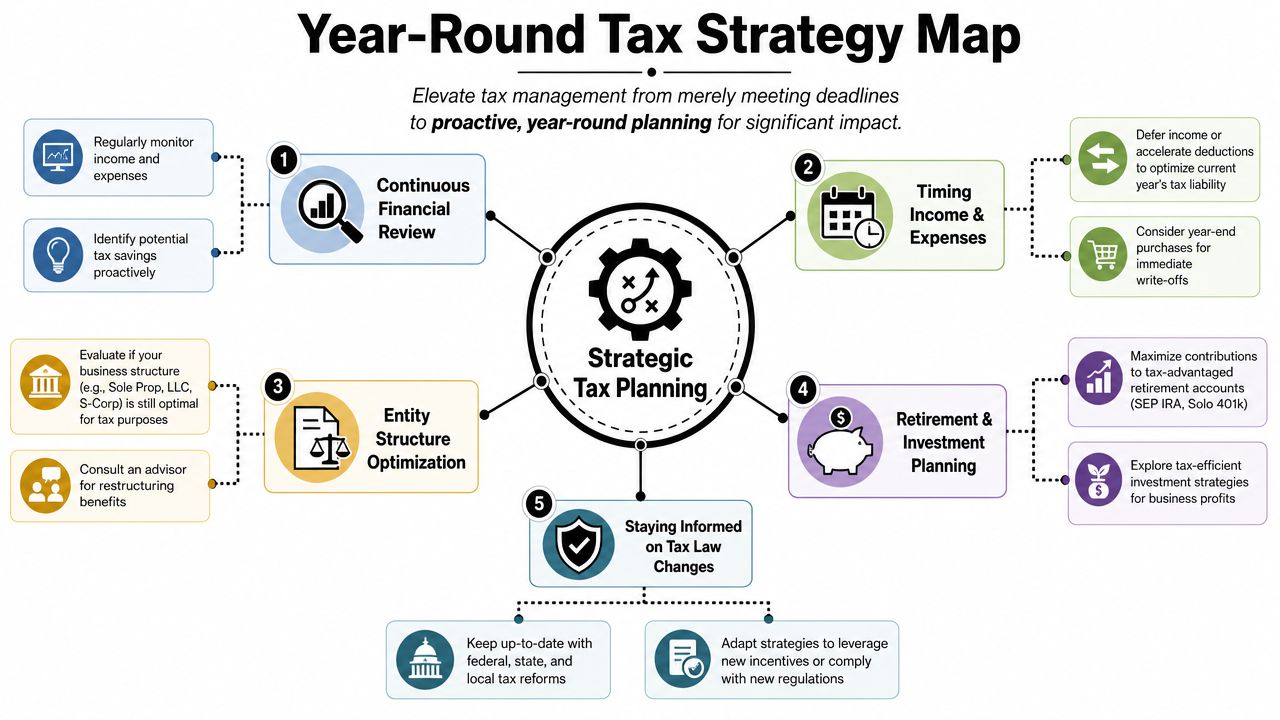
Set a rhythm and keep it. Review your books every month. Review projected tax liability every quarter. Make bigger moves before year-end, while you still have room to act.
For San Diego owners, that means looking at federal taxes and California consequences together. An entity choice, retirement contribution, or equipment purchase may help federally, but California does not always follow the same rules in the same way. If you only look at the IRS side, you miss part of the bill.
Focus on a few decisions that move the number:
- Retirement contributions can lower current taxable income and build personal savings at the same time.
- Timing major purchases can change when you get the deduction and how much it helps this year.
- Entity review matters once profit becomes consistent. A structure that worked when revenue was uneven may cost you more once the business settles in.
- Income timing matters if you control invoicing, deposits, or project completion near year-end.
December gets crowded fast. Make the hard calls earlier.
Planning also depends on clean numbers. If your bookkeeping is late, your payroll reports are messy, or your profit-and-loss statement is wrong, you are not planning. You are guessing.
Losses and lean years still need strategy
A down year still deserves attention. Losses may help in future years, but they do not always create immediate relief, and the rules are more restrictive than many owners expect. Federal net operating losses generally carry forward under current law, and their use can be limited against future taxable income. California treatment can differ depending on the year and the business situation, which is one more reason San Diego owners should not rely on generic online tax advice.
The practical takeaway is simple. If your business has a rough season, keep the books tight, document the loss correctly, and revisit your plan before the next profitable stretch. That is how you preserve options.
Year-round strategy usually needs more than tax software. Firms like Allied Tax Advisors in San Diego handle ongoing tax planning, bookkeeping support, payroll processing, and entity-related filings for local businesses. Keep your own eyes on the numbers, but do not pretend a once-a-year return is enough infrastructure for a growing company.
Bulletproof Recordkeeping for Audit Readiness
Audit-ready businesses aren't always bigger. They're cleaner.
If you want calm tax seasons, good loan applications, and fewer ugly surprises, build recordkeeping that supports your return. This is basic, but it's where a lot of businesses lose money. They have the deduction. They just can't prove it well enough.
Separate everything from day one
Your first move is essential. Separate business and personal finances.
Open a business bank account. Use a business credit card. Run business subscriptions, supplies, client meals, and software through those accounts. Don't pay business costs from your personal debit card because it's “faster.” That shortcut creates bookkeeping sludge.
For most small businesses, QuickBooks is still the practical default because many bookkeepers and tax pros already work with it. If you use another system, fine. Just make sure it gives you clean categories, reconciliations, and exportable reports.
What to keep and how to keep it
Keep records in a way another adult could understand without you standing there explaining them.
Here's the short list:
- Income records such as invoices, deposit records, processor summaries, and sales reports.
- Expense support including receipts, bills, contracts, and proof of payment.
- Bank and credit card statements for every business account.
- Payroll records if you have employees.
- Mileage logs if you claim vehicle use.
- Asset purchase details for equipment, furniture, and technology.
- Formation and tax documents such as entity paperwork, prior returns, notices, and elections.
A simple folder structure works well. Use one top-level folder for each tax year, then subfolders for income, expenses, payroll, assets, taxes, and notices. Digital is fine if it's organized and backed up.
Records aren't just for the IRS. They protect you from your own bad memory.
If a notice shows up, slow down
If the IRS or California sends a notice, don't ignore it and don't panic. Read it carefully. Confirm what year and issue it references. Match it against your return and your records.
Then get help if the issue touches payroll, sales tax, missing forms, or mismatched income reporting. Notices often start small and become expensive because owners freeze or respond emotionally. Calm, organized responses usually work better than scrambling.
When to Hire a San Diego CPA or Enrolled Agent
DIY works up to a point. Then it becomes expensive.
If you're a sole proprietor with clean books, no employees, limited transactions, and no California sales tax complications, software may be enough for a while. But once your business gets any real complexity, tax software stops being a solution and starts becoming a risk multiplier.
When DIY stops being smart
You should seriously consider hiring a professional if any of these are true:
- You formed an LLC or elected S-Corp status. Entity filings and compensation issues aren't beginner territory.
- You hired employees. Payroll errors can create tax problems fast.
- You sell taxable goods in California. Sales tax mistakes are easy to make and annoying to unwind.
- Your books are behind or messy. Filing off bad books just locks bad numbers into your return.
- You got a notice from the IRS or state. That's not the moment to start learning by trial and error.
- You're making enough money that planning matters. Once profit grows, strategy matters more than bare-minimum filing.
What the cost really means
A lot of owners hesitate because they focus only on preparation cost. That's too narrow. A better comparison is cost versus preventable errors, missed deductions, bad entity choices, and your own time.
According to this small business tax preparation cost overview, a simple Schedule C averages $600 nationwide in 2025, while S-Corporation and partnership returns typically range from $800 to $1,200. That's not pocket change. But it's often reasonable compared with the cost of filing the wrong return, missing a key election, or spending weekends untangling books.
If you need year-round help, not just filing, costs can go beyond return prep. That's usually appropriate when the business has payroll, multiple owners, sales tax exposure, or recurring planning needs.
CPA or EA
A CPA and an Enrolled Agent can both be strong choices. The better question is whether the person understands small business tax work in California and can help beyond data entry.
Hire someone who will do these things:
- Review your entity and filing posture, not just prepare forms.
- Look at your books before filing, not blindly trust whatever got imported.
- Talk through estimated taxes, payroll, and local compliance in plain English.
- Stay available during the year when your business changes.
If you want local support, this San Diego CPA page gives you a sense of what a firm-based relationship looks like when you need planning, compliance, and ongoing advice in one place.
If you're tired of guessing, Allied Tax Advisors can help you clean up the basics, choose the right structure, stay current on filings, and build a tax process that fits how your San Diego business operates.