
When it comes to filing your taxes, one of the first big decisions you'll make is whether to take the standard deduction or to itemize your deductions. The concept is pretty simple: you want to pick the option that gives you the biggest tax break.
The choice boils down to a straightforward comparison. The standard deduction is a set dollar amount determined by the IRS based on things like your filing status and age. It's the simple, no-fuss route. Itemizing, on the other hand, means you'll be tallying up a list of specific, eligible expenses to deduct.
Choosing Your Path: Standard or Itemized Deductions
Think of the standard deduction as the express lane for your tax return. It’s a predetermined amount that reduces your taxable income without you needing to track every single qualifying expense. It’s designed for simplicity and efficiency.
Itemizing is the scenic route. It requires careful record-keeping throughout the year, but if your eligible expenses—like mortgage interest, significant charitable donations, or high state and local taxes—add up to more than the standard deduction, it can lead to substantial tax savings.

This decision is a cornerstone of smart tax planning. For many people, working with professional tax preparation services can help clarify which path is truly the most beneficial for their unique financial picture.
At a Glance: Standard vs. Itemized Deductions
To make sense of the practical differences, it helps to see the two methods laid out side-by-side. This table provides a high-level summary of the core differences between the two deduction methods, helping you quickly grasp the main concepts.
| Attribute | Standard Deduction | Itemized Deductions |
|---|---|---|
| Complexity | Simple. No detailed records needed. | Complex. Requires tracking and documenting specific expenses. |
| Eligibility | Available to most taxpayers. | Requires having enough eligible expenses to exceed the standard deduction. |
| Record-Keeping | Minimal. | Extensive; must keep receipts, statements, and other proof of expenses. |
| Best For | Taxpayers with fewer deductible expenses or those who prefer simplicity. | Homeowners, those with high medical bills, or individuals who make large charitable donations. |
Ultimately, your financial situation and willingness to keep detailed records will point you in the right direction.
This choice became even more significant after the Tax Cuts and Jobs Act of 2017. That legislation nearly doubled the standard deduction amounts, which completely changed the game for millions of taxpayers. As a result, the incentive to itemize shrank dramatically. The percentage of taxpayers who itemized plummeted from 31% in 2017 to just 9% by 2020.
The Bottom Line: Your decision really comes down to the math. If your total itemized deductions are greater than the standard deduction for your filing status, you should itemize. If they aren't, taking the standard deduction is almost always the smarter move.
Understanding the Standard Deduction
Think of the standard deduction as the IRS's way of giving most people a tax break without the headache of tracking every single expense. It’s a specific dollar amount, set by the government, that you can subtract from your income. This lowers your taxable income, which in turn lowers your tax bill.
For most taxpayers, it’s the simplest and most effective way to go. You don’t need a shoebox full of receipts or complex spreadsheets—just a straightforward, no-questions-asked deduction.

The decision really comes down to a simple math problem. If all your potential itemized expenses add up to less than the standard deduction for your filing status, taking the standard deduction is the clear winner.
Standard Deduction Amounts by Filing Status
The IRS adjusts the standard deduction amounts every year to keep up with inflation. For the 2024 tax year (the return you'll file in early 2025), the numbers are:
- Single: $14,600
- Married Filing Separately: $14,600
- Head of Household: $21,900
- Married Filing Jointly: $29,200
- Qualifying Widow(er): $29,200
These figures are your baseline. For instance, if you're a single filer with only $10,000 in potential itemized expenses, grabbing the $14,600 standard deduction instantly gives you a much bigger tax break. For a deeper look at these yearly changes, check out our guide on how the IRS raises the standard deduction for 2024 and what this means for your taxes.
Additional Deductions for Age and Blindness
The tax code offers an extra helping hand to certain individuals by increasing their standard deduction. You can claim an additional amount if, by the end of the tax year, you or your spouse are:
- Age 65 or older
- Legally blind
These aren't mutually exclusive, either. A single taxpayer who is both 65 and blind gets to claim two of these additional amounts, boosting their total standard deduction even higher.
For example: A single person who is 68 years old gets their base standard deduction plus one additional amount. If a married couple files jointly, they are both over 65, and one spouse is also blind, they can claim a total of three additional amounts on top of their base deduction.
When You Cannot Take the Standard Deduction
While it’s an option for the vast majority of people, there are a few specific scenarios where you’re required to itemize. This is a crucial detail when weighing the standard deduction vs. itemized deductions.
You must itemize your deductions if you are:
- A married individual filing a separate return, and your spouse is itemizing.
- A nonresident alien or a dual-status alien during the year (though some exceptions apply).
- Filing a tax return for a period shorter than 12 months because you changed your accounting period.
In these cases, the choice is made for you. For everyone else, it all comes down to running the numbers and seeing which path saves you more money.
A Closer Look at Your Itemized Deduction Options
If the standard deduction is the easy, no-fuss route, think of itemizing as the scenic route—it takes more effort, but the payoff can be huge if you know where to look. Instead of a one-size-fits-all number, you’ll be adding up specific, IRS-approved expenses on a form called Schedule A. It’s a hands-on approach that demands good record-keeping, but it can seriously lower your tax bill if your expenses add up to more than the standard deduction for your filing status.
The whole point is to account for major expenses that the tax code acknowledges can put a dent in your finances. Historically, this has been a go-to strategy for certain taxpayers. While only about 30% of filers used to itemize, that number shot up with income. For instance, a whopping 93% of people with an adjusted gross income (AGI) between $200,000 and $500,000 chose to itemize, compared to just 5% of those with an AGI under $20,000. You can find more of the backstory on these deduction trends over at everycrsreport.com.

What this really shows is that the decision between the standard deduction vs. itemized deductions isn't random. It’s almost always driven by your personal financial picture, especially if you own a home or live in a high-tax state.
The Most Common Itemized Deductions
While the list of possible deductions is long, a handful of big ones do most of the heavy lifting. Getting familiar with these will help you figure out pretty quickly if itemizing is even on the table for you.
-
Mortgage Interest: This is the big one for most homeowners. You can typically deduct the interest you pay on the mortgage for your main home and even a second home, as long as the loan was used to buy, build, or make significant improvements. To get the most out of this, check out our guide on how to handle mortgage interest payments on your tax return.
-
State and Local Taxes (SALT): This bucket includes property taxes and your choice of either state income taxes or state sales taxes (you can't take both). The catch? There's a major cap here. The total SALT deduction is limited to $10,000 per household, per year.
-
Charitable Contributions: If you donate to qualified charities, you can deduct those contributions. This covers cash, property, and even the miles you drive doing volunteer work. Just be aware that for larger non-cash gifts, you might need a formal appraisal.
-
Medical and Dental Expenses: This one trips a lot of people up. You can only deduct the portion of your medical bills that exceeds 7.5% of your adjusted gross income (AGI). That high bar means it really only helps people who have had a year with unusually high medical costs compared to what they earn.
Why Meticulous Records Are Non-Negotiable
Unlike taking the standard deduction, itemizing isn't on the honor system. You need to be able to back up every single dollar you claim with clear, organized proof. If the IRS decides to take a closer look at your return, the responsibility is entirely on you to prove your deductions were legitimate.
Key Takeaway: When you itemize, receipts and financial statements become your best friends. Without solid proof, a perfectly valid deduction can be thrown out in an audit, which could leave you on the hook for back taxes, penalties, and interest.
Good documentation is more than just a shoebox full of receipts. It means having a system for tracking your expenses all year long.
Your Documentation Checklist for Itemizing:
- Mortgage Interest: Your lender will send you a Form 1098 at the end of the year. Keep it. It spells out exactly how much interest you paid.
- Property Taxes: Hold onto your canceled checks, bank statements, or official notices from your local tax office that show what you paid and when.
- State and Local Taxes: For income taxes, your W-2s and state tax returns are your proof. If you're deducting sales tax, you can use the IRS's official tables or hang onto receipts from your major purchases.
- Charitable Donations: For any donation of $250 or more, always get a receipt or an acknowledgment letter from the charity. For smaller cash donations, a canceled check or credit card statement will do.
- Medical Expenses: Keep every receipt from doctors, dentists, hospitals, and pharmacies. Don't forget to log your mileage for medical appointments—that counts, too.
Ultimately, choosing to itemize means you're signing up for a bit more financial homework. But for homeowners, high-earners in high-tax states, or anyone with significant medical bills or charitable giving, the potential savings can make that extra effort well worth it.
Standard vs. Itemized Deductions: A Side-by-Side Breakdown
Choosing between the standard and itemized deductions is more than just a math problem—it's a strategic decision that pits simplicity against potentially significant tax savings. Each path comes with its own trade-offs, from the level of effort required to the amount of attention you might get from the IRS. The right answer really comes down to your unique financial picture.
For the vast majority of taxpayers, the standard deduction is the clear winner. It's a clean, no-fuss way to lower your taxable income. You don't need a shoebox full of receipts or any special proof. This straightforward approach is why nearly 90% of households now take the standard deduction, making tax season a much less stressful event.
On the flip side, itemizing is for the detail-oriented. It requires you to track your spending carefully and understand exactly what the IRS allows. This path is more complex, but it can unlock a deduction that’s far larger than the standard amount, especially if you have major expenses like high mortgage interest or medical bills.
Complexity and Record-Keeping
The most glaring difference between the two methods is the sheer amount of work involved. The standard deduction is as easy as it gets—it's just a number you plug into your tax form. No receipts to save, no logs to keep, no calculations to stress over.
Itemizing is the complete opposite. It forces you to be an active participant in your tax planning all year long. Every single expense you want to claim has to be tracked, documented, and proven.
- Standard Deduction: Basically zero effort. Your eligibility is based on your filing status, age, and whether you're blind—things that don't require any ongoing paperwork.
- Itemized Deductions: A major effort. You need to keep immaculate records for everything you claim, from your mortgage interest statement (Form 1098) and property tax receipts to every charitable donation slip and medical bill.
The real secret to successful itemizing is that the work doesn't start in April; it ends there. Smart itemizers have a system for organizing their documents as the expenses happen, so they aren't scrambling to find everything at the last minute.
The Bottom Line: Potential Tax Savings
Ultimately, the choice comes down to one big question: which route saves you more money? The answer isn't static. It can change based on life events like buying a home, facing unexpected medical costs, or living in a state with high income or property taxes. Tax pros often use powerful software like Drake Tax Hosting to run the numbers and see which scenario gives their clients the biggest break.
This graphic gives you a quick visual of how the standard deduction stacks up against what the average itemizer claims.
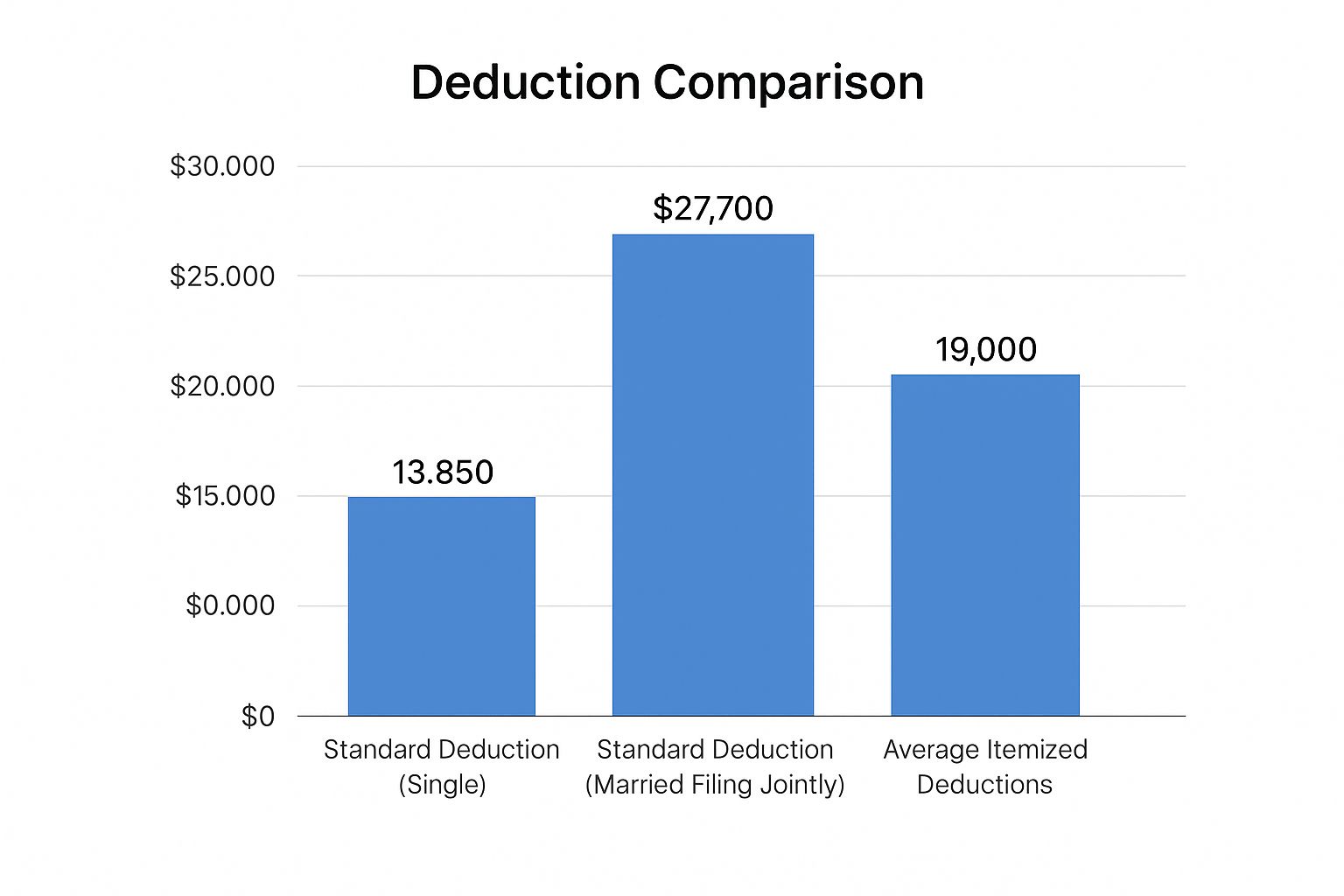
As you can see, the standard deduction amounts are quite generous. That means your itemized total needs to clear a pretty high bar to make the extra effort worth it.
Thinking through these factors is crucial. The following table breaks down the strategic considerations to help you weigh your options.
Strategic Analysis: Standard vs. Itemized Deductions
| Decision Factor | Standard Deduction Analysis | Itemized Deductions Analysis |
|---|---|---|
| Complexity | Simple. A fixed amount based on your filing status, age, and vision. No calculations needed. | Complex. Requires tracking dozens of potential expenses across multiple categories and understanding specific IRS rules. |
| Record-Keeping | None. No need to save receipts or provide documentation for the deduction itself. | Intensive. Meticulous records are essential. You must keep receipts, statements, and acknowledgments to prove every expense. |
| Tax Savings | Predictable but limited. The amount is set by law. You get what you get, which may be less than your actual expenses. | High potential. Your deduction can be significantly larger if your qualifying expenses are substantial. |
| Audit Risk | Extremely low. Since it's a fixed statutory amount, the deduction itself cannot be challenged by the IRS. | Higher. The IRS can scrutinize any and all of your claimed expenses. Certain deductions are known to attract more attention. |
This table highlights the core trade-off: The standard deduction offers safety and simplicity, while itemizing offers greater savings potential at the cost of complexity and risk.
Audit Risk and Substantiation
Nobody likes to think about an IRS audit, but your choice of deduction can affect your risk level. Taking the standard deduction is about as safe as it gets. It's a number set by law, so there's nothing for the IRS to question.
Itemizing, however, opens your return up to a closer look. When you itemize, you're making specific claims about your spending, and you have to be ready to back them up. Some deductions, like large non-cash donations or home office expenses, are well-known audit red flags. That doesn't mean you shouldn't take them—it just means your paperwork better be perfect.
If you claim a $5,000 deduction for a gift to charity, you absolutely must have a written acknowledgment from the organization. If you're deducting a mountain of medical bills, you'll need the receipts and proof of payment for every last one. The burden of proof always falls squarely on you.
"Bunching": A Smart Strategy for Those on the Fence
If your itemized deductions are usually right around the standard deduction amount, you might feel stuck. This is where a clever strategy called "bunching" comes in. The idea is to consolidate your deductible expenses into one year to push you over the itemization threshold. Then, in the off-years, you just take the easy standard deduction.
For example, you could make two years' worth of your planned charitable donations in December. This could give you enough to itemize for that year. The next year, with fewer expenses, you'd just take the standard deduction. This works great for things like:
- Charitable Giving: Paying a two-year pledge at once or contributing a larger amount to a donor-advised fund.
- Medical Expenses: Scheduling an elective surgery or buying new glasses and contacts before the year closes out.
- State and Local Taxes (SALT): Paying your fourth-quarter state estimated taxes in December instead of January, as long as you stay under the $10,000 SALT cap.
This approach takes some planning, but for taxpayers hovering near the line, it can be a fantastic way to maximize your deductions over time.
When Itemizing Your Deductions Makes Sense
The choice between taking the standard deduction and itemizing isn't just a theoretical exercise—it's about how your real life fits into the tax code. For most people, the standard deduction is simple and sufficient. But certain life events and financial situations can make itemizing a much smarter, more profitable move.
The trick is knowing when your expenses have a real shot at adding up to more than the standard deduction for your filing status. Let’s move beyond a simple list and look at some real-world examples of when the extra work of tracking and itemizing deductions really pays off.
You’ve Just Bought a Home
Becoming a homeowner is one of the most common reasons people switch from the standard deduction to itemizing. The mortgage interest deduction alone is often a game-changer in the standard deduction vs itemized deductions debate.
Take Alex and Jordan, a married couple filing their taxes jointly. They recently bought a home with a $450,000 mortgage.
- Mortgage Interest Paid: In their first year, they paid a hefty $25,000 in mortgage interest.
- Property Taxes: Their local property taxes came to $6,500.
- State Income Taxes: They also paid $8,000 in state income taxes.
Remember, the State and Local Tax (SALT) deduction is capped at $10,000. So, they can claim their $6,500 in property taxes plus $3,500 of their state income taxes. Even with that cap, their itemized total is looking pretty good.
Let's do the math:
- Mortgage Interest: $25,000
- SALT Deduction: $10,000
- Total Itemized Deductions: $35,000
The 2024 standard deduction for married couples filing jointly is $29,200. By itemizing, Alex and Jordan get to deduct an extra $5,800. That single life event—buying a house—turned them into savvy itemizers.
You Live in a High-Tax State
Your address can have a huge impact on your taxes. Living in a state with high income or property taxes can push you past the standard deduction threshold, even with the $10,000 SALT cap.
For example, in Washington D.C., about 20% of tax filers itemized their deductions, and their average claim was $42,359. That’s significantly higher than the national average and shows just how much location matters. You can see more on this in SmartAsset's research on where Americans write off the most in taxes.
Key Insight: Don't underestimate the $10,000 SALT deduction. While capped, it provides a powerful foundation. Add in other big-ticket items like mortgage interest or substantial charitable gifts, and itemizing quickly becomes the obvious choice.
You're a Generous Giver
Making significant charitable contributions is another great reason to itemize. The tax code is designed to encourage giving, and you can deduct donations made to qualified organizations.
Let's look at Maria, a single filer who is a dedicated supporter of her local animal shelter.
- Adjusted Gross Income (AGI): Maria’s AGI is $90,000.
- Charitable Donations: Over the year, she donated $12,000 in cash.
- State and Local Taxes: She also paid $6,000 in state income taxes.
Here’s how her numbers stack up:
Let's do the math:
- Charitable Contributions: $12,000
- SALT Deduction: $6,000
- Total Itemized Deductions: $18,000
For 2024, the standard deduction for a single filer is $14,600. By itemizing, Maria boosts her deduction by $3,400. That directly reduces her taxable income and frees up money she can put toward other goals—or even more donations.
You've Had High Medical Bills
Major out-of-pocket medical expenses can also make itemizing worthwhile, but the rules here are a bit tricky. You can only deduct the portion of your medical costs that exceeds 7.5% of your Adjusted Gross Income (AGI).
Consider Sam, a head of household filer with two kids.
- Adjusted Gross Income (AGI): Sam’s AGI is $80,000.
- AGI Threshold (7.5%): This means the first $6,000 of medical bills aren't deductible ($80,000 x 0.075).
- Total Medical Expenses: After an unexpected surgery, Sam's family racked up $15,000 in out-of-pocket medical costs.
First, we figure out his deductible amount: $15,000 (total costs) – $6,000 (AGI threshold) = $9,000.
Now, we add in his other deductible expenses:
Let's do the math:
- Deductible Medical Expenses: $9,000
- SALT Deduction (Property & State Taxes): $10,000
- Mortgage Interest: $8,000
- Total Itemized Deductions: $27,000
The standard deduction for a head of household is $21,900. Sam’s itemized deductions are $5,100 higher. For him, a tough medical year created a clear financial incentive to itemize. As these situations show, your own financial life is the best guide for deciding between the standard and itemized deductions.
Answering Your Top Questions About Tax Deductions
When you’re weighing the standard deduction against itemizing, a few key questions always seem to pop up. Getting these sorted out is the first step toward making a smart, confident decision when you file.
Can I Switch Between Itemizing and the Standard Deduction?
Absolutely. You aren't locked into one choice for life. The decision to itemize or take the standard deduction is made fresh every single year.
Think about it—a major life event like buying a house could make itemizing a no-brainer one year due to mortgage interest and property taxes. But the following year, if nothing much has changed, you might find the standard deduction puts you in a better position.
How Do Life Changes Affect My Choice?
If you get married or divorced, your filing status changes, and so does your standard deduction amount. This single change can completely flip which option is better for you, so it's crucial to rerun the numbers based on your new status for that tax year.
There’s also a big catch for married couples who file separate returns. If one spouse chooses to itemize, the other spouse is forced to itemize as well. You can't mix and match. This rule prevents a couple from getting an unfair advantage by having one person claim all the itemized expenses while the other takes the hefty standard deduction.
A huge factor in this decision is the State and Local Tax (SALT) deduction cap, which is currently stuck at $10,000. Even if your property taxes and state income taxes add up to way more than that, you can only deduct up to $10,000. This cap often makes it tough for total itemized deductions to beat the standard deduction.
Finally, remember that deductions and credits are two very different things. To get a clear picture, check out our guide explaining the key differences between tax deductions and tax credits.