
Business travel is more than just an expense line on your P&L—it’s an investment in your company's growth. But for entrepreneurs, LLCs, and S Corps, every dollar spent on a trip has to be accounted for. Getting a firm grip on what qualifies as a deductible business travel expense is non-negotiable.
If you don't track and deduct these expenses correctly, you're simply handing over your hard-earned money to the IRS.
The High Stakes of Business Travel Deductions
Think of your travel budget as a core part of your business strategy. Every trip, whether it's to land a new client, attend a critical conference, or scout a new location, is a calculated move designed to generate a return. You wouldn't throw money at a marketing campaign without tracking the results, and the same discipline should apply to your travel spending.
The reality is that business travel costs are climbing, and fast. Global spending is on track to hit a staggering $1.57 trillion in 2025. Here in the U.S., businesses are projected to spend $314.5 billion that same year. For many companies, these costs are the second-largest controllable expense right after payroll.
With the average cost per trip jumping 35.3% to $1,128, thanks to higher airfares and hotel rates, meticulous record-keeping has gone from a "nice-to-have" to an absolute must. You can explore the complete breakdown of recent business travel expense statistics to see just how quickly these costs are adding up.
Understanding where this money goes is the first step in controlling it. The following table highlights the main spending categories you'll need to watch.
Business Travel Cost Components at a Glance (2025 Projections)
| Expense Category | Projected Global Spend | Percentage of Total |
|---|---|---|
| Lodging & Accommodations | $518 Billion | 33% |
| Air Transportation | $486 Billion | 31% |
| Food & Beverage | $235 Billion | 15% |
| Ground Transportation | $173 Billion | 11% |
| Miscellaneous/Other | $158 Billion | 10% |
As the data shows, lodging and airfare consume the lion's share of the budget. However, smaller expenses in other categories can add up to a significant amount, making comprehensive tracking essential for maximizing your deductions.
Why Your Tracking System Is Everything
Every undocumented expense is a lost tax deduction—it's that simple. A shoebox full of crumpled receipts or a "best guess" on your mileage log is a direct invitation for IRS scrutiny. The IRS demands clear proof that every expense was both ordinary (common and accepted in your line of work) and necessary (helpful and appropriate for your business).
Without a solid system in place, you're guaranteed to make costly mistakes:
- You'll forget the small stuff. All those coffees, tips, and parking fees seem minor at the moment, but they can add up to thousands over a year.
- You'll mix personal and business costs. This is a massive red flag for the IRS and can put all your legitimate deductions at risk.
- You'll lose the big receipts. A single lost receipt for a flight or a week-long hotel stay can wipe out hundreds of dollars in tax savings.
From Cost Center to Growth Driver
The key is to start treating your travel spending not as a liability, but as a strategic asset. That shift begins with knowing exactly which costs are deductible and having a bulletproof system to capture every single detail. Your goal is to build an unshakable record that proves the business purpose behind every dollar spent.
By weaving your business travel deduction strategy into your core financial planning, you ensure every trip directly strengthens your bottom line. It’s about being audit-proof while fueling your company's growth.
This guide will walk you through all the specifics, with clear examples and steps you can take today. We’ll break down what you can claim, how to document it perfectly, and how to sidestep the common pitfalls that trip up even the most experienced business owners. Let's get started.
What Travel Expenses You Can Actually Deduct
To get the most out of your tax savings, you have to know what the IRS actually considers a valid business travel expense. It all comes down to one core principle: any expense you claim must be both ordinary and necessary for your work.
Think of "ordinary" as what’s common and accepted in your line of business. "Necessary" doesn't mean it has to be indispensable, just that it's helpful and appropriate for getting business done. With that foundation, let’s get into the specifics of what you can write off.
Transportation Costs
First up is the cost of getting from point A to point B. This is probably the most straightforward category, as long as the main reason for your trip is business.
You can deduct the real costs of:
- Tickets for air, rail, or bus travel between your home base and your business destination.
- Operating your own car, whether you track actual expenses or use the simpler standard mileage rate.
- Taxis, ride-shares like Uber or Lyft, or other local transport that gets you from the airport to your hotel, or from your hotel to a work site.
Imagine a real estate investor from San Diego who flies to Austin to look at a few potential investment properties. That flight is 100% deductible. The Uber she takes from the airport to her downtown hotel is also deductible, as is the rental car she uses to drive between property viewings.
This is how travel expenses fit into your bigger business picture.
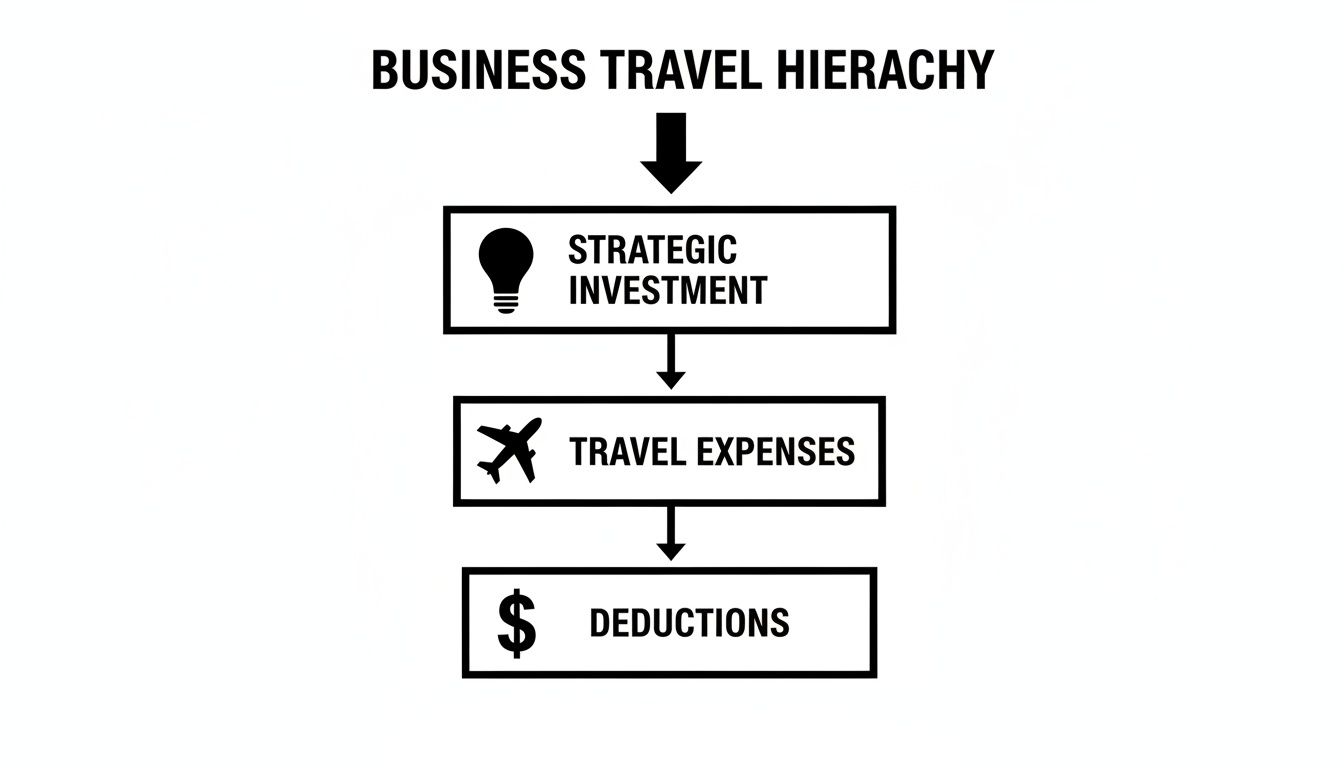
As you can see, these expenses aren't just costs—they're part of a strategic investment that ultimately leads to valuable tax deductions.
Lodging and Accommodations
The cost of your hotel, motel, or even an Airbnb while you're away from home on business is another key deduction. The only real rule here is that the cost has to be reasonable. A five-star luxury suite might raise eyebrows if a standard hotel room would have done the job.
Your lodging expenses are only deductible for the nights you're actually working. If you decide to tack on a few extra days for a personal vacation, you can't deduct your hotel bill for those personal days.
Meals and Incidental Expenses
This is where the rules get a little more specific, and where many people get tripped up. While you can deduct the cost of meals on a business trip, the IRS typically only allows you to deduct 50% of the total bill. This 50% limit also applies to meals you have with clients, whether you're traveling or just down the street from your office.
Incidental expenses are the small, miscellaneous costs that pop up on the road. These include things like:
- Tips you give to hotel staff, bellhops, or porters.
- The cost of laundry and dry cleaning during your trip.
It's easy to see why careful tracking matters. Projections for 2025 put global business travel spending at $1.57 trillion, with lodging at $501 billion, air travel at $282 billion, and food/beverages at $245 billion. For a small business owner, forgetting to apply the 50% rule to that last category can quickly lead to disallowed deductions and a headache come tax time.
For a more detailed breakdown, our guide on deducting business meals covers this topic in full.
Non-Deductible Travel Expenses
Knowing what you can't deduct is just as important as knowing what you can. The IRS draws a hard line here: personal, living, or family expenses are never deductible business travel costs.
Common examples of non-deductible items include:
- Any costs related to a spouse, child, or friend traveling with you, unless they are also an employee traveling for a genuine business purpose.
- Expenses for personal fun, like sightseeing tours, shows, or recreational activities.
- Anything the IRS would consider lavish or extravagant for your business needs.
So, while taking a client to a nice dinner is a deductible meal (at 50%), buying front-row concert tickets for after-dinner entertainment is a personal expense and is not deductible.
Building Your Audit-Proof Recordkeeping System
Knowing what you can deduct is one thing; proving it to the IRS is another game entirely. When it comes to the travel expenses business owners claim, your deductions are only as strong as your records. Without solid proof, even legitimate expenses can be thrown out during an audit.
The days of wrestling with a shoebox full of crumpled, faded receipts are behind us. A modern, digital recordkeeping system isn't just about convenience—it's about building a fortress around your deductions that can withstand any scrutiny.
The Four Pillars of Proof
Think of every business travel expense as a table supported by four legs. If even one leg is missing, the whole thing comes crashing down. For each deduction, the IRS demands you document these four specific details.
You must be able to prove:
- The Amount: How much did it cost? A detailed receipt is your best friend here.
- The Date: When did you pay for it?
- The Place: Where did the transaction happen? (e.g., the hotel's name, the restaurant's address).
- The Business Purpose: Why was this expense necessary for your business? This is the most crucial piece of the puzzle and where most people trip up.
A simple credit card statement that says "Hilton Garden Inn – $250" won't cut it. Your records need to tell the full story, like adding a note: "Lodging for the 2-day XYZ industry trade show in Chicago." For a deeper dive into taming the paper trail, check out our complete guide on how to organize business receipts.
Moving to a Digital Shoebox
This is where modern accounting software and expense-tracking apps become your greatest allies. Tools like QuickBooks can snap a picture of a receipt, automatically pull the data, and file it away correctly. It turns a tedious chore into a simple tap on your phone.
An audit-proof system is proactive, not reactive. When you log expenses as they happen using digital tools, you create a real-time, compliant record that saves you from a year-end panic and protects your business.
If you find yourself with a damaged or lost receipt, you'll need a clean, itemized replacement to fill that gap in your records. A professional receipt maker can be a lifesaver for generating a proper substitute for your files.
Managing Mixed-Purpose Trips
When your business trip includes a few days of vacation on the side, you have to be extra careful. Your recordkeeping needs to draw a bright, clear line between what was for work and what was for play.
Imagine you spent three days at a conference and then two extra days exploring the city. You must allocate your costs with precision.
- Business Days: Document your lodging, meals (at the 50% limit), and incidental costs for the days you were actually working.
- Personal Days: Any expenses from your personal time—like hotel nights, meals, or tours—are not deductible.
For example, let's say you take a five-day trip to Orlando. Three days are for a convention, and two are for fun. Your flight is fully deductible because the main reason for the trip was business. However, you can only deduct the hotel and meal costs for those three business days. A clear note next to each expense in your software is absolutely essential to prove this split to the IRS.
Choosing Between Per Diem Rates and Actual Expenses

When it comes to handling your team's meal and incidental travel costs, you have a fundamental choice to make. This decision isn't just about paperwork; it shapes your administrative workload, your budget's predictability, and even your potential tax deductions.
Think of it like ordering at a restaurant. You can go à la carte, paying for every single item individually (the Actual Expense method), or you can choose the fixed-price menu (the Per Diem method). Both get the job done, but the process and costs involved are entirely different.
The A La Carte Approach: Actual Expenses
The Actual Expense Method is as straightforward as it sounds. You track, document, and claim every single dollar spent on meals and incidentals during a business trip. This means your team is on the hook for saving every receipt—for every coffee, every tip, and every meal.
This approach gives you precision. If your travel expenses in a high-cost city climb above the standard government rate, you can deduct the full, higher amount (still subject to the 50% limit on meals).
The trade-off, however, is a massive administrative headache. Someone has to collect, organize, and process a mountain of receipts, which requires a nearly flawless record-keeping system to stay compliant.
The Fixed-Price Menu: Per Diem
On the flip side, the Per Diem Method simplifies everything. Instead of collecting endless receipts for food and tips, you use a flat daily allowance set by the U.S. General Services Administration (GSA). This single rate is meant to cover both lodging and M&IE (meals and incidental expenses).
This approach brings some powerful benefits to the table:
- Simplicity: No more chasing down crumpled receipts for a $5 coffee or a $2 tip.
- Predictability: Budgeting becomes much easier when you know the exact daily allowance in advance.
- Less Admin: Your accounting team and your traveling employees save a ton of time. In fact, companies with unified systems often process expense reports twice as fast.
Per diem rates aren't one-size-fits-all. They vary by location to reflect the local cost of living, so a trip to Manhattan will have a much higher daily rate than one to a small town in Iowa.
Key Insight: You can find the most up-to-date per diem rates for any location in the continental U.S. directly on the GSA website. This is the official source the IRS recognizes.
Just remember, even if you use per diem for meals and incidentals, you still have to keep detailed receipts for your lodging if you're not using the lodging portion of the per diem rate. And no matter which method you choose, you always need to document the trip's time, place, and business purpose.
Which Method Is Right for Your Business?
So, which path should you take? The right answer really hinges on your company's travel habits, administrative resources, and overall goals.
Consider Per Diem if:
- You want to slash administrative work and make expense reporting dead simple.
- Your team travels often to many different places.
- You value predictable budgets and straightforward compliance.
Consider Actual Expenses if:
- Your team frequently travels to high-cost cities where their real spending consistently tops the per diem rates.
- You already have a very robust and automated expense tracking system in place.
- Travel is rare, making the detailed tracking of a few trips more manageable.
Ultimately, the best strategy for your travel expenses business policy is the one that finds the sweet spot between compliance, accuracy, and efficiency. This same choice applies to vehicle costs, where you also have to decide between actual costs and a standard rate. You can learn more about how to maximize your savings by deducting vehicle expenses in our comprehensive guide.
Common Travel Deduction Mistakes That Trigger Audits
Nothing gets you on the IRS's radar faster than sloppy travel deductions. While it's tempting to write off every trip-related cost, the IRS has gotten very good at spotting patterns that don't add up, making poorly managed travel expenses business deductions a favorite target for audits.
Getting this wrong can cause a single legitimate claim to unravel, leading to a much deeper, more expensive review of your entire tax return. The goal isn't to be scared of taking deductions—it's to make every claim you make completely bulletproof. Let's walk through the most common pitfalls that practically invite an audit.
Mistake 1: Confusing Commuting with Business Travel
This is the big one, and it's a shockingly common mistake. The IRS is crystal clear on this: the cost of getting from your home to your regular place of work is commuting, and it is never deductible. It doesn't matter if your drive is five minutes or two hours; the government sees that as a personal expense.
Deductible business travel only starts when you leave your "tax home"—your primary office or business location—to go somewhere else temporarily for work.
- Commuting (Not Deductible): Driving from your house in the suburbs to your main office every morning.
- Business Travel (Deductible): Driving from your main office to a client's location across town for a scheduled meeting.
Trying to write off your daily drive is like waving a giant red flag at the IRS. Don't do it.
Mistake 2: Failing to Separate Business from Pleasure
Ah, the "bleisure" trip—adding a few vacation days onto a business trip is a fantastic perk, but it's also a bookkeeping minefield. The most common error here is not drawing a clean line between the business and personal parts of your journey.
If the main reason for your trip is business, you can generally deduct 100% of your transportation to and from the destination. But for day-to-day costs like hotels and meals, you can only deduct expenses for the days you were actually working.
A Word of Warning: Imagine a consultant flies to Miami for a two-day conference and then stays for three extra days at the beach with family. A huge mistake would be claiming the hotel bill for all five nights. An auditor will spot that in a heartbeat, disallow the costs for the three personal days, and likely start digging into every other travel deduction on the return.
Mistake 3: Claiming Lavish or Extravagant Expenses
The IRS has a "reasonableness" test. Your expenses must be "ordinary and necessary," not "luxurious and extravagant." There’s no hard-and-fast dollar amount, but auditors know an unreasonable expense when they see one.
Booking a first-class international ticket for a one-hour domestic flight or reserving the presidential suite for a routine trade show are classic examples. These costs are almost impossible to justify as "necessary" and immediately make an auditor suspicious of everything else you've claimed.
The pressure to cut these kinds of costs is everywhere. Even though 89% of business travelers think budgets will increase or hold steady into 2025, a whopping 87% of companies are actively slashing non-essential perks like premium-class seats. As corporations tighten their belts, the IRS pays even more attention to entrepreneurs who don't. You can discover more insights into 2025 business travel trends and see how this focus on essentials is shaping company policies.
Mistake 4: Relying on Incomplete or Missing Records
This is the mistake that sinks more legitimate deductions than any other. You could have a perfectly valid business trip, but without the right paperwork, your deductions are worthless in an audit. A credit card statement by itself is not enough proof.
For every single travel expense, the IRS expects you to have a record that clearly shows four key things:
- How much it cost.
- When you paid for it (the date).
- Where it was (the name and city of the vendor).
- Why it was a business expense (the business purpose).
Forgetting to jot down "Lunch with Jane Smith to finalize the Q3 marketing proposal" on a receipt turns a deductible meal into a personal expense in an auditor's eyes. You have to document the "why" for every single transaction to protect your deductions.
How to Turn Your Travel Expenses Into a Strategic Advantage
Alright, we've covered the IRS rules, the documentation pitfalls, and the nitty-gritty of record-keeping. Now it’s time to move beyond just staying out of trouble with the IRS. Let’s talk about turning your travel expenses from a necessary evil into a real strategic asset for your business.
Think of it this way: simply tracking costs is playing defense. Optimizing your entire travel expense process is playing offense. When your system is smart and seamless, you're not just complying with tax law; you’re unlocking capital and time that can be poured right back into growing your company.
From Reactive Tracking to Proactive Strategy
Building a truly effective strategy isn't just about logging receipts after a trip. It's about creating a framework that guides smart spending before it even happens and makes documentation practically automatic.
The most successful businesses I’ve worked with have this down to a science. They’ve built systems around a few core ideas:
- Flawless Record-Keeping: They use modern accounting software and expense apps to build a bulletproof digital paper trail. No more shoeboxes full of faded receipts.
- Clear Policies: Everyone on the team knows the rules of the road. Is it actual expenses or a per diem? The policy is clear, removing any guesswork or frustration.
- Avoiding Red Flags: They are intentional about sidestepping common audit triggers, like trying to expense a lavish dinner or mixing personal vacation days into a business trip without proper separation.
Mastering effective corporate travel expense management is where you really start to see the financial benefits. A well-run system doesn't just save you money on taxes; it saves countless administrative hours that are better spent on what actually makes you money.
Partnering with an Expert for Maximum Advantage
Putting all these pieces together can feel like a full-time job, especially when you’re already juggling the demands of running your business. That's exactly where a good tax advisor stops being a cost and starts being an investment.
At Allied Tax Advisors, we help clients implement these systems seamlessly. We don’t just prepare your taxes; we build the financial framework that helps your business thrive year-round.
We can help you set up your accounting software to capture receipts effortlessly, design an accountable plan that works for your team, and provide solid IRS resolution services if you ever find yourself under audit. By taking the complexity of tax compliance off your plate, we give you the freedom to focus on the big picture—knowing every business trip is a well-managed investment in your company's future.
Common Questions We Hear About Business Travel
Once you get the basics of business travel expenses down, you'll inevitably run into those tricky "what if" scenarios. Let's tackle some of the most common questions that come up, so you can handle these situations confidently and keep your records straight for the IRS.
These aren't just hypotheticals—they're real-world situations we help business owners navigate every day.
Can I Still Deduct Expenses If I Mix in a Little Vacation?
Absolutely, but the IRS has strict rules on how you split the costs. The key is proving the trip's primary purpose was business.
If business is the main reason for your travel, you can generally deduct 100% of your transportation costs (like your flight). However, for things like your hotel and meals (which are still subject to the 50% limit), you can only claim the costs for the days you were actually working.
Think of it this way: You fly to a three-day conference and decide to stay two extra days to see the sights. Your entire round-trip flight is deductible because the main point of the trip was the conference. But you can't deduct your hotel room or food for those two personal days. This is where keeping detailed notes becomes your best friend.
What's the Real Difference Between Commuting and Business Travel?
This is a big one, and it trips up a lot of people. Getting this wrong can lead to disallowed deductions.
The IRS is very clear: Commuting is the travel between your home and your main workplace, and those costs are never deductible. Business travel, on the other hand, is when you travel away from your "tax home" (your primary place of business) for a specific work assignment.
Here’s how that plays out in the real world:
- Commuting: Driving from your house to your office each morning. (Not deductible)
- Deductible Local Travel: Driving from your office to a client's headquarters across town. (Deductible)
- Deductible Business Travel: Flying from Chicago to a trade show in Las Vegas. (Deductible)
Do I Really Need to Keep Every Single Paper Receipt?
You need proof for every expense, but thankfully, that doesn't always mean a shoebox full of crumpled paper receipts. The IRS does allow for some common-sense exceptions, especially for smaller purchases.
Here's the rule of thumb you need to remember. You absolutely must have a receipt for:
- Any lodging expense, no matter how small.
- Any other single expense that is $75 or more.
For those smaller expenses under $75 (like a coffee with a client or a taxi ride), a detailed entry in your logbook or accounting app is usually enough. Just be sure it lists the amount, date, place, and business purpose. Still, the best practice is simply to snap a photo of every receipt with your phone and upload it. It’s the easiest way to create a rock-solid, audit-proof record.
Getting business travel deductions right takes more than just knowing the rules—it requires a solid system. If you want to be certain your process is compliant and that you're not leaving any money on the table, it’s wise to partner with a pro. The team at Allied Tax Advisors can help you set up a streamlined expense strategy, from choosing the right software to providing support if the IRS ever comes knocking. Schedule a consultation with Allied Tax Advisors today and let’s make sure your travel expenses are working for you.