
So, you were counting on a tax refund, but when it arrived, the amount was much smaller than you expected—or worse, it never showed up at all. If that’s the case, you’ve probably run into what’s known as a tax refund offset.
It’s a completely legal process where government agencies can intercept your refund to cover certain overdue debts you owe. Think of it as the government’s way of settling your accounts before sending any money back to you.
Why Your Tax Refund Was Suddenly Taken
Let’s use a simple analogy. Say you have an outstanding balance with your local utility company, but you also overpaid another bill and now have a credit with them. Before they cut you a check for that credit, they’re going to apply it to your overdue balance first. It just makes sense.
A tax refund offset works on the exact same principle. The U.S. government views your tax refund as a credit in your name. If you owe money to another government agency, they’ll use that credit to pay off your debt.
The whole system is managed by the Treasury Offset Program (TOP), a centralized collection agency run by the Bureau of the Fiscal Service. When a federal or state agency has a delinquent debt on its books, they report you to the TOP. From there, the system automatically flags any upcoming tax refund you have and redirects it to cover that debt.
Common Debts That Can Trigger an Offset
Now, not just any old bill can trigger an offset. This program is specifically for collecting legally enforceable debts owed to government agencies.
Here’s a look at the most common culprits that will get your refund taken:
- Past-due federal income taxes from a prior tax year.
- Unpaid state income taxes that your state’s tax agency has reported.
- Delinquent child and spousal support payments.
- Overdue federal student loans that have gone into default.
- Unpaid unemployment compensation debts that you might owe back to a state.
And this system is incredibly effective. In fiscal year 2023, the TOP recovered over $1.5 billion just from tax refund offsets. Looking at 2022, around 2.5 million refunds were redirected to pay off debts. If you’re trying to figure out what happened to your money, it's worth exploring the common reasons your tax refund is low, including tax offsets.
To make it clearer, here’s a quick breakdown of the debts that can lead to an offset.
Common Debts That Can Trigger a Tax Refund Offset
This table summarizes the primary types of overdue debts that the Treasury Offset Program can collect from a federal tax refund.
| Type of Debt | Description & Examples |
|---|---|
| Federal Tax Debt | Unpaid income taxes from previous years. |
| State Tax Debt | Overdue income tax liabilities reported by a state agency. |
| Child Support | Past-due child or spousal support payments ordered by a court. |
| Federal Non-Tax Debt | Defaulted federal student loans, overpayments of Social Security benefits, or other federal agency debts. |
| State Non-Tax Debt | Debts owed to state agencies, like unpaid unemployment insurance fraud penalties. |
Understanding these categories can help you quickly identify if you might have a debt that could put your refund at risk.
It's important not to confuse an offset with other collection actions. While an offset specifically targets your refund, a tax levy is a much more direct seizure of your property—think wage garnishments or draining your bank account to pay off a tax debt. You can get the full story by reading our guide explaining what is a tax levy.
How the Treasury Offset Program Works
Think of the Treasury Offset Program (TOP) as the federal government's central collection agency. It’s an automated system managed by the Bureau of the Fiscal Service—a part of the U.S. Treasury—that keeps a master list of overdue debts owed to government agencies.
When a federal or state agency decides your debt is seriously delinquent, they don't just send another letter. They report that debt to the Treasury. This action places a flag on your taxpayer ID, essentially putting the government on alert to intercept any federal payments coming your way, including your tax refund.
The Collection Priority Order
So, what happens if you owe money to multiple places? Your refund doesn't just get split evenly. The TOP has a strict pecking order for who gets paid first, ensuring the most critical debts are settled before others.
Here's how the government prioritizes your intercepted refund:
- Federal Tax Debt: First and foremost, any money you owe the IRS gets paid. No surprise there.
- Child Support: Overdue child and spousal support obligations are next on the list.
- Other Federal Agency Debt: This bucket includes things like defaulted federal student loans or Social Security benefit overpayments.
- State Tax and Non-Tax Debts: If there's anything left after all that, it goes toward state income tax debts or other state-level obligations, like unemployment fraud repayments.
This hierarchy makes it clear: the feds get their cut first, followed by family support, and then everything else.
A tax refund offset is a powerful collection tool, but it is just one of many. The TOP can also intercept other federal payments, such as federal wages, retirement benefits, and certain Social Security benefits, to satisfy delinquent debts.
This simple diagram shows exactly how your tax refund gets stopped in its tracks and rerouted to pay off a debt.
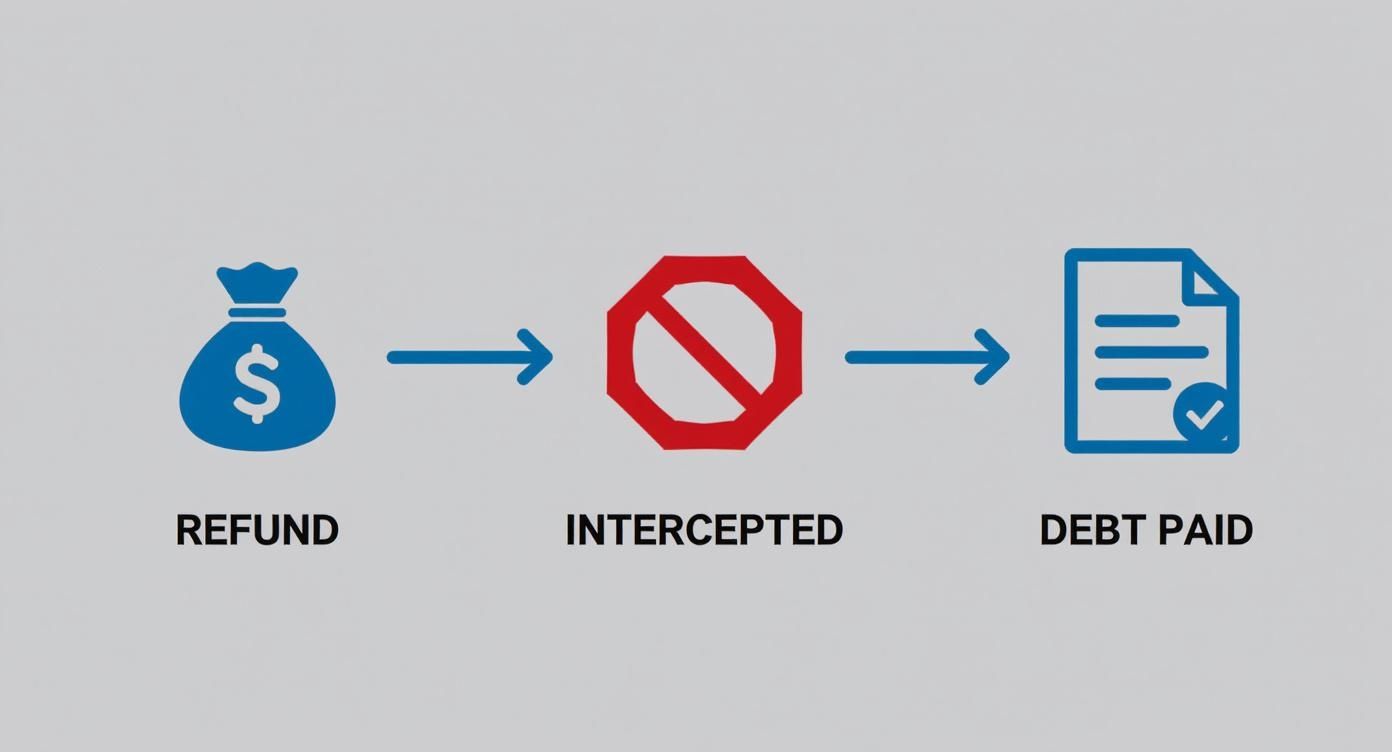
As you can see, the moment your refund is approved, the TOP system checks for any flags. If it finds one, it intercepts the funds before they ever have a chance to land in your bank account.
From Debt Reporting to Refund Seizure
The journey from an unpaid bill to a seized refund follows a clear, legally defined path. It doesn't happen overnight or without warning.
First, the agency you owe money to is required to send you a "Notice of Intent to Offset" at least 60 days before they can even submit your debt to the TOP. This letter is your official heads-up, giving you a crucial window to dispute the debt or arrange a payment plan directly with them.
If you don't resolve the issue within that timeframe, the agency will refer your account to the TOP. Once you're in that database, the process is largely automated. The next time you're due a refund, the system will automatically grab it, apply it to your balance, and then send a separate notice from the Bureau of the Fiscal Service explaining where your money went.
Understanding the Offset Notice You Received
A tax refund offset shouldn't come out of nowhere. Federal law actually requires government agencies to give you a heads-up before they take your refund, so you have a chance to see what’s going on and do something about it. The process involves two key letters you need to watch out for.
The first one you’ll get is the Notice of Intent to Offset. Think of this as the warning shot. The agency you owe—whether it's the Department of Education for a student loan or your state’s tax department—is required to mail this letter to your last known address at least 60 days before they hand your debt over to the Treasury Offset Program (TOP). This notice is your single best chance to get ahead of the problem.
This initial letter will lay everything out for you:
- The type of debt and the exact amount you owe.
- The agency's plan to collect that debt by taking your tax refund.
- Your right to see the records related to the debt.
- How you can officially dispute the debt or set up a payment plan.
Ignoring this letter is the surest way to see your refund disappear. Acting on it quickly is the key to sorting things out before the TOP even gets involved.
Decoding the Official Offset Letter from the BFS
If you don't resolve the debt after that first warning, the next piece of mail you see will arrive after your refund has already been taken. Once the TOP intercepts your refund, the Bureau of the Fiscal Service (BFS) sends you an official offset notice. This letter is the final confirmation that the offset happened and tells you exactly where your money went.

This second notice isn't a bill—it's more like a receipt for a transaction you didn't authorize. It gives you a full breakdown, which is exactly what you need to figure out what to do next.
When you open this letter, look for these key pieces of information:
- Your Original Refund Amount: This confirms the total refund you were due before any money was taken.
- The Amount of the Offset: This is the line item showing precisely how much of your refund was used to pay the debt.
- The Receiving Agency: This is the most important part. It names the specific government agency that got your money.
- Contact Information: The notice will provide a phone number and address for the agency that collected the funds.
Here’s the number one thing people get wrong: the IRS didn't keep your money. They processed your tax return as usual, but the BFS stepped in and rerouted the payment to another agency. You must contact the agency listed on that BFS notice—not the IRS—to ask questions or dispute the debt.
Knowing how to read these notices is the first step toward getting back in control. The details inside are your roadmap for either fighting a wrongful offset or making arrangements to pay off a valid debt.
Your Guide To Disputing A Tax Refund Offset

It’s a gut-punch moment: finding out the tax refund you were counting on has been intercepted. If you're certain a mistake has been made, don't panic. You have every right to challenge the offset, but the process has to be handled correctly.
Here’s the most important thing to get right from the start: your dispute is with the agency that took your money, not the IRS. The IRS acts like a cashier in this scenario. They calculate your refund, but the Bureau of the Fiscal Service (BFS) is the one that actually reroutes the payment at another agency's request. That agency’s contact info will be right there on the offset notice you received in the mail.
Do You Have a Valid Case for a Dispute?
Before you start making calls, let's figure out if you have solid ground to stand on. Generally, you can build a strong case if you can prove one of the following situations applies to you:
- The Debt is Incorrect: You believe the amount they claim you owe is just plain wrong.
- The Debt Was Already Paid: You have proof, like receipts or bank statements, showing you’ve already cleared this debt.
- You Are Not the Debtor: This is a classic case of mistaken identity—the debt simply isn't yours.
- The Debt is Unenforceable: The debt was either discharged in a bankruptcy or it's too old to be legally collected due to the statute of limitations.
To win a dispute, documentation is everything. Start gathering any relevant paperwork you can find—cancelled checks, court orders, bank statements, or any letters about the debt. Tools using Intelligent Document Processing (IDP) can be a huge help here, allowing you to quickly scan and pull key data from your financial records.
What if the Debt Belongs to Your Spouse?
This is a common scenario. You filed a joint return, and suddenly your shared refund is taken to cover a debt that belongs solely to your spouse—maybe an old student loan from before you even met. In this situation, you’re not disputing the debt itself. Instead, you're asking for your portion of the refund back.
This is where Form 8379, Injured Spouse Allocation, comes into play. Filing this form tells the IRS to split the refund based on who earned what and who paid what in taxes, protecting your share from being seized. You can file Form 8379 with your tax return ahead of time if you expect an offset, or you can file it separately after the fact.
Key Distinction: Don't confuse an "Injured Spouse" with an "Innocent Spouse." An injured spouse claim is used when your joint refund is taken for your spouse's separate debt. An innocent spouse claim is a completely different process for seeking relief from tax debt that was created by your spouse without your knowledge on a joint return.
A Tale of Two Paths: Disputing vs. Claiming Injured Spouse Status
It can be confusing to know which route to take. This table breaks down the two most common scenarios to help you decide on the right course of action.
| Scenario | Correct Action | Who to Contact | Key Form/Process |
|---|---|---|---|
| The debt itself is wrong (incorrect amount, already paid, not yours). | Dispute the Debt | The creditor agency listed on the offset notice. | Follow the agency's specific dispute resolution process. |
| The debt is valid but belongs only to your spouse, and your joint refund was taken. | File an Injured Spouse Claim | The IRS. | File Form 8379, Injured Spouse Allocation. |
Essentially, if the problem is with the debt, talk to the agency that owns it. If the problem is that your joint refund was unfairly taken for a spouse's debt, talk to the IRS.
Building and Submitting Your Case
Once you've gathered your evidence, reach out to the agency on your offset notice to officially start the dispute. They'll walk you through their specific procedures.
Having airtight records is your best asset. A great starting point is pulling your official tax documents directly from the source. Knowing how to get an IRS transcript online gives you access to the exact records the government has on file, which can be invaluable proof. A well-documented, clearly presented case gives you the best possible shot at getting your money back.
How to Prevent Future Tax Refund Offsets
Let's be honest, finding out your tax refund has been seized is a gut punch. It’s stressful, frustrating, and can throw your financial plans into chaos. The best way to deal with an offset is to make sure it never happens in the first place.
A few proactive habits can keep you off the Treasury Offset Program's radar and ensure your refund lands safely in your bank account, year after year.
The number one reason people get blindsided by an offset? Outdated contact information. If government agencies can't find you, they can't warn you. Make it a priority to keep your current mailing address updated with any agency you owe, from the Department of Education to your state's revenue department.
Stay Ahead of Your Debts
Don't let a manageable debt snowball into a delinquent one. If you have an outstanding balance—whether it's student loans, back taxes, or something else—the key is to open a line of communication. Most agencies would much rather work with you than send your account to collections.
Think about taking these steps:
- Get on a Payment Plan: Call the agency holding your debt. Ask about setting up a payment plan you can actually afford. This simple action keeps your account in good standing and away from the TOP.
- Look into Deferment or Forbearance: If you're struggling with federal student loans, you might qualify to temporarily pause your payments through deferment or forbearance. This can give you breathing room without triggering a default.
- Never Ignore Official Mail: That "Notice of Intent to Offset" is your final warning. Responding to it immediately is your last, best shot at resolving the debt directly before they take your refund.
Check Your Status Before You File
Worried you might have an old debt lurking that could trigger an offset? You don't have to file your taxes and hope for the best. You can find out for yourself if you're in the Treasury's database.
The Bureau of the Fiscal Service (BFS) has an automated hotline just for this. You can call the TOP Call Center to see if you have an offset pending. It’s a quick, simple check that gives you a straight answer and puts you back in the driver's seat.
By keeping your info current, managing your debts proactively, and checking your status when in doubt, you can dramatically lower your risk of a future tax refund offset. It’s all about swapping that feeling of uncertainty for one of financial control.
When Should You Bring in a Tax Professional?
Look, you can often handle a straightforward tax refund offset on your own. It's like changing a flat tire—a bit of a hassle, but manageable. But some situations are more like trying to rebuild an engine on the side of the road. That’s when you need to call in a pro.
So, when does it make sense to get professional help?
Facing a Multi-Front Battle
If you're getting notices from the IRS, your state's tax agency, and maybe even the Department of Education all at once, things can get chaotic fast. Juggling different rules, deadlines, and contacts is overwhelming. A tax professional can coordinate all of it for you.
Disputing a Complicated Debt
What if the debt they're collecting seems wrong? Maybe it's ancient, or the records are a mess. Challenging these kinds of debts requires a deep understanding of the law, solid evidence, and skilled negotiation. This isn't a DIY project; it's where an expert really shines.
Filing a Complex Injured Spouse Claim
If you're filing an Injured Spouse Claim (Form 8379) and your joint finances are anything but simple—think business income, investments, or separate assets—it's incredibly easy to make a mistake. A tax advisor ensures the form is prepared perfectly to protect your share of the refund.
A seasoned expert from Allied Tax Advisors doesn't just give you advice; they become your official representative. They’ll get on the phone with the agencies for you, handle the endless paperwork, and make sure every legal option is on the table.
Sometimes, a great first step is getting help from the IRS Taxpayer Advocate Service. A professional can guide you through that process, too. The right support doesn't just save you from headaches—it can often save you a substantial amount of money.
Frequently Asked Questions About Tax Offsets
Running into a tax refund offset can feel confusing and frustrating. It’s natural to have a lot of questions. Here are some straightforward answers to the most common concerns we hear from taxpayers who find their refund is smaller than they anticipated—or doesn't show up at all.
How Can I Find Out if I Have a Tax Refund Offset?
You don't have to be left in the dark, waiting for a letter that might come too late. The Bureau of the Fiscal Service (BFS) has a system you can use to check for yourself.
The easiest way is to call the Treasury Offset Program (TOP) Call Center's automated line. This service can tell you right away if you have an offset pending against you. It's the fastest method to get a clear answer, even before you've filed your taxes.
Will I Get Any Leftover Money if the Debt Is Smaller Than My Refund?
Yes, absolutely. The government is only entitled to collect the specific amount you owe. They can't just keep your entire refund.
Think of it this way: if you're owed a $3,000 refund but have an old student loan debt for $1,200, the Treasury will take just the $1,200 to settle that debt. The remaining $1,800 is still yours, and the IRS will send it to you. You'll also get an official notice from the BFS explaining exactly where the money went.
You are always entitled to any portion of your refund that exceeds your total offsettable debt. The government's goal is debt collection, not keeping your entire refund regardless of what you owe.
How Long Does the Treasury Offset Program Keep a Debt on File?
A debt will stay active in the TOP database for as long as it's legally collectible and the agency you owe money to keeps reporting it. There's no single expiration date for all debts; it really depends on the specific type of debt and the laws around it.
For many federal debts, like a defaulted federal student loan, there’s generally no statute of limitations for this kind of collection. That means it can follow you for years, staying in the system until the debt is fully paid or otherwise resolved.
Can a Tax Refund Offset Be Reversed?
It's possible, but only if you can prove the offset was a mistake. Reversing an offset isn't about asking for a second chance; it's about formally disputing the debt with solid evidence to back up your claim.
If you believe your refund was taken in error, you need to:
- Contact the agency that received your payment—this is crucial, as the IRS can't help you here.
- File a dispute with them, providing proof that the debt isn't valid, was already paid, belongs to someone else, or is unenforceable for some other legal reason.
If the agency agrees your dispute is valid, they will notify the Treasury to return your money. This can be a slow process, so acting quickly and having your documentation in order is key.
Trying to sort out a tax refund offset on your own can be a real headache, especially when you're up against government agencies and strict deadlines. If you're dealing with a complex dispute or need to file an Injured Spouse Claim, the team at Allied Tax Advisors has the expertise to help you through it. We can represent you, manage the paperwork, and fight to protect your rights. Visit us online to schedule a consultation and take control of your tax situation.