
Ever heard of the "pay-as-you-go" tax system? That's essentially what estimated tax payments are. If you're a freelancer, run your own business, or have other income sources that don't have taxes automatically taken out, you can't just wait until Tax Day in April to settle up with the IRS. This system is how you pay your taxes in quarterly chunks throughout the year, much like a traditional employee has taxes withheld from every paycheck.
Deconstructing the Pay-As-You-Go System
At its heart, the U.S. tax system is built to collect taxes as you earn your money, not in one lump sum at the end of the year. For most W-2 employees, this process is practically invisible. Their employer handles withholding a portion of each paycheck and sends it straight to the government. But when you earn money outside of that traditional employer-employee relationship, that automatic withholding simply doesn't exist.
This is precisely where estimated tax payments come into play. They are the official method for people and businesses to stay current on their tax obligations for all that income not subject to withholding. It’s a proactive approach that helps you avoid a massive, potentially unmanageable tax bill come April, and it also keeps a steady stream of revenue flowing to fund government services.
This system isn't new; it was formally established back in 1943 with the Current Tax Payment Act. The goal was to ensure those with significant non-wage income paid their taxes throughout the year, which helps stabilize government cash flow and prevents huge year-end tax surprises for filers. You can see how this system works in practice by looking at the IRS filing season statistics.
For those who just need the highlights, this table breaks down the essentials.
Estimated Tax Payments At a Glance
| Key Aspect | Brief Explanation |
|---|---|
| What It Is | A "pay-as-you-go" system for paying taxes on income not subject to withholding. |
| Who Pays | Primarily self-employed individuals, freelancers, small business owners, and investors. |
| Threshold | Required if you expect to owe $1,000 or more in taxes for the year. |
| Frequency | Paid in four quarterly installments throughout the year. |
| Purpose | To avoid a large tax bill in April and prevent underpayment penalties. |
This quick summary gives you the basics, but let's dig a bit deeper into who exactly needs to be making these payments.
Who Typically Makes These Payments?
While the official rules have some nuances, the need to pay estimated taxes usually falls on a few specific groups of people. You’ll almost certainly need to make these payments if you are:
- Self-employed: This is a huge category that includes freelancers, independent contractors, and gig economy workers.
- Small business owners: Sole proprietors, partners in a partnership, and S corporation shareholders are common examples.
- Investors: Anyone earning significant income from dividends, capital gains, or interest should pay attention.
- Recipients of other income: This can include money from rental properties or even alimony.
The core principle is actually quite simple.
If you expect to owe at least $1,000 in tax for the year after subtracting any withholding and tax credits, the IRS expects you to pay estimated taxes.
This guide is designed to walk you through the entire process, breaking it down into clear, manageable steps. We'll cover why these payments are necessary, who needs to make them, and how to figure out your payments without getting a headache. Our goal is to turn a confusing topic into a simple roadmap, so you can handle your tax duties with confidence and sidestep any costly penalties.
Who Needs to Pay Estimated Taxes?

Figuring out if you need to make estimated tax payments can seem a bit murky at first, but the core idea is pretty simple. If you have income rolling in where taxes aren't automatically taken out, it's up to you to send that money to the IRS throughout the year.
This isn't just for traditional business owners, either. The net is cast much wider than you might think, covering anyone whose income doesn't come with the standard W-2 payroll withholding. If you're earning money and no employer is handling the tax side of things, the buck stops with you.
The Self-Employed and Gig Economy Workers
The most obvious group that needs to pay estimated taxes is the self-employed. This world has blown up in recent years and now includes a huge range of professionals who are their own boss.
If you're in one of these roles, you're effectively running your own business, and that means managing your own tax obligations.
- Freelancers and Independent Contractors: Think writers, designers, consultants, or anyone who works on a project-by-project basis for different clients.
- Gig Economy Participants: This is anyone driving for a rideshare app, making deliveries, or earning cash through other online platforms.
- Small Business Owners: This includes sole proprietors, partners, and S-corp shareholders who take income that isn't a formal salary.
For anyone on this list, every check from a client is pure gross income. Unlike a regular employee, no one has pulled out money for Social Security, Medicare, or federal income tax. That’s why making estimated payments is so critical.
Investors and People with Other Income Streams
But the requirement to pay estimated taxes doesn't stop with business income. If you have significant money coming in from sources other than your main job, you're likely on the hook, too. The goal is to make sure all your major earnings are taxed as you go.
Just think about any income that shows up without any tax withheld.
The trigger for paying estimated taxes is pretty clear-cut: if you expect to owe at least $1,000 in tax for the year after subtracting any withholding and credits, you generally have to pay estimated tax.
This rule often catches people like:
- Investors: Anyone earning a good chunk of change from dividends, interest, or capital gains when they sell stocks or other assets.
- Landlords: If you're collecting rent from properties you own, that's taxable income.
- Retirees: Some pensions and retirement distributions don't have taxes withheld. Understanding how federal retirement income is taxed is essential to see if you fall into this category.
- Others: This can include anyone receiving other types of income not subject to withholding, like alimony.
Putting It All Together: Real-World Scenarios
Let's make this practical. Say you're a graphic designer with a full-time W-2 job, but you take on a freelance project that nets you $8,000. No taxes were withheld from that side gig, so you'll almost certainly owe more than the $1,000 threshold. Time to make an estimated payment.
Or imagine you sell some stock and walk away with a $20,000 capital gain. That profit is taxable income. If you don't send in an estimated payment, you could be staring down a huge tax bill—and penalties—come April.
The IRS gives you two key rules to follow to know for sure:
- You expect to owe at least $1,000 in tax for the current year.
- You expect your withholding and refundable credits to be less than the smaller of these two numbers:
- 90% of the tax you'll report on your current year's return.
- 100% of the tax you paid on last year's return (or 110% if your adjusted gross income was over $150,000).
If both of these apply to your financial picture, then making those quarterly payments isn't just a smart move—it's a requirement.
How to Calculate Your Estimated Tax Payments
Figuring out your estimated tax payments can feel like you're trying to hit a moving target, but it's more manageable than it looks. The IRS knows you don't have a crystal ball to predict your exact income for the year. That's why they've created a few structured approaches to help you get close.
At its heart, the goal is simple: make a solid guess at your total tax bill for the year and then break that amount into four quarterly payments. This involves projecting your income, subtracting your business expenses and deductions, and factoring in any tax credits you expect to receive.
If you're dealing with a lot of complex documents to pull these numbers, a tool like an AI-powered Tax Document Analyzer can be a huge help in making sure no important figures get missed.
So, let's dive into the two main methods the IRS gives you to nail down your numbers.
The Safe Harbor Rule: A Simple Approach
The Safe Harbor Rule is by far the most straightforward way to calculate your payments. If your income is fairly consistent from year to year, this is probably the method for you. Think of it as a safety net—as long as you meet a certain threshold based on last year's tax bill, you’re protected from underpayment penalties.
Here's the breakdown:
- Pull out last year's tax return and find your total tax liability (it's on line 24 of Form 1040).
- Your total estimated payments for this year need to be at least 100% of that number.
- There's one catch: If your Adjusted Gross Income (AGI) last year was more than $150,000 (or $75,000 if you're married filing separately), you have to pay 110% of last year's tax to be in the "safe harbor."
By sticking to this rule, you can set up four equal payments and pretty much forget about it. Even if you have a fantastic year and your income shoots up, you won't get hit with a penalty.
Key Takeaway: The Safe Harbor Rule gives you a clear, fixed target. Pay 100% (or 110%) of last year's tax liability, and the IRS generally won't penalize you for underpayment. It’s perfect for people with predictable income.
The beauty of this method is its simplicity—no need to forecast your current year's income. The downside? If your income drops this year, you’ll end up overpaying your taxes and giving the government an interest-free loan until you file your return and get it back.
The Annualized Income Method: For Fluctuating Earnings
What if your income is anything but steady? If you're a freelancer, a seasonal business owner, or have income that spikes and dips, the Annualized Income Method is built for you.
Instead of one yearly calculation, this approach lets you pay as you go. You adjust your payments based on what you actually earn in each quarter. You essentially "annualize" your income at the end of each payment period to figure out what you owe, which means your payments will mirror your cash flow.
This method definitely takes more work, since you'll be running the numbers before each quarterly deadline. But for anyone with an unpredictable income, the benefit is massive. You can learn more about managing this in our detailed guide to quarterly taxes.
- Pro: You won’t overpay during a slow quarter, which is great for managing your cash flow.
- Con: It demands meticulous bookkeeping and requires you to recalculate your tax situation four times a year.
A Practical Walkthrough Using Form 1040-ES
The official tool for this whole process is Form 1040-ES, Estimated Tax for Individuals. It looks a bit daunting at first, but it’s really just a step-by-step worksheet.
Here's a simplified rundown of how it works:
- Estimate Your Adjusted Gross Income (AGI): Project your total income for the year (from your business, investments, etc.) and then subtract any "above-the-line" deductions, like student loan interest or IRA contributions.
- Calculate Your Taxable Income: Take your estimated AGI and subtract either the standard deduction for the year or your total itemized deductions (like mortgage interest and charitable giving).
- Figure Out Your Estimated Tax: Use the current year's tax brackets to calculate the income tax on your estimated taxable income. Crucially, don't forget to add in your self-employment tax, which is typically 15.3% on 92.35% of your net self-employment income.
- Subtract Tax Credits: Deduct any tax credits you’re eligible for, like the Child Tax Credit. What’s left is your total estimated tax for the year.
- Determine Your Required Annual Payment: This is where the Safe Harbor rule comes back into play. Your required payment is the smaller of two numbers: 90% of this year's estimated tax or 100%/110% of last year's tax bill.
- Calculate Your Quarterly Payment: Take your required annual payment and just divide it by four. That's the amount you need to send in by each deadline.
The Rhythm of Estimated Tax Payments: A Year-Round Schedule
Think of your estimated tax payments as a financial rhythm you need to follow throughout the year. The IRS sets a specific quarterly calendar, and staying in sync is non-negotiable if you want to steer clear of penalties. The first, and maybe most important, step is getting these dates firmly planted in your calendar.
Now, the term "quarterly" can be a little misleading. It makes you think of four neat, equal three-month blocks, but the reality is quite different. The payment periods are actually uneven, which is a common stumbling block for many freelancers and business owners. Knowing how this unique schedule works is key to managing your cash flow and keeping the IRS happy.
This timeline lays out the standard federal due dates you'll need to know.
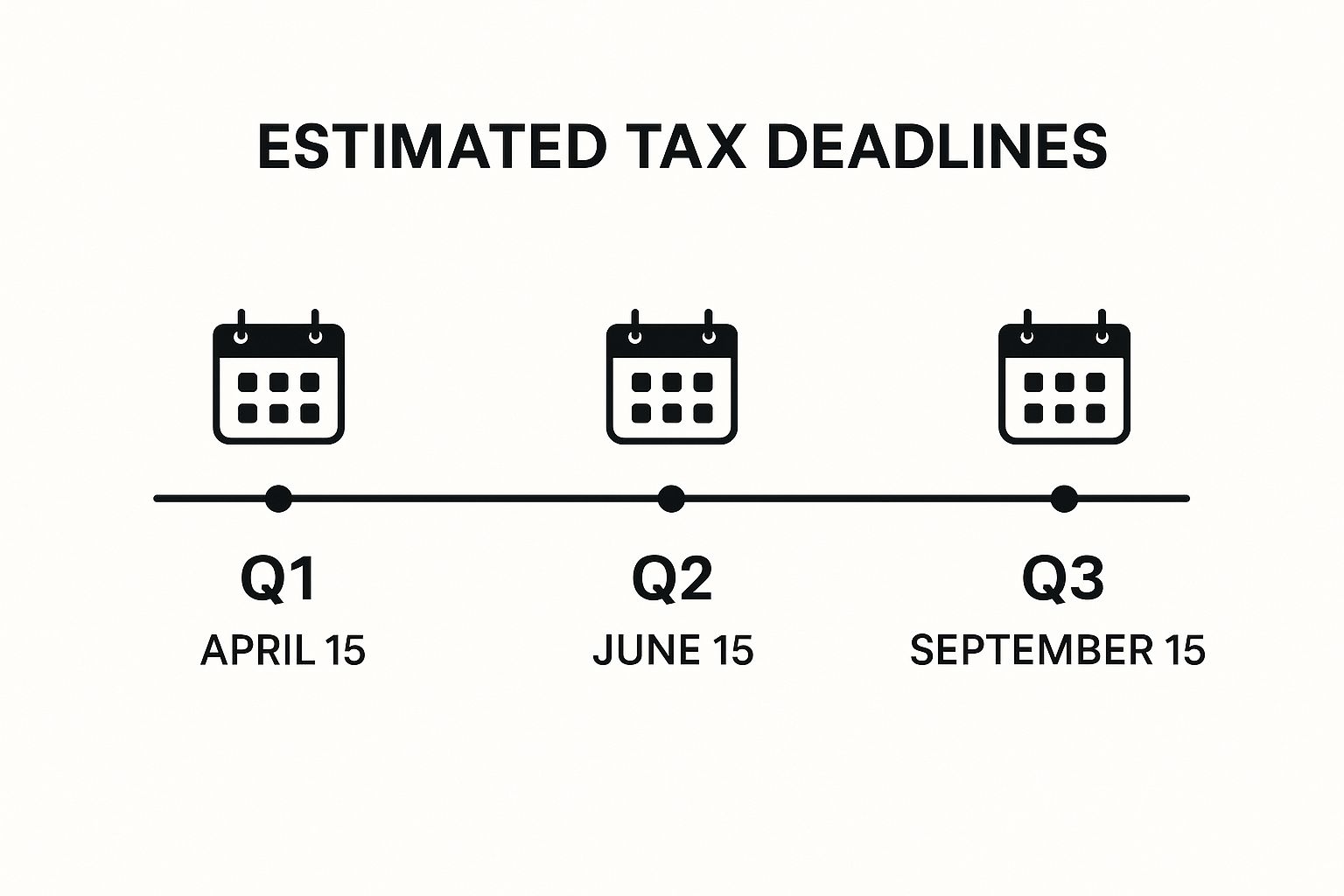
As you can see, the big four dates are April 15, June 15, September 15, and January 15 of the following year. Getting a handle on this schedule is fundamental to mastering your estimated tax obligations.
Matching Your Income to the Right Payment Period
One of the most frequent questions I get is, "Which income does each payment cover?" It's a great question because it’s not as simple as one payment per quarter. You have to align your earnings with the correct, and sometimes quirky, timeframes set by the IRS.
To make it crystal clear, here is a schedule mapping the income periods to their payment deadlines.
IRS Estimated Tax Payment Deadlines and Coverage Periods
| For Income Earned During | Payment Due Date |
|---|---|
| January 1 – March 31 | April 15 |
| April 1 – May 31 | June 15 |
| June 1 – August 31 | September 15 |
| September 1 – December 31 | January 15 (of the next year) |
Notice how the second "quarter" is only two months long, while the last one covers four. This is especially critical if you use the annualized income method to calculate your payments, as that approach requires you to report income earned within these exact windows.
Expert Tip: These are the federal deadlines. If you live in a state with an income tax, it almost certainly has its own estimated tax system with its own schedule. Don't assume the dates are the same—always check with your state's tax agency.
What If a Deadline Falls on a Weekend or Holiday?
So, what happens when a due date like April 15 lands on a Saturday or a public holiday? Thankfully, the IRS has a simple, common-sense rule for this.
If a payment deadline falls on a weekend or a legal holiday, your payment is still considered on time as long as it's made by the very next business day. So, if April 15 is a Sunday, your deadline automatically slides to Monday, April 16. It’s a small bit of breathing room that keeps you from getting penalized for the calendar working against you.
Keep in mind that major events can also shift these dates. The IRS often postpones deadlines for taxpayers in federally declared disaster areas, like those affected by hurricanes or wildfires. If you're ever in that situation, check the official IRS news releases for updates. The best strategy is to set calendar reminders well in advance and stay proactive—it’s the easiest way to stay compliant and avoid any last-minute stress.
How to File and Pay Your Estimated Taxes
Alright, you've crunched the numbers and figured out what you owe for the quarter. Now comes the easy part: actually getting that money to the IRS.
Fortunately, you have options. The IRS has moved far beyond the days of only accepting paper checks, giving you several ways to pay. Whether you prefer a quick digital click or the old-school feel of a paper voucher, there's a method that will work for you.
Modern Electronic Payment Options
For most people, paying online is the way to go. It's fast, secure, and you get immediate confirmation that the IRS has your money. No more wondering if your check got lost in the mail.
Here are the most popular digital routes:
- IRS Direct Pay: This is the simplest tool for online payments. You can pay straight from your checking or savings account directly on the IRS website for free. You don't even have to create an account.
- Electronic Federal Tax Payment System (EFTPS): Think of EFTPS as the pro version. It's also free, but it does require enrollment. The big advantage here is the ability to schedule payments up to 365 days in advance and see a complete history of all your federal tax payments in one place.
- Debit Card, Credit Card, or Digital Wallet: You can also use your card or a service like PayPal. Just know that you'll be going through a third-party payment processor, and they charge a fee for the convenience.
Going digital gives you peace of mind. You get an electronic receipt instantly and avoid any potential mail-related headaches.
Traditional Mail-In Payments
If you’re more comfortable with a paper trail, you can absolutely still mail a check or money order.
To do this, you’ll need to use the payment vouchers that come with Form 1040-ES, Estimated Tax for Individuals. The form package includes four separate vouchers, one for each payment deadline.
Just fill out the correct voucher for the quarter, make your check payable to the "U.S. Treasury," and mail it to the address specified in the form instructions for your location.
Pro Tip: Don't forget this part! Always write your Social Security number and the tax year on the front of your check—something like "2024 Form 1040-ES" in the memo line. This ensures your payment gets credited to the right person and the right tax period.
This whole "pay-as-you-go" system isn't just a U.S. thing. Many countries have similar requirements for self-employed workers and investors. It's a standard practice that helps governments maintain a steady revenue stream. You can find more global tax practice insights from the OECD if you're curious.
At the end of the day, how you pay is up to you. Whether you value the instant confirmation of an online transaction or the tangible record of a mailed check, the most important thing is to get your payment in correctly and on time, every single quarter.
Avoiding Common Mistakes and Underpayment Penalties
Handling estimated tax payments can feel a bit like walking a tightrope, but sticking the landing and avoiding penalties is easier than you think. The IRS isn't out to get you; the system is just designed to have you pay tax as you earn income, not all at once at the end of the year. When you get that timing wrong, you can get hit with an underpayment penalty.
Think of this penalty as an interest charge on the money you should have paid each quarter. The rate changes, but it's calculated from the moment a payment was due until the day you finally pay up. That interest can pile up surprisingly fast, turning what was once a manageable tax situation into a real headache.
Pinpointing Frequent Taxpayer Pitfalls
The best way to sidestep these penalties is to know where the common traps are. I've seen countless well-meaning freelancers and small business owners get dinged with penalties, not because they were trying to cheat the system, but because of a few simple, avoidable mistakes.
Here are the most common slip-ups that trigger underpayment penalties:
- Forgetting a Payment: Life is busy. It's shockingly easy to let a quarterly deadline fly right by. The simplest fix? Put the four payment dates in your calendar right now with alerts.
- Miscalculating Income: Underestimating what you'll earn for the year is a classic mistake, especially if your income bounces around. It's so important to check in on your earnings periodically and bump up your payments if you have a great quarter.
- Failing to Adjust for Windfalls: Did you land a huge one-off project or sell some stock for a big gain? That extra cash can throw your tax calculations way off. If you don't send in a bigger estimated payment to cover it, you're almost asking for a penalty.
- Ignoring State Estimated Taxes: This one gets people all the time. They're so focused on the IRS that they completely forget their state wants a piece of the pie, too. Most states with an income tax have their own estimated tax rules and, you guessed it, their own penalties.
If your financial picture is complicated, bringing in some help from professional accounting and tax services can be a game-changer. They can make sure you're covered on all fronts.
When Can Penalties Be Waived or Reduced?
The IRS knows that life doesn't always go according to plan. In some cases, they're willing to reduce or even waive the underpayment penalty if you have a good reason.
The key is proving that your failure to pay on time wasn't due to willful neglect. Circumstances beyond your control are often viewed with more leniency.
While it's never a sure thing, you might get a break from the IRS in these situations:
- Disaster, Casualty, or Unusual Circumstance: If you were in the path of a federally declared disaster, like a hurricane or wildfire, the IRS often grants automatic penalty relief and moves deadlines back.
- Retirement or Disability: If you retired (after turning 62) or became disabled during the tax year (or the year before), you may qualify for a waiver. You'll have to show that your underpayment had a reasonable cause and wasn't intentional.
- Income Fluctuation: Did most of your income come in late in the year? You can use Form 2210, Underpayment of Estimated Tax by Individuals, Estates, and Trusts, to show the IRS exactly when you earned the money. This is called the annualized income method, and it can often lower or completely wipe out the penalty.
Falling behind on payments can be expensive, but knowing the rules—and the exceptions—puts you back in the driver's seat. For a deeper dive into penalties, our guide on how to avoid costly fees for late tax filing has even more strategies to keep you in the clear.
Common Questions About Estimated Tax Payments
Even when you've got a handle on the basics, real-life situations always bring up new questions about estimated taxes. Let's walk through some of the most common "what if" scenarios that trip up freelancers, business owners, and investors every year.
Getting these details right is the key to handling your tax obligations with confidence.
What If My Income Changes During the Year?
Life happens. Your income isn't set in stone, and neither are your estimated tax payments. If you land a huge new client or hit an unexpected slow spell, it’s time to revisit your numbers before the next payment is due.
This is a critical step for staying on the right side of the IRS.
- If your income jumps up, you'll need to increase your next quarterly payments to cover the difference.
- If your income drops, you can lower your future payments, which is a great way to protect your cash flow when you need it most.
All you have to do is grab the worksheet in Form 1040-ES and recalculate your payments for the rest of the year. This flexibility is precisely why the Annualized Income method is a lifesaver for anyone with an unpredictable income stream.
Do I Have to Pay State Estimated Taxes Too?
Yes, absolutely. This is a big one, and it’s surprisingly easy to overlook. If your state collects income tax, you can bet it has its own system for estimated tax payments. Forgetting about this can leave you facing state-level penalties, even if your federal payments are perfect.
State rules, forms, and due dates can be completely different from what the IRS requires. You have to check with your state's tax agency to know what’s expected of you. Don’t assume the rules are the same.
For example, a consultant based in California has to juggle federal deadlines with the IRS and a separate set of deadlines with the Franchise Tax Board.
Can I Just Pay Everything in April When I File?
I wish it were that simple, but no. The U.S. tax system is built on a "pay-as-you-go" foundation. That means the government expects you to pay tax on your income as you earn it throughout the year, not all at once at the end.
If you’re required to make estimated payments, waiting until April to settle your entire tax bill will almost certainly result in an underpayment penalty. It doesn't matter if you pay the full amount then—the penalty is for not paying on time in quarterly installments.
What Happens If I Overpay My Estimated Taxes?
It's actually pretty common to overpay, especially if you'd rather be safe than sorry. When you file your annual tax return and realize you sent the IRS too much money, you have two clear options.
- Get a Refund: You can simply ask for the extra cash back, just like a regular tax refund.
- Apply It to Next Year's Taxes: A smart alternative is to have the overpayment credited toward next year's estimated taxes.
Applying the overage is a great way to get a head start on the following year—it can even cover your entire first-quarter payment. To figure out if you've overpaid, you need accurate numbers. Using a detailed 2024 tax filing checklist is the best way to make sure everything is in order.
Estimated taxes can feel like a moving target, but you don't have to figure it all out on your own. The experts at Allied Tax Advisors are here to offer personalized guidance, helping you stay compliant while making the best decisions for your financial health. Contact us today to see how we can help.