
You're probably here because you moved to the U.S., left the U.S., changed visa status, got a green card, or earned income in more than one country and now the tax software is asking a question that matters: Should you file Form 1040 or Form 1040-NR?
Individuals often make expensive mistakes. They assume the answer follows their passport, visa, or where their employer is based. It doesn't. The form choice usually turns on U.S. tax residency, and if you get that wrong, you can report the wrong income, miss required filings, or expose foreign income that didn't belong on the return in the first place.
Most articles stop at “1040 is for residents, 1040-NR is for nonresidents.” That's too shallow to be useful. Real life is messier. People arrive mid-year, leave mid-year, work remotely for foreign companies while living in the U.S., hold F or J visas, or end up in a dual-status year without realizing it.
Table of Contents
- Determining Your U.S. Tax Residency Status
- Form 1040 vs 1040-NR A Core Comparison
- Key Differences in Deductions and Credits
- Navigating Complex Filing Scenarios
- The Important Role of Tax Treaties
- When to Get Professional Tax Help
Determining Your U.S. Tax Residency Status
A common filing mistake starts like this: an international employee spends part of the year in the U.S., keeps income abroad, sees a temporary visa in the passport, and assumes Form 1040-NR is the safe choice. Then the day count says otherwise. Now the return is wrong before the first number is entered.
Your filing form follows tax residency
Your filing form follows your U.S. tax residency status. That decision does not turn on citizenship alone, and it does not turn on visa label alone.
If you meet the green card test or the substantial presence test, you generally file Form 1040. If you meet neither, you generally file Form 1040-NR, as explained in this residency overview from Greenback Tax Services.
The green card test is usually straightforward. If you are a lawful permanent resident for tax purposes, the filing path is usually clear.
The harder cases are the ones clients get wrong. F and J visa holders may have exempt days that change the substantial presence calculation. A first-year arrival or departure can create a dual-status year. A remote worker can have U.S. presence, foreign payroll, and mixed-source income all in the same filing year. Those are not edge cases. They are exactly where people pick the wrong form and create expensive cleanup work.

Practical rule: Run the residency tests first. Choose the form second.
How the substantial presence test works
The substantial presence test usually decides the issue for non-green-card filers. You generally qualify as a U.S. tax resident if you were present in the United States for at least 31 days in the current year and your weighted total reaches 183 days over a three-year formula.
Use this order:
- Count all U.S. days in the current year.
- Add one-third of your U.S. days from the prior year.
- Add one-sixth of your U.S. days from the second prior year.
- Check whether the weighted total reaches the threshold.
Do not guess on the day count.
That advice matters most for people with complicated facts. Students and scholars often miscount exempt days. Cross-border employees often ignore short U.S. trips for training, meetings, or onboarding. Remote workers often focus on who paid them and miss the more important question, which is where they were physically present and whether the income is U.S. or foreign source. If you also file abroad, keep your records tight. This expatriate tax guide France is a useful example of how residency and sourcing questions can overlap across countries.
My recommendation is simple. Build a real travel file before you file the return. Pull I-94 records, passport stamps, travel calendars, payroll dates, and visa history. If your result is close, or if you arrived, departed, changed visa status, or worked across borders, get professional help before filing.
The wrong day count leads to the wrong residency result. The wrong residency result leads to the wrong tax form, the wrong income base, and a return that is much harder to fix later.
Form 1040 vs 1040-NR A Core Comparison
Form 1040 vs. 1040-NR key differences at a glance
This is the side-by-side comparison many taxpayers need first.
| Feature | Form 1040 (U.S. Resident) | Form 1040-NR (Nonresident Alien) |
|---|---|---|
| Who generally files it | U.S. citizens and resident aliens | Nonresident aliens |
| Core tax basis | Resident taxation | Nonresident taxation |
| Income reported | Worldwide income | Generally U.S.-source income |
| Foreign income treatment | Usually in scope | Generally not in scope unless otherwise required by the facts |
| Best for | People who meet resident tax rules | People who do not meet resident tax rules |
| Common risk if filed incorrectly | Underreporting foreign income | Overreporting income that may not belong on a nonresident return |
Form 1040 is the standard return for U.S. citizens and resident aliens, and it generally requires reporting worldwide income. Form 1040-NR is for nonresident aliens and generally reports only U.S.-source income, as summarized by Universal Tax Professionals.
That difference is not cosmetic. It determines your tax base.
Why the income scope difference matters
If you file Form 1040 when you should have filed 1040-NR, you may report income the U.S. wasn't taxing under nonresident rules. That can include foreign wages, foreign freelance income, or foreign investment items that a nonresident filer might not report the same way.
If you file 1040-NR when you should have filed 1040, the problem flips. You may leave off foreign income that belongs on a resident return. That's a serious compliance issue.
The biggest practical difference in 1040 vs 1040nr is income scope. Resident returns generally pull in worldwide income. Nonresident returns generally focus on U.S.-source income.
This is why remote workers get tripped up. A person can sit in the U.S., work for a foreign employer, and assume the income is “foreign” because the company is foreign. Tax analysis is rarely that simple. The right answer depends on the facts, and the return has to match the residency result first.
For cross-border filers who also have French nonresident obligations, a useful companion resource is this expatriate tax guide France. It helps frame the other side of the compliance picture when someone is dealing with both U.S. and foreign filing systems.
A practical shortcut is this:
- Use Form 1040 when you are a U.S. tax resident for the year under the applicable rules.
- Use Form 1040-NR when you are a nonresident for the year.
- Stop and review carefully if your status changed during the year, because that may not be a simple one-form answer.
Key Differences in Deductions and Credits
People focus on income reporting first. They should. But the next place errors show up is deductions and credits.
A resident return and a nonresident return don't feel the same because they don't offer the same tax posture in practice. Nonresident filings are generally more limited, and taxpayers often discover that only after they've entered numbers into software designed around standard resident assumptions.

Why nonresident returns usually feel less forgiving
If you're filing Form 1040-NR, don't assume you get the same deductions and credits that appear on a typical resident return. In practice, nonresident returns often involve tighter rules and fewer benefits.
That matters because taxpayers frequently overclaim by copying what a resident friend did, what general tax software suggested, or what last year's return looked like after a status change.
Here's the practical impact:
- Standard deduction assumptions can be dangerous. Many filers move through tax software on autopilot and never stop to ask whether the return type supports the deduction profile they're claiming.
- Credits aren't interchangeable. A credit commonly available on a resident return may not be available, or may apply differently, on a nonresident filing.
- The wrong form distorts the whole return. It's not just one line item. Once the wrong return starts with the wrong residency status, the deduction and credit analysis usually goes wrong too.
If you're trying to understand how refundable credits differ from ordinary deductions, this overview of the earned income credit rules is worth reading before you rely on software prompts.
Where people overclaim and get into trouble
The most common pattern is simple. Someone meets friends at the same university or workplace, compares refunds, and assumes the same tax treatment should apply to everyone. It won't.
Advisor's view: In cross-border tax, “my coworker filed this way” is not evidence. It's usually the start of a mistake.
Another problem shows up when a taxpayer changes status during the year. A resident at year-end may assume the entire year gets resident treatment. A nonresident may assume that no deductions apply because their situation feels unusual. Both assumptions can be wrong.
If your facts include foreign income, visa-based exceptions, treaty benefits, or a mid-year move, don't treat deductions and credits as an afterthought. They follow status, sourcing, and timing. Get those wrong and the tax result won't hold up.
Navigating Complex Filing Scenarios
You arrive in the U.S. in August, keep working remotely for a foreign employer, pick up some U.S. investment income, and assume tax software will sort it out. That is how people file the wrong return.
The hard cases are not rare. They are the cases that cause the most expensive mistakes. If your year includes a move, a visa exception, foreign income, or mixed-source income, stop treating 1040 versus 1040-NR as a simple label. It controls what income belongs on the return, what disclosures apply, and whether you are reporting too much or too little.
Dual-status years
A dual-status year means you were a nonresident for part of the year and a resident for the rest. That often happens when someone moves to the U.S. midyear, leaves midyear, receives a green card during the year, or has facts that change the residency result after applying the normal tests.
The filing problem is practical, not academic. You have to separate the resident period from the nonresident period and assign income correctly. Get that wrong and the return can overreport worldwide income, omit taxable U.S. income, or apply the wrong rules to both periods.
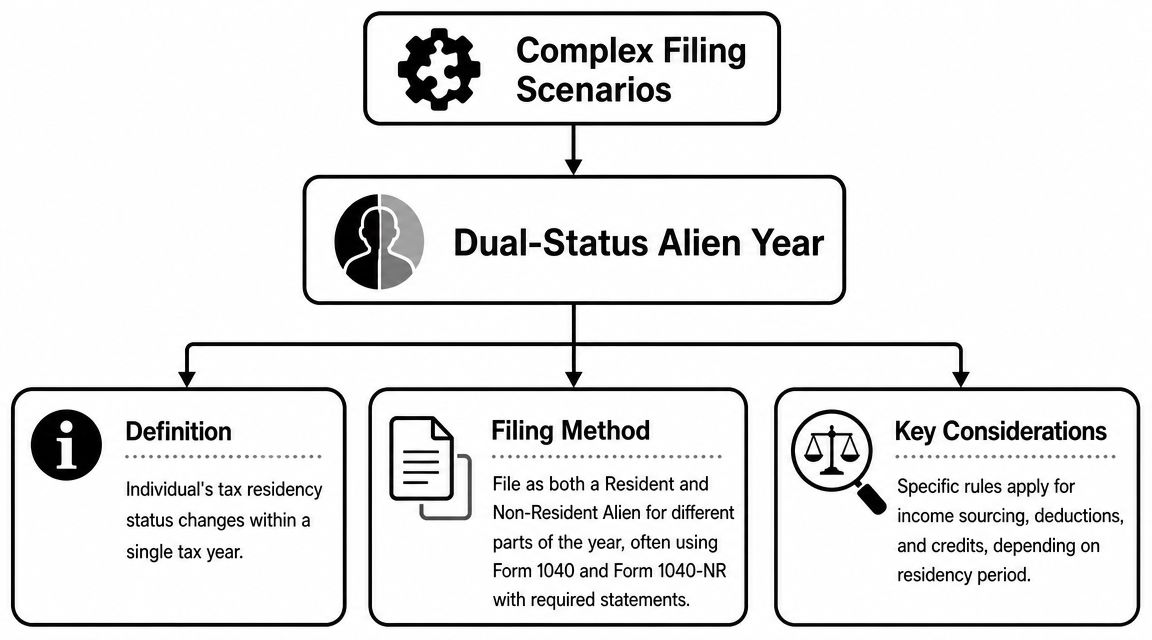
Dual-status filings also create procedural issues. The return may require one form plus supporting statements, not a single clean filing the software prepares correctly by default.
If you already filed the wrong form, fix it before the error spreads into later years. Start with this guide on how to amend a tax return.
Students, scholars, and exempt days
F, J, M, and Q visa holders are where bad tax advice spreads fastest. People hear "nonresident" or "no income" and assume there is nothing to file. That is wrong.
The first question is not your refund. It is whether your days in the U.S. count for residency purposes and whether you must file Form 8843. Many students and scholars miss that step, especially in their first years in the U.S. or after a status change.
Use this framework:
- Confirm your visa category and time in the U.S. Exempt days can change the substantial presence analysis.
- Decide whether Form 8843 is required. A filing duty can exist even without wages.
- Separate immigration-status filing rules from income-tax return rules. They overlap, but they are not the same question.
- Recheck the year of arrival and any status change. Those details often decide whether you stay on 1040-NR, move to 1040, or end up dual-status.
My recommendation is simple. If you are an F-1 or J-1 filer and your facts are anything other than straightforward student wages and the same visa status all year, do not guess.
Remote work, investments, and mixed-source income
This is the fact pattern many international filers get wrong. You spend part of the year in the U.S., work online for a foreign company, maybe do freelance work, and also have U.S. brokerage activity. The answer is not "file 1040 because I lived here" or "file 1040-NR because my employer is foreign." You have to analyze residency status and sourcing together.
A resident generally reports worldwide income. A nonresident generally reports U.S.-source income and income effectively connected with a U.S. trade or business. That distinction matters immediately for remote work. The location where services were performed can matter more than where the employer is based. Investment income adds another layer because different sourcing and withholding rules may apply depending on the type of income and your status.
Crypto can make the recordkeeping worse. If digital asset activity is part of the file, review how to navigate crypto tax forms before you start matching exchange statements to a resident, nonresident, or dual-status return.
Here is the advisor's rule. If your year includes remote work across borders, foreign pay, U.S. presence, and investment income in the same calendar year, treat the return as a sourcing project first and a form-selection question second. That is how you choose the right filing position.
The Important Role of Tax Treaties
A treaty claim can change the answer after you think you have already picked the right form.
That is why treaties deserve their own analysis. They do more than reduce tax on a specific payment. In the right case, a treaty can change residency treatment, exempt income that would otherwise be taxable, or require disclosures that affect whether Form 1040, Form 1040-NR, or a dual-status approach makes sense.
This issue comes up often with international filers who had a messy year. You moved to or from the U.S. midyear. You worked remotely across borders. You are on F, J, M, or Q status and assumed the visa label answered the tax question. It does not. Treaty rules sit on top of the default tax rules, and if you apply them wrong, the return can be wrong from the first page.
Treaty claims require a technical match between the article and your facts
Use the treaty article that fits your income, status, and timing. Do not copy a coworker's filing position, and do not assume that being from the same country means the same treaty result.
A treaty claim only works when the details line up. That includes the specific article, whether you qualify under its terms, whether you are claiming an exemption or a residency tie-breaker, and whether the return reports that position correctly. For international students, trainees, teachers, researchers, founders, and spouses with cross-border moves, this is often where the key decision happens.
F, J, M, and Q visa holders are a common trouble spot. As noted earlier, some of these filers still have Form 8843 filing obligations even when they have little or no U.S. income. That filing requirement is separate from whether a treaty benefit is available.
A treaty is a technical filing position. If you claim it, every part of the return has to support it.
My advice is simple. If your filing depends on a treaty tie-breaker, a treaty-based residency override, or an income exemption under a treaty article, stop treating the return like standard software work. Get someone who handles cross-border filings regularly. If you need help vetting that person, use this guide to find a qualified tax preparer for a complex return.
When to Get Professional Tax Help
Cases that are not do-it-yourself returns
Some returns are manageable. Many international returns are not.
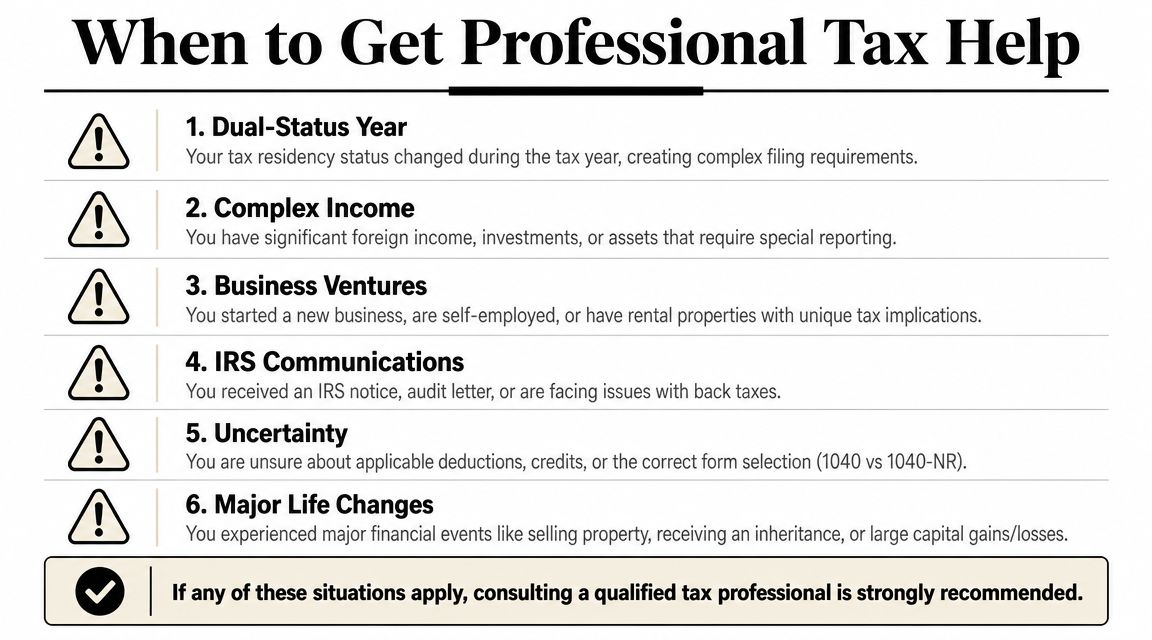
If any of the following apply, stop relying on general tax software and get experienced help:
- Your status changed during the year. Dual-status filing is where many self-prepared returns break.
- You plan to claim a treaty benefit. Treaty positions need technical support and clean reporting.
- You have foreign income and U.S. income in the same year. Mixed-source income invites sourcing errors.
- You're on F, J, M, or Q status and aren't sure whether 8843, 1040-NR, 1040, or nothing else is required.
- You filed the wrong form already. Fixing it early is better than explaining it later.
- You own U.S. rental property, have investment income, or report crypto along with cross-border income.
If you need to vet credentials before hiring someone, use this guide on finding the right tax preparer.
My recommendation
If your facts are clean and stable, one country, one status, one income pattern, you may be able to handle the return yourself.
If your facts changed mid-year, cross borders, involve treaty issues, or don't fit neatly into a software interview, don't wing it. The cost of getting 1040 vs 1040nr wrong is usually higher than the cost of getting it reviewed properly.
The right question isn't “Which form seems familiar?” It's “What was my tax residency status, what income is in scope, and did my facts create exceptions?”
If you're unsure whether you should file Form 1040 or Form 1040-NR, or you need help fixing a return that was already filed the wrong way, talk to Allied Tax Advisors. Their team can review your residency status, identify treaty or dual-status issues, and help you file correctly before a manageable problem turns into an expensive one.