
That sinking feeling when you realize you’ve made a mistake on your tax return is something we see all the time. But don't panic. Fixing it is often much simpler than you might imagine, and the key is knowing whether you actually need to file an amended return—the official Form 1040-X.
Knowing When You Should Amend Your Tax Return

First things first: not every little mistake requires you to go through the amendment process. The IRS is surprisingly good at catching and correcting minor math or clerical errors on its own, so you don't need to jump to file a Form 1040-X for a simple typo.
What about a missing form, like a W-2 you forgot to attach? In that case, the IRS will almost always just send you a letter asking for it. No amendment needed.
So, when is it absolutely necessary? The rule of thumb is this: if the error changes your tax liability—the actual amount of tax you owe—then it’s time to amend. This usually happens when you've made a mistake related to your income, deductions, credits, or filing status.
Common Scenarios That Require an Amendment
Over the years, we've seen a few key situations that almost always require filing a Form 1040-X. If you see your own mistake in this list, it’s a clear sign you need to take action.
- Reporting Incorrect Income: This is a big one. Maybe a freelance client sent you a 1099 after you’d already filed, or you simply forgot to report income from a side hustle. Underreporting income is one of the most common reasons people need to amend.
- Claiming Incorrect Deductions or Credits: Did you realize after filing that you qualified for a major education credit? Or maybe you forgot to deduct a large charitable donation. On the flip side, if you accidentally claimed a credit you weren't entitled to, you need to correct that, too.
- Choosing the Wrong Filing Status: This can dramatically change your tax outcome. For example, filing as "Single" when you were legally married on the last day of the year is a significant error that needs to be fixed by amending to "Married Filing Jointly" or "Married Filing Separately."
- Receiving a Corrected Tax Form: If a W-2c (a corrected W-2) or an updated 1099 shows up in your mailbox after you've filed, you have to amend your return to reflect the new, accurate numbers.
Let’s say a freelance graphic designer files their return in March. A month later, an unexpected 1099-NEC arrives from a client they forgot about. Since this income wasn't on the original return, the designer must file a Form 1040-X to report it and pay the correct amount of tax.
When You Can Skip Filing an Amendment
It’s just as important to know when not to file. Amending a return unnecessarily can actually create confusion and slow down the processing of your original return or refund.
You can usually skip the amendment process for things like:
- Simple Math Errors: The IRS computers are built to catch basic addition and subtraction mistakes. They’ll fix it for you.
- Missing Forms: As mentioned, if you just forgot to attach a form, wait for the IRS to send you a notice. Don’t amend.
- A Tiny Refund Difference: If you crunch the numbers again and find the error only changes your refund by a dollar or two, the effort to amend probably isn't worth it.
Use this quick table as a gut check.
Should You File an Amended Return? A Quick Check
| Scenario | Action Required | Reasoning |
|---|---|---|
| You received a corrected W-2c from your employer. | Yes, Amend | The new numbers change your total income and tax liability. |
| You made a math error adding up your receipts. | No, Wait | The IRS will likely catch and correct the calculation error for you. |
| You found a large charitable donation you forgot to deduct. | Yes, Amend | This changes your total deductions and could result in a refund. |
| You forgot to attach a copy of your Form 1099. | No, Wait | The IRS will send a notice (CP2000) requesting the missing document. |
| You filed as Single but were married on Dec. 31. | Yes, Amend | Your filing status is incorrect and significantly impacts your tax. |
| Your corrected tax due is only $1 different. | No, Skip It | The difference is negligible and not worth the time and effort. |
This should give you a clearer picture of whether it's time to act.
Finally, keep in mind there are deadlines for making these changes. If you’re digging into a return from a few years back, you’ll want to be sure you’re still within the window. You can learn more about the specific deadlines in our guide on how far back you can amend taxes. It’s all about correcting the meaningful errors, not chasing down every last penny.
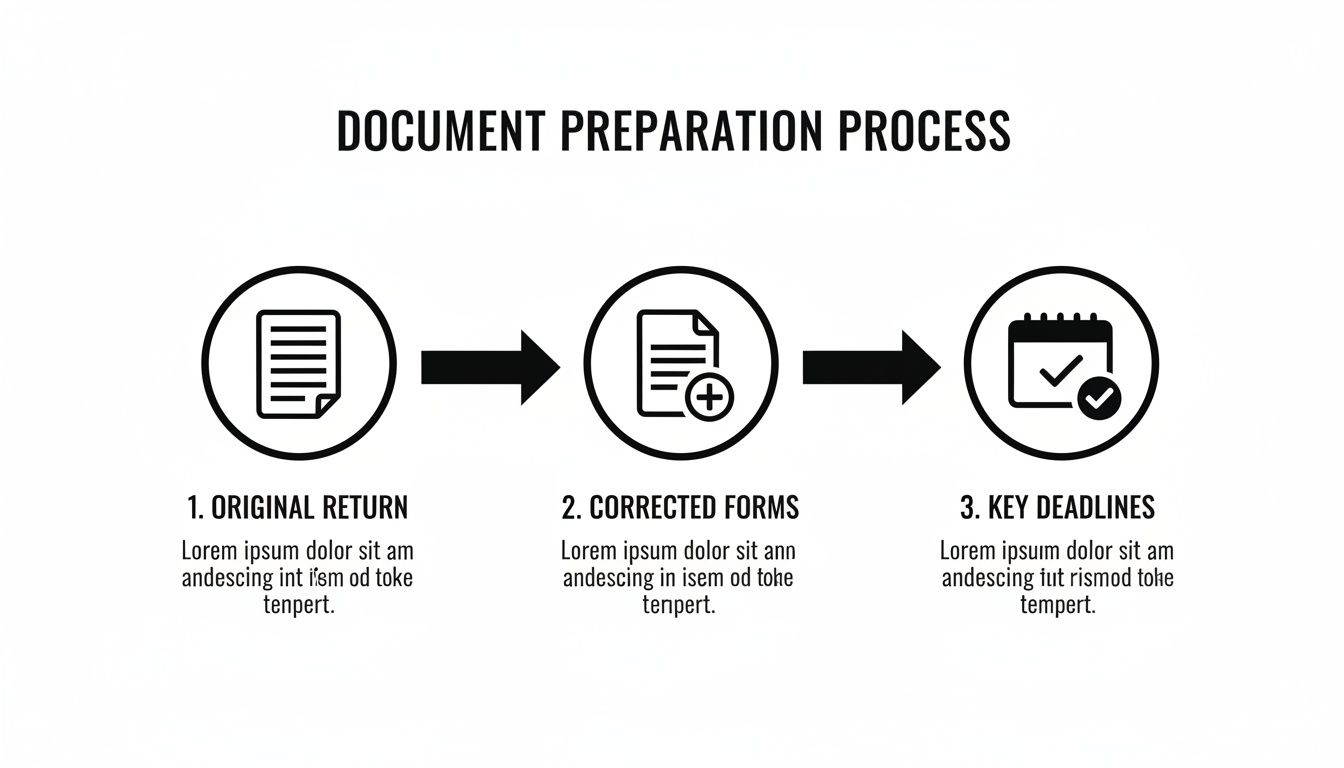
Gathering Your Documents and Understanding Key Deadlines
Before you even touch Form 1040-X, let's talk about prep work. I can't stress this enough: rushing into an amendment without all your paperwork in order is a recipe for a headache. The best way to get this done right is to approach it like you're building a case—you need clear, organized evidence for the changes you're making.
The first thing you absolutely must have is a copy of the original tax return you’re amending. This is your starting point, the "before" picture of what the IRS has on file. Without it, you’ll be flying blind when trying to fill out the columns on the 1040-X, which compare the original figures to the new ones.
Next, round up all the new or corrected documents that are forcing you to amend in the first place. This is your "why." It could be a W-2c (a corrected W-2) that just showed up from your employer, an updated 1099-NEC from a client, or maybe a 1099-DIV with dividend income you completely forgot about. It could also be receipts for a major deduction you missed, like a big charitable gift or a pile of medical bills.
Having solid proof for your deductions is always critical. For instance, if you're a landlord and realize you missed out on some valuable landlord tax write-offs, you’ll need every receipt and record to back up those new claims. If you can’t find your original return, don't panic. Our guide on how to get your IRS transcript online walks you through getting an official record straight from the source.
The Clock is Ticking: IRS Deadlines
When it comes to amending, time is not on your side—especially if you're expecting a refund. The IRS has a strict statute of limitations, and if you miss that window, you could lose out on that money for good.
The big one to remember is the “three-year rule.” You generally have three years from the date you filed your original return to file Form 1040-X and claim a refund. But here’s a common point of confusion: if you filed early, the clock actually starts on the official tax deadline (usually April 15th).
Here’s a real-world example: Let's say you filed your 2022 tax return way ahead of schedule on March 1, 2023. The due date that year was April 18, 2023. Your deadline to amend for a refund isn't three years from March 1st; it's April 18, 2026.
There’s also a less common “two-year rule.” This allows you to file an amendment within two years from the date you paid the tax, if that date is later than the three-year deadline. This might apply if you filed on time but paid a tax bill much later.
How Long Will This Take? Setting Expectations
Once you send off your amended return, it’s time to play the waiting game. Processing a Form 1040-X takes a lot longer than an original return. While the IRS is getting better, you need to be patient.
Right now, the official IRS guidance says to expect a wait of up to 20 weeks or more. This can stretch longer depending on how busy they are and how complicated your changes are.
Thankfully, you won't be completely in the dark. The IRS has a handy "Where's My Amended Return?" tool on their website. Here’s how to use it effectively:
- Give it time. Don’t even bother checking for the first three weeks. Your return needs time to get logged into their system.
- Have your info ready. To track the status, you’ll need your Social Security number, date of birth, and ZIP code.
- Know the lingo. The tool will show one of three statuses:
- Received: They have your Form 1040-X and it’s in line to be processed.
- Adjusted: They’ve finished and made changes to your account. This could mean a refund is coming, you owe more, or there's no change.
- Completed: It’s all done. The IRS has mailed you a notice explaining the outcome.
Getting your documents in order and understanding these timelines from the get-go will make the entire amendment process feel much more manageable. It’s all about setting yourself up for a smooth, successful filing.
A Practical Walkthrough of Completing Form 1040-X
Once you've gathered all your paperwork, it's time to dig into Form 1040-X, Amended U.S. Individual Income Tax Return. At first glance, it can look a bit intimidating, but the form’s design is actually pretty clever. Its whole purpose is to give the IRS a clear "before and after" picture of your tax return.
The key to getting it right lies in understanding its three-column structure. Think of these columns as telling a story.
- Column A: Original amount. This is your starting point. You'll pull these numbers directly from the tax return you originally filed. This column simply reflects what the IRS already has on record.
- Column B: Net change. Here’s where you do the math. For every line you're adjusting, you’ll enter the amount of the increase or decrease. A quick tip: if a number is going down, you need to put the amount in parentheses.
- Column C: Correct amount. This is the finish line—the final, corrected figure. It’s simply Column A plus or minus the change you entered in Column B. This column shows what your tax return should have looked like all along.
Navigating the Key Sections of the Form
Let’s walk through this with a real-world example. Imagine a freelance writer, Alex, who filed his taxes on time but later received a 1099-NEC for $5,000 worth of work he completely forgot to report. It happens.
Alex grabs his original Form 1040 and a blank Form 1040-X. Here's how he'd fill it out:
- Top Section: He starts with the basics—personal information and the tax year he's amending. It’s critical to check the box for the correct calendar year.
- Income and Deductions (Lines 1-5): On Line 1 for Adjusted Gross Income (AGI), Alex puts his original AGI in Column A. In Column B, he enters $5,000, reflecting the increased income. In Column C, he adds the two numbers to get his new, correct AGI. This change will then ripple down through the next few lines.
- Tax Liability (Lines 6-15): More income usually means more tax. Alex will have to recalculate his tax liability using his new AGI from Column C and enter the corrected amount. The difference between the old tax and the new tax is what goes into Column B.
- Payments (Lines 16-22): This part covers payments you’ve already made, like withholding from a W-2 or estimated tax payments. For Alex, these figures likely won't change, so he'd enter the same numbers in Column A and Column C, leaving Column B blank.
- Refund or Amount You Owe (Lines 19-22): This is the moment of truth. Based on his changes, Alex will figure out the final result. Since his income went up, he’ll owe more tax. He calculates that new amount and enters it on Line 20, "Amount you owe."
This three-column approach ensures you account for every change methodically, creating a clear paper trail for you and the IRS.
Don't Skip the "Explanation of Changes"
I can't stress this enough: Part III, the "Explanation of Changes," is arguably the most important section on the entire form. This is your one chance to speak directly to the IRS agent who will be reviewing your file. Don’t just jot down a vague sentence and call it a day.
Your goal is to be crystal clear and concise.
A strong explanation gets straight to the point. In our scenario, Alex should write something like this: "Amending to report an additional $5,000 in self-employment income from a 1099-NEC received from ABC Company after the original return was filed. A corrected Schedule C and Schedule SE are attached to reflect this income."
This explanation works so well because it:
- States the exact reason for the change (forgotten income).
- Specifies the amount ($5,000) and the source (ABC Company).
- Lists the supporting forms he's attaching (Schedule C and SE).
A clear explanation like this can dramatically speed up processing and prevent follow-up questions from the IRS, which is what we all want.
Finally, remember to attach any new or corrected schedules that back up your changes. If you're adding income like Alex, you must include a new Schedule C and Schedule SE. If you found a receipt and are now claiming a new charitable deduction, you'd attach a revised Schedule A. Think of these attachments as the evidence that proves your story.
This is a common process. During the 2025 filing season alone, the IRS processed approximately 788,000 amended returns. They met their 30-day processing standard for about 84% of those, which shows just how important a complete and clear submission really is. You can find more amended return statistics directly from the IRS.
Submitting Your Amended Return: E-File vs. Paper Mail

You’ve done the hard work. Your Form 1040-X is filled out, and you have all your supporting documents ready to go. Now for the final step: getting it to the IRS.
These days, you have a couple of choices. For years, amending a return meant one thing—a trip to the post office. But thankfully, the IRS now allows electronic filing for Form 1040-X for recent tax years, which has been a game-changer for taxpayers and professionals alike. Deciding which route to take comes down to your specific situation.
The Case for E-Filing Your Amended Return
For most people, e-filing is the way to go. The biggest advantage isn't necessarily faster processing (that still takes a while), but rather the immediate confirmation you receive. Once you hit submit, you get a digital handshake from the IRS acknowledging they have it. That peace of mind is priceless.
Another huge benefit is accuracy. The tax software you use acts as a safety net, catching common errors before the form is even sent. This built-in error check drastically reduces the chance of your return getting kicked back for a simple mistake.
Here’s why it's often the better choice:
- Instant Confirmation: You know within minutes that the IRS has officially received your form.
- Fewer Errors: Good software double-checks your work, flagging mistakes that could otherwise cause significant delays.
- Clear Digital Trail: It's simple to save a perfect digital copy of exactly what you sent and the date you sent it.
- Sheer Convenience: No printing, no assembling packets of paper, no trip to the post office. You can file right from your desk.
When Paper Mail is Your Only Option
While e-filing is great, sometimes you have to go old-school. If you're amending a return for an older tax year that isn't supported by e-file software, paper is your only choice. Certain complex situations or less-common forms can also force you down the snail-mail path.
If you find yourself needing to mail your return, be meticulous. Use the IRS's official "Where to File" page for Form 1040-X to find the correct mailing address, which changes depending on where you live.
A Pro Tip You Can't Ignore: Always, and I mean always, send your amended return via USPS Certified Mail with a return receipt requested. It costs a few extra bucks, but it provides you with a legal, trackable record of when you sent the form and when the IRS signed for it. This little green postcard can be your best friend if your submission is ever questioned.
Don't Forget the Domino Effect on Your State Return
A federal amendment rarely happens in a vacuum. If the changes on your 1040-X—like adjusting your income, credits, or deductions—also affect your state tax liability, you must file an amended state return, too.
Most states have their own version of the 1040-X and, of course, their own deadlines and rules. A good rule of thumb is to wait until your federal amendment has been officially accepted by the IRS before you file your state amendment. This keeps the numbers consistent and helps you avoid confusing notices from your state's department of revenue.
This whole process underscores why getting the original return right is so crucial. Systemic issues at the IRS, including a 17% staffing reduction in the Accounts Management division, have a direct and painful impact on processing times. With just over 4,100 employees slated to handle an estimated 788,000 amended returns in 2025, delays are pretty much guaranteed. You can learn more about these IRS processing challenges in this detailed report. Choosing the right filing method at least ensures your return gets in the queue cleanly from the start.
What to Expect After You File an Amended Return
You’ve filed your Form 1040-X, and now the waiting game begins. It can feel a bit like shouting into the void, but knowing what the IRS does behind the scenes can give you some much-needed peace of mind.
Once your amended return lands with the IRS, it doesn't get fast-tracked. It goes into a completely separate, more manual processing queue. My advice? Don't even think about tracking it for at least three weeks. During that initial window, it’s simply being logged into their system.
After that three-week mark, you can start checking the IRS’s “Where's My Amended Return?” online tool. This portal will become your go-to for updates, showing you if your return has been received, adjusted, or completed. Just be prepared for a long haul—the IRS officially says it can take 20 weeks or more to get everything sorted out.
If You Are Expecting a Larger Refund
Finding out you’re owed more money is one of the best reasons to amend a return. If your changes result in a bigger refund, the IRS will process the 1040-X and send you the difference. But don't expect the lightning-fast direct deposit you might have gotten with your original return.
For reasons rooted in their older systems, the payment almost always comes as a paper check. So, keep an eye on your physical mailbox, not just your bank account. The timeline for that check showing up is tied directly to that 20+ week processing window.
The amount of money at stake here is no small thing. During the 2025 filing season, the IRS issued over 103 million refunds totaling nearly $329 billion. With the average refund climbing to $3,167, it really drives home how important it is to amend your return if you've left money on the table. You can see the full breakdown in the 2025 filing season statistics from the IRS.
When Your Amended Return Results in a Tax Bill
On the flip side, if your amended return shows you actually owe more tax, you need to act fast. Don't wait for the IRS to process the 1040-X and send you a formal bill. Interest and penalties started adding up from the original tax deadline, not the day you filed the amendment.
The best way to stop the bleeding is to pay the additional tax as soon as you file. You can pay online using IRS Direct Pay or send a check by mail.
Crucial Tip: When you make the payment, be absolutely sure to specify the correct tax year and note that it's for a Form 1040-X. This is key to making sure the payment gets applied properly and helps you avoid confusing automated notices later on.
Understanding Potential IRS Notices
No matter the outcome—refund, tax due, or no change—the IRS will eventually send you a letter once they've processed your amended return. This notice serves as the official record of their decision and will explain exactly what changes were made to your account.
Sometimes, though, you might get a notice before they're finished. This usually happens if they have a question or need more information from you. A classic example is the CP2000 notice, which is automatically triggered when the income information the IRS has on file doesn't match what you reported.
If any IRS correspondence shows up, read it carefully and respond by the deadline. If the notice looks complicated, our guide on what to do if you receive an IRS CP2000 notice can walk you through it. Dealing with these communications promptly is the best way to get things resolved without any extra headaches.
Common Questions About Filing an Amended Tax Return
Even with a step-by-step guide, it's completely normal to have a few lingering questions. Most people don't amend their taxes very often, so it’s smart to get everything straight before jumping in. We've pulled together the questions we hear most often from clients to give you clear, direct answers.
Think of this as the final check-in before you move forward, making sure you feel confident and have all your bases covered. Let's tackle the specifics.
How Long Do I Have to File an Amended Return?
The IRS has a strict deadline, and if you miss it, you could lose out on a refund for good. The rule of thumb is that you have three years from the date you originally filed your return to submit a Form 1040-X.
There's a small catch, though. If you filed early—say, in February—the three-year clock actually starts on that year's tax deadline (usually around April 15th). There's also a "two-year rule" that applies if it gives you more time: you have two years from the date you paid the tax, if that date is later than the three-year deadline. Keeping an eye on these timelines is crucial.
Should I Wait for My Original Refund Before Amending?
Yes, absolutely. This is one of the most important procedural tips we can give. Always wait until the IRS has completely finished processing your original tax return.
If you're expecting a refund, don't do anything until that money is in your bank account or you've cashed the check. If you owed money, wait for confirmation that your payment has been processed. Filing an amended return while the original is still making its way through the IRS system can create a tangled mess, leading to serious confusion and major delays.
Will Filing an Amended Return Increase My Audit Risk?
This is a fear we hear all the time, but the act of amending a return itself doesn't automatically flag you for an audit. In fact, proactively correcting a mistake often looks like a sign of good faith to the IRS.
What can draw more attention is the reason for the amendment. For instance, if you suddenly claim a very large, previously forgotten deduction for a home office or add a series of complex investment sales, the IRS might want to take a closer look.
The best way to avoid any issues is to be accurate and transparent. Write a clear, simple explanation for the changes in the space provided on the form, and make sure you attach every piece of documentation needed to back up your new figures. Honesty is always the best policy here.
Do I Have to Amend My State Return, Too?
More than likely, yes. Your federal and state returns are directly connected. If the changes on your federal Form 1040-X affect your federal adjusted gross income (AGI), your itemized deductions, or your tax credits, then it's almost guaranteed to change your state tax liability as well.
Every state has its own specific form and process for amendments. The best practice is to handle the federal amendment first. Once the IRS has accepted your 1040-X, you can take those updated numbers and file your amended state return. This ensures everything stays consistent across the board.
Navigating an amended return can feel overwhelming, especially if your situation isn't straightforward. If you're dealing with something complex or just want the peace of mind that comes from an expert eye, Allied Tax Advisors is here to help. Our team has decades of experience helping clients correct their tax returns accurately and efficiently. Visit us at https://alliedtax.com to learn how we can support your financial journey.