
Getting a Form 1099-MISC in the mail for rental income can be a bit of a surprise if you're not expecting it. But all it really means is that a business or individual paid you $600 or more in rent for your property during the year, and now they’re letting the IRS know about it.
Think of it as an official heads-up to the IRS. This form is simply a record of the gross rental income you received from that one particular source.
What a 1099-MISC For Rental Income Really Means
At its core, the 1099-MISC is just an informational slip. It doesn't calculate your tax bill or tell you what you owe. It’s simply a way for the IRS to connect the dots between the rent a business paid and the income you received.
The person or company paying you rent—your tenant or property manager—sends a copy to you and another to the IRS. Your job is to take that information and report it on your tax return, usually on Schedule E. It’s a system of checks and balances that keeps everything transparent.
Who’s Who in the 1099-MISC Process?
To get this right, you need to know who is responsible for what. In any 1099 MISC rental income transaction, there are two main players, each with a specific job to do.
-
The Payer: This is the person, business, or property management company that cut you the rent checks. If their payments to you hit that $600 mark for the year, they’re required by law to send you a 1099-MISC.
-
The Recipient (That’s You!): As the property owner who received the rent, you’re the recipient. Your responsibility is to make sure the income shown on that form gets reported correctly on your tax return.
Remember, the 1099-MISC only shows your gross rental income from that one payer. It knows nothing about your expenses—like that new water heater, the property taxes, or your mortgage interest. It’s on you to track those deductions to figure out your actual taxable profit.
This is just one piece of the puzzle when it comes to your rental property finances. To see the bigger picture, check out our complete guide on the tax on rental income. It provides a much broader context for managing your tax obligations.
Key Roles in Reporting 1099 MISC Rental Income
To make things even clearer, let's break down who does what in this process. The table below outlines the part each party plays.
| Role | Who They Are | Primary Responsibility |
|---|---|---|
| Payer | The tenant, business, or property manager paying rent. | Issues Form 1099-MISC to the property owner and files a copy with the IRS if payments total $600 or more for the year. |
| Recipient | The property owner or landlord receiving rent payments. | Receives Form 1099-MISC and uses it to report gross rental income accurately on their annual tax return (Schedule E). |
| IRS | The U.S. federal tax agency. | Receives copies from the payer and uses the information to cross-reference and verify income reported by the property owner. |
Understanding these roles helps ensure that you're meeting your obligations and that there are no surprises come tax time.
Identifying All Reportable Rental Income Sources

When you picture "rental income," that monthly check or direct deposit from your tenant is probably what comes to mind. But the IRS sees things a bit differently. Their definition is much broader, and missing these other income sources is an easy—and potentially costly—mistake for landlords. Getting your 1099 misc rental income right means looking at the whole picture, not just the base rent.
Think of it like putting together a puzzle. The monthly rent is the biggest, most obvious piece in the middle. But to complete the picture and avoid IRS scrutiny, you have to find and fit in all the smaller, easily overlooked pieces.
Moving Beyond Monthly Rent Checks
To stay on the right side of tax law, you need to account for every dollar the IRS considers part of your gross rental income. It's often a surprise for landlords to learn just how many different types of payments fall under this umbrella.
Here are a few common examples that you absolutely must report:
- Advance Rent: Let's say you collect the first and last month's rent upfront. That entire amount—both months' worth—counts as income in the year you receive it, not the year it might apply to.
- Lease Cancellation Fees: Did a tenant pay a penalty to get out of their lease early? That fee is 100% taxable income and needs to be reported in the year it was paid.
- Tenant-Paid Expenses: If your lease states you're responsible for the water bill but the tenant pays it directly for you, the amount they paid is considered rental income to you. The good news? You can then turn around and deduct that same amount as a rental expense.
The main takeaway here is that rental income isn't just about the cash that lands in your bank account. The IRS casts a wide net, including any payment you receive for the use or occupation of your property.
The Special Case of Security Deposits
Security deposits are a classic point of confusion. Here's the simple rule: a security deposit is not income when you first receive it, as long as the plan is to return it to the tenant when they move out. At that point, it’s basically a loan you’re holding in trust.
But the second you keep any portion of that deposit, things change. If you withhold part of it to cover unpaid rent or repair damages that go beyond normal wear and tear, that specific amount immediately becomes reportable income for that tax year. You only have to declare the exact amount you kept.
For instance, if a tenant moves out and you keep $400 of their $1,500 security deposit to fix a broken window, only that $400 is added to your income. The $1,100 you returned to them doesn't count. Getting this distinction right is key.
Pulling It All Together for Accurate Reporting
Grasping these details ensures the gross income you report is what the IRS is expecting to see. This comprehensive view includes not just the rent but also those advance payments, early termination fees, and even tenant-paid bills. Generally, this income is taxable when you receive it, following what’s known as the cash basis accounting method.
As you work on identifying all your reportable income, it's also a smart move to look into strategies to maximize passive income from rental property. Boosting your income and reporting it accurately are two sides of the same coin for running a successful rental business. Properly categorizing every dollar is the foundation for solid financial management, which also means correctly handling things like depreciation on your rental property.
Understanding the New Reporting Thresholds
If you're a landlord, the way you report rental income has seen some major changes recently. It's crucial to get up to speed on the new rules to stay on the right side of the IRS. The old, high reporting thresholds that let many smaller landlords operate without issuing 1099s are a thing of the past. The IRS has lowered the bar significantly, signaling a major push for more transparent income reporting.
Think of it like a familiar speed limit on your daily commute that suddenly drops. If you keep driving at the old speed, you're going to get a ticket. In the same way, sticking to outdated tax assumptions can land you in hot water with the IRS. This shift brings millions of property owners who never had a formal reporting requirement before directly into the IRS's focus.
The New Threshold Every Landlord Must Know
The biggest change is the massive drop in the income level that triggers a 1099 reporting requirement. For years, the threshold was quite high, but that’s all changed.
For the 2024 tax year, the IRS has dropped the reporting threshold for rental income on Form 1099 from a whopping $20,000 down to just $5,000. This move is part of a broader IRS enforcement effort to make sure rental income is being properly reported and taxed.
And it doesn't stop there. This is a phased plan:
- The threshold is planned to drop to $2,500 in 2025.
- Then, it will settle at $600 from 2026 onward.
This aligns rental income with the standard reporting rules for most other types of miscellaneous income. So, if you manage rental properties and receive more than $5,000 in rent during 2024, you're now required to report it. You can learn more about these updated landlord requirements to make sure you're fully informed.
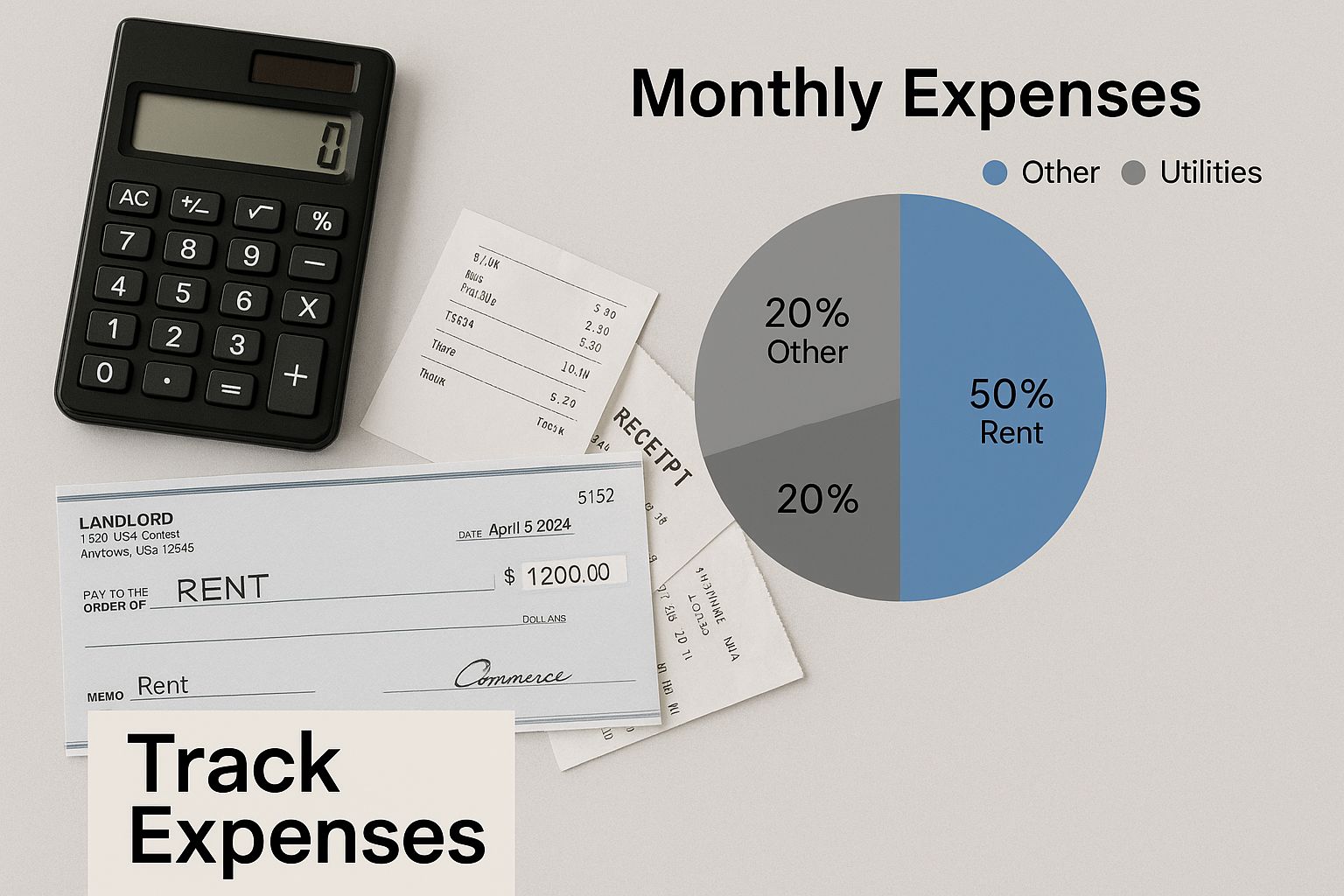
With the reporting floor dropping so fast, every dollar counts. Meticulous record-keeping isn't just good practice anymore—it's essential for accurately calculating your net taxable income.
Old vs. New Rules: A Direct Comparison
To really see what a big deal this is, let's put the old and new rules side-by-side. This isn't just a minor tweak; it's a fundamental overhaul of how tax authorities monitor rental income.
For property owners who have gone years without ever touching a 1099 form, these new requirements mean stepping up your game. Even a single property generating modest income will now likely need official reporting.
The message from the IRS couldn't be clearer: more rental income must be formally documented. This shift from a high, rarely-met threshold to a much lower, all-inclusive one is designed to close the tax gap and ensure everyone pays their fair share.
The table below breaks down the stark difference between the old way of doing things and the new reality for landlords.
Form 1099 Reporting Thresholds Old vs New Rules
| Time Period | Reporting Threshold | Who Is Affected |
|---|---|---|
| Pre-2024 | $20,000 and 200 transactions | Primarily affected large-scale landlords or those using payment apps for business at high volumes. Most small landlords fell below this line. |
| Tax Year 2024 | $5,000 | Affects a much larger number of landlords, including those with just one or two properties, bringing them into the formal reporting system. |
| Tax Year 2026 & Beyond | $600 (Planned) | Aligns rental income reporting with the long-standing threshold for contractors, impacting nearly all landlords. |
This systematic reduction is a deliberate strategy. It highlights just how important it is for all property owners to have solid systems for tracking income and expenses. What was once optional is now mandatory for a whole new group of people.
Getting your ducks in a row now for the eventual $600 threshold is the smartest move you can make. It will save you a world of compliance headaches down the road.
How Property Managers Handle 1099 Reporting

When you hire a property management company, you’re not just outsourcing rent collection and repairs; you're bringing on a partner with serious tax responsibilities. They become a critical link in your financial chain, and their role in handling 1099 MISC rental income directly impacts your own tax filings.
Think of your property manager as the official record-keeper between you, your tenant, and the IRS. They are legally required to report the gross rent they collect for you. This isn't just good practice—it's a federal mandate.
The Property Manager's Core Reporting Duty
The rule is simple but firm. If your property manager collects $600 or more in rent for you during the tax year, they must send you a Form 1099-MISC. This form clearly states the total gross rent they collected in Box 1, labeled "Rents."
This isn't a one-way street. The management company sends a copy of that 1099-MISC to you and an identical one to the IRS. This creates an official paper trail of your rental income, which is why the numbers need to be perfect.
Key Takeaway: The 1099-MISC you receive from your property manager reports gross income only. It doesn’t factor in their management fees, maintenance costs, or any other expenses paid on your behalf. You are responsible for tracking those deductions separately.
To issue the form correctly, your manager will first need a completed Form W-9 from you to get your taxpayer identification number. According to experts at RentGoWalters, this is a foundational step for ensuring compliance for landlords who receive at least $600 in rent annually.
Distinguishing Between 1099-MISC and 1099-NEC
Here's where things can get a little confusing for property owners. Your manager doesn't just issue one type of 1099. They actually handle two different forms.
If your property manager pays a contractor—like a plumber, electrician, or landscaper—$600 or more for their services throughout the year, they must issue that vendor a Form 1099-NEC (Nonemployee Compensation).
- Form 1099-MISC (for you): This reports the gross rent they collected for you.
- Form 1099-NEC (for contractors): This reports payments made for services to maintain your property.
Knowing the difference is key. You, the owner, get the 1099-MISC for income. The professionals who worked on your property get the 1099-NEC for their service payments. It’s all part of your manager's job to make sure every dollar is properly accounted for.
Reconciling Your Records and Handling Complexities
Come tax time, your property manager should provide two crucial documents: your 1099-MISC and an annual owner statement or cash flow report. The 1099 shows the big number—total rent collected. The statement breaks it all down, detailing their fees, repair costs, and other expenses.
Your job is to line these two documents up with your own records. The amount in Box 1 of your 1099-MISC should perfectly match the total rental income listed on your annual statement. You’ll then use that detailed statement to claim all your rightful deductions on your Schedule E.
Things can get tricky if you switch management companies mid-year. In that scenario, you’ll receive a 1099-MISC from each one. Just add the amounts from all the forms together to get your total gross rental income for the year. The goal is to make sure every dollar of income is reported and every legitimate expense is deducted. Exploring different forms of Property Management Tech can reveal how top companies automate these processes to ensure accuracy.
A Step-by-Step Guide to Filing Your Rental Income
Getting that 1099-MISC in the mail is just the starting gun for your tax reporting race. It's a crucial piece of the puzzle, but it doesn't tell the whole story. The form reports your gross rental income to the IRS, and now it's your turn to fill in the details and create a complete financial picture.
This is where a key IRS form comes into play: Schedule E (Supplemental Income and Loss). Think of Schedule E as the official ledger for your rental business. It’s where you report the income you received and, just as importantly, where you subtract all the legitimate expenses you paid to keep your property running.
Step 1: Start with Your Gross Rental Income
Your first move is to take the income figure from your 1099-MISC and get it onto your tax return. Find Box 1, "Rents," on the 1099-MISC. That’s your gross income number.
You'll plug this amount directly onto Line 3 ("Rents received") of Schedule E. If you have multiple properties with different managers or tenants who sent you a 1099-MISC, just add them all up. The total of all forms goes on Line 3.
Step 2: Gather Every Last Expense Document
This is where the real work happens—and where you can make a huge difference in your final tax bill. The 1099-MISC only shows the income side of the equation. It's on you to track and report every single deductible expense to calculate your net income, which is what you're actually taxed on.
Your mission is to collect every receipt, invoice, and bank statement related to managing your property. A solid system for financial organization is your best friend here. If you're new to this, it's worth learning more about preparing for tax season as a landlord to avoid any last-minute scrambles.
Some of the most common write-offs include:
- Mortgage Interest: That big chunk of your mortgage payment that goes to the bank is a major deduction.
- Property Taxes: Your local and state property tax bills are fully deductible.
- Insurance: Premiums for your landlord or homeowner's insurance policy are a necessary cost of doing business.
- Repairs and Maintenance: Did you fix a leaky pipe, patch drywall, or service the furnace? Those costs are deductible.
- Management Fees: If you pay a company to manage the property for you, their fees are a business expense.
Step 3: List Your Deductions on Schedule E
Once you’ve tallied up your expenses, you’ll list them out on Schedule E in the "Expenses" section, which covers Lines 5 through 18. The form breaks it down pretty clearly, with a specific line for most common costs.
The concept is simple: The 1099-MISC shows what you made. Your expense records show what it cost you to make it. The IRS only taxes you on the difference.
For instance, you'll put your total insurance costs on Line 9, mortgage interest on Line 12, and repairs on Line 14. Be thorough! Every dollar you can legally deduct lowers your taxable income. This is why having a firm grasp of all the taxes on rental income is so important.
Step 4: Don't Forget About Depreciation
Depreciation is one of the most powerful tax deductions for landlords, but it's also one of the most overlooked. In a nutshell, the IRS lets you deduct a portion of your property's value each year to account for wear and tear.
For residential rental properties, this happens over a period of 27.5 years. While you're not actually spending this money each year, it's a massive "on-paper" deduction that can significantly lower your tax burden. You'll use Form 4562 to calculate it, then transfer the final number to Line 18 on Schedule E. Skipping this is one of the biggest rookie mistakes you can make.
A Quick Example of How It All Works
Let's put it all together. Say you received a 1099-MISC showing $24,000 in gross rental income for the year.
- Report Income: You enter $24,000 on Schedule E, Line 3.
- Calculate Expenses: After digging through your records, you find you spent:
- $7,000 on mortgage interest
- $3,500 on property taxes
- $1,200 on insurance
- $2,000 on various repairs
- $4,000 on depreciation for the year
- Total Your Deductions: Your total deductible expenses come to $17,700.
- Find Your Net Income: Now, you just subtract your expenses from your income: $24,000 – $17,700 = $6,300.
So, even though your 1099 misc rental income was $24,000, your taxable rental income is only $6,300. This perfectly illustrates why meticulous expense tracking isn't just a suggestion—it's the key to paying only what you owe.
Answering Your Top 1099-MISC Questions
Even when you feel like you have a handle on the rules, the real world has a way of throwing curveballs. When it comes to 1099-MISC rental income, navigating those unique, "what if" scenarios is where things can get tricky. Let's clear up some of the most common gray areas that landlords run into.
Think of this as your go-to guide for those nagging questions that always seem to surface right in the middle of tax season. Getting these details right from the start saves a ton of headaches later.
Do I Need a 1099 for Rent Paid by a Friend or Family Member?
This question comes up all the time, and the answer almost always boils down to one simple test: is the rent a business expense for them?
In most cases, if you're renting a room or a whole property to a friend or relative for their personal home, they don't need to send you a 1099-MISC. The reporting requirement is strictly for payments made in the course of a trade or business. An individual paying for their personal residence simply doesn't fit that description.
But, if that same family member runs a business out of the property and pays the rent from their business bank account, the game changes completely. In that situation, the rent is a business expense for them, and they absolutely need to issue you a 1099-MISC if their total payments hit that $600 annual threshold. The relationship doesn't matter—the purpose of the payment is everything.
What if My Tenant Pays Rent Through an App Like Venmo or PayPal?
The way rent gets paid has changed. Checks are out, and digital payments are in. Many landlords now collect rent through platforms like Zelle, Venmo, or PayPal, which adds a new layer to the tax reporting rules.
Here’s the key difference: when a tenant pays you through one of these third-party payment networks, the reporting duty shifts from your tenant to the platform itself. They won't send you a 1099-MISC. Instead, they are responsible for issuing a Form 1099-K once you cross their specific reporting thresholds for goods and services.
For the 2024 tax year, the IRS has set the 1099-K reporting threshold at $5,000. If you receive more than this amount for goods and services through a single platform, you should expect to get a 1099-K in the mail.
This is a critical distinction. You won't get a 1099-MISC rental income form from your tenant, but you are still 100% responsible for reporting every dollar of that rental income on your tax return. The form you receive doesn't change your obligation to report your income.
What Happens if I Receive an Incorrect 1099-MISC?
Mistakes happen. Maybe the income amount is wrong, your name is misspelled, or your tax ID number is off. Whatever you do, don't just ignore it, and definitely don't file your taxes using the wrong information.
Your first move should always be to contact the person or company that sent you the form. Politely explain the error and ask them to issue a corrected 1099-MISC. They have a formal process for this and can file the updated version with the IRS.
If the payer is unresponsive or refuses to fix it, you're not stuck. You have two options:
- Report the Correct Amount: File your Schedule E using the actual rental income you received.
- Attach an Explanation: Include a short statement with your tax return that explains the difference between the income you're reporting and the amount shown on the incorrect 1099-MISC.
This is where having meticulous records becomes your best friend. Your bank statements, digital payment histories, and rent receipts are your proof and will be essential for backing up your numbers.
Are Payments for Equipment or Facility Rentals Also Reportable?
Yes, absolutely. When the IRS talks about "rents" in Box 1 of Form 1099-MISC, they aren't just talking about apartments and houses. The definition is much broader and includes payments for the use of almost any tangible property.
This means if you rent out machinery, vehicles, or other equipment, those payments follow the very same rules.
Here are a few common examples that would require a 1099-MISC if payments top $600 for the year:
- Machine Rentals: A business renting a forklift, commercial copier, or other specialized machinery.
- Facility Rentals: Payments for using a self-storage unit, warehouse space, or even a dedicated parking garage.
- Land Leases: Rent paid for using pastureland for grazing livestock.
It's important to note that if a payment bundles rent and services together—like a maintenance fee included in a copier lease—only the part that is pure rent goes in Box 1. The service fees belong elsewhere. This ensures the 1099-MISC rental income you report or receive is strictly for the use of the property.
Trying to figure out rental income and tax compliance on your own can be overwhelming, but you don't have to go it alone. The team at Allied Tax Advisors specializes in helping real estate investors build smart tax strategies and stay fully compliant. From getting your filings right to planning for the future, we're here to help. Contact us today to see how we can simplify your taxes at https://alliedtax.com.