
Let's get right to it. When is your C corporation's Form 1120 actually due? For most businesses, the answer is simple: April 15.
But—and this is a big but—that date only applies if your company's financial year ends on December 31. The real answer depends entirely on your corporation's specific tax year.
Understanding the C Corporation 1120 Due Date
The IRS has one core rule for this deadline, and it's surprisingly straightforward. Your corporate tax return is due on the 15th day of the fourth month after your fiscal year officially closes. That single rule applies to every C corp, whether you follow a standard calendar year or a custom fiscal year.
Most businesses keep things simple and align their tax year with the calendar year, ending their books on December 31. Doing the math from there—January, February, March, April—lands you squarely on that familiar April 15 deadline.
However, some companies use a different 12-month period for their accounting, known as a fiscal year. This is common for seasonal businesses that want their tax year to match their natural business rhythm. If that's your company, your filing deadline will be different.
Calendar Year vs. Fiscal Year Deadlines
The first step is always to pinpoint your corporation's official year-end date. Once you know that, you just count four months forward to find your deadline. It's worth noting that for many years, the C corp deadline was actually March 15, a date that shaped tax planning for countless businesses until recent law changes shifted it. You can learn more about the history of corporate tax rates from the Tax Policy Center.
This flowchart really simplifies the two paths to finding your Form 1120 due date.
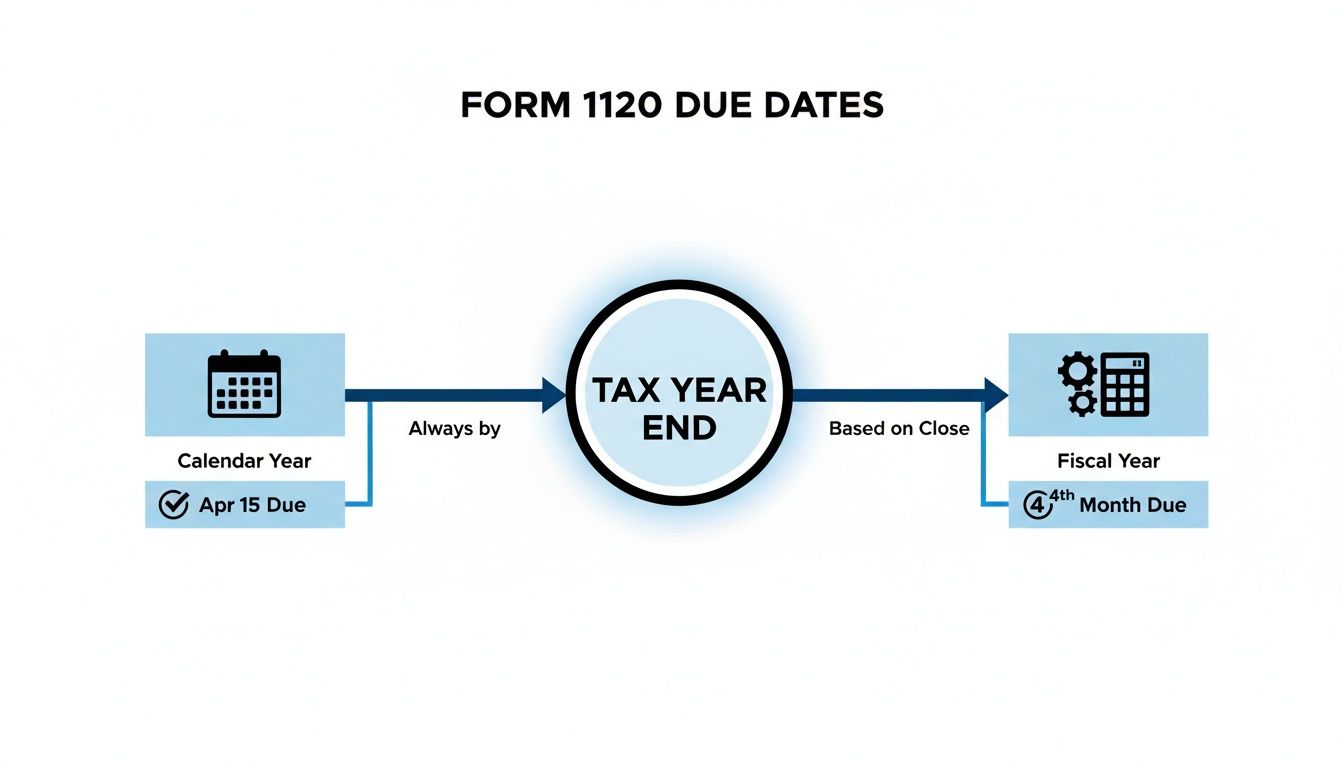
As you can see, everything hinges on your tax year's end date. That's the fork in the road that determines whether you're aiming for April 15 or another date dictated by the fourth-month rule.
Key Takeaway: Your tax year dictates your tax deadline. Never just assume April 15 applies to your corporation without first confirming your official fiscal year-end date.
To make this crystal clear, here’s a quick-reference table that lays out the most common filing scenarios.
Form 1120 Due Dates at a Glance
| Filing Scenario | Standard 1120 Due Date | Extended Due Date (with Form 7004) |
|---|---|---|
| Calendar Year Filer (Year-end Dec 31) | April 15 | October 15 |
| Fiscal Year Filer (Year-end June 30) | October 15 | April 15 (of the next year) |
Getting this foundational knowledge right is the first and most important step toward staying on top of your tax obligations and making sure you're never caught off guard.
How a Fiscal Year Affects Your Tax Deadline
Does your company’s financial year run from January 1 to December 31? If so, you’re on a standard calendar year, and your tax life is pretty straightforward. But if not, your business operates on a fiscal year, and that changes everything about your Form 1120 due date.
Think of it like a school year versus a calendar year. They're both twelve months long, but one might run from September to August, while the other is January to December. A fiscal year is the business equivalent—it’s any 12-month accounting period that doesn't end on December 31.
This distinction is critical. If you're a fiscal year filer, the classic April 15 tax deadline doesn't apply to you. Instead, you have to follow the universal IRS rule for corporations: your return is due on the 15th day of the fourth month after your fiscal year closes.
Why Choose a Fiscal Year?
You might wonder why any business would voluntarily complicate its taxes this way. The truth is, it's a strategic move that’s almost always tied to the natural rhythm of the business. Aligning the fiscal year-end with the end of your busy season just makes sense—it simplifies financial reporting and makes things like inventory counts much easier.
Here are a few common reasons for adopting a fiscal year:
- Seasonal Operations: Think of a ski resort. It makes perfect sense for them to end their fiscal year on May 31, right after the snow melts and the winter season's revenue is all in.
- Inventory Cycles: Many retailers end their fiscal year on January 31. Why? The holiday rush is over, returns have been processed, and their inventory is at its lowest, making it the perfect time to take stock.
- Project-Based Work: A construction company might align its year-end with the typical completion dates of its major projects, giving them a cleaner snapshot of their annual profitability.
By matching the tax year to the business cycle, you get a much clearer picture of your company's performance without a major season getting awkwardly split between two different tax years.
A fiscal year isn’t about making taxes more complicated; it’s about making your financial reporting more accurate and reflective of your true business cycle.
Calculating Your Fiscal Year Deadline
Once you know your year-end date, figuring out your fiscal year 1120 due date is actually pretty simple. You just find the month your fiscal year ends and count four months forward. The 15th of that fourth month is your magic number.
Let's walk through a real-world example. Say your C corporation’s fiscal year ends on June 30, 2024.
- Month 1: July
- Month 2: August
- Month 3: September
- Month 4: October
Easy enough. Your Form 1120 would be due on October 15, 2024.
Here’s another common scenario. Let's say a company's fiscal year wraps up on September 30, 2024.
- Month 1: October
- Month 2: November
- Month 3: December
- Month 4: January (of the next year)
In this case, the corporation's tax return is due on January 15, 2025. Getting this simple calculation right is the key to managing your unique tax obligations and avoiding any stressful, last-minute surprises from the IRS.
Filing an Extension with Form 7004
Let's be realistic—sometimes, hitting that tax deadline just isn't in the cards. Maybe you're still chasing down a critical financial statement, or you've run into a last-minute complication. Life happens.
Thankfully, the IRS offers a safety net: Form 7004, "Application for Automatic Extension of Time to File." Filing this form grants your corporation an automatic six-month extension to get your Form 1120 paperwork in. It's not a license to procrastinate; it's a strategic tool to ensure you file an accurate, complete return instead of a rushed, mistake-ridden one.
The Most Important Rule of Extensions
Before we dive into the "how," there's one golden rule about extensions that trips up countless business owners every single year. Get this one thing right, and you'll save yourself a world of headaches.
An extension of time to file your return is not an extension of time to pay your taxes.
This distinction is absolutely critical. Your tax payment is still due by the original 1120 due date, whether you file an extension or not. If you anticipate owing the IRS, you need to make a solid estimate of your tax bill and pay that amount by the deadline. Skip this step, and you’ll be on the hook for penalties and interest, even with a valid extension on file.
How to File Form 7004
The good news is that requesting an extension is straightforward. You just have to submit Form 7004 by your original tax deadline—for a standard calendar-year corporation, that means April 15.
Here’s a quick rundown of what’s involved:
- Gather Your Details: You'll need the basics: your corporation's name, address, and Employer Identification Number (EIN).
- Specify the Form: The form asks which return you're extending. You'll indicate Form 1120.
- Estimate Your Tax Liability: This is the most important part. You need to run the numbers to get a reasonable estimate of your total tax for the year and figure out what you've already paid through quarterly installments.
- Pay What You Owe: The difference between your total estimated tax and your payments is the balance due. You must pay this amount when you submit Form 7004.
These days, any decent tax software can e-file Form 7004 for you, which is the quickest and safest way to get it done. As long as the form is filled out correctly and submitted on time, the IRS grants the extension automatically.
For a deeper look into the specifics, our guide on the business tax extension deadline can walk you through more of the details. Using an extension wisely is a smart business move that gives you the breathing room to file correctly and confidently.
The Real Cost of Missing Your Filing Deadline

Meeting your tax deadline is more than just a box-ticking exercise; it’s a critical financial move. Missing the 1120 due date sets off a chain reaction of IRS penalties that can eat into your company's profits surprisingly fast. It’s a painful and expensive mistake, but knowing how the penalties are calculated is the best way to steer clear of them.
The IRS hits you with two separate penalties when you're late: one for failing to file on time and another for failing to pay on time. They are not the same thing, and it’s very possible to get slapped with both.
The Failure to File Penalty
This is the big one. The IRS is far more concerned about getting your tax return filed than getting your money immediately. That’s why the Failure to File penalty is so aggressive.
The penalty comes in at 5% of the unpaid taxes for each month (or even part of a month) that your return is late. It kicks in the day after your deadline and can grow until it hits a cap of 25% of your total unpaid tax bill. The sheer size of this penalty sends a clear message: file your return—or an extension—no matter what.
The Failure to Pay Penalty
The second penalty, for not paying the tax you owe, is more forgiving but still adds up. The Failure to Pay penalty is 0.5% of your unpaid taxes for each month the bill remains outstanding. It also maxes out at 25% of your unpaid tax liability.
Key Insight: Notice the difference? The Failure to File penalty is ten times higher than the Failure to Pay penalty (5% vs. 0.5%). The IRS is practically shouting, "Even if you can't pay us, you absolutely must file your paperwork."
Let’s walk through an example to see how quickly this can get out of hand.
Imagine your C-corp operates on a standard calendar year and owes $20,000 for its 2023 taxes. You get busy, miss the April 15, 2024, deadline, and don't get around to filing or paying until July 2, 2024.
Here's the damage assessment:
- Months Late: The return is late for part of April, all of May, all of June, and part of July. The IRS counts this as four full months.
- Failure to File Penalty: 5% per month x 4 months = 20%. That’s 20% of $20,000, which comes to $4,000.
- Failure to Pay Penalty: 0.5% per month x 4 months = 2%. That’s 2% of $20,000, which is $400.
- Total Penalties: The combined penalties from this short delay are already $4,400.
And that’s not all. The IRS also charges interest on both the unpaid tax and the penalties, and it compounds daily. In less than three months, your $20,000 tax bill has grown by more than 20%. This is exactly why filing Form 7004 for an extension is always the right call if you're running behind.
To dig deeper into this topic, check out our guide on how to avoid costly IRS penalties for late tax filing.
Looking Beyond Your Annual Federal Return

Getting your annual Form 1120 filed on time feels like a huge win, but it's really just one piece of a much larger compliance puzzle. A common—and often costly—misconception is treating corporate taxes as a single, once-a-year headache. The reality is that your tax obligations are a continuous cycle, involving regular payments throughout the year and separate responsibilities to state governments.
To truly stay on top of your corporate tax duties, you need to see the full picture. This means managing two other critical areas: your quarterly estimated tax payments and all your state-level tax filings. These are not optional side quests; they are essential for keeping your company in good standing and avoiding nasty financial surprises.
The Pay-As-You-Go System for Corporations
Most of us are used to the W-2 world, where taxes are automatically withheld from each paycheck. C corporations, however, play by a different set of rules. They operate on what the IRS calls a "pay-as-you-go" system. This simply means you can't wait until you file your annual return to pay your tax bill; you have to pay it in installments throughout the year.
These installments are known as quarterly estimated tax payments. The whole point is to keep tax revenue flowing steadily to the government and, just as importantly, to prevent your business from getting hit with a massive, potentially crippling tax bill all at once.
For a typical calendar-year business, these payments are due on the 15th day of the 4th, 6th, 9th, and 12th months.
- Payment 1: Due by the 15th day of the 4th month (April 15th)
- Payment 2: Due by the 15th day of the 6th month (June 15th)
- Payment 3: Due by the 15th day of the 9th month (September 15th)
- Payment 4: Due by the 15th day of the 12th month (December 15th)
When you eventually file your Form 1120, it’s time to settle up. You’ll calculate your total tax liability for the year and then subtract the estimated payments you’ve already sent in. If you overpaid, you get a refund. If you underpaid, you’ll owe the difference, likely with some penalties and interest tacked on. We dive much deeper into this in our article on quarterly estimated tax payments.
Navigating the Maze of State Tax Filings
Just when you think you have the federal rules down, you have to contend with the states. Nearly every state has its own corporate income tax system, adding a whole new layer of complexity to your tax strategy. And trust me, no two states do things exactly the same way.
State tax compliance isn't just an afterthought; it's a parallel track that demands its own attention. Deadlines, forms, and tax rates can vary dramatically from your federal requirements.
For instance, a state might have a completely different filing deadline, require its own unique extension form, or have specific rules about what income is even taxable. This gets exponentially more complicated if your corporation operates in multiple states. Suddenly, you're juggling the distinct requirements for every single state where you do business.
Dropping the ball here can lead to state-level penalties and interest charges that are entirely separate from anything the IRS might levy. Understanding these dual federal and state obligations is absolutely fundamental to your company's financial health.
Your C Corp Filing Checklist: A Step-by-Step Guide
Alright, let's get down to brass tacks. A smooth tax season isn't about luck—it's about having a solid plan. Think of this checklist as your roadmap for navigating the Form 1120 deadline without the last-minute panic.
The Pre-Filing Game Plan
The real work starts months before the deadline. Getting your financial house in order early is the single best thing you can do to ensure a timely and accurate filing.
Finalize Your Books: First things first, close out your books for the tax year. This means reconciling every single bank account, credit card, and loan. Your internal records need to match what the banks are saying, down to the penny.
Generate Key Financial Reports: Next, you'll need to pull your essential year-end financial statements. We're talking about the Profit and Loss (P&L) statement, which shows your income and expenses, and the Balance Sheet, which gives a clear snapshot of your company's assets and liabilities.
Gather All Your Documents: Now it's time to compile all the supporting paperwork. This goes beyond the big financial statements. You’ll need payroll reports, records of any major asset purchases or sales, and documentation for any significant business expenses you plan to deduct.
A well-organized file is the foundation of a stress-free tax filing. The more prepared you are, the more efficiently your tax advisor can work, potentially saving you both time and money.
Once you have all of this pulled together, you can be confident that your tax return is being built on solid ground. The next step? Schedule a meeting with your advisor at Allied Tax Advisors well before the deadline to go over everything.
Still Have Questions About the 1120 Due Date? Let’s Clear Things Up.
Even after you get the hang of the calendar vs. fiscal year rules, a few specific questions always seem to pop up. Let's tackle some of the most common ones we hear from business owners.
What Happens if the Deadline Falls on a Weekend?
The IRS gives you a little grace here. If your Form 1120 due date lands on a Saturday, Sunday, or a legal holiday, the deadline automatically bumps to the next business day.
So, if April 15 falls on a Saturday and the following Monday isn't a holiday, your new deadline becomes Monday, April 17. This handy rule applies to both the original due date and your extended one.
Does Filing an Extension Make Me a Target for an Audit?
This is one of the most persistent myths in the tax world, and the answer is a firm no. Filing for an extension with Form 7004 is a completely normal and accepted IRS procedure that millions of businesses use every year. It does not raise a red flag.
Think of an extension as a strategic tool, not a sign of trouble. The IRS is far more interested in getting an accurate tax return than a rushed one. Taking the extra time to get your numbers right can actually help lower your audit risk by preventing careless mistakes.
Can a Corporation Just Change Its Fiscal Year?
While it’s possible for a corporation to change its accounting period, it's not something you can just decide to do on a whim. The process requires getting formal approval from the IRS by filing Form 1128, Application to Adopt, Change, or Retain a Tax Year.
You'll need a legitimate business reason for the change, like wanting to align your tax year with your industry's natural business cycle. Simply trying to get a tax advantage won't cut it. It’s a formal process with specific rules to make sure the change doesn't improperly distort your income for the year.
Managing your C corporation's tax obligations is complex, but you don't have to navigate it alone. For expert guidance on hitting every deadline and building a smart tax strategy, contact the team at Allied Tax Advisors. Learn how we can help your business thrive.