
When you hear "business tax extension deadline," it's easy to think of a single, universal date. But that's a common misconception that trips up a lot of business owners. The reality is that your specific deadline depends entirely on how your business is structured.
S corporations and partnerships, for instance, have a much earlier due date than sole proprietorships or C corporations. Getting this wrong can lead to some painful, and completely avoidable, penalties.
Decoding Your Business Tax Extension Deadlines

The biggest mistake I see entrepreneurs make is assuming their business tax deadline is the same as the personal one in April. The IRS actually staggers these dates based on your legal business entity, and knowing which one applies to you is the first step toward staying compliant.
Getting these dates right isn't just about avoiding late fees; it's about planning your year with confidence. When you know your deadlines well in advance, you can avoid that last-minute scramble. This kind of proactive awareness is really the foundation of solid https://alliedtax.com/business-tax-planning-2/.
How Deadlines Differ by Business Structure
Your company’s legal structure is the key that unlocks both your original filing deadline and your extended one. The logic is pretty simple: pass-through entities, like S corps and partnerships, have to file earlier so their owners can get the necessary information (like a Schedule K-1) to complete their own personal returns on time.
- S Corporations (Form 1120-S) & Partnerships (Form 1065): The deadline for these is typically March 15th.
- Sole Proprietorships (Schedule C) & C Corporations (Form 1120): These entities generally follow the familiar April 15th deadline.
For the 2025 tax season (filing for the 2024 tax year), this means partnerships and S corps need to either file their returns or request an extension by March 17, 2025, since the 15th falls on a weekend.
Key Business Tax Filing and Extension Deadlines by Entity Type
To make this crystal clear, here’s a quick reference table that breaks down the original and extended deadlines for the most common business structures.
| Business Entity Type | Original Filing Deadline (Calendar Year) | Extension Form | Extended Filing Deadline |
|---|---|---|---|
| S Corporation | March 15 | Form 7004 | September 15 |
| Partnership | March 15 | Form 7004 | September 15 |
| Sole Proprietorship | April 15 | Form 4868 | October 15 |
| C Corporation | April 15 | Form 7004 | October 15 |
Think of this table as your go-to guide. Pinning down your specific dates is a fundamental part of keeping your business in good standing.
Remember, an extension gives you a six-month grace period to file your paperwork. It is not an extension to pay the taxes you owe. This is the single most important rule to avoid penalties and interest.
Knowing your business tax extension deadline is a crucial part of a larger business compliance checklist. When you have a firm grasp on these dates, you can manage your cash flow, organize your records, and operate without the constant pressure of a looming—and potentially incorrect—deadline.
How to File for a Business Tax Extension Correctly
Once you know your deadline, it's time to actually file the extension. Getting this part right is crucial for making sure the IRS accepts your request without a hitch. The key here is IRS Form 7004, which is the "Application for Automatic Extension of Time To File Certain Business Income Tax, Information, and Other Returns."
Don't let the long name fool you; this form is your ticket to a six-month breather. Filing it properly is what stands between you and a potential Failure to File penalty, which can be a nasty 5% of your unpaid taxes for each month you're late. It adds up fast.
First, Get Your Ducks in a Row
Before you even pull up the form, do yourself a favor and get your essential information together. A little prep work now makes the actual filing process take just a few minutes.
You'll need:
- Your official business name and address. Make sure this is the exact same information the IRS has on record for your business.
- Your Employer Identification Number (EIN). This is a must-have. I always recommend double-checking it, as a simple typo can cause a rejection.
- The specific tax form you're extending. Are you a C-corp filing Form 1120? Or a partnership filing Form 1065? You'll need to know which one applies to you.
Good record-keeping is the foundation of a stress-free tax season, even when you're filing an extension. If your books are a mess, now is a good time to learn how to organize business receipts so you're not in the same boat six months from now.
Filling Out and Sending in Form 7004
With your info handy, you're ready to tackle the form. Let’s walk through a typical example. Say you run a small marketing agency set up as a multi-member LLC. For tax purposes, you file as a partnership using Form 1065.
On Form 7004, you’d fill in your LLC's name, EIN, and address at the top. In Part I, you’ll look for the code that corresponds to Form 1065. This is a common trip-up spot; people often select the wrong code, so take a second to confirm which tax form your business files.
Then, in Part II, you'll need to estimate your total tax liability for the year and the total payments you’ve already made. The difference between these two numbers is the balance you owe, which you really should pay when you file the extension.
The most important thing on Form 7004 is making a "good faith" estimate of your tax liability. This can't be a random number plucked from thin air. It needs to be a reasonable calculation based on the financial data you have available. A solid estimate shows the IRS you're taking your obligations seriously.
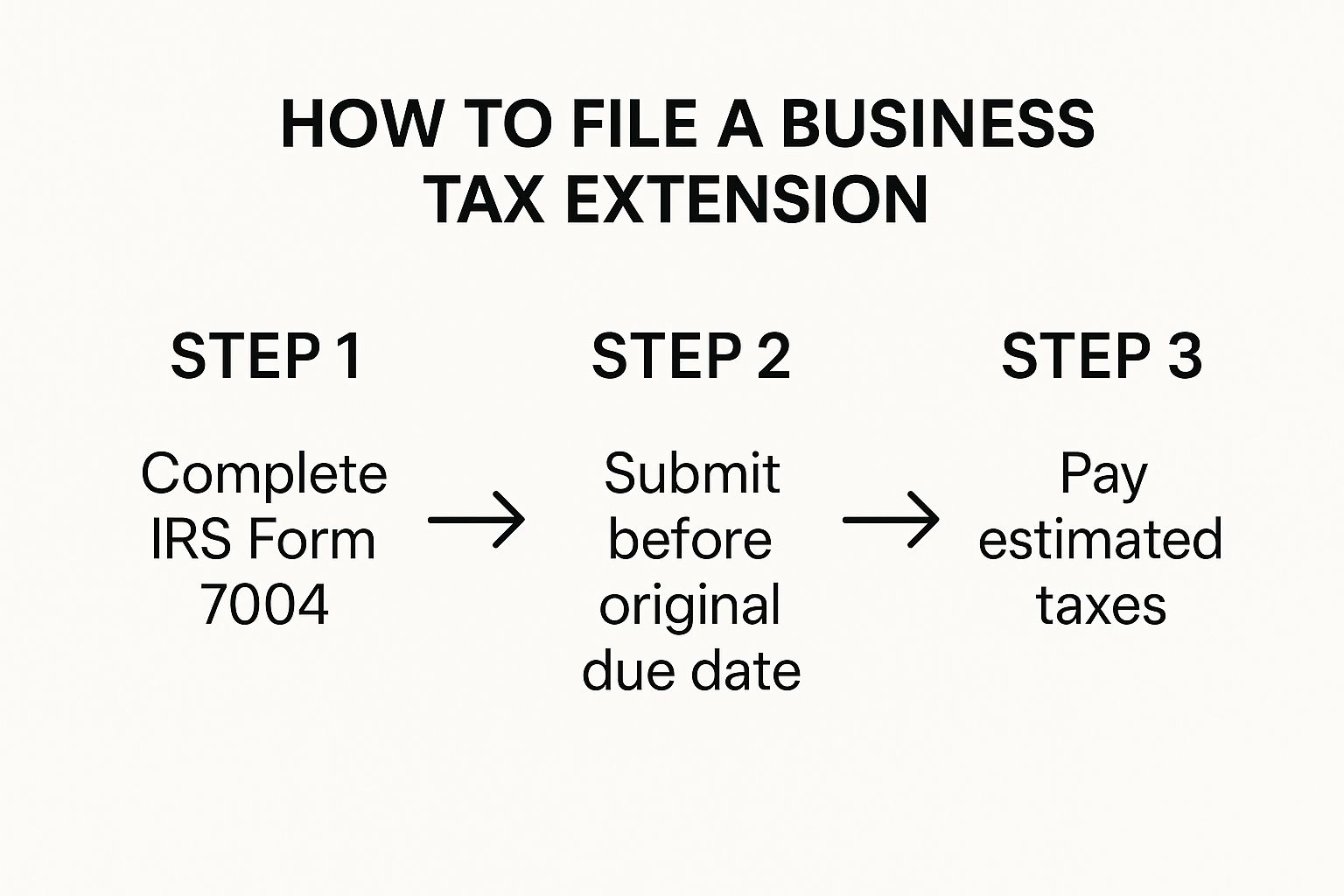
When it comes down to it, there are just three core actions: fill out the form, submit it by the deadline, and pay what you think you owe.
Finally, you need to decide how to send it to the IRS. You have two choices:
- E-file (Highly Recommended): This is by far the fastest and safest way. You can use professional tax software or IRS Free File. The best part? You get an instant confirmation that the IRS has received it, which gives you immediate peace of mind.
- Mail a Paper Form: If you're old-school and prefer paper, you can mail the form to the address listed in the Form 7004 instructions. If you go this route, I strongly advise sending it via certified mail. That way, you have undeniable proof of when you mailed it.
An Extension to File Is Not an Extension to Pay

Let’s get one thing straight, because it's the most important rule when it comes to tax extensions: filing an extension gives you more time to do the paperwork, not more time to pay what you owe.
This is a trap so many business owners fall into. You get a welcome six-month breather to finalize your return, but your tax payment is still due on the original deadline.
If you miss that payment date, the IRS starts charging interest and penalties on the unpaid balance immediately. Trust me, those charges add up a lot faster than you'd think.
Making a Good Faith Estimate
So, how do you pay your taxes if you haven't finished your return? The answer is a "good faith" estimate.
This isn't just a number you pull out of thin air. It’s a carefully calculated guess based on the financial information you have on hand. The goal is to get as close as possible to your actual tax liability.
For example, a freelance graphic designer could look at their 1099s and bank deposits to tally up their income. Then, they’d subtract known business expenses—like software subscriptions, marketing costs, and a portion of their home office—to figure out their net income and estimate the self-employment tax.
A small e-commerce shop could do something similar by looking at gross sales from their Shopify dashboard and subtracting the cost of goods sold. The key is to be able to show your work and prove to the IRS that you made a sincere effort.
As a rule of thumb, your goal is to pay at least 90% of your actual tax liability by the original deadline. If you hit that mark, you’ll usually avoid the hefty Failure to Pay penalty. You'll still owe some interest on the remaining amount, but it’s far less painful.
How to Remit Your Estimated Payment
Once you’ve landed on your estimated tax number, it's time to send the money to the IRS. Thankfully, they’ve made this part pretty easy with several online payment options.
Here are the methods I see clients use most often:
- IRS Direct Pay: This is a free and secure way to pay straight from your bank account. It’s a fantastic, no-fuss option for sole proprietors who are paying their personal and business taxes at the same time.
- Electronic Federal Tax Payment System (EFTPS): A free service from the U.S. Treasury, EFTPS is built for businesses. You can schedule payments in advance, which is incredibly handy for managing quarterly estimated taxes all year long.
- Debit Card, Credit Card, or Digital Wallet: You can also pay using a third-party processor. Just be mindful that these services always charge a processing fee on top of your tax payment.
Staying on top of deadlines and payments is the name of the game. For a closer look at local requirements and avoiding common mistakes, check out our guide on San Diego tax deadlines and penalties.
Think of a tax extension as a tool for accuracy, not a get-out-of-jail-free card for paying. By estimating what you owe and paying on time, you can use that extra six months to get your return perfect—without the nasty surprise of penalties.
Don't Forget About Your State Tax Extension
You've filed your federal extension. Great. But don't pop the champagne just yet, because you're only halfway there. One of the most common and costly mistakes I see business owners make is assuming their federal extension automatically takes care of their state tax obligations.
That’s a dangerous assumption. Every state plays by its own set of rules, and if you ignore them, you could be facing some nasty penalties, completely undoing all the breathing room you just created for yourself on the federal side. Your business tax extension deadline for the state might be completely different.
How States Handle Tax Extensions
To keep your business in good standing, you have to figure out exactly what your state expects. It's rarely as simple as just forwarding them a copy of your federal form.
Let's walk through the three main ways states typically handle this:
-
The "Easy" States: Some states keep it simple. If you get a federal extension, they automatically give you a state extension, too. No extra paperwork needed. States like New Jersey and Illinois often operate this way, which is a huge relief for busy entrepreneurs.
-
The "We Have Our Own Form" States: Other states insist on their own specific extension form. California is a classic example. While they might grant you an automatic extension to file your return, you absolutely must pay any taxes you owe by the original due date. Their system is separate, so you have to play by their rules and use their forms.
-
The "Piggyback" States: A third group of states splits the difference. They want you to attach a copy of your approved federal extension (Form 7004) when you eventually file your state return. This basically proves you had a valid reason for filing late.
Here's my best advice: Before you do anything else, go directly to your state's Department of Revenue or Franchise Tax Board website. That's the only place you'll find the real, up-to-date deadlines, forms, and payment instructions. Rules can and do change, so never assume this year is the same as last year.
Juggling Multiple State Filings
Things get even more complicated if your business operates in more than one state.
Let’s say your main office is in Texas (which has no corporate income tax, lucky you), but you have locations or significant sales in both Colorado and Arizona. Now you're on the hook for figuring out the unique extension rules for both of those states, on top of your federal filing.
This is where a simple checklist can be a lifesaver. Make a list of every single state where you have a "tax nexus" (meaning a significant business presence). For each one, document their specific extension process, the original payment deadline, and the extended filing deadline. These dates often don't line up with the federal ones.
Taking a few minutes to get organized like this ensures no state falls through the cracks and you hit every single business tax extension deadline without a hitch.
A Global View on Business Tax Deadlines

If your business operates across international borders, the idea of a single business tax extension deadline goes right out the window. It's a completely different ballgame. What keeps you compliant in the United States could get you into serious trouble abroad. Assuming tax timelines are the same everywhere is a rookie mistake that can cost you dearly.
Every country marches to the beat of its own drum, with filing requirements shaped by unique economic policies and legal systems. This is where having local expertise on the ground becomes non-negotiable for any business with a global footprint. You have to tackle this with a country-by-country strategy.
Contrasting International Filing Timetables
The differences in tax deadlines from one country to the next can be staggering, which really drives home how complex global compliance is. There's no such thing as a one-size-fits-all tax calendar.
Take Nigeria, for example. In this emerging market, corporate tax returns are due within six months of the company's financial year-end. So, if your books close on December 31, you've got until June 30 to file. Then you have places like Pakistan, which uses a completely different system of quarterly installment payments on specific dates. For a deep dive into various deadlines, PwC's comprehensive tax summary site is an excellent resource.
These examples just scratch the surface, showing the wide range of approaches governments take, from simple annual filings to more frequent, piecemeal payments.
The Importance of Local Tax Knowledge
Getting a handle on these international quirks is the first step. If you're a U.S. company expanding into Europe, you’ll quickly find that the rules for deadlines and extensions in Germany look nothing like those in France or the UK.
The biggest takeaway here is that you can't apply a domestic mindset to your foreign tax obligations. It just doesn't work. Trying to force it will only lead to missed deadlines, painful financial penalties, and compliance headaches that could put your entire operation in that country at risk.
This is why working with local tax professionals in every market you enter is an absolute must. They’re the ones who can give you the specific, on-the-ground guidance you need to navigate local laws. They make sure every form is filed and every payment is made correctly and on time, protecting your company’s reputation and good standing around the world.
Answering Your Business Tax Extension Questions
Even with the best intentions, filing a tax extension can feel a bit murky. Let's clear up some of the most common questions business owners ask so you can move forward with confidence.
What Happens If I Miss the Business Tax Extension Deadline?
Honestly, missing the extension deadline is a costly mistake you want to avoid. If you don't file Form 7004 by your original due date, the IRS can hit you with a Failure to File penalty.
This isn't a small slap on the wrist. The penalty is typically 5% of your unpaid taxes for each month your return is late, and it can add up to a staggering 25% of your total tax bill. That's a huge, unnecessary expense.
For comparison, the Failure to Pay penalty is only 0.5% per month. The takeaway here is simple: always, always file the extension on time, even if you know you can't pay the full tax amount right away. Filing Form 7004 on time completely removes that harsh Failure to File penalty, provided you get your final return in by the new extended date.
Think of a timely extension as your best defense against the most severe IRS penalties. It buys you six months to get your paperwork right without the threat of that costly Failure to File penalty.
Can I Get a Second Extension?
For nearly every business out there, the answer is a hard no. That initial six-month extension you get from filing Form 7004 is the only one on the table. This means your extended deadline—whether it's September 15th or October 15th—is final.
The IRS only grants further extensions in truly exceptional circumstances, like for businesses located in federally declared disaster areas or for owners serving in a combat zone. For everyone else, that six-month window is your last chance to finalize the books and submit an accurate return.
Does Filing a Tax Extension Increase My Audit Risk?
This is one of the biggest myths in the tax world, and I hear it all the time. Let’s set the record straight: filing an extension does not increase your chances of being audited.
The IRS flags returns for audits based on what’s in the return, not when it was filed. Their systems look for anomalies like unusually large deductions, major income discrepancies compared to your 1099s, or other red flags. The timing just isn't part of their equation.
In fact, I'd argue the opposite is true. Taking that extra time to prepare a more accurate and thorough return can actually reduce your risk of making errors that might trigger an audit. Strategically using this time can be a key part of your financial strategy, and you can explore more tax-saving tips for business owners on our blog.
Do I Need to Explain Why I Need an Extension?
Nope. You don't have to provide any reason or justification for requesting an extension. The entire process is designed to be automatic.
As long as you fill out and submit Form 7004 correctly before your original business tax extension deadline, the IRS grants the extension automatically. No questions asked. They provide this tool so any business owner can get the breathing room they need to file an accurate return. Your only job is to file the form on time.
At Allied Tax Advisors, we help businesses navigate every aspect of their financial journey, from timely filings to strategic tax planning. If you need expert guidance to ensure your taxes are handled correctly and efficiently, visit us at https://alliedtax.com to see how our team can support you.