
For savvy real estate investors and business owners, maximizing returns isn't just about appreciation and rental income-it's about strategic tax planning. One of the most powerful yet underutilized tools in this arena is the cost segregation study. This detailed engineering analysis allows property owners to reclassify building components, significantly accelerating depreciation deductions and creating substantial tax savings.
While the concept might sound technical, the results are tangible: improved cash flow, reduced tax liabilities, and optimized investment returns. Understanding the key cost segregation study benefits is the first step toward unlocking significant hidden value within your properties. This is a crucial strategy for anyone looking to make their real estate assets work harder and more efficiently from a tax perspective.
This article will break down the six most impactful benefits of conducting a study, providing actionable insights and real-world examples. We will explore how this powerful tax tool can transform your financial outlook. Whether you own a commercial building, a residential rental portfolio, or a specialized industrial facility, the following list will demonstrate precisely how to leverage a cost segregation study to your advantage.
1. Accelerated Depreciation Deductions
The most significant and immediate of all cost segregation study benefits is the ability to accelerate depreciation deductions. In standard real estate accounting, commercial properties are depreciated over 39 years and residential properties over 27.5 years. This straight-line method results in small, consistent annual deductions. A cost segregation study surgically dismantles a property into its various components, allowing for strategic reclassification.
Instead of treating the entire structure as a single asset, the study identifies specific components that qualify for much shorter recovery periods. This is the core of accelerated depreciation.
How It Works: Reclassifying Assets
A qualified engineering-based study identifies personal property and land improvements that are typically lumped into the long-term building cost. These assets are then reclassified into shorter depreciation schedules:
- 5-Year Property: Includes assets like carpeting, specific manufacturing equipment, and decorative lighting.
- 7-Year Property: Often includes office furniture and fixtures.
- 15-Year Property: Covers land improvements such as parking lots, landscaping, and fences.
By moving a significant portion of the building's cost basis from a 27.5- or 39-year schedule to these shorter periods, you can claim much larger depreciation expenses in the initial years of ownership. This front-loading of deductions directly reduces your taxable income, freeing up substantial cash flow.
Real-World Impact: Consider a $2 million commercial building. A cost segregation study might reclassify 20% of the property's value ($400,000) into 5- and 15-year assets. This can generate over $150,000 in additional depreciation deductions in the first year alone, creating a significant tax shield that wouldn't be possible otherwise.
The following infographic summarizes the core principles of how accelerated depreciation creates value.
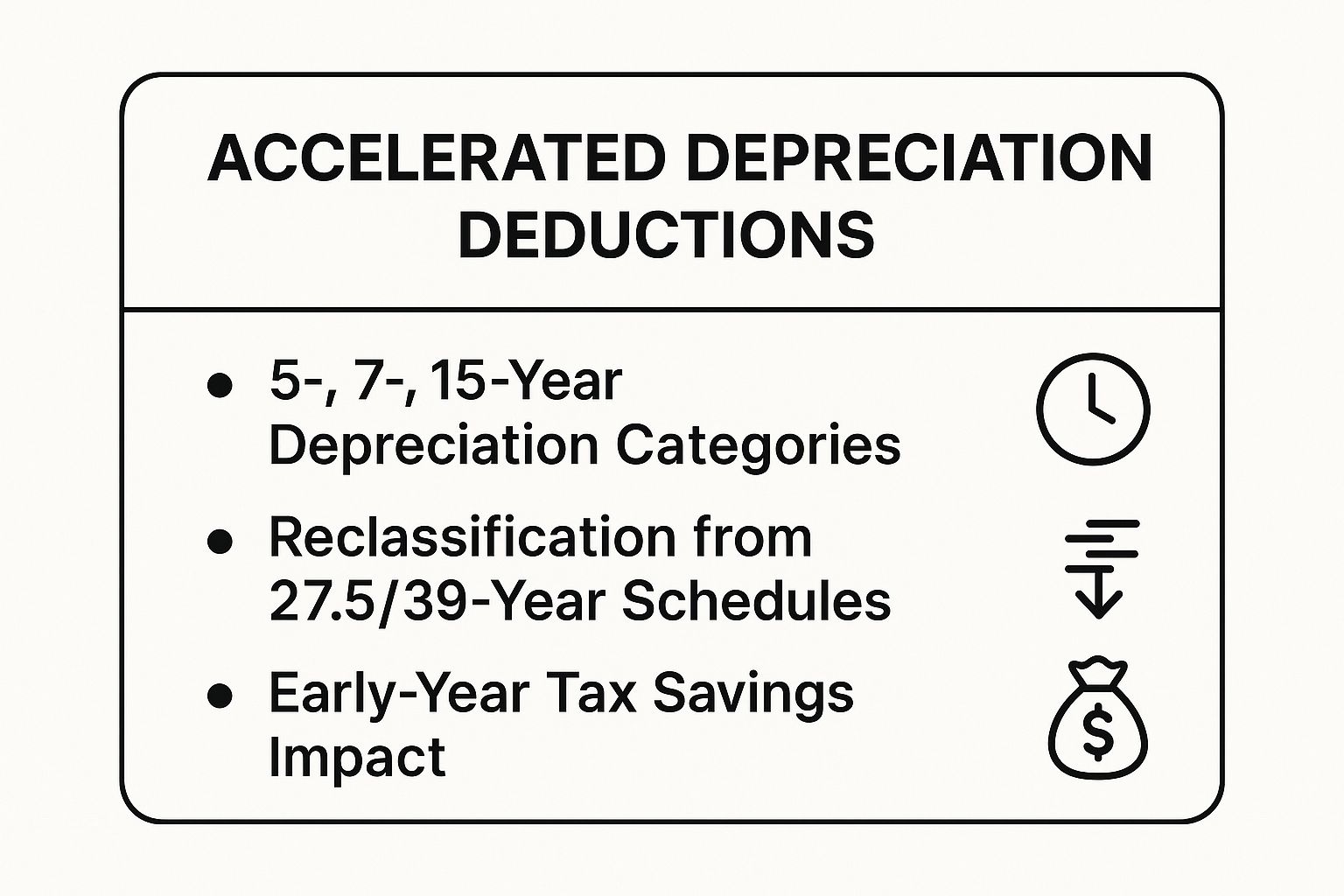
This visual highlights how shifting assets from long-term schedules to shorter 5, 7, and 15-year categories directly boosts early-year tax savings. By maximizing deductions upfront, you can reinvest that capital into your business or other properties, compounding your returns.
2. Immediate Cash Flow Improvement
One of the most powerful cost segregation study benefits is the direct and immediate improvement in cash flow. By significantly reducing your current-year tax liability through accelerated depreciation, you keep more of your own money in your pocket. This isn't a theoretical saving; it's a tangible increase in liquid capital that becomes available for you to use right away.

The tax savings generated are not a tax credit but a deferral. By front-loading depreciation, you are essentially receiving an interest-free loan from the government. This newfound liquidity can be a game-changer for any real estate investor or business owner, providing the financial flexibility needed to grow, stabilize, or innovate. Effective cash flow management for your business is crucial, and a cost segregation study is a key tool to enhance it.
How It Works: Turning Tax Savings into Capital
The mechanism is straightforward: lower taxable income means a lower tax bill. The cash that would have been paid in taxes remains in your bank account, ready for strategic deployment. This unlocks immediate opportunities that might otherwise be out of reach.
For example, a business can leverage this improved cash flow to:
- Fund Property Improvements: Renovate units, upgrade common areas, or improve energy efficiency to increase property value and rental income.
- Acquire More Properties: Use the tax savings as a down payment for another income-producing asset, accelerating portfolio growth.
- Pay Down Debt: Reduce principal on existing loans to lower interest payments and build equity faster.
- Reinvest into Operations: A manufacturing company can upgrade essential equipment, while a restaurant chain can fund the opening of a new location.
This ability to convert a tax strategy into working capital is what makes a cost segregation study so valuable beyond the numbers on a tax return.
Real-World Impact: Consider a $5 million hotel that undergoes a cost segregation study. The study could reclassify 25% of the property's value ($1,250,000) into shorter-lived assets. This might generate an additional $400,000 in tax deductions in the first year alone, potentially creating over $150,000 in immediate cash flow improvement (assuming a 37% tax rate). That capital can be used to renovate rooms, upgrade amenities, or market the property more aggressively.
3. Bonus Depreciation Eligibility
Beyond accelerating depreciation, one of the most powerful cost segregation study benefits is unlocking eligibility for bonus depreciation. This provision in the tax code allows property owners to deduct a substantial percentage of the cost of qualifying assets in the very first year they are placed in service. A cost segregation study is the mechanism that identifies which assets qualify.
Without a study, these qualifying assets remain buried within the long-term building structure, ineligible for this immediate and impactful tax incentive. The study effectively "unearths" them, making them eligible for this powerful tax-saving tool.
How It Works: Maximizing First-Year Deductions
A cost segregation study identifies personal property and land improvements that are eligible for bonus depreciation. These are typically the same assets reclassified into 5-, 7-, and 15-year recovery periods. Under current tax law, these assets qualify for a significant bonus percentage, allowing you to take a massive deduction upfront instead of spreading it over several years.
- Qualifying Assets: Assets with a recovery period of 20 years or less, such as carpeting, specialty plumbing, decorative fixtures, and land improvements, are generally eligible.
- Immediate Impact: The bonus percentage is applied to the reclassified asset basis in the first year, creating an immediate and substantial reduction in taxable income. To learn more about how this incentive is structured, you can explore how bonus depreciation works.
This immediate deduction supercharges the cash flow benefits of a cost segregation study, providing capital that can be reinvested, used to pay down debt, or fund further acquisitions.
Real-World Impact: An investor purchases a $10 million office building. A cost segregation study identifies $2 million in 5- and 15-year property. Assuming an 80% bonus depreciation rate, the owner could take a first-year bonus deduction of $1.6 million ($2 million * 80%). This creates an enormous tax shield far beyond what standard straight-line depreciation would ever allow in year one.
The ability to claim bonus depreciation is a time-sensitive advantage. The bonus percentage is scheduled to decrease each year, making it crucial for property owners to act promptly to maximize this benefit. Planning for its impact on alternative minimum tax and potential depreciation recapture upon sale is also a key strategic consideration.
4. Retroactive Tax Benefits
One of the most powerful and often overlooked cost segregation study benefits is the ability to apply the findings retroactively. If you've owned a property for several years without conducting a study, you haven't lost the opportunity. The IRS allows taxpayers to perform a "look-back" study and capture the depreciation deductions that were missed in previous years.
This retroactive application means you can claim years' worth of accelerated depreciation in a single tax year. Instead of amending multiple past returns, this is typically done through a "catch-up" adjustment, which significantly simplifies the process while providing a substantial, immediate financial benefit.
How It Works: Capturing Missed Deductions
A retroactive cost segregation study analyzes a property you acquired or improved in a prior year. The engineering team identifies and reclassifies assets just as they would for a newly purchased building. The key difference is the outcome: the cumulative amount of missed depreciation from all prior years is calculated and claimed on your current tax return.
This is accomplished by filing IRS Form 3115, Application for Change in Accounting Method. This form informs the IRS that you are correcting your depreciation schedule from an incorrect method (straight-line for all assets) to a correct one (component-based depreciation).
- No Amended Returns: Filing Form 3115 allows you to take the entire catch-up deduction in the current year, avoiding the cost and complexity of amending previous tax returns.
- Immediate Impact: The adjustment creates a large, one-time deduction that can dramatically lower your current year's taxable income, often resulting in a significant tax refund or a reduction in taxes owed.
- Audit Protection: A properly filed Form 3115 provides a degree of audit protection for the change in accounting method, securing your tax position.
By correcting past depreciation, you essentially reclaim tax savings that were rightfully yours but left on the table. It's a strategic way to generate a large infusion of cash flow from an existing asset.
Real-World Impact: Imagine a real estate investor who purchased a commercial property for $3 million five years ago. A retroactive study identifies $600,000 in assets that should have been depreciated over 5 and 15 years. The investor can now claim approximately $300,000 in "catch-up" depreciation deductions on their current tax return, potentially generating a tax refund of over $100,000, depending on their tax bracket.
5. Enhanced Property Tax Planning
While often celebrated for income tax benefits, one of the most overlooked cost segregation study benefits is its powerful application in property tax planning. Property taxes are typically assessed based on the value of the "real property," which includes land and permanent structures. By providing a detailed breakdown of assets, a cost segregation study can help distinguish real property from personal property, potentially lowering your overall assessed value.
This detailed asset classification offers a strong foundation for challenging and reducing property tax assessments, creating long-term annual savings.
How It Works: Distinguishing Real vs. Personal Property
Local tax assessors often use a mass appraisal method, which may not accurately differentiate between various asset types within a building. A cost segregation study provides the granular detail needed to make this distinction.
- Real Property: Includes the building structure, foundation, and other permanent components. These are subject to property tax.
- Personal Property: Includes items not permanently affixed to the building, such as specific manufacturing equipment, decorative fixtures, and certain electrical systems supporting equipment. This is often exempt from real property tax.
- Land Improvements: Items like parking lots and landscaping are real property but may be assessed differently than the main building.
By identifying and valuing the personal property components, you can provide documented evidence to the local assessor that a portion of the property's total value should be excluded from the real property tax assessment. This strategic separation can lead to a direct reduction in your annual tax liability.
Real-World Impact: A manufacturing facility was assessed at a value that included all its specialized production equipment. By using a cost segregation study to identify $1.5 million in personal property (machinery and equipment), the owner successfully appealed the assessment. This resulted in a property tax reduction of over $50,000 annually.
This level of detail is crucial for ensuring you are only taxed on the true value of your real estate, not the equipment and fixtures inside it. As part of a comprehensive strategy, this can be an essential component of your end-of-year tax planning. The savings from a successful property tax appeal can recur year after year, making this a highly valuable benefit.
6. Investment Return Optimization
Beyond immediate tax savings, one of the most compelling cost segregation study benefits is the direct enhancement of key investment performance metrics. By front-loading depreciation deductions, a study fundamentally alters a property's financial projections, making it a more powerful and attractive asset. This process improves returns by increasing cash flow in the critical early years of an investment, which has a disproportionately positive effect on time-sensitive calculations.
The core principle is the time value of money: a dollar saved today is worth more than a dollar saved ten years from now. A cost segregation study puts this principle into action by generating significant tax deferrals upfront.

How It Works: Boosting Key Metrics
A cost segregation study directly impacts the proforma and actual financial performance, leading to measurable improvements in the metrics that investors and lenders scrutinize most closely. This makes a property more appealing for acquisition, partnership, or refinancing.
- Internal Rate of Return (IRR): By generating larger cash flows in the initial years, the study significantly boosts a project's IRR. An apartment complex might see its projected IRR improve from 12% to 16% solely due to the accelerated depreciation.
- Net Present Value (NPV): The increased early-year cash flow, when discounted back to its present value, directly increases the project's NPV. A $20 million office building could see its NPV increase by over $800,000.
- Cash-on-Cash Return: This metric, which measures annual cash flow against the initial equity invested, sees a substantial lift in the first several years as tax liabilities are reduced.
By modeling these benefits during the underwriting process, investors can make more competitive offers, justify acquisition prices, and present a more robust financial case to partners and lenders.
Real-World Impact: An industrial property portfolio manager uses cost segregation studies on all new acquisitions. This strategy consistently improves the portfolio's average investment returns by 2-3 percentage points, enhancing shareholder value and providing more capital for reinvestment into new properties.
This strategic financial modeling demonstrates that a cost segregation study is not just a tax compliance tool, but a powerful instrument for optimizing investment performance. It allows savvy investors to unlock hidden value and maximize the financial efficiency of their real estate holdings from day one.
Cost Segregation Study Benefits Comparison
| Item | Implementation Complexity 🔄 | Resource Requirements ⚡ | Expected Outcomes 📊 | Ideal Use Cases 💡 | Key Advantages ⭐ |
|---|---|---|---|---|---|
| Accelerated Depreciation Deductions | Requires detailed engineering study and documentation; moderate to high complexity | Initial study costs can range from $5,000 to $50,000+ | Larger early-year tax deductions, improved early cash flow | Property owners seeking accelerated tax deductions early in ownership | Substantial immediate tax deductions, retroactive application possible |
| Immediate Cash Flow Improvement | Moderate complexity managing accelerated deductions with cash flow management | Minimal additional borrowing; depends on tax savings reinvestment | Immediate increase in liquidity and working capital | Businesses needing enhanced cash flow without taking on debt | Provides cash savings without borrowing, enhances investment flexibility |
| Bonus Depreciation Eligibility | Complex tax compliance; planning required due to changing legislation | Dependent on qualifying assets; requires tax professional input | Massive first-year deductions but decreasing yearly benefits | Owners acquiring new/used property wanting maximum first-year deduction | Large immediate tax savings; strategic election possible |
| Retroactive Tax Benefits | High complexity due to amended returns, documentation, IRS scrutiny risk | Higher professional fees; extensive prior-year records needed | Potential tax refunds and catch-up depreciation | Owners with previously missed deductions seeking refunds | Recovers lost benefits, no penalty if compliant |
| Enhanced Property Tax Planning | Moderate complexity coordinating income and property tax strategies | Requires coordination with local tax professionals | Possible reduction in property tax assessments | Owners aiming to reduce property tax burdens via asset reclassification | May reduce property taxes; supports appeals with professional data |
| Investment Return Optimization | High complexity involving investment modeling and financial analysis | Requires sophisticated modeling and tracking tools | Improved IRR, NPV, cash-on-cash returns | Investors and portfolio managers focused on maximizing return metrics | Better investment metrics; supports higher valuations and financing |
Maximize Your Returns with Expert Tax Strategy
The strategic advantages of a cost segregation study represent one of the most powerful tools available to commercial property owners and real estate investors. As we've explored, the benefits extend far beyond a simple line-item deduction on your tax return. They form a comprehensive financial strategy that fundamentally alters the economics of property ownership, shifting it decisively in your favor.
By reclassifying assets, you unlock the ability to claim accelerated depreciation, which directly translates into a significant reduction in your current tax liability. This isn't just a deferral; it’s a direct injection of liquidity back into your business. The immediate cash flow improvement created can be the catalyst for your next acquisition, a critical property upgrade, or an opportunity to pay down debt and strengthen your balance sheet. When combined with powerful incentives like 100% bonus depreciation, the financial impact becomes even more profound, allowing for massive first-year write-offs that can zero out tax obligations on a new acquisition.
From Theory to Tangible Results
Understanding the cost segregation study benefits is the first step, but implementation is where true value is created. We've seen how these studies are not just for new purchases; they can be applied retroactively to capture missed deductions from prior years, resulting in substantial "catch-up" depreciation and potential tax refunds. This strategic look-back capability provides a valuable safety net for investors who may have previously overlooked this opportunity.
Furthermore, the detailed asset breakdown from a quality study provides a clear roadmap for:
- Enhanced Property Tax Planning: Armed with precise data on personal property versus real property, you can more effectively challenge property tax assessments and avoid overpayment.
- Investment Return Optimization: By front-loading tax savings, you immediately increase your internal rate of return (IRR) and improve the overall performance metrics of your real estate portfolio.
Ultimately, a cost segregation study is an investment in financial intelligence. It transforms your property from a static asset into a dynamic financial instrument, providing the capital and flexibility needed to thrive in a competitive market. The key to unlocking this potential lies in a meticulously executed, engineering-based study that adheres to strict IRS guidelines. This is not the place for estimates or shortcuts; precision is paramount to ensuring compliance and maximizing your returns.
Ready to transform your real estate investments from a tax liability into a cash-flow-generating asset? The experts at Allied Tax Advisors specialize in conducting detailed, engineering-based cost segregation studies that unlock maximum tax savings while ensuring full IRS compliance. Contact us today for a personalized analysis and discover how much you can save. Visit us at Allied Tax Advisors to get started.