
If you've ever gotten a W-2 from an employer, you're familiar with tax withholding. Your employer takes a cut for taxes from every paycheck and sends it to the IRS for you. It's a "pay-as-you-go" system that happens automatically.
But what happens when you're the boss? As a freelancer, small business owner, or independent contractor, there's no employer to handle that for you. That's where quarterly estimated tax payments come into play. They are your way of manually paying into that same pay-as-you-go system, covering both your income and self-employment taxes throughout the year.
Decoding Quarterly Estimated Tax Payments
Think of the U.S. tax system as a subscription for government services. For traditional employees, the subscription fee is paid automatically with each paycheck. When you earn income outside of a W-2 job, though—from your business, a side gig, or even certain investments—you're responsible for making those payments yourself.
This isn't a new concept. The basic framework was put in place with the Revenue Act of 1918, and it remains a critical part of how our tax system functions today. It ensures the government has a consistent revenue stream to operate, rather than getting all its funds in one lump sum every April. In 2023 alone, IRS data showed that over 40 million taxpayers made estimated payments, highlighting just how common this is.
To give you a quick overview, here's a simple breakdown of what estimated taxes are all about.
Quarterly Estimated Tax Payments at a Glance
| Component | Description |
|---|---|
| What It Is | A pay-as-you-go tax system for income not subject to withholding. |
| Who Pays | Self-employed individuals, freelancers, business owners, and others with non-W-2 income. |
| What It Covers | Income tax and self-employment tax (Social Security and Medicare). |
| Frequency | Typically paid four times a year, based on specific IRS deadlines. |
| Why It's Required | To ensure taxpayers meet their tax obligations throughout the year, not just at tax time. |
Understanding this system is a foundational piece of managing your finances as an entrepreneur.
Why This System Matters for You
Getting a handle on quarterly payments is about more than just checking a box for the IRS. It's a smart financial strategy. By paying your taxes in installments, you avoid the shock of a massive, unexpected bill when you file your annual return.
This proactive approach helps you in a few key ways:
- Avoid Underpayment Penalties: The IRS doesn't like surprises. If you pay too little tax throughout the year, they can hit you with penalties. Making timely quarterly payments is the best way to stay in their good graces.
- Improve Your Cash Flow Management: When you regularly set aside money for taxes, you have a much more realistic view of your actual, spendable income. This makes budgeting and financial planning way more accurate.
- Reduce Financial Stress: Nothing creates anxiety like a looming, five-figure tax bill. Breaking that large obligation into four smaller, predictable payments transforms tax season from a moment of panic into a routine administrative task.
The core idea is simple: You pay tax on your income as you earn it, not months later. This principle aligns your tax obligations with your cash flow, creating a more predictable financial environment for entrepreneurs and independent workers.
Ultimately, mastering estimated taxes is a fundamental skill for anyone who is self-employed. It turns a potentially daunting obligation into a manageable part of running your business.
Who Needs to Make Estimated Tax Payments
So, who actually has to deal with quarterly estimated taxes? It's a common question, and the answer is broader than you might think. This isn't just a system for the super-rich; it's for anyone who earns significant income without having taxes automatically taken out.
Think of it this way: when you have a traditional job, your employer withholds taxes from every paycheck. But when that automatic system isn't in place, the responsibility falls on you to send the IRS its cut throughout the year.
The rule of thumb from the IRS is pretty clear: if you expect to owe at least $1,000 in tax for the year after accounting for any withholding and credits, you need to be making estimated payments.
That $1,000 threshold catches a lot of people, from seasoned business owners to folks just starting a side hustle. If you've got income streams that aren't being taxed at the source, you need to pay attention. Let's break down who typically falls into this boat.
The Self-Employed and Freelancers
This is the biggest group, hands down. When you’re a freelance writer, a consultant, a graphic designer, or any other kind of independent professional, you’re the boss. That means you're also the payroll department. No one is withholding taxes for you.
Take someone like Alex, a freelance developer. His income can be a rollercoaster—a $15,000 project one quarter, followed by a much slower period. Because none of that money has taxes withheld, it's entirely on him to calculate and pay his income and self-employment taxes every three months to stay in the clear.
If this sounds like you, getting proactive is key. There are plenty of smart tax-saving strategies for freelancers and small business owners that can help you manage your tax bill and keep more of what you earn.
Gig Workers and Independent Contractors
The explosion of the gig economy means millions of people are now independent contractors, whether they realize it or not. If you drive for a rideshare company, deliver food, or do other contract-based work, you get a 1099 form, not a W-2. All that income gets reported to the IRS, but with zero taxes taken out.
Imagine Maria, who drives for a delivery service on evenings and weekends. It might feel like extra cash, but it all adds up. If the taxes on her side gig income will be more than $1,000 for the year, she's required to make quarterly payments.
- Multiple Gigs: Juggling a few different apps or contracts? You have to combine the income from all of them to figure out your total tax liability.
- Don't Forget Expenses: The good news is you're running a small business! You can deduct legitimate business expenses, like mileage, to lower your taxable income.
Small Business Owners
If you own a business—whether it's a sole proprietorship, a partnership, or an S corp—estimated tax payments are almost certainly a part of your life. The business's profits "pass through" to you personally, and you're responsible for paying the taxes on that income as you earn it.
This is a crucial point that trips up many new entrepreneurs: you’re taxed on your business’s net profit, not just the money you draw out for yourself. Even if you're pouring every dollar of profit back into growing the company, the IRS still considers it taxable income for the year. This makes solid bookkeeping an absolute must for projecting your quarterly payments accurately.
Others Who May Owe Estimated Taxes
It's not all about self-employment. Several other common situations can put you on the hook for estimated taxes.
- Investors: Did you sell some stock or another asset and realize a big profit? That capital gain is taxable income. A single, large transaction can easily push you over the $1,000 tax threshold.
- Landlords: If you own rental properties, the net income you collect is taxable and doesn't have any withholding.
- Retirees: Sometimes, the automatic withholding from pensions or IRA distributions isn't enough to cover the total tax bill, especially if you have other sources of income.
Even W-2 employees aren't always exempt. If you have a full-time job but also a profitable side business or significant investment gains, your regular paycheck withholding might not be enough to cover it all. In that case, you have two choices: either ask your employer to withhold more from your paycheck or jump in and start making quarterly payments yourself.
How to Calculate Your Estimated Tax Payments
Figuring out what you owe for quarterly estimated taxes can feel like the trickiest part of the whole deal, but it really boils down to a few logical steps. The main goal is to get a solid estimate of your total tax bill for the year and then break it into four equal, manageable payments. You're essentially creating your own version of a payroll withholding system.
The key tool for this is IRS Form 1040-ES, Estimated Tax for Individuals. Don't just think of it as a payment voucher; the form includes a detailed worksheet that acts as your roadmap, walking you through the entire calculation.
Step 1: Project Your Total Annual Income
Everything starts with your income. You have to forecast how much you realistically expect to earn for the full year, from every single source. This can feel like gazing into a crystal ball, especially if your income fluctuates, but a well-reasoned estimate is all the IRS is looking for.
- Look Back to Look Forward: A great starting point is last year's income. Was it a pretty typical year? Do you expect to earn more, less, or about the same this year?
- Check Your Current Progress: If you're already partway through the year, see what you've earned so far and project that out. Make sure to account for any seasonal lulls or big projects you have lined up.
- Tally Up All Sources: Don't forget anything! This includes your main business income, side hustle cash, investment gains, rental income—everything.
It's completely fine if this projection isn't perfect down to the penny. The idea is to make a good-faith estimate based on the information you have now. You can always adjust your payments in later quarters if your income takes an unexpected turn.
Step 2: Subtract Your Deductions and Credits
The IRS doesn't tax your gross income. They let you subtract a variety of deductions and credits to lower the amount of income you're actually taxed on. Your mission here is to find every legitimate write-off you can claim.
First, you'll figure out your Adjusted Gross Income (AGI). This involves subtracting "above-the-line" deductions, which might include contributions to a retirement plan like a SEP IRA or Solo 401(k), or half of your self-employment taxes. For a more detailed breakdown, you can learn more about what adjusted gross income is and how it fits into the bigger picture.
After that, you'll subtract either the standard deduction for your filing status or your itemized deductions—whichever one saves you more money. Finally, apply any tax credits you qualify for, like the Child Tax Credit. Credits are pure gold because they reduce your final tax bill dollar-for-dollar.
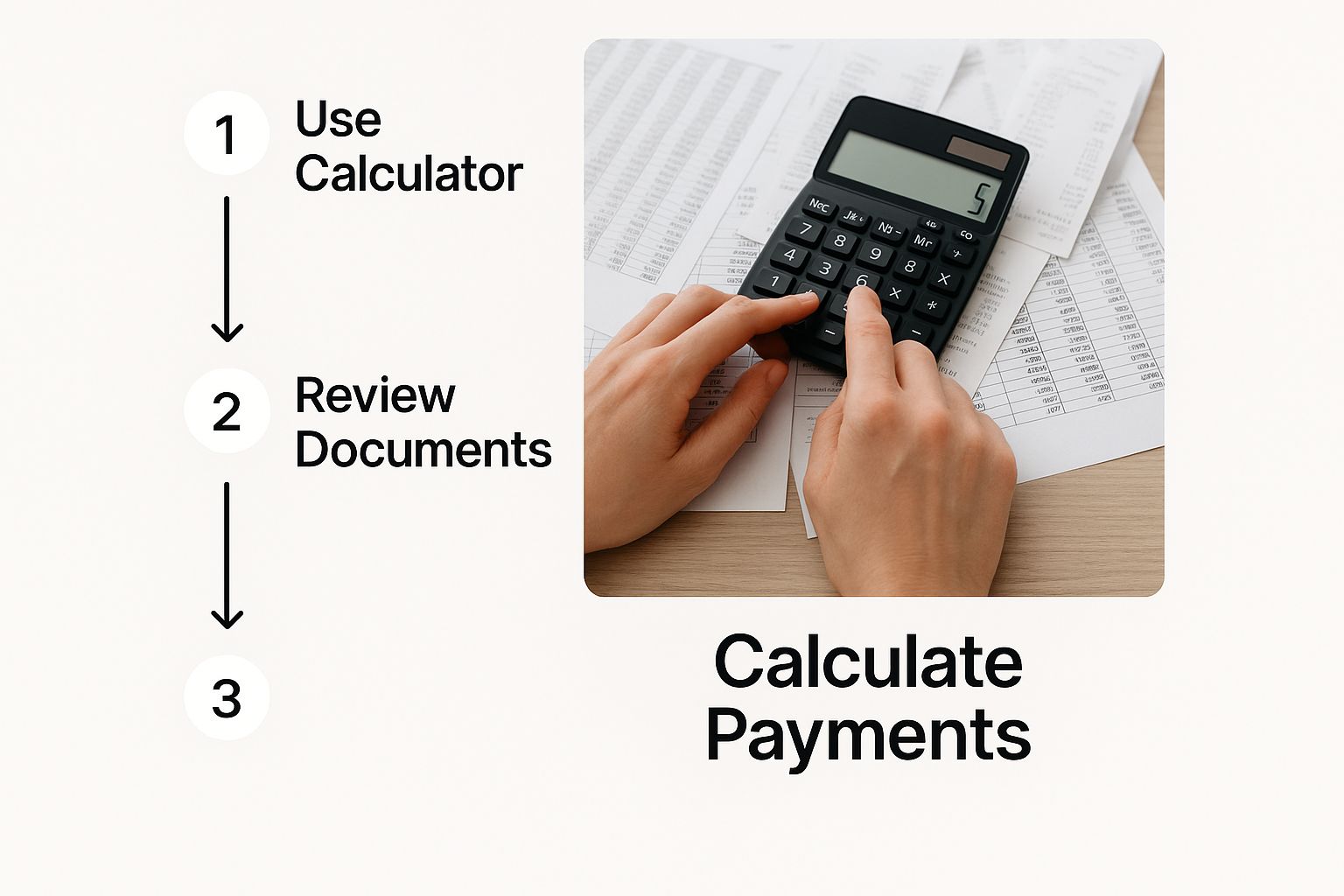
Step 3: Calculate Your Total Expected Tax
With your estimated taxable income in hand, it's time to calculate the actual tax. For most self-employed folks, this involves two key parts: your regular income tax and your self-employment tax.
You'll use the current IRS tax brackets to estimate your income tax. For self-employment tax, the rate is a flat 15.3% on your net self-employment earnings. This single tax covers both your Social Security (12.4%) and Medicare (2.9%) contributions.
Getting the self-employment tax portion right is crucial. Using a good self-employment tax calculator can help you nail this number with more confidence. Once you have both figures, just add them together to get your total expected tax liability for the year.
Step 4: Apply a Safe Harbor Rule
Here's some good news: the IRS doesn't expect you to be a psychic. To keep you from facing underpayment penalties, they provide "safe harbor" rules. Think of them as clear, compliant targets to aim for.
The Safe Harbor Rule: To avoid a penalty, your total estimated payments for the year must be at least the smaller of two amounts: 90% of your tax liability for the current year, or 100% of your tax liability from the prior year.
For most people, the 100% rule is the simplest and safest bet, especially if your income is steady or growing. It gives you a concrete, known number to work with from your last tax return. Just be aware: if your AGI was over $150,000 last year, this threshold bumps up to 110% of last year's tax.
Step 5: Determine Your Quarterly Payment
Once you've used a safe harbor rule to figure out the total amount you need to pay for the year, the last step is the easiest.
Divide that annual total by four.
Annual Estimated Tax ÷ 4 = Your Quarterly Payment
That's it. This is the amount you'll send to the IRS by each of the four quarterly deadlines. If your income is extremely irregular (say, a farmer who earns most of their money in the fall), you might look into the Annualized Income Installment Method to time your payments with your cash flow. But for most, four equal payments is the way to go.
Mastering the When and How of Estimated Tax Payments
Figuring out what you owe is one thing, but getting your payments to the IRS on time is a whole different ballgame. The deadlines for these quarterly payments are set in stone, and honestly, they're a little weird. Getting a handle on this schedule and picking the right way to pay is key to staying on the government's good side and keeping your stress levels down.
Here’s a common tripwire I see all the time: people assume "quarterly" means every three months, like rent. It doesn't. This strange rhythm often catches freelancers and small business owners by surprise, leading to late payments and a penalty notice in the mail.
The term "quarterly" is a bit of a misnomer, and that's putting it lightly. The payment periods are not evenly spaced. For example, your second payment is due just two months after the first, but then you don't make your final payment for the year until January of the next year.
Because of this quirky timing, you absolutely have to mark these dates on your calendar. Treat them like you would any other critical business deadline.
Key Deadlines for Quarterly Estimated Tax Payments
To make it crystal clear, here is the standard schedule the IRS uses for quarterly payments. These dates are pretty consistent from year to year, but keep in mind that if a deadline falls on a weekend or a holiday, you get a little extra time—the payment is due the next business day.
Quarterly Estimated Tax Payment Deadlines
| Payment Period | Due Date |
|---|---|
| January 1 – March 31 | April 15 |
| April 1 – May 31 | June 15 |
| June 1 – August 31 | September 15 |
| September 1 – December 31 | January 15 (of the next year) |
Keeping a copy of this table somewhere you'll see it is a simple but effective way to stay on track. If you're looking ahead and worried about cash flow for an upcoming payment, there's some great advice on managing your July tax payment that can help you plan.
Choosing Your Payment Method
Once you know the when, you have to figure out the how. Thankfully, the IRS gives you a few different ways to send them your money, so you can choose whatever fits best with how you manage your finances.
-
IRS Direct Pay: This is probably the easiest way to go. It’s a free, secure portal on the IRS website where you can pay directly from a checking or savings account. You don't even need to create an account, which makes it incredibly fast.
-
Electronic Federal Tax Payment System (EFTPS): Think of this as the heavy-duty version. EFTPS is another free service from the Treasury Department, but it requires you to enroll first. The big advantage here is that you can schedule payments up to 365 days in advance and see your full payment history. It's a favorite for businesses.
-
Credit or Debit Card: You can always pay online or by phone with a card, but it'll cost you. The IRS uses third-party processors for this, and they charge a service fee. It might make sense if you’re in a pinch or trying to rack up credit card reward points, but just be aware of the extra cost.
-
Mail a Check or Money Order: The old-school method still works. You can fill out a payment voucher from Form 1040-ES and mail it in with a check. It’s reliable, but it’s also the slowest option and you won’t get that instant confirmation that an electronic payment provides.
At the end of the day, paying online through Direct Pay or EFTPS is almost always the smartest move. These digital options give you immediate proof that your payment was received, eliminating any worries about lost mail or processing delays. That little bit of extra peace of mind is priceless.
How to Avoid Underpayment Penalties

The biggest fear for anyone just starting with quarterly estimated tax payments is the dreaded underpayment penalty. It sounds scary, but it helps to know what it actually is: an interest charge from the IRS for not paying your taxes as you earned the income.
Think of it this way. If you were supposed to make four payments throughout the year but held onto all that cash until April, you essentially gave yourself a loan from the government. The underpayment penalty is just the interest the IRS charges you on that loan.
Luckily, the IRS gives you a clear way to avoid this charge with a set of guidelines called "safe harbor" rules. Think of them as your shield. As long as you aim for one of their targets, you can pay with confidence and keep your hard-earned money where it belongs.
Understanding the Safe Harbor Rules
The IRS doesn't expect you to be a psychic. To steer clear of penalties, you just need to hit one of two key benchmarks with your total payments for the year. Meeting either one protects you, even if you still owe a bit more when you file your final return.
The whole point of the safe harbor is to show you're making a good-faith effort to pay your taxes on time. As long as your total payments for the year hit one of these thresholds, you're generally in the clear.
Here are the two main ways to stay on the right side of the IRS:
-
The 90% Rule: Pay at least 90% of the tax you'll owe for the current year. This method is the most accurate, but it's tough for freelancers or business owners with fluctuating income because it requires you to predict your earnings.
-
The 100% Rule: Pay at least 100% of the tax you paid for the prior year. This is almost always the simplest and safest bet because you're working with a hard number you already know.
Now, there’s one important catch for the 100% rule. If your Adjusted Gross Income (AGI) last year was over $150,000 (or $75,000 if you're married filing separately), the bar is raised. You'll need to pay at least 110% of last year's tax bill to qualify for this safe harbor.
Putting the Safe Harbor Rules into Practice
Let's make this real. Imagine a freelance graphic designer named Sarah. Last year, her total tax liability was $12,000. This year, she landed a couple of huge projects and knows her income—and her tax bill—is going to be much higher.
- Using the 100% Rule: To play it safe, Sarah just needs to make sure her total estimated tax payments for this year add up to at least $12,000. That breaks down to $3,000 per quarter.
Even if her final tax bill for this year ends up being $16,000, she won't face an underpayment penalty. Why? Because she met the 100% safe harbor based on last year's taxes. It's a straightforward strategy that gives you a clear, reliable target.
Interestingly, tax systems like this are common around the world, though they take different forms. According to the OECD, tax-to-GDP ratios vary dramatically, from 17.7% in Mexico to over 43.8% in France. Countries that rely heavily on income taxes often use prepayment systems to keep revenue flowing steadily, a method that has proven effective even in shaky economies. You can explore more of these global tax statistics from the OECD.
Correcting Course if You Fall Behind
So what happens if you have a surprisingly good quarter and realize your first few payments were too low? Don't panic. You can always adjust.
If you see you're on track to underpay, just increase your next quarterly payment to cover the difference. For example, if you figure out in September that you've underpaid by $1,000 so far, you can add that amount to your third and fourth quarter payments.
Another trick, if you also have a regular W-2 job, is to ask your employer to increase your tax withholding for the rest of the year. That extra withholding can cover the shortfall from your freelance income. The key is to be proactive and make a change as soon as you spot a potential issue.
Smart Tax Planning Strategies
Let's reframe how you think about quarterly estimated taxes. Stop seeing them as a chore and start seeing them as an opportunity—a chance to sharpen your financial strategy. When you weave tax planning into the very fabric of your business operations, this quarterly task becomes a powerful way to build wealth and financial stability.
It's about shifting from being reactive to proactive. Instead of scrambling to meet deadlines, you start taking control of your financial future.
It all starts with one simple, practical move: open a separate bank account just for your tax savings. This isn't just about being organized; it's a powerful psychological trick. By creating a hard line between your business operations account and your tax savings, you prevent that tax money from being accidentally swallowed up by day-to-day cash flow.
Automate and Adjust Your Savings
Once that account is set up, make saving automatic. Every time a client pays you or you make a sale, have a system in place to transfer a percentage of that income straight into your tax account. For most service businesses or freelancers, setting aside 25-30% is a solid, conservative starting point.
This "pay-yourself-first" approach, but for taxes, guarantees you'll have the funds ready to go when it's time to make a payment.
Treating your tax savings like any other non-negotiable business expense is a fundamental mindset shift. It gets you out of the cycle of scrambling for cash and into a rhythm of systematic preparation, which dramatically reduces stress.
Smart planning also means you don't just "set it and forget it." Your business isn't static, and neither are your tax obligations. Get into the habit of reviewing your income and expenses at the end of each quarter.
- Did you have a monster sales month? You'll probably need to bump up your next payment to avoid a penalty.
- Was business a bit slower than you projected? You might be able to reduce your payment, which frees up valuable cash flow for other needs.
Maximize Deductions and Retirement Contributions
Good tax planning is also about legally and ethically minimizing the income you have to pay tax on. This means keeping meticulous records of every single business expense throughout the year. We're talking everything from software subscriptions and office supplies to client lunches and mileage.
Every dollar you claim as a valid deduction directly lowers your taxable profit. That, in turn, reduces both your income tax and your self-employment tax bill.
Beyond your daily operating costs, one of the most effective tax-reduction tools for the self-employed is retirement accounts. Funneling money into a SEP IRA or a Solo 401(k) usually gives you an immediate tax deduction. It’s a classic win-win: you’re building a nest egg for the future while simultaneously cutting your tax bill today. As you put together your financial plan, exploring these and other tax planning strategies for individuals can uncover some serious savings.
Frequently Asked Questions
When you're trying to get a handle on quarterly estimated taxes, it's natural for specific questions to pop up. Let's tackle some of the most common ones I hear from freelancers and business owners.
What Happens If I Miss a Deadline?
It's a common mistake, but one you want to fix quickly. The moment you miss a deadline, the IRS starts charging an underpayment penalty on what you owe, which works a lot like interest.
The best thing you can do is make the payment as soon as you remember. The sooner you pay, the less the penalty will be.
Can I Just Pay All My Estimated Taxes at Once?
You can, but it’s almost always a bad idea. The IRS calculates the underpayment penalty for each quarter independently. This means sending a huge check in January won't save you from the penalties you might already owe for missing the deadlines last April, June, and September.
The name of the game is consistency. The IRS expects you to pay taxes as you earn income throughout the year—it’s a pay-as-you-go system. Spreading out your payments is the only real way to steer clear of penalties.
Do I Need to Pay State Estimated Taxes Too?
Almost certainly, yes. If your state has an income tax, it likely has its own rules for quarterly estimated payments.
Be careful here, because the deadlines, payment thresholds, and rules can be completely different from the federal system. Always double-check with your state's tax agency to make sure you're covered on all fronts.
How Do I Adjust Payments If My Income Changes?
This is a great question, especially for those with fluctuating income. If your earnings aren't steady, you can use something called the Annualized Income Installment Method.
This approach lets you match your tax payments to when you actually made the money. It's a lifesaver for seasonal businesses or freelancers whose project flow is unpredictable, helping you avoid getting hit with penalties during your slower months.
Trying to manage all this can feel like a lot, but you don't have to figure it out on your own. The experts at Allied Tax Advisors are here to help you with smart tax planning, making sure you stay compliant while keeping your finances in the best possible shape. Schedule a consultation with our team today.