
So, can you write off a car purchase on your taxes? The short answer is yes, but with a huge asterisk: only if you use it for your business.
That daily drive from your house to your primary office? The IRS calls that a personal commute, and it doesn't count. But driving out to meet a client, visit a second work location, or pick up supplies? Now you're talking business use, and that's where the deductions kick in.
Understanding Car Tax Write-Offs

For small business owners and self-employed people, the ability to deduct vehicle expenses is a game-changer. But it's crucial to understand that the IRS draws a very clear, firm line in the sand between what’s for you and what’s for your business.
You can only deduct the portion of your car's expenses that are directly related to your work. This means if you use your car for both work and personal trips, you can't just write off the whole thing. You've got to do a little math.
The Core Concept: Business-Use Percentage
Think of your car's total annual mileage as a pie. The IRS only lets you deduct the slices that represent your business trips. To figure out how big that piece of the pie is, you need to calculate your business-use percentage. This is the most critical number for claiming any vehicle deduction.
The formula is straightforward:
- (Total Business Miles Driven / Total Miles Driven for the Year) x 100 = Business-Use Percentage
Let's say you drove 20,000 miles last year. After looking through your records, you find that 15,000 of those miles were for client meetings and job site visits. Your business-use percentage is 75% (15,000 / 20,000). That means you can deduct 75% of all your eligible vehicle expenses—from depreciation on the car's price to gas, insurance, and repairs.
Key Takeaway: You cannot deduct the full cost of a vehicle unless it is used 100% for business purposes. To prove your business-use percentage, keeping a detailed, accurate mileage log isn't just a good idea; it's an absolute must.
To make this distinction crystal clear, here’s a quick breakdown of how the IRS views business versus personal vehicle use.
Business vs Personal Car Use Tax Implications
This table simplifies the core differences in how your car's use impacts your tax situation.
| Scenario | Is the Purchase a Write-Off? | Are Operating Costs Deductible? | Key Requirement |
|---|---|---|---|
| 100% Business Use | Yes, through depreciation deductions. | Yes, 100% of costs like gas, insurance, repairs. | The vehicle must be exclusively used for business. |
| Mixed-Use (Business & Personal) | Partially, based on business-use percentage. | Partially, based on business-use percentage. | Meticulous records separating business and personal miles. |
| 100% Personal Use | No, it's considered a personal asset. | No, these are considered personal living expenses. | N/A |
As you can see, the moment a vehicle is used for personal errands, commuting, or vacations, its tax treatment changes. The burden of proof is always on you, the taxpayer, to show how you used the vehicle.
Two Paths to Your Deduction
Once you have your business-use percentage, the IRS gives you two different ways to calculate your deduction. The method you choose in the first year you use your car for business can lock you into that choice for future years, so it's a decision worth considering carefully.
Often, the best choice depends on whether you buy or lease the car. We cover this in depth in our guide comparing the tax benefits of leasing versus buying a car.
Here are the two options:
- The Standard Mileage Rate: This is the simpler route. The IRS sets a standard rate per business mile (e.g., 67 cents per mile for 2024), and you simply multiply your business miles by that rate.
- The Actual Expense Method: This method is more involved but can lead to a bigger deduction. You track and add up all your car-related expenses for the year—gas, oil changes, insurance, registration, repairs, and depreciation—and then multiply the total by your business-use percentage.
We'll dive deeper into both of these methods a bit later to help you figure out which one will put more money back in your pocket.
Choosing Your Path: Standard Mileage vs. Actual Expenses
When it comes to deducting your business vehicle costs, the IRS gives you a choice between two very different approaches. Think of it as a fork in the road. The path you take not only changes how you calculate your deduction but also how much paperwork you'll need to wrangle.
This isn't a small decision. The method you pick in the first year can lock you in for as long as you own that car, so it pays to understand your options right from the start. You can go with the simple Standard Mileage Rate or the more hands-on Actual Expense Method.
The Simplicity of the Standard Mileage Rate
The standard mileage rate is the "easy button" for car deductions. Instead of hoarding every gas receipt and repair bill, you just need to keep a solid log of your business mileage. That's it.
At tax time, you simply multiply your total business miles by a set rate the IRS provides each year. For 2024, that rate is 67 cents per mile. So, if you drove 10,000 miles for your business, you'd get a straightforward deduction of $6,700.
This all-in-one rate is designed to cover the typical costs of running a car, including:
- Gas and oil
- Maintenance and repairs
- Insurance
- Depreciation (the wear and tear on your car's value)
The beauty of this method is its simplicity. But don't forget, you can still deduct other specific travel costs on top of the mileage rate, like parking fees and tolls for business trips or the business-use portion of your car loan interest.
Here's a key strategic point: if you start with the standard mileage rate in the first year you use a car for business, you can switch to the actual expense method later on if it makes more sense. That flexibility is a huge plus.
Getting Granular with the Actual Expense Method
If you're someone who likes to track every penny, the actual expense method might be for you. This approach lets you add up all the real costs of operating your vehicle for the year and then deduct the portion that applies to your business.
It definitely requires more discipline. You’ll be tracking and saving receipts for pretty much everything.
Key Insight: The actual expense method often delivers a bigger tax break for newer, more expensive vehicles. Why? Because the depreciation deduction alone can sometimes be more than the entire standard mileage deduction would have been. It also tends to work well for people who have high vehicle costs but don't rack up a massive number of miles.
So, what kind of costs can you track? The list is pretty comprehensive:
- Fuel: Every gallon of gas or charge of electricity.
- Repairs & Maintenance: From oil changes and new tires to unexpected engine trouble.
- Insurance: Your annual premiums.
- Registration & Fees: What you pay the state to keep your vehicle on the road.
- Lease Payments: If you’re leasing instead of buying.
- Depreciation: This is often the biggest piece of the puzzle, accounting for your car's loss in value.
Let's run a quick example. Say your total car expenses for the year add up to $15,000, and you used the car for business 80% of the time. Your deduction would be $12,000. For many business owners, that number easily beats what the standard mileage rate would offer.
But there's a catch, and it's a big one. If you choose the actual expense method the first year and take an accelerated depreciation deduction (like the popular Section 179 deduction), you're stuck. You generally can't switch back to the standard mileage rate for that car, ever. This makes that initial choice incredibly important.
Unlocking the Power of Depreciation
Beyond just tracking mileage and gas receipts, the single biggest tax benefit of a business vehicle comes from depreciation. Think of it this way: the moment you drive a new car off the lot, it starts losing value. The IRS knows this and allows you to deduct that loss in value over time. This isn't just a minor write-off; it's a powerful tool for reducing your taxable income.
This is where strategy comes into play. While some countries have incredibly high vehicle taxes to discourage ownership, the U.S. tax code actually creates strong incentives for business owners. For instance, Japan's automobile taxes are a staggering 23.4 times higher than in the U.S., making business-use vehicles one of the only ways to get a tax break. You can see a full breakdown in this insightful report on automotive taxation.
The image below gives you a great visual of how this works. Everything starts with the vehicle's total cost, but it's your business-use percentage that ultimately determines what you can actually deduct.
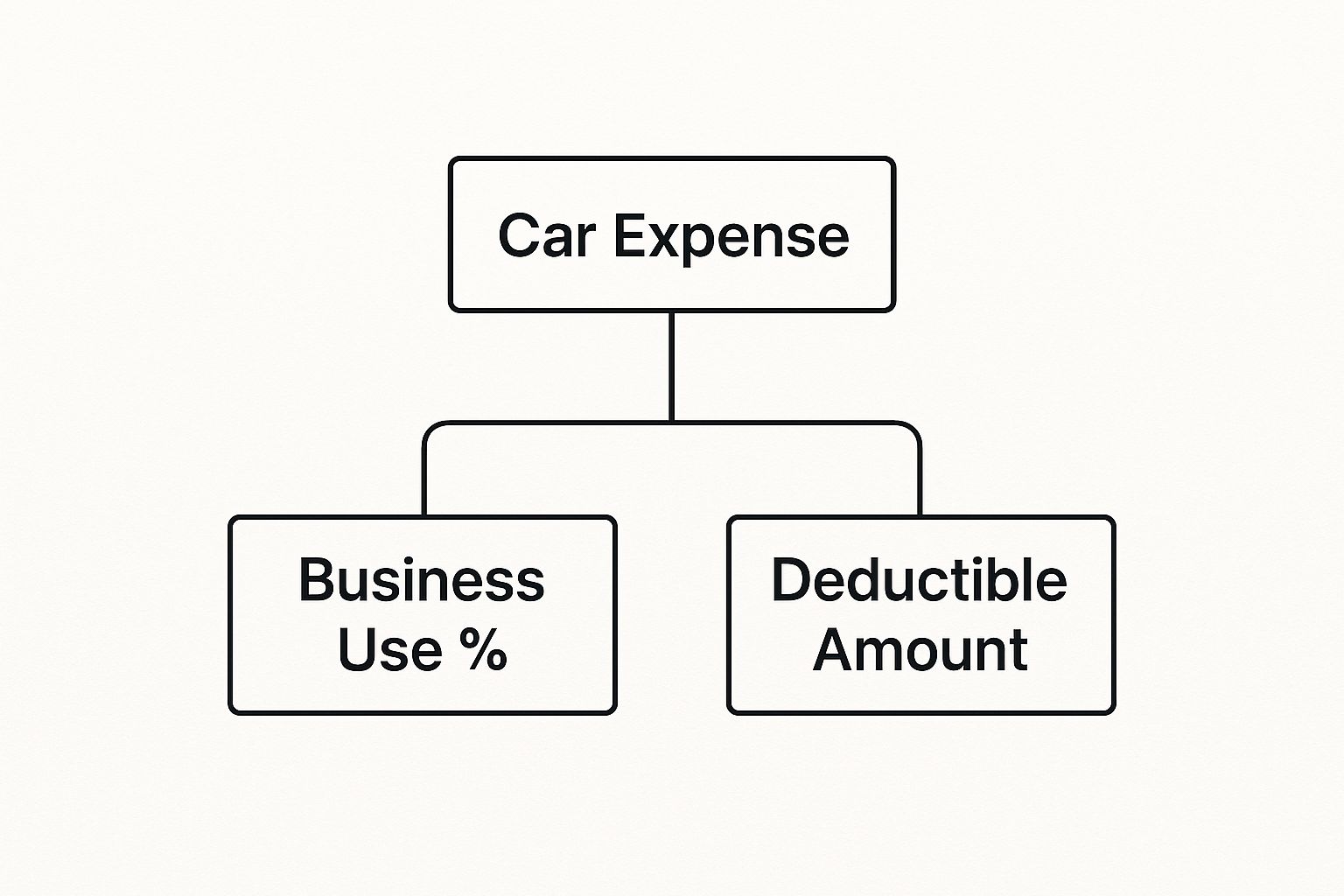
As you can see, that business-use percentage is the gatekeeper for every deduction we're about to cover, especially the big ones related to depreciation.
The Slow and Steady Method: Standard Depreciation (MACRS)
The default, most common way to depreciate a business vehicle is through the Modified Accelerated Cost Recovery System, or MACRS. This is the standard multi-year schedule the IRS sets for business assets. For cars, this typically means you deduct a portion of the vehicle's cost each year over a five-year period.
MACRS is a marathon, not a sprint. It provides a consistent and predictable deduction year after year. While the deductions are a bit larger in the early years, they are still spread out. It's a solid, reliable choice, but it doesn't offer the immediate tax-saving punch that gets most business owners excited.
The Ultimate First-Year Write-Off: Section 179
Now we get to the real game-changers. Section 179 of the tax code is an incredible tool that basically lets you treat a huge purchase, like a car, as a regular, one-time expense. Instead of slowly chipping away at the car's cost over five years, Section 179 often allows you to deduct the entire business portion of the purchase price in the very first year.
Key Insight: To use Section 179, the vehicle must be used for business more than 50% of the time. If your business use ever drops to 50% or below in later years, the IRS might make you pay back some of that deduction.
This is a massive win for your cash flow. By taking a huge deduction upfront, you can dramatically lower your taxable income for the year, freeing up money to put right back into your business. When people ask "is buying a car a tax write-off?", they are often thinking of this powerful, immediate benefit. You can get into the nitty-gritty of the math in our guide on how to calculate depreciation.
The Extra Boost: Bonus Depreciation
Bonus depreciation is another way to accelerate your write-off, and it works a lot like Section 179. It lets you deduct a large percentage of an asset's cost in the first year. The big difference is that while Section 179 has an annual cap on how much you can deduct overall, bonus depreciation doesn't.
For 2024, bonus depreciation is set at 60% for qualifying new and used vehicles. This means you can immediately deduct 60% of the vehicle's cost. You can even combine these methods—take your Section 179 deduction first, and then apply bonus depreciation to whatever cost basis is left over.
To help you decide which approach is right for you, here's a quick comparison of the three main depreciation methods.
Comparing Vehicle Depreciation Methods
| Depreciation Method | Key Feature | Best For | Vehicle Type Limitations |
|---|---|---|---|
| Section 179 | Deduct up to 100% of the vehicle's cost in the first year. | Business owners who want a large, immediate tax deduction to reduce current-year income. | Annual deduction limits apply; most effective on vehicles over 6,000 lbs. GVWR. |
| Bonus Depreciation | Deduct a set percentage (60% in 2024) in the first year with no income limit. | Businesses with large capital expenditures that exceed the Section 179 cap. | Percentage is phasing down annually; not available in all states. |
| MACRS (Standard) | Spreads the deduction out over a 5-year period. | Businesses wanting consistent, predictable deductions or those who don't qualify for accelerated methods. | Lower annual limits apply to passenger vehicles under 6,000 lbs. GVWR. |
Each of these methods offers a different strategic advantage. Choosing the right one depends on your vehicle choice, your income, and your long-term business goals.
The Heavy Vehicle Advantage
This is where a little bit of planning can lead to a huge tax saving. The IRS puts strict annual limits on how much you can depreciate a normal passenger car. They do this to stop people from getting massive write-offs on fancy luxury cars.
But those limits disappear for "heavy" vehicles. Any vehicle with a Gross Vehicle Weight Rating (GVWR) of over 6,000 pounds qualifies. This category covers many full-size SUVs, pickup trucks, and work vans. If you buy a qualifying heavy vehicle and use it more than 50% for business, you can often use Section 179 to write off 100% of the purchase price in the first year. It's one of the biggest tax advantages available to business owners today.
Why Meticulous Records Are Your Best Friend (Especially with the IRS)

When you wonder, "is buying a car a tax write off?" the IRS always answers with a big "if." If you can prove it. The strength of any deduction you claim hinges entirely on the quality of your documentation. Without solid proof, a perfectly legitimate expense can get thrown out during an audit, turning a smart tax move into a massive headache.
Think of your records as the foundation of your tax strategy. If that foundation is shaky—or just a shoebox full of crumpled receipts—the whole thing can collapse under the slightest pressure. This is why having a consistent, modern system for record-keeping isn't just a good idea; it's your only real defense.
What a Bulletproof Mileage Log Looks Like
The absolute cornerstone of any vehicle deduction is your mileage log. This isn't optional, regardless of whether you're using the standard mileage rate or the actual expense method. The IRS wants to see "contemporaneous" records, which is just their formal way of saying you need to log trips as they happen, not guess at them months down the road.
For every single business trip, your log needs to capture four essential details:
- The date of your trip.
- The total miles you drove.
- Where you went (your destination).
- The specific business reason for the trip.
And "client meeting" just won't cut it. You need to be more specific. Something like, "Met with Jane Smith at ABC Corp to discuss the Q3 project proposal" is much stronger. The more detail, the better.
Thankfully, we've moved past the days of pen-and-paper logs. Modern GPS-powered mileage tracking apps can do most of the heavy lifting for you, running quietly on your phone to generate precise, detailed reports that are ready for an audit.
Key Takeaway: Your mileage log is your number one piece of evidence. A vague or incomplete log is one of the fastest ways to see your vehicle deductions get denied.
Keeping Your Actual Expense Paperwork in Order
If you decide to go with the actual expense method, your record-keeping duties expand. You’ll need a neatly organized file of every single receipt related to running your vehicle. This means everything from gas and oil changes to insurance payments and new tires.
This is where digital organization is a lifesaver. Create a dedicated folder in your cloud storage or use a receipt-scanning app to snap a picture and categorize each expense right when it happens. This saves you from the frantic year-end search for receipts and builds a clean, easily searchable record of your spending. It’s all about tracking all business expenses accurately to ensure nothing gets missed.
This level of detail is also crucial in a global context. While buying a car isn't a direct tax write-off for individuals in many European countries, businesses still rely on detailed records to claim deductions. Take Belgium, which has the highest annual motor vehicle tax in the EU, averaging a steep €2,896 per vehicle. For businesses there, documenting every kilometer is absolutely essential.
At the end of the day, building these habits is about more than just staying compliant. Knowing https://alliedtax.com/how-to-track-business-expenses/ gives you a crystal-clear view of your company's financial health and makes sure you're always prepared if the IRS comes knocking.
Steer Clear of These Common (and Costly) Tax Mistakes
Claiming vehicle deductions can feel a bit like walking a tightrope. You want to get every deduction you’re entitled to, but one misstep can lead to problems. Many well-intentioned business owners, trying to lower their tax bill, stumble into simple mistakes that either cost them money or, even worse, put them on the IRS's radar.
Knowing what not to do is just as important as knowing what you can do. Let’s shine a light on the most common blunders so you can sidestep them and keep your tax strategy on solid ground.
Mistake #1: Deducting Your Daily Commute
This is the big one—the most common and easily flagged error. The drive from your home to your main place of work is never deductible. It doesn't matter if you take work calls or plan your day on the way; the IRS considers this a personal commuting expense, period.
Think of it like this: a graphic designer drives from her house to her downtown studio every morning. That's her commute, and it's not deductible. But when she leaves the studio to meet a client across town, that trip is 100% business mileage.
The Golden Rule of Commuting: Any travel between your home and your primary office or worksite is considered personal. Claiming it is a surefire way to attract an audit.
Mistake #2: Guessing Your Business-Use Percentage
Your business-use percentage is the bedrock of all your vehicle deductions. If you get this number wrong, every other calculation—from depreciation to fuel—will be wrong, too. The most frequent foul-up here is simply guessing or wildly overestimating how much a vehicle is used for work.
The formula itself is straightforward: (Business Miles / Total Miles) x 100. The hard part is the discipline it takes to track those miles. If you claim 90% business use but your mileage log is spotty or nonexistent, you'll have a tough time defending that figure if the IRS asks.
This single number directly impacts how much of these expenses you can write off:
- The vehicle's purchase price (through depreciation)
- Fuel and maintenance costs
- Insurance premiums and registration fees
Mistake #3: The "Double-Dipping" Dilemma
Another classic mistake is trying to have your cake and eat it too. This happens when you choose the Standard Mileage Rate but then also try to deduct actual operating costs like gas, oil changes, or repairs.
You have to pick a lane. You can either use the simple, all-inclusive standard mileage rate or you can track every single penny with the actual expense method. The standard mileage rate is specifically designed to cover all those running costs in one neat package. Trying to claim both is a definite no-go.
To put it simply:
- If you take the Standard Mileage Rate: You deduct the set rate for every business mile you drive, plus any business-related tolls and parking fees. That's it.
- If you use the Actual Expense Method: You deduct a percentage of your fuel, insurance, repairs, and depreciation. You cannot also claim the mileage rate.
Mistake #4: Ignoring the "Luxury Car" Rules
The IRS knows a flashy sports car isn't always a "business necessity." To curb massive write-offs on high-end vehicles, they put strict depreciation limits on passenger cars that weigh less than 6,000 pounds. For 2024, the maximum first-year depreciation you can claim on these vehicles (even with bonus depreciation) is capped at $20,400.
This is precisely why so many business owners opt for heavier vehicles. Trucks, full-size SUVs, and cargo vans with a Gross Vehicle Weight Rating (GVWR) over 6,000 pounds are exempt from these "luxury auto" limits. This opens the door to using Section 179 to potentially write off a huge chunk—sometimes even 100%—of the purchase price in the very first year. Confusing a sleek sedan with a qualifying heavy SUV on your tax return will result in a much smaller deduction than you were counting on.
Answering Your Top Car Write-Off Questions
When you start digging into vehicle deductions, a lot of "what-if" questions pop up. It's totally normal. Getting a handle on these common scenarios is the key to feeling confident that you're making the right calls for your business.
Let’s jump right into the questions I hear most often.
Can I Switch Between Mileage and Actual Expense Methods?
Yes, but there's a huge catch you need to know about. If you start out using the standard mileage rate for the first year you put a car in service, you can switch over to the actual expense method in a later year if you choose. You've got options.
The reverse, however, is a one-way street. If you kick things off with the actual expense method and take an accelerated depreciation deduction (like Section 179), you're pretty much locked in. You can't flip back to the standard mileage rate for that same vehicle down the road. That makes your first-year decision a big one.
Do Used Cars Qualify for Business Tax Deductions?
They sure do. A used car gets the same tax treatment as a new one, which is fantastic news if you're looking to save some cash. You can claim its business use with either the standard mileage rate or the actual expense method, no problem.
And here's the best part: a used vehicle that is "new to you" and your business can also qualify for the powerful Section 179 deduction. This means you could potentially write off a huge chunk of the purchase price in the very first year, making a pre-owned vehicle a seriously smart tax move.
What About Leasing a Car for My Business?
Leasing is another great way to get a tax benefit. When you lease, you can deduct the portion of your monthly lease payments that corresponds to your business use. This falls under the actual expense method, and you can add it to your other write-offs like gas, maintenance, and insurance.
Key Distinction: Depreciation is only for assets you own. So, if you're deducting your lease payments, you can't also claim Section 179 or bonus depreciation. You're also not allowed to use the standard mileage rate if you're deducting the actual lease payments.
It's common to weigh your options when thinking about how a car purchase might offer a tax write-off. Understanding the pros and cons is crucial, as this guide on Leasing vs. Buying a Car explains well.
How Does the Heavy Vehicle Deduction Work?
This is easily one of the biggest tax breaks on the books for business vehicles. The IRS has pretty strict annual limits on how much depreciation you can claim for typical passenger cars—they don't want people writing off fancy luxury vehicles all at once.
But vehicles with a Gross Vehicle Weight Rating (GVWR) over 6,000 pounds are a different story. They're exempt from those low limits. This category usually includes:
- Full-size SUVs
- Pickup trucks
- Cargo vans
If you buy one of these qualifying heavy vehicles and use it more than 50% for business, Section 179 could let you write off 100% of the purchase price in year one. This is a game-changer for many businesses and a major strategic advantage at tax time.
At Allied Tax Advisors, our job is to help business owners like you cut through the confusion and make sure you're getting every deduction you deserve. If you need an expert to look over your vehicle expenses or your broader tax strategy, we’re ready to help. See everything we offer at https://alliedtax.com.