
When it comes to the car lease vs. buy tax benefits, the core difference is simple. Leasing lets you write off the monthly payments as a business expense, while buying gives you a hefty upfront tax break through depreciation. Honestly, the right move boils down to your company's cash flow, how long you'll use the vehicle, and what your big-picture financial strategy looks like.
Leasing vs. Buying Your Next Vehicle: A Financial Overview
Choosing to lease or buy your next vehicle is a major financial decision, and the tax implications are a huge part of it. This isn't just about the size of your monthly payment; it's about making a choice that fits your long-term financial goals and helps you save as much as possible on taxes, especially when the vehicle is for business.
For a lot of businesses, leasing is all about predictable costs. You can typically deduct the business-use percentage of your monthly lease payment, which keeps the bookkeeping clean and your cash flow steady. On the other hand, when you buy a vehicle, it becomes a company asset. This opens the door to powerful tax deductions like depreciation, letting you write off the vehicle's cost over its useful life.
Key Financial Differences at a Glance
Getting a handle on the main distinctions is the first step. Each option has its own set of perks that cater to different business models and financial realities. One route offers simplicity and lower upfront costs, while the other can deliver a massive tax deduction right out of the gate.
At its heart, the lease vs. buy tax decision is all about timing. Leasing provides steady, smaller deductions year after year. Buying can give you a significant, immediate tax write-off in year one.
Here’s a quick side-by-side look at the key financial and tax factors:
| Feature | Leasing a Vehicle | Buying a Vehicle |
|---|---|---|
| Primary Tax Benefit | Deductible monthly payments (business portion) | Depreciation deductions (including Section 179) |
| Upfront Cost | Generally lower (first month's payment, security deposit) | Higher (down payment, sales tax) |
| Ownership | No equity; you return the vehicle at the end of the term | You build equity and own the asset |
| Long-Term Cost | Can be more expensive over many years | Generally cheaper in the long run if kept |
| Flexibility | Easy to upgrade to a new model every few years | You are responsible for selling or trading in |
How Leasing a Vehicle Impacts Your Taxes

When it comes to business vehicles, leasing often provides a more straightforward path to tax savings compared to buying. The big draw is being able to deduct your monthly lease payments as a regular business expense. This approach keeps your accounting clean and can deliver consistent, predictable tax benefits throughout the year, which is a huge plus for any business focused on stable cash flow.
One of the main reasons people lean toward leasing is how neatly the deduction works. If the vehicle is used 100% for business, the entire lease payment is deductible. That's much simpler than purchasing, where you're juggling separate, and often complex, rules for depreciation, loan interest, and other ownership costs. You can find a great breakdown of this direct deductibility on the Jackson Hewitt website.
Calculating Your Lease Deduction
The key to figuring out your deduction is your business-use percentage. Let's be honest, very few vehicles are used exclusively for business, which means you need to be diligent about keeping records. You'll have to track your total annual mileage and, more importantly, the miles driven specifically for business activities. This ratio determines how much of your lease payment you can actually write off.
Let's walk through a quick example. Picture a freelance consultant who leases a car for $600 a month. In a year, they drive a total of 15,000 miles. Of those, 12,000 were for client visits, site inspections, and other business-related trips.
- Business-Use Percentage: (12,000 business miles / 15,000 total miles) = 80%
- Deductible Monthly Amount: $600 x 80% = $480
- Total Annual Deduction: $480 x 12 months = $5,760
This kind of clear, simple math makes tax planning much easier.
The Luxury Car Rule: An "Inclusion Amount"
Now, the IRS isn't going to let you write off a six-figure sports car without a catch. They have a special rule to prevent huge write-offs on high-end vehicles, known as the "lease inclusion amount." If the fair market value of the car you're leasing is above a certain limit (for instance, over $62,000 for cars first leased in 2024), you have to reduce your total lease deduction by a small, specific amount.
The inclusion amount is the IRS’s way of leveling the playing field. It makes sure that the tax benefit of leasing a fancy car is roughly equivalent to the depreciation limits you'd face if you bought it instead.
You can find this figure in official IRS tables, and you'll prorate it based on your business-use percentage. While it does chip away at your deduction, the adjustment is usually pretty minor. For most typical work vehicles, this rule won't even come into play. But if you’re leasing a premium model, it’s a detail you can’t afford to miss.
Maximizing Deductions When You Buy a Vehicle
When you purchase a vehicle for your business, you unlock a completely different set of tax benefits than you'd get with a lease. The big one? Depreciation. Instead of just writing off your monthly payment, buying lets you treat the car or truck as a business asset, deducting its cost over time. This strategy can create some serious, front-loaded tax savings that can make a real difference to your bottom line right away.
At the heart of the "buy" strategy is depreciation—the process of writing off a vehicle's value as it ages. You can do this slowly over several years, but the real power comes from accelerated methods that pack a much bigger punch in year one.
Accelerated Depreciation: Your Key to Upfront Savings
The most compelling tax reason to buy a business vehicle often boils down to accelerated depreciation. These are powerful tax code provisions designed to encourage businesses to invest in themselves. They let you deduct a huge chunk—sometimes even the entire cost—of the vehicle in the very same year you start using it.
There are two main tools you'll want to know about:
- Section 179 Deduction: This lets you treat the full purchase price of the vehicle as an immediate expense. For 2024, the maximum you can expense under Section 179 is a whopping $1,220,000, as long as your total equipment purchases don't exceed $3,050,000.
- Bonus Depreciation: This is another first-year perk that allows you to deduct a set percentage of the asset's cost. For 2024, that percentage is 60% for both new and used vehicles. Keep in mind, though, that this percentage is set to drop in the coming years.
The ability to stack these methods and potentially write off the full cost of a vehicle in the first year is a game-changer. It's one of the single biggest differentiators when weighing the car lease vs buy tax benefits.
Special Rules for Heavy Vehicles
Now, the IRS does have limits on how much you can depreciate a typical passenger car each year. But there's a huge exception for what they consider "heavy" vehicles. If you buy an SUV, truck, or van with a Gross Vehicle Weight Rating (GVWR) over 6,000 pounds, it isn't held to those same restrictive luxury auto depreciation caps.
This rule is a big deal. It means a qualifying heavy vehicle can often be fully expensed using the Section 179 deduction in the first year. It's no wonder that buying a larger truck or SUV is such a common and effective tax strategy for small business owners.
Of course, depreciation isn't the only perk. You can also deduct other costs of ownership based on the percentage you use the vehicle for business. This includes the interest on your auto loan, registration fees, and even sales tax. It’s a comprehensive approach, much like how you’d handle other business assets. For more context on managing asset deductions, you can see how the principles apply to taxes on rental income. Keeping meticulous records of all these expenses is key to getting the full tax savings you’re entitled to.
Comparing Tax Implications Lease vs Buy Side by Side
When it comes to the car lease vs buy tax benefits, there's no single right answer. It really boils down to your business's financial situation and what you're trying to achieve. Think of it this way: leasing gives you predictable, steady deductions, while buying offers a massive, front-loaded tax break through depreciation.
Let's put these two approaches head-to-head. With a lease, your tax write-off is a clean, simple calculation based on your monthly payment and how much you use the car for business. It’s consistent and easy to forecast. On the flip side, buying a car lets you tap into powerful depreciation deductions, which can be accelerated to create a significant tax shield right out of the gate.
A Three-Year Financial Scenario
To see how this plays out in the real world, let's run the numbers. Imagine a small business gets a new $45,000 vehicle that will be used 100% for business. Here’s a look at how the tax deductions could shake out over the first three years.
Scenario 1: The Leased Vehicle
They sign a three-year lease for $650 per month, which comes out to $7,800 per year.
- Year 1 Deduction: $7,800
- Year 2 Deduction: $7,800
- Year 3 Deduction: $7,800
- Total 3-Year Deduction: $23,400
The deductions are perfectly predictable, which makes budgeting a breeze. No surprises here.
Scenario 2: The Purchased Vehicle
Instead, the business buys the vehicle outright and decides to use accelerated depreciation. With Section 179, they could potentially deduct the full purchase price in the very first year, provided they meet the criteria.
- Year 1 Deduction: $45,000 (assuming they can take the full Section 179 deduction)
- Year 2 Deduction: $0 (though they can still deduct loan interest and operating costs)
- Year 3 Deduction: $0 (same as year 2, deductions would be for ongoing costs)
- Total 3-Year Deduction: $45,000+
This approach gives the business a huge tax benefit immediately, which could dramatically lower their taxable income for the year.
The core trade-off is clear: Leasing delivers consistent, smaller deductions over time, while buying can offer a large, immediate tax write-off that provides instant financial relief.
This chart breaks down the fundamental differences in how each option impacts your finances and your balance sheet.
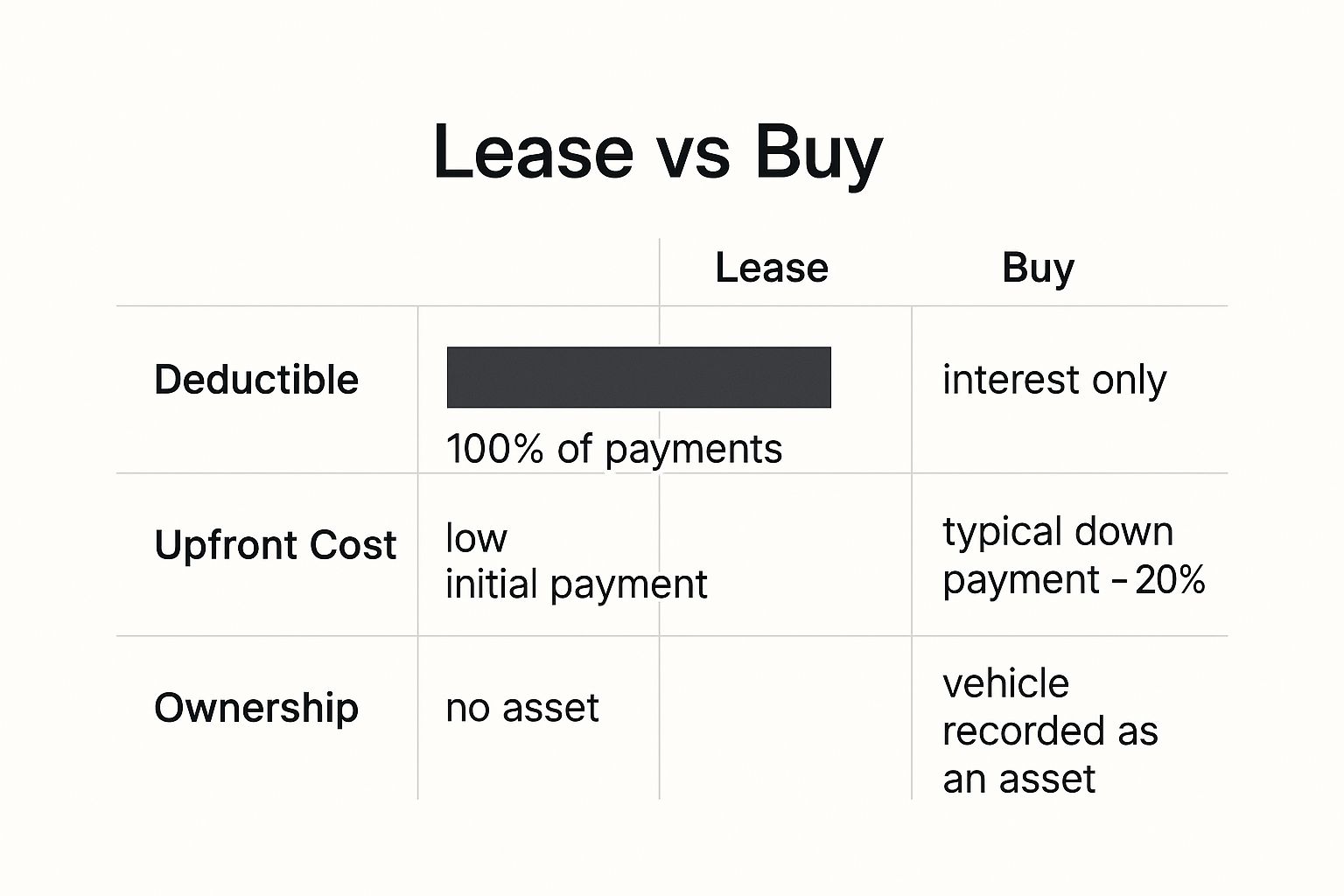
As you can see, leasing keeps the vehicle off your books—it’s not an asset you own, which simplifies your accounting. Buying, however, adds an asset to your balance sheet that you'll need to depreciate over its useful life.
To help you see the key differences at a glance, here's a quick summary table.
Lease vs Buy Tax Benefit Comparison
| Tax Consideration | Leasing a Car | Buying a Car |
|---|---|---|
| Primary Deduction | The business-use portion of monthly lease payments. | Depreciation, loan interest, and operating costs. |
| Upfront Savings | Minimal. Deductions are spread out evenly over the lease term. | Potentially huge via Section 179 or bonus depreciation in Year 1. |
| Record-Keeping | Simpler. Mainly requires tracking business mileage to justify deductions. | More complex. Involves depreciation schedules, loan interest, and all operating expenses. |
| Long-Term Value | None. You build no equity in the vehicle. | You own an asset and build equity as you pay down the loan. |
| Flexibility | High. Easy to switch to a new vehicle every few years. | Lower. Selling a vehicle can have its own tax implications (recapture). |
Ultimately, the right choice comes down to your priorities. If you need to maximize your tax savings right now and want to build equity in an asset, buying is tough to beat. But if you value predictable expenses, lower upfront costs, and simpler bookkeeping, leasing is often the smarter move. Each path offers distinct advantages designed for different business strategies.
How EV Tax Credits Influence the Decision
The explosion in popularity of electric vehicles (EVs) throws a fascinating new wrinkle into the lease versus buy debate. Government incentives, especially federal tax credits, can completely change the math, adding a new layer to the already complex discussion of car lease vs buy tax benefits. These credits were created to make EVs more accessible, but the way you get the car dictates who actually gets the money.
This is a critical distinction because the tax credit almost always goes to the vehicle's legal owner. If you buy a new EV that qualifies, you can claim that credit directly on your tax return. It’s a dollar-for-dollar reduction of what you owe, which can be a huge financial victory.
Who Claims the EV Credit: Lease vs. Buy
When you lease an EV, it's the leasing company—the legal owner—that pockets the tax credit. This is a game-changer. You might be the one driving the car every day, but that direct financial incentive from the government goes to the financing institution, not you.
Now, some leasing companies are good about passing those savings on to you, often as a "lease credit" that lowers your monthly payments. But this isn't guaranteed, and the process isn't always transparent. It's on you to ask the dealer exactly how—and if—that credit is being factored into your lease terms.
The core issue here comes down to control and certainty. Buying an EV gives you direct access to the tax credit, provided you qualify. Leasing makes you dependent on the dealership's policy for passing along the savings.
This reality often makes buying an EV the more powerful financial move, especially for individuals or businesses with enough tax liability to use the full credit. Those upfront savings can easily be large enough to overshadow the usual perks of leasing, like a lower monthly payment.
The Shifting Landscape of EV Incentives
The rules for EV credits are always in flux, so you have to keep a close eye on them. For instance, recent legislation has dramatically reshaped the financial landscape here. Beginning in 2023, the Inflation Reduction Act introduced a federal tax credit of up to $7,500 for qualified new EV purchases, a direct benefit to buyers. As the rules stand, lessees generally can't claim this credit since it belongs to the leasing company that owns the car. You can find more details on these tax law changes at 1800Accountant.com.
This has definitely tilted the scales, making buying an EV much more appealing from a pure tax-saving perspective for those who qualify. While a lease still gives a business deductions on its payments, the buyer's ability to claim a massive tax credit can more than make up for the higher initial cost. Getting a handle on these incentives is crucial, and you can explore more strategies for maximizing your refund with top tax tips for San Diego residents to make sure your decision is the right one for your situation.
So, Which Is Right for Your Business?
Figuring out the lease vs. buy puzzle really comes down to what your business actually does day-to-day. There’s no magic formula here. The best move depends entirely on your cash flow, how you plan to grow, and what you need from a vehicle.
To get to the right answer, let’s look at a few common business scenarios. See which one sounds most like you—it’ll help clarify whether leasing or buying is the smarter financial play.
Real-World Scenarios: Making the Call
Matching the financing to your business needs is what it's all about. Let's walk through a few examples.
-
The High-Mileage Consultant: If you’re constantly on the road racking up miles, buying is almost always your best bet. Leases have strict mileage limits, and the overage fees are brutal—they can wipe out any tax benefit you thought you were getting. When you own the vehicle, you can drive as much as you need without penalty.
-
The Cash-Conscious Startup: For a new business trying to protect every dollar, leasing is a lifesaver. You avoid a huge down payment, and the fixed monthly payments keep your budget predictable. This frees up precious capital for marketing, inventory, or hiring. Plus, deducting the lease payment is clean and simple.
-
The Image-Focused Business: Think about tech companies, high-end real estate agents, or any business that needs to project a modern, successful image. Leasing is perfect here. A short 2- or 3-year lease cycle means you’re always in a new, impressive vehicle with the latest tech, and you don’t have the headache of selling the old one.
The right decision balances immediate tax advantages with long-term operational needs. A startup might prioritize the low monthly payments of a lease, while a construction company needing a customized truck will find buying the only practical choice.
At the end of the day, buying gives you a powerful, immediate tax punch, especially once you understand how bonus depreciation works on a qualifying heavy vehicle. You're also building equity in a business asset.
Leasing, on the other hand, is all about financial agility and simplicity. It treats the vehicle as a straightforward operating cost. Take a hard look at your annual mileage, your need for vehicle modifications, and your overall financial strategy to make a smart, tax-efficient decision.
Common Questions on Vehicle Tax Benefits
It's easy to get tangled up in the tax rules for vehicle expenses. But once you get a handle on a few core concepts, the fog starts to clear. Let's tackle some of the most common questions people have when trying to maximize their deductions, whether they're leasing or buying.
Can I Still Deduct Car Expenses if I Take the Standard Mileage Rate?
You can, but it's an either/or situation. You can't deduct both the standard mileage rate and your actual expenses like lease payments or depreciation. The standard mileage rate is designed to be an all-in-one figure that covers most of your operating costs.
Just be aware, if you choose the standard mileage rate for a car you're leasing, you're locked into that decision for the entire lease period.
What if My Business Use of the Vehicle Drops?
This is where things can get a bit hairy, especially if you bought the vehicle. If your business use drops to 50% or less, the IRS might hit you with depreciation recapture. In simple terms, you have to add a portion of the accelerated depreciation you claimed in earlier years back into your taxable income.
With a leased car, the process is much cleaner. You simply deduct a smaller percentage of your monthly payment to reflect the reduced business use—no complicated recapture math involved.
A significant drop in business use for a purchased vehicle can trigger unexpected tax consequences. This is a critical factor to consider if your business activity fluctuates.
Are There Any Tax Perks for a Strictly Personal Vehicle?
For the most part, no. Federal tax deductions for vehicles are almost exclusively reserved for business-related driving. All those great write-offs—depreciation, lease payments, fuel, maintenance—are only deductible for the portion of miles driven for work.
The one small exception is that you might be able to deduct the state and local sales taxes you paid on a purchased car. However, you'd have to itemize your deductions, and even then, it's subject to the $10,000 cap on state and local taxes (SALT).
Ready to optimize your business finances and navigate complex tax decisions with confidence? The expert team at Allied Tax Advisors is here to provide personalized guidance. Visit us online to schedule your consultation.