
So, you're wondering, "how long does an IRS audit take?" While there's no single magic number, most audits wrap up within a year. A simple inquiry by mail, known as a correspondence audit, might be over in just three to six months. On the other hand, a full-blown field audit can easily stretch past the one-year mark. The timeline really comes down to the complexity of your tax situation and which type of audit the IRS has kicked off.
Deconstructing the IRS Audit Timeline
Getting that official envelope from the IRS is enough to make anyone's stomach drop, but knowing what to expect can take a lot of the anxiety out of the process. An audit isn't a single event; it's a process, and the speed can vary wildly. Think of it like a car inspection: some are quick, routine checks, while others require the mechanic to take the whole engine apart to diagnose a deeper problem.
The audit timeline really depends on the flavor of audit you're dealing with. The good news is that the vast majority are simple correspondence audits handled entirely through the mail. These are the fastest to resolve because they usually just involve sending in a specific document or providing a quick clarification on a deduction you claimed.
Comparing Audit Types and Durations
The next step up in intensity is the office audit, which requires you to meet an IRS agent at one of their local offices. These naturally take a bit longer because they involve a more detailed look at your financial records. Finally, the field audit is the most thorough and time-consuming of all. This is where an agent comes to your home or place of business for a deep dive into your books.
An IRS audit's duration is directly proportional to its complexity. Simple issues resolved by mail are fast, while in-depth examinations requiring face-to-face meetings naturally extend the process.
This infographic gives you a great visual breakdown of the typical timeline for each of these audit types.
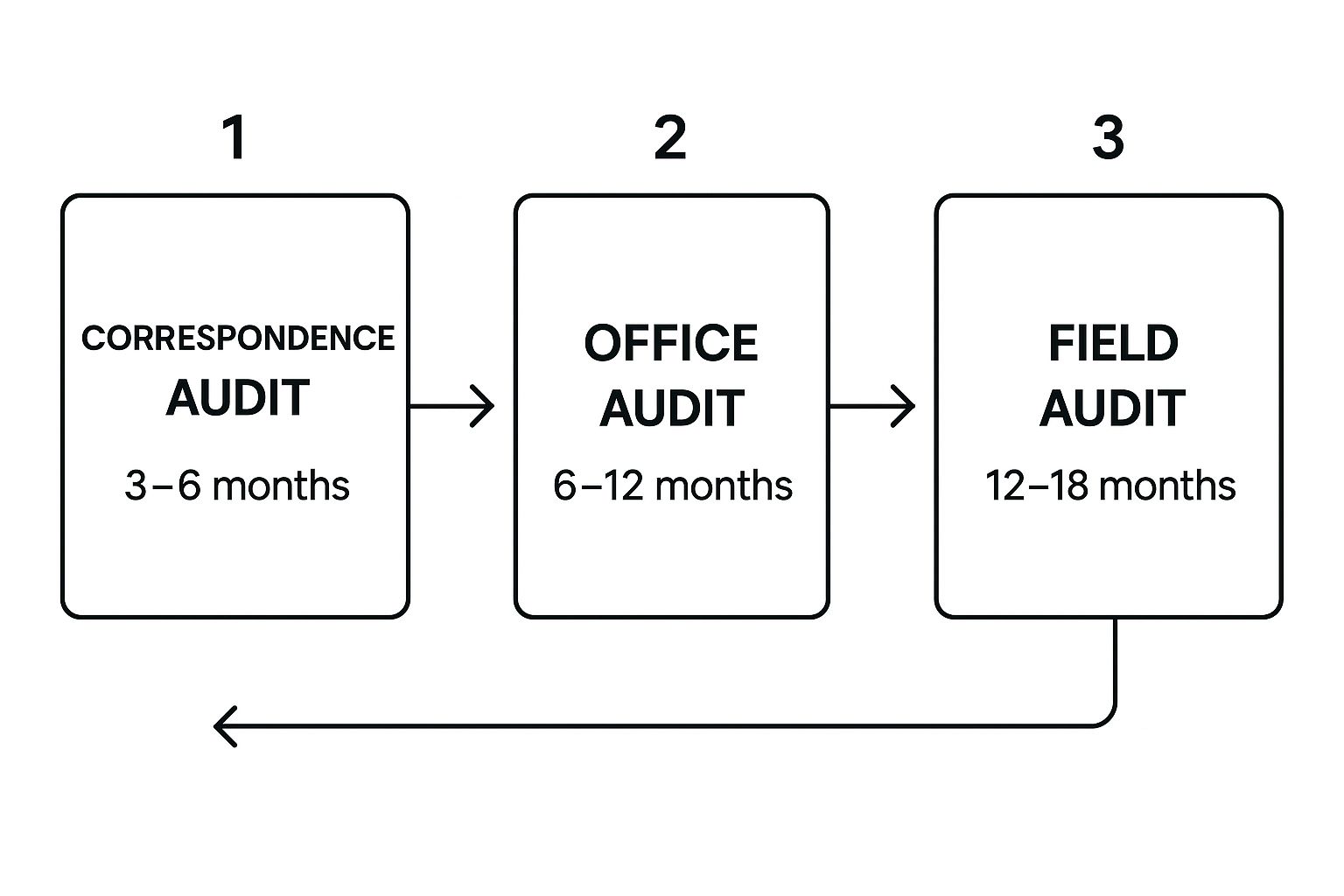
As you can see, the more personal and detailed the examination gets, the longer you should prepare for it to last.
To give you a clearer picture, here’s a quick summary of what to expect from each audit type.
IRS Audit Timelines at a Glance
| Audit Type | Typical Duration | What It Involves |
|---|---|---|
| Correspondence Audit | 3-6 months | Conducted entirely by mail. The IRS requests specific documents or information to verify items on your return. |
| Office Audit | Around 1 year | You meet with an auditor at an IRS office to review your records. It's more detailed than a correspondence audit. |
| Field Audit | Over 1 year | An IRS agent visits your home, business, or accountant's office for the most comprehensive review of your finances. |
This table helps set some realistic expectations. Remember, these are just averages, and your specific case could be faster or slower depending on the details.
The clock officially starts ticking the moment you receive that audit notice, which almost always asks for a response within a 30-day window. According to the IRS's own guidelines, the entire journey—from that first letter to the final resolution—can range from a few months to well over a year. The biggest factors influencing that timeline are the case's complexity and how cooperative you are. You can always get more details on what to expect directly from the IRS and learn more about their official audit procedures on their website.
The Four Core Stages of an IRS Audit

An IRS audit isn't some sudden, chaotic event. It's actually a fairly predictable process with a clear beginning, middle, and end. Once you understand the roadmap, the whole experience feels a lot less intimidating and far more manageable.
The entire process really breaks down into four distinct stages. How long an IRS audit takes from start to finish almost always comes down to how smoothly you navigate each of these phases.
Stage 1: Selection and Notification
It all kicks off when the IRS computer system or an agent flags your tax return for a closer look. This can happen for all sorts of reasons—maybe the numbers on a W-2 don't quite match up, or perhaps it was just a random compliance check.
The one thing you can count on is that you’ll be notified by mail. The IRS will never initiate an audit with a phone call or email.
That first letter is your official heads-up. It will lay out exactly what the IRS is questioning and give you a deadline to respond, which is typically 30 days. This is the starting gun for the entire audit timeline.
Stage 2: Information Gathering
After you've been notified, the real work begins. This is the "examination" phase, where the auditor digs into the specific items they flagged. For a simple mail audit, this might just involve sending copies of receipts for a deduction you claimed.
If you’re facing an in-person office or field audit, this stage gets much more involved and can take quite a bit longer. The examiner will send a detailed request for documents—bank statements, invoices, mileage logs—to back up the numbers on your return.
The key to a faster resolution is preparation. Having your documents organized and readily accessible can significantly shorten the information-gathering stage, which is often the longest part of the audit.
How quickly you respond here is critical. Getting the auditor clear, organized records without delay is the best way to keep the process from dragging on.
Stage 3: Findings and Proposed Changes
Once the examiner has gone through all your documents, they'll come back with their findings. In a perfect world, you'll get a "no-change" letter, which means they found no issues. The audit is over. Time to celebrate!
More often, the examiner will propose changes. You’ll get a report that details every adjustment they want to make and why. This could result in you owing more tax, getting an unexpected refund, or even having no change to what you owe.
Stage 4: Closing and Appeals
This final stage is all about how you react to the examiner’s report. You have a couple of paths you can take:
- Agree: If the proposed changes make sense, you can sign the agreement form, pay any tax you owe, and the case is closed.
- Disagree: If you don't agree with the findings, you have the right to appeal. You can start by requesting a conference with the examiner's manager or file a formal appeal to take your case to the Independent Office of Appeals.
Choosing to appeal will, of course, extend how long the IRS audit takes, but it’s a crucial right that ensures every taxpayer gets a fair shake. Whether you agree right away or go through the appeals process, the audit officially ends when you receive a final closing letter.
How Long the IRS Has to Audit You
A lot of people think the IRS can dig into your financial past forever, but that's just not true. The agency has to follow a strict set of rules called the statute of limitations, which sets a specific deadline for them to assess more taxes. Think of it like a shot clock in basketball—once that clock hits zero, the play is over.
For most people and most tax returns, this window is surprisingly short. The IRS generally gets just three years to start an audit after you file. The countdown officially starts on the date you file your return or the tax deadline (usually April 15th), whichever is later. So, if you're an early bird and file on March 1st, the three-year clock doesn't start ticking until April 15th of that year.
This three-year rule is the standard, but it's not the whole story. Certain situations can stretch that timeline out, sometimes by a lot.
The Six-Year Rule for Big Mistakes
That audit window can double from three years to six if you’ve seriously understated your income. We're not talking about a few small errors here; this rule kicks in when you've left off more than 25% of your gross income. The idea is to give the IRS a longer runway to catch significant reporting gaps, whether you made them on purpose or not.
Let's say a freelance graphic designer reports $80,000 in gross income, but the IRS finds out they actually made $110,000. That's an understatement of $30,000. Since that $30,000 is more than 25% of the reported $80,000, the IRS now has a full six years to audit that return. For more on this, you can read about these statute of limitations exceptions from tax experts.
That 25% threshold is a bright red line. Crossing it gives the IRS twice as long to scrutinize your finances, which is why reporting your income accurately is so crucial.
When the Clock Never Runs Out
While it’s not common, there are a few situations where the statute of limitations simply doesn't apply. In these cases, the IRS can audit and assess taxes at any point in the future.
- Filing a fraudulent return: If the IRS has proof that you deliberately filed a false return to cheat on your taxes, there is no time limit. They can go as far back as they need to.
- Failure to file a return: The clock can't start if it was never punched. If you don't file a return at all, the IRS can show up years—or even decades—later.
- Willful attempt to evade tax: This is a broad category covering any deliberate action taken to dodge your tax obligations.
These "forever" scenarios really drive home the importance of filing your taxes honestly and on time. If you realize you've made a mistake on a return you already filed, it’s almost always better to fix it yourself. We cover this in our guide on how far back you can amend tax returns. Getting ahead of a problem is a much better move than waiting for the IRS to find it for you.
What Factors Can Make an Audit Take Longer

Some IRS audits wrap up in just a few months, while others seem to drag on forever. The real answer to "how long does an IRS audit take?" usually comes down to a few key variables that can either slam the brakes on the process or help it cruise to the finish line.
Think of it like a home renovation. A simple bathroom remodel with a clear plan and all the materials ready to go will finish on time. But if you’re rebuilding the entire foundation, plans are complicated, and materials are missing, that timeline can easily double. It’s the same basic principle with an IRS examination.
The biggest things that drive an audit’s duration are the complexity of your return, the scope of the audit itself, and how cooperative you are. Each one can add a surprising amount of time to the clock.
The Complexity of Your Tax Return
A simple tax return with just a W-2 and the standard deduction is a piece of cake for an auditor to verify. Certain financial situations, however, are naturally going to require a much deeper, more time-consuming review. The more moving parts in your finances, the longer the IRS will need to look at everything.
Factors that really dial up the complexity include:
- Multiple sources of income: Juggling a full-time job, a side hustle, and rental property income just means there are more records for them to review.
- International financial accounts: Any foreign assets and income bring complex reporting rules into play that demand extra scrutiny.
- Large or unusual deductions: If you claim significant non-cash charitable contributions or unusually high business expenses, you can bet the IRS will want to take a closer look.
- Business ownership: Running a business involves countless transactions, from payroll and inventory to marketing expenses, and an auditor may need to verify any or all of them.
It's no secret that the IRS audit process is more intense for taxpayers with higher incomes or complicated finances. In fact, while overall audit rates have dropped, they're on the rise for high-income individuals. For instance, audit rates for those earning over $10 million are projected to hit about 16.5% by 2026, a big jump from 11% in 2019. You can discover more insights about these IRS audit trends in their official reports.
Your Level of Cooperation and Organization
This is the one factor where you have the most control. An auditor’s job is to verify information. If that information is a disorganized mess, their job gets much, much harder—and takes a lot longer.
An IRS auditor doesn’t have the time or patience to piece together a shoebox full of crumpled receipts. Providing clear, organized, and complete documentation is the single best way to get your audit over with faster.
When an examiner has to send multiple requests for the same documents or wait weeks for you to respond, the whole timeline grinds to a halt. On the other hand, responding quickly with well-organized records shows good faith and helps the auditor close your case and move on. If you're a business owner, knowing how to organize business receipts is a game-changing skill that can dramatically shorten an audit.
The Type and Scope of the Audit
Finally, the very nature of the audit itself plays a huge role. As we’ve covered, a simple mail audit focused on one issue is going to be worlds away from a comprehensive, in-person field audit.
- Limited Scope: If the IRS just wants to double-check your reported mortgage interest, the review is narrow and can be resolved pretty quickly.
- Broad Scope: If the audit is a full-blown examination of your entire small business, the process will naturally take much longer as the agent digs into everything from income to expenses.
In the end, it’s a combination of these elements that determines how long you’ll be dealing with the IRS. A complex return paired with disorganized records is a surefire recipe for a lengthy and stressful examination.
How to Navigate Your Audit More Efficiently

While you can’t control every part of an IRS audit, you have more influence over the timeline than you might think. Being proactive, organized, and professional can take a potentially stressful marathon and turn it into a much smoother, shorter process. The secret is to stop reacting and start preparing.
Instead of just waiting for the IRS to ask for things, you can get ahead of their questions. This simple shift in mindset can cut down on the endless back-and-forth that drags audits out for months.
Create a Proactive Audit Strategy
The single best way to shorten an audit is to be incredibly organized. An auditor's job is to verify your information. If that information is clear, complete, and easy to find, you’ve just made their job—and your life—a whole lot easier.
Using a detailed financial audit checklist is a great way to make sure all your financial records are buttoned up and ready to go. This level of preparation shows the examiner you're acting in good faith and helps them close your case much faster.
Here are a few essential steps to get you started:
- Gather All Relevant Documents: Before you even think about meeting with an auditor, pull together every piece of paper related to the tax year in question. We're talking bank statements, receipts, invoices, mileage logs—everything.
- Organize Your Records: Please don't just hand over a shoebox full of receipts. Sort your documents logically, maybe by category and then by date. Make it simple for the auditor to follow the trail.
- Review Your Return: Take a fresh look at the tax return that's under scrutiny. Make sure you understand every line item so you can confidently explain your deductions and income sources when asked.
Consider Professional Representation
Trying to handle an audit alone can be incredibly stressful and eats up a ton of your time. This is where bringing in a tax professional, like a CPA or an Enrolled Agent, can be a game-changer. These folks live and breathe tax law and know exactly how to speak the IRS's language.
Think of a seasoned tax pro as a buffer between you and the IRS. They can manage all the communication, handle document requests, and make sure your rights are protected. This alone can prevent you from making simple mistakes that end up prolonging the audit.
Hiring an expert doesn’t look like you're guilty; it shows you're taking the process seriously. If the audit is complex, professional tax audit defense provides the expertise you need to get to a fair and fast resolution.
Audit Preparation Dos and Don'ts
Your attitude and how you respond to questions can have a massive impact on the audit's duration. Here’s a quick reference guide to help you manage your interactions effectively and steer clear of common mistakes that can extend the process.
| Action (Do) | Mistake to Avoid (Don't) |
|---|---|
| Do be polite, professional, and courteous with the auditor. | Don't be hostile, argumentative, or uncooperative. |
| Do provide only the specific documents requested. | Don't volunteer extra information or documents. |
| Do meet all deadlines for providing information. | Don't ignore requests or miss response deadlines. |
| Do ask for clarification if you don't understand a question. | Don't guess or provide speculative answers. |
Ultimately, a calm, organized, and strategic approach is your best bet. By preparing thoughtfully and interacting professionally, you can help ensure the audit is as painless as possible.
Common Questions About IRS Audit Timelines
Even with a map of the process, an IRS audit can feel like a journey into the unknown. It's the uncertainty that really gets to people—the questions about timelines and what comes next. Let's tackle some of the most frequent concerns head-on, giving you clear answers so you feel more grounded.
Getting a handle on these key issues can change how you navigate the audit, helping you understand your rights and how your actions might affect the overall timeline.
Can I Ask for More Time to Provide Documents?
Yes, absolutely. The IRS knows that digging up financial records from a few years back isn't always a quick job. That first notice you get usually gives you 30 days to respond, but that deadline isn't necessarily set in stone.
If you know you're going to need more time, the best thing to do is be proactive. Don't wait until the last minute. Call the auditor assigned to your case, politely explain why you need an extension, and give them a realistic date for when you can get them the documents. Most of the time, they'll grant a reasonable extension. They’d much rather get complete, well-organized information than a rushed, messy pile of papers.
Just remember, while an extension gives you valuable breathing room, it does pause the clock on the audit. The extra time you take is added to the total duration, so use it wisely to get your records in perfect order.
What Happens if the Audit Nears Its Deadline?
This is where that statute of limitations we talked about earlier really comes into play. The IRS is working against a ticking clock, and if an audit is dragging on close to that three-year (or six-year) deadline, the auditor has to make a move.
What usually happens is the auditor will ask you to sign a consent form—typically Form 872, "Consent to Extend the Time to Assess Tax." This document officially extends the statute of limitations, giving everyone more time to work through the issues without being up against a hard deadline.
Signing a consent form is a standard part of the process and doesn't mean you're admitting to anything. It simply extends the timeline so the audit can be completed properly, which prevents the IRS from issuing a rushed assessment against you just to beat the clock.
You technically don't have to sign it, but refusing can be a gamble. If you don't agree to the extension, the auditor might have no choice but to issue a Statutory Notice of Deficiency with the information they have on hand. If their information is incomplete, this could easily lead to a much higher tax bill than you actually owe.
Does One Audit Make Future Audits More Likely?
That’s a common fear, but the short answer is no. Getting audited once doesn't put you on some sort of IRS blacklist or make you a permanent target. For the most part, the IRS selection process is impersonal and driven by data.
Each year, your tax return is judged on its own merits. The same computer algorithms and scoring systems that flagged you the first time will be looking at your future returns independently.
Now, if your audit resulted in major changes because of certain errors, and you keep making those same mistakes on future returns, then yes, your odds of getting flagged again will go up. The best approach is to treat the audit as a learning experience. Use it to understand what the IRS looks for and make sure your future tax filings are clean, accurate, and thoroughly documented.
Navigating an IRS audit can be complex, but you don't have to do it alone. The experts at Allied Tax Advisors have decades of experience guiding individuals and businesses through every stage of the process, from initial notice to final resolution. Let us help you achieve peace of mind and the best possible outcome. Find out how our tax resolution services can support you.