
So, you're wondering how to file quarterly taxes. Before we get into the nitty-gritty, the first thing to figure out is if you even need to. For most self-employed folks, freelancers, and small business owners, the answer is usually yes if you expect to owe at least $1,000 in tax for the year. Think of it as a pay-as-you-go system to keep you on the right side of the IRS.
Do I Actually Need to File Quarterly Taxes?
If you've ever had a traditional W-2 job, you're familiar with your employer taking taxes out of every paycheck. It's automatic. But when you work for yourself, you're the boss—and you're also the payroll department. That's the whole reason estimated quarterly taxes exist: to let you pay your income tax and self-employment taxes throughout the year.
The IRS has a clear line in the sand. If you think you'll owe $1,000 or more in taxes for the year when you file your annual return, you're expected to make these payments.
This rule catches a wide net of people whose income isn't subject to automatic withholding. You'll likely need to pay quarterly if you are a:
- Freelancer or independent contractor
- Gig economy worker (think rideshare or delivery drivers)
- Sole proprietor or small business owner
- Person with significant income from investments like dividends, interest, or capital gains
Let’s Look at a Couple of Real-World Scenarios
Imagine you're a freelance graphic designer and you just landed a big project that will net you $8,000. After you subtract your business expenses, you can pretty easily see that your final tax bill will be well over that $1,000 threshold. Time to start thinking about quarterly payments.
Or what about a part-time rideshare driver? Their income might be up and down, but a busy summer could push their projected annual tax liability past the $1,000 mark. Even with inconsistent income, the responsibility for estimated taxes is still there.
The Withholding Safety Net
Now, there is a handy workaround. If you or your spouse has a regular W-2 job, you might be able to avoid making separate quarterly payments. The trick is to increase the tax withholding on that W-2 paycheck to cover the extra taxes from your self-employment income.
The goal here is to hit what the IRS calls a "safe harbor." You can avoid underpayment penalties if your total withholding and credits for the year equal at least 90% of what you owe for the current year or 100% of what you owed for the previous year. For higher earners, that second number goes up to 110%.
Making these payments on time is crucial. The IRS splits the year into four payment periods, and missing these deadlines can lead to penalties.
Knowing your deadlines is half the battle. Here's a quick breakdown to help you stay on track:
Quarterly Tax Payment Deadlines
| Payment Period | Due Date |
|---|---|
| January 1 – March 31 | April 15 |
| April 1 – May 31 | June 15 |
| June 1 – August 31 | September 15 |
| September 1 – December 31 | January 15 of next year |
Keep these dates handy! It’s easy to let them slip by when you're busy running your business.
Ultimately, figuring out if you need to file comes down to some honest forecasting. You'll have to estimate your income for the year and account for your deductions to see where you'll land. For a detailed guide on running these numbers, our post on how to calculate self-employment tax is the perfect next step.
Calculating Your Estimated Tax Payments
Let's be honest—this is the part that makes most people nervous. But figuring out your estimated tax payment is less about getting a perfect number and more about making an educated guess. The whole point is to get close enough to what you'll actually owe so you don't get hit with an underpayment penalty from the IRS.
Your main tool for this job is the IRS Form 1040-ES, Estimated Tax for Individuals. Think of it as your roadmap. It comes with a worksheet that walks you through the whole process, from projecting your income to figuring out your deductions and tax credits.
This infographic gives a great birds-eye view of how all the pieces fit together.
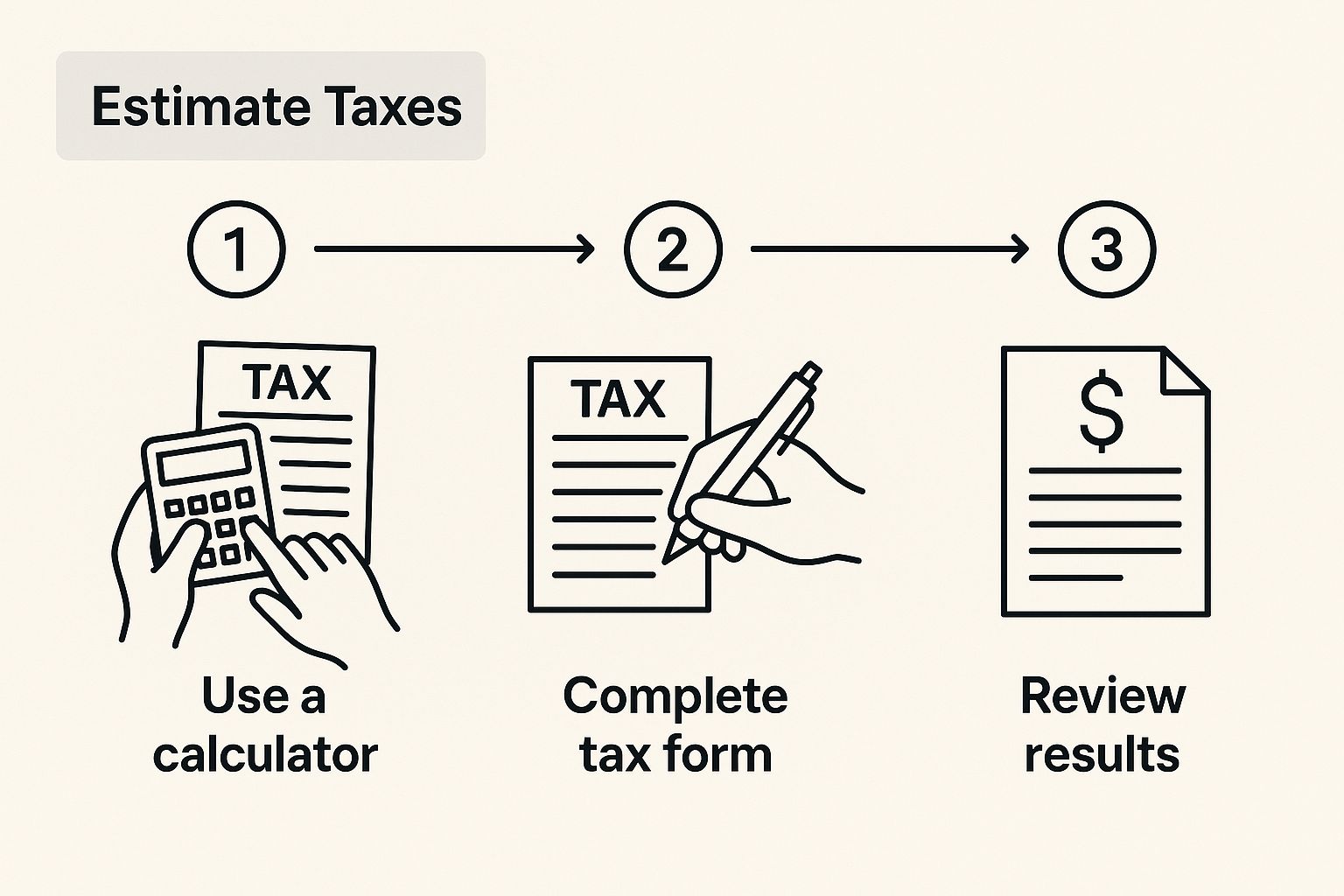
As you can see, it all boils down to projecting what you'll earn, subtracting what you can deduct, and then applying the right tax rates to what's left.
Projecting Your Annual Income
First thing's first: you need to estimate your total income for the whole year. And I mean all of it, not just the money from your business.
- Self-Employment Income: This is the money from your freelance projects, your business, or that side hustle you've got going.
- W-2 Income: If you or your spouse has a regular day job, that salary counts too.
- Other Income: Don't forget about things like interest from a savings account, dividends from stocks, or any capital gains.
If your income is all over the place month-to-month, like a freelance designer, this can feel like a shot in the dark. My advice? Start by looking at what you made last year. If you've been landing bigger clients, maybe bump that number up a bit. If you lost a major contract, you'll want to adjust it down.
Accounting for Deductions and Credits
Once you have a rough idea of your income, it's time to start shrinking that number with deductions. The goal here is to arrive at your Adjusted Gross Income (AGI). This figure is a huge deal in the tax world, as it's the starting point for calculating most of what you owe.
For a freelancer, some common business write-offs might be:
- Your home office (a percentage of your rent, mortgage, and utilities)
- Software subscriptions you need for work, like project management tools
- Miles you drive for business in your personal car
- Professional development courses or fees for industry groups
And here’s a big one a lot of new freelancers miss: the self-employment tax deduction. You can deduct one-half of your self-employment taxes, which is a fantastic way to lower your overall tax bill.
Key Takeaway: Every dollar you claim as a legitimate business expense lowers your taxable income. This directly reduces the amount you need to send to the IRS each quarter. Keeping clean records year-round isn't just good practice—it saves you money.
Putting It All Together: A Practical Example
Okay, let's walk through a quick scenario. Imagine a freelance writer who expects to earn $70,000 this year.
- Projected Net Earnings: They anticipate about $10,000 in business expenses (software, home office, etc.). That leaves them with net earnings from self-employment of $60,000.
- Calculate Self-Employment Tax: The SE tax is 15.3% on the first $168,600 of earnings (for 2024). They first multiply their net earnings by 92.35% ($60,000 x 0.9235 = $55,410). Now, they apply the 15.3% rate to that number ($55,410 x 0.153 = $8,478).
- Find the AGI: They can deduct half of that SE tax ($8,478 / 2 = $4,239). Let's assume they're single and will take the standard deduction, which is $14,600 for 2024. Their final taxable income is $41,161 ($60,000 – $4,239 – $14,600).
- Estimate Income Tax: Using the IRS tax brackets for their filing status, the income tax on $41,161 comes out to about $4,757.
- Total Estimated Tax: Finally, add the income tax and the self-employment tax: $4,757 + $8,478 = $13,235.
That $13,235 is their estimated total tax bill for the entire year. To get the quarterly payment, they just divide by four, which equals $3,308.75 due each period. For a more detailed breakdown, it's worth learning more about what estimated tax payments are and how they fit into the bigger tax picture.
How to Submit Your Quarterly Tax Payments

You’ve run the numbers and figured out what you owe. Now for the final piece of the puzzle: actually getting that money to the IRS. There are a few ways to get this done, and the best method really just boils down to what works for you—whether you prioritize speed, convenience, or a paper trail.
This whole "pay-as-you-go" system isn't just a U.S. thing, by the way. It’s a pretty standard practice worldwide for managing cash flow and ensuring people, especially those with business income, are paying their taxes on time. Countries like Canada, the UK, and Australia all have their own versions of provisional or periodic tax payments based on estimated income. If you're curious about the global landscape, this 2025 quarterly tax update from EY offers a deeper look.
Paying Your Taxes Online
For most self-employed folks I know, paying online is the way to go. It's fast, secure, and you get immediate confirmation that your payment went through, which is great for peace of mind. The IRS gives you two main options here: IRS Direct Pay and EFTPS.
- IRS Direct Pay: Think of this as the express lane. You can pay straight from your checking or savings account for free, and you don't even need to create an account. It’s perfect for making a quick, one-off payment without any fuss.
- Electronic Federal Tax Payment System (EFTPS): This one takes a little setup upfront, but the features are fantastic. Once you’re enrolled, you can schedule payments up to 365 days out, see your payment history for the last 16 months, and handle all sorts of federal tax payments. It’s built for people who want to plan ahead.
My Personal Tip: Take the 15 minutes to enroll in EFTPS. Seriously. The ability to schedule all four quarterly payments at the start of the year is a total game-changer. It practically guarantees you won't forget a deadline. A little effort now saves a lot of headaches later.
Other Payment Methods
If you're not a fan of paying directly from your bank account online, don't worry. You've got other options.
You can always use a debit card, credit card, or a digital wallet through one of the IRS-approved third-party payment processors. The big advantage here is convenience, and maybe you want to rack up some credit card rewards. Just keep in mind that these services aren't free; they charge a processing fee that’s usually between 1.87% and 1.98% of your payment.
Then there’s the tried-and-true method: mailing a check or money order. If you go this route, you absolutely have to include the correct Form 1040-ES payment voucher for that specific quarter. Make sure to write your Social Security number and the tax year right on the check, and get it in the mail with plenty of time to spare so it gets postmarked by the deadline.
Common Quarterly Tax Mistakes (And How to Sidestep Them)
Knowing the steps to file quarterly taxes is one thing, but actually doing it without making a costly mistake is a whole different ball game. When you're self-employed, you're not just the CEO—you're the entire payroll department. Even a tiny misstep can create a massive headache down the line.
Let's walk through some of the most common pitfalls I see people fall into, so you can keep your business finances clean and stress-free.
The biggest and most frequent error? Simply underpaying. It's so easy to be a little too optimistic about your deductions or to underestimate just how good of a year you're having. But if your total tax payments don't hit a specific target, the IRS will hit you with an underpayment penalty plus interest.
Don't Get Hit With an Underpayment Penalty
This isn't a simple flat fee; the penalty is calculated based on how much you underpaid and for how long you owed it. This is where the safe harbor rule becomes your absolute best friend.
To stay off the IRS penalty radar, you just need to make sure your total payments for the year (that includes your estimated payments and any W-2 withholding) add up to at least:
- 90% of the tax you owe for the current year, OR
- 100% of the tax you owed for the previous year. This threshold bumps up to 110% if your Adjusted Gross Income (AGI) was over $150,000.
Hit either of those marks, and you’re in the "safe harbor." You're protected from penalties even if you still have a small balance to pay when you file your annual return. For a deeper dive, you can learn more about how to handle IRS penalties for late tax filing and what to do if you get a notice.
Failing to Account for Lumpy Income
Most freelancers and small business owners don't have a perfectly predictable, steady income. You might land a massive project in the spring and then hit a slow patch in the summer. A huge mistake is basing all four of your quarterly payments on a slow first quarter, which can lead to a shocking tax bill and a massive underpayment by the time December rolls around.
If your income is all over the place, look into the annualized income method. It’s a bit more work, but it lets you adjust your payments each quarter based on what you actually earned in that period. This keeps you from overpaying during lean months or getting caught short after a windfall.
Expert Insight: Don't just "set it and forget it" with your quarterly payments. Before every deadline, take five minutes to review your income and expenses. That quick check-in can be the difference between a smooth tax season and a painful surprise bill.
Forgetting About Self-Employment Tax
This one is a classic. Many people budget for their income tax but completely forget about self-employment (SE) tax. You have to remember, SE tax is how you pay into Social Security and Medicare—and it's a hefty 15.3% of your net earnings. Forgetting about it can literally double what you thought you'd owe.
Get into this habit right now: every single time a client pays you, immediately transfer 25-30% of that income into a separate high-yield savings account. Think of it as your tax vault. When the deadlines hit, the money is already there waiting for you.
Procrastination and Messy Books
At the end of the day, procrastination and disorganization are the enemies of good tax hygiene. Missing a payment deadline—even by a single day—can trigger penalties. If you find yourself constantly putting it off, it might be helpful to explore some strategies to overcome procrastination to build better habits.
Just as damaging is sloppy bookkeeping. If you don't have clear records of your income and all your business expenses, you're just throwing a dart at a board when you try to calculate your tax. Not only does this put you at high risk of underpaying, but it also means you’re almost certainly leaving money on the table by missing valuable deductions.
Expert Tips for Managing Estimated Taxes
Filing your quarterly taxes on time is one thing, but really getting a handle on them is another game entirely. When you move past just crunching the numbers and sending the check, you can turn tax time from a dreaded chore into just another smooth part of your business rhythm. A few key habits can make all the difference, keeping you compliant and improving your company's financial health.
The single most powerful habit? Treat your tax savings like any other bill you have to pay. That means getting the money you owe the IRS out of your main checking account. As soon as a client pays you, that's your cue to act.
Create a Dedicated Tax Savings Account
Go to your bank and open a separate savings account—ideally a high-yield one—just for your tax money. This isn't just a "nice-to-have" tip; it's the bedrock of good financial discipline for any freelancer or business owner. It creates a mental and physical barrier, so you won't accidentally dip into funds that technically belong to Uncle Sam.
Then, put it on autopilot. Set up an automatic transfer to whisk a percentage of every single invoice payment straight into that tax account. I usually tell clients to start with a baseline of 25-30%. This simple move ensures the money is always there, waiting, when those quarterly deadlines pop up. No more last-minute panic.
Pro Tip: Don't just let that tax money collect dust. Parking it in a high-yield savings account means it will actually earn a little interest while it sits. It’s a small win, but it’s a smart way to make your tax obligations work for you.
Embrace Technology for Better Record-Keeping
A shoebox full of receipts is the fastest way to a massive tax headache—and probably an overpayment. Good accounting software is your best friend here. It takes the drudgery out of bookkeeping and keeps everything organized. These tools are non-negotiable for a modern business.
- Track income and expenses in real time: You can link your business bank accounts and credit cards so every transaction gets categorized automatically.
- Simplify deduction tracking: See a potential write-off? Just tag it. This way, you won't forget a single legitimate deduction when it's time to calculate your profit.
- Generate instant financial reports: Need to see where you stand? Pull a profit and loss statement in seconds for a clear, current snapshot of your earnings. This makes your tax estimates way more accurate.
To make sure you've got all your ducks in a row, a detailed small business tax preparation checklist can be a lifesaver. It’s a great way to guarantee you have every document and figure ready to go before you sit down to file.
Know When to Call in a Professional
Doing your own taxes is perfectly fine for many, but there are definite moments when it's time to bring in an expert. As your business scales, your financial picture gets a lot more complicated.
It might be time to find a tax pro if:
- Your income suddenly jumps or starts fluctuating wildly.
- You're about to hire your first employee or even a regular contractor.
- You’ve made a major equipment or property purchase for the business.
- You're thinking about changing your business entity, like from a sole proprietorship to an S Corp.
A good CPA or enrolled agent does more than just fill out paperwork. They offer strategic advice that can save you a fortune, find deductions you didn't know existed, and keep you on the straight and narrow as your business evolves. Think of their fee as an investment, not an expense.
Even after you get the hang of quarterly taxes, a few tricky questions always seem to pop up. It's a system that can feel a bit confusing at first, so let's clear the air on some of the most common hangups for freelancers and small business owners.
So, I Can Skip My Annual Return, Right?
This is a big one, and the answer is a hard no. It's a common misconception, but making those four payments doesn't get you out of filing your annual tax return.
Think of your quarterly payments as pre-payments or installments on your total tax bill for the year. Your annual return—the good old Form 1040—is the final reconciliation. It's where you officially tally up your income, claim all your deductions, and figure out your actual, final tax liability.
That final return is what tells you if your estimates were accurate. You'll either get a small refund if you overpaid or have a final bill to settle if you underpaid.
What if My Income Is All Over the Place?
Welcome to the club! This is the classic freelancer's dilemma. What do you do if you have a slow first quarter and then land a huge project in August? You can't just keep paying the same small estimate you figured out back in April.
You absolutely need to adjust your payments to reflect what you're actually earning. If you don't, you're setting yourself up for a nasty underpayment penalty come tax time.
To handle this, the IRS offers something called the annualized income method. It's a bit more involved, but it lets you calculate each quarterly payment based on the income you earned in that specific period. It's the best way to manage a fluctuating cash flow and make sure you're not paying too much or too little at any given time.
Can't I Just Pay It All at Once?
Another common question is about timing. It seems simpler to just pay the whole year's estimated tax in one lump sum on April 15, right?
While it might feel proactive, the IRS runs on a "pay-as-you-go" system. The whole point is for them to get their piece of the pie as you earn your income throughout the year.
Paying everything upfront won't save you from penalties. For example, if you earned a lot in the third quarter but didn't make the September payment, the IRS can still hit you with a penalty for that missed installment. This is true even if you technically overpaid for the year back in April. Sticking to the official deadlines and spreading out the payments is the only way to stay in the clear.
Trying to navigate the details of quarterly taxes—from adjusting for sudden income spikes to figuring out the annual true-up—can be a real headache. The team at Allied Tax Advisors lives and breathes this stuff. We help individuals and businesses cut through the complexity, ensuring you stay compliant and keep your finances on track. Let us handle the tax details so you can get back to doing what you love. Learn more about our personalized tax solutions.
First off I want to say fantastic blog! I had a quick question that
I’d like to ask if youu do not mind. I was curious to find out how you center yourself and clear your head
before writing. I have had a tough time clearing my mind in getting my thoughts out there.
I do enjoy writing however itt just seems like the first 10 to 15 minutes are generally lost just
trying to figure out how to begin. Any recommendations or tips?
Many thanks!