
If there's one date every business owner should circle in red on their calendar, it's January 31. This is the hard-and-fast deadline for getting Form 1099-NEC out the door—both to your contractors and to the IRS. No wiggle room here.
Your Quick Guide to 1099 Filing Deadlines
Trying to pin down 1099 deadlines can sometimes feel like chasing a moving target. The right answer for "when are 1099s due?" really boils down to which form you're using and whether you're filing on paper or online. The two heavy hitters, Form 1099-NEC and Form 1099-MISC, run on different schedules, and mixing them up can lead to some painful penalties.
It helps to think of January 31 as your foundational date. For both forms, this is the day you absolutely must have the copies in the hands of the people you paid. After that, though, the paths diverge, which is where a lot of business owners get tripped up.
Key Dates for NEC and MISC Filers
For Form 1099-NEC, the deadline is simple: January 31 is the due date for everything. You need to send copies to your contractors and file your report with the IRS by this day.
Form 1099-MISC is a bit different. While you still have to get copies to recipients by January 31, the IRS gives you a little more breathing room. If you’re filing by mail (paper filing), your forms need to be postmarked by February 28. If you’re filing electronically, you have until March 31. For a deeper dive, you can review key employment tax reporting due dates to stay on top of all your obligations.
This infographic breaks it down visually, making the core deadlines much easier to digest.
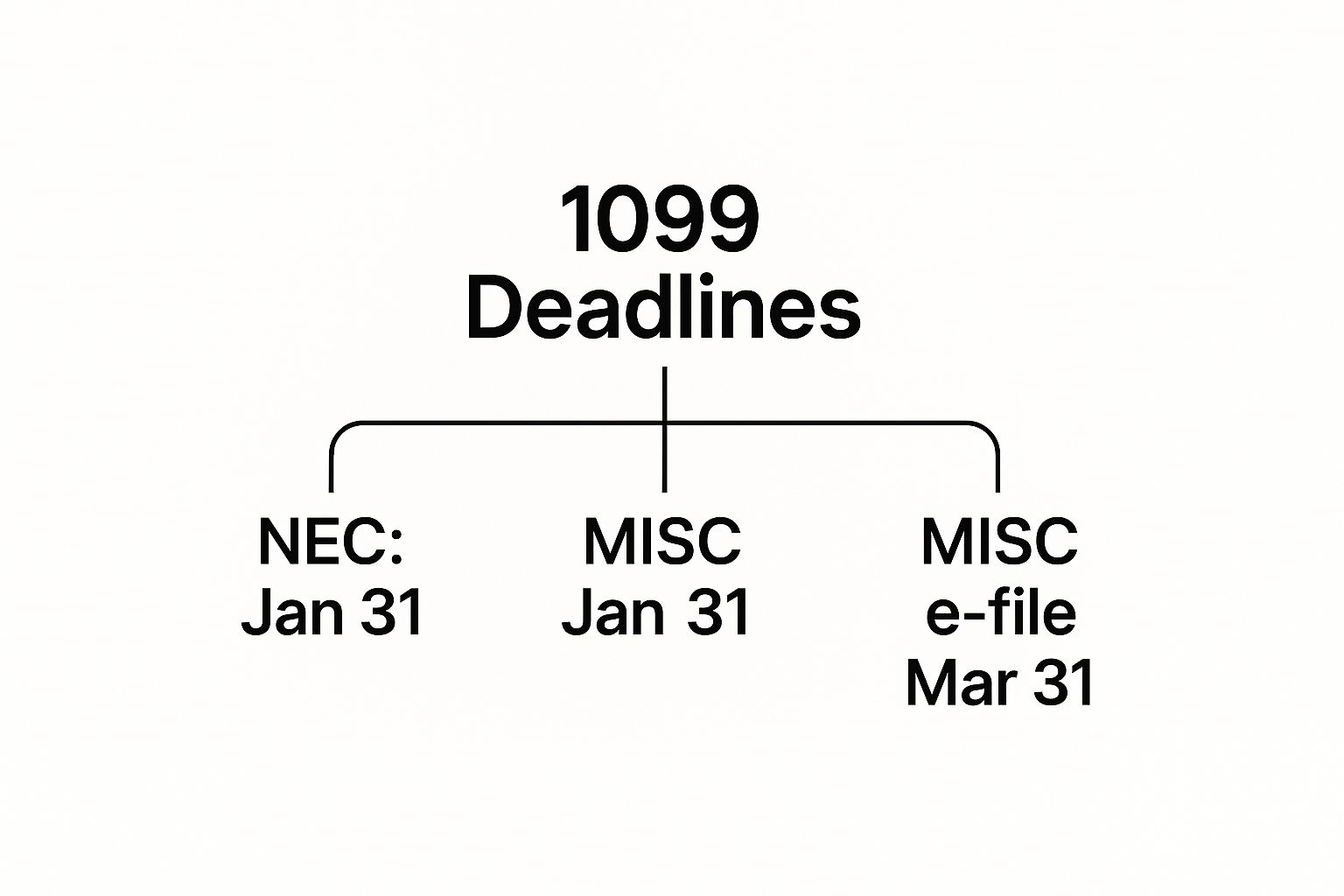
As you can see, the recipient deadline is the same across the board. The real flexibility comes with the 1099-MISC filing dates for the IRS, especially if you file online.
To make things even clearer, here's a simple table summarizing the most important deadlines you need to know.
Key 1099 Filing Deadlines at a Glance
This table summarizes the crucial deadlines for the two most common 1099 forms, helping you quickly identify your obligations.
| Form Type | Deadline to Furnish to Recipient | Deadline to File with IRS (Paper) | Deadline to File with IRS (Electronic) |
|---|---|---|---|
| 1099-NEC | January 31 | January 31 | January 31 |
| 1099-MISC | January 31 | February 28 | March 31 |
Keep this table handy as you prepare your forms. It’s a great quick-reference tool to ensure you don’t miss a critical date.
Understanding 1099-NEC vs 1099-MISC Deadlines
Not all 1099s are created equal, and their filing deadlines are a perfect example of that. You'll most often deal with two forms: the 1099-NEC and the 1099-MISC. Getting their timelines straight is absolutely critical for staying compliant.
Think of it like this: the 1099-NEC is an overnight priority package, while the 1099-MISC is more like standard ground shipping. Both need to get there, but one has a much tighter schedule.
The 1099-NEC: A Single, Hard Deadline
The Form 1099-NEC (Nonemployee Compensation) is that priority package. The IRS brought this form back a few years ago for one specific reason: to report payments to independent contractors. Since that income is how millions of freelancers and gig workers file their own taxes, the deadline is firm.
Here's what you need to know:
- You must send copies to your contractors by January 31.
- You must file the forms with the IRS by that same date: January 31.
There’s no wiggle room here. It doesn’t matter if you file by mail or electronically—the date is the same. This strict, unified deadline helps prevent tax fraud and ensures contractors have their documents ready to go when they file their own returns. Miss it, and you're not just late; you're creating a headache for your contractors and setting yourself up for penalties.
Why the 1099-MISC Deadline Is More Flexible
On the other hand, the Form 1099-MISC (Miscellaneous Information) is your standard ground shipment. This form is a catch-all for various other payments that aren't for contractor services.
You’ll use a 1099-MISC to report things like:
- Rent paid for your office or equipment.
- Royalties paid out.
- Prizes and awards.
- Certain legal settlements.
Because these types of income aren't as directly tied to an individual's primary earnings as contractor pay, the IRS gives businesses a bit more breathing room.
The deadline to get the form into the recipient’s hands is still January 31. However, the deadlines for filing with the IRS are different:
- February 28 if you're filing paper forms by mail.
- March 31 if you're filing electronically.
This staggered schedule gives you more time to get your reporting in order for these less urgent payments. For instance, if you're a property manager, knowing the specific rules is key. You can find a complete guide on how to handle 1099-MISC forms for rental income to make sure you're covering all your bases.
The bottom line? Always start by identifying the type of payment. If you paid an independent contractor for their work, grab a 1099-NEC and mark January 31 on your calendar in bright red. For everything else, like rent or royalties, the 1099-MISC is your form, and you can take advantage of the later filing dates.
A Practical Guide to Filing Your 1099 Forms
Knowing the deadlines for your 1099s is half the battle. The other half is actually filing them correctly. While the process isn't rocket science, it does demand a bit of prep work and a clear understanding of your options. You've got two main routes: traditional paper filing and modern e-filing. Spoiler alert: recent IRS changes have pretty much made that decision for you.
Before you can even think about filing, you need to have your ducks in a row with accurate information. This starts the minute you bring a new contractor on board. Seriously, don't pay them a dime until they've filled out and signed a Form W-9, "Request for Taxpayer Identification Number and Certification." This simple form gives you their legal name, address, and all-important Taxpayer Identification Number (TIN)—the essential ingredients for a correct 1099.
Keeping all these documents straight throughout the year is key to a stress-free tax season. It’s worth looking into solid small business document management practices to make sure everything is organized and ready when you need it. A tidy system for your W-9s and payment records will save you a world of hurt down the line.
Choosing Between E-Filing and Paper Filing
Sure, you can still mail in paper forms, but the IRS is making it very clear they want everyone to file electronically. A new rule now requires e-filing for any business submitting a combined total of 10 or more information returns in a year. And that "total" includes all forms—W-2s, the whole 1099 series, you name it. For most businesses, this new, lower threshold means e-filing isn't just a good idea; it's the rule.
Even if you’re one of the very few who file fewer than 10 forms, the perks of e-filing are hard to ignore:
- Instant Confirmation: No more wondering if your forms got lost in the mail. You get immediate proof that the IRS has them.
- Fewer Errors: Good e-filing software is designed to catch common typos and mistakes before you hit submit.
- Extended Deadlines: For Form 1099-MISC, the e-file deadline is March 31, giving you an entire extra month compared to the paper filing due date.
The writing is on the wall: e-filing is the new standard. By dropping the threshold from 250 returns to just 10, the IRS is pushing for greater efficiency and accuracy, making electronic submission the default for almost everyone.
The E-Filing Process Step-by-Step
Ready to jump into e-filing? It's pretty straightforward, but you can't just upload a PDF of the form to the IRS website. You'll need to go through an IRS-approved service or software.
- Gather Your Information: First things first, round up all your completed W-9s. Tally up the total payments made to each contractor who received $600 or more from you during the year.
- Select an E-File Provider: Now, pick your tool. Many payroll and accounting platforms have this built-in. If not, there are plenty of dedicated services that specialize in 1099 filing.
- Enter the Data: This is where you'll plug in the information for your business (the payer) and your contractor (the recipient). Take your time and double-check every name, address, and TIN. Accuracy is everything.
- Submit the Forms: Once everything looks good, the service will handle the electronic transmission to the IRS. A huge bonus is that most providers will also take care of sending copies to your contractors, either by mail or secure email, ensuring you meet that crucial January 31 deadline to furnish copies.
The Real Cost of Missing a 1099 Deadline

Let's be clear: missing a 1099 deadline isn’t just a minor administrative slip-up. It's a direct hit to your company's wallet. The IRS doesn't mess around with late filings, and their penalties are designed to escalate quickly. A small oversight can easily turn into a major financial headache.
Think of it like a snowball rolling downhill—it starts small, but the longer it goes, the bigger and more destructive it gets. This is exactly how the IRS penalty system works. The cost of your delay is directly tied to how long you wait to fix it.
These deadlines exist for a good reason. They allow the government to promptly match the income you report paying out with the income your contractors report receiving. When you file late, you throw a wrench in that system, and the penalties reflect that.
How IRS Penalties Escalate
The penalty structure is based on a "per-form" fee that gets bigger the longer you wait. For a small business with only a handful of contractors, a short delay might not seem like a big deal. But for companies with many forms to file, these fines can stack up frighteningly fast.
Here’s a quick breakdown of how the penalties generally increase for late filings:
- Within 30 Days: If you file up to 30 days past the due date, you'll face the lowest tier of penalties. It's still a hit you want to avoid.
- 31 Days to August 1: If you file after that initial 30-day window but before August 1, the per-form penalty roughly doubles.
- After August 1 or Not at All: Waiting until after this summer deadline—or worse, intentionally ignoring your filing duty—triggers the highest penalty tier. We're talking hundreds of dollars per form.
For small businesses, there are typically caps on the total penalties. However, if the IRS determines you showed "intentional disregard" by knowingly choosing not to file, those caps disappear. That can expose your business to absolutely crippling fines.
Protecting your business's financial health means understanding the full scope of IRS penalties for late tax filing and how to avoid costly fees.
The Hidden Risk of Backup Withholding
On top of the late fees, there's another expensive trap to watch out for: backup withholding.
If you're about to pay a contractor but don't have a valid Form W-9 from them, the IRS may require you to withhold a flat 24% of their payment and send it straight to the government.
This isn't a choice; it's mandatory. It’s the IRS's way of making sure they get their cut when a contractor's tax information is incorrect or missing. This creates a huge administrative hassle for you and can seriously damage your relationship with your contractor.
The best defense is a good offense. Make it a non-negotiable policy to collect a signed W-9 from every single contractor before you cut their first check. This one simple step is your best protection against both penalties and the headache of backup withholding.
How to Request a 1099 Filing Extension
Let's be realistic—sometimes, life gets in the way of tax season. A key system goes down, you're still waiting on records, or the person who handles payroll is suddenly out of the office. It happens. When you're staring down the clock, knowing how to file for a 1099 extension can be a lifesaver.
Your go-to tool here is IRS Form 8809, officially called the "Application for Extension of Time to File Information Returns." Submitting this form gets you an automatic 30-day extension to file your 1099s with the IRS. That extra breathing room can be the difference between a rushed, error-filled submission and a clean, accurate one.
But there’s a massive catch you can't afford to miss. This extension is only for filing your forms with the IRS.
Crucial Clarification: An extension from Form 8809 does not push back the January 31 deadline for getting 1099-NEC copies to your contractors. That deadline is firm. No matter what, you still need to get those forms in their hands on time.
How to Properly File Form 8809
Filing Form 8809 is pretty straightforward, but you have to be proactive. You can't ask for an extension after the original deadline has already passed. The form must be submitted by the original due date of the returns.
You have a couple of ways to get it done:
- E-file: This is the best route. Using the IRS FIRE (Filing Information Returns Electronically) system is quick, efficient, and gives you a digital paper trail confirming they received it.
- Mail: You can still send a paper copy of Form 8809 the old-fashioned way. Just make absolutely sure it’s postmarked by the deadline to count as on-time.
On the form itself, you’ll fill out your business details and check off which returns you need more time for, like the 1099-NEC or 1099-MISC. The good news is that this initial 30-day extension is granted automatically, so you don't need to write a long story explaining why.
What Is a Valid Reason for an Extension?
While that first 30-day extension is a given, you might be wondering what it takes to get a second, non-automatic extension. For that, the IRS wants to see a serious reason—something truly beyond your control.
Think along these lines:
- A fire, flood, or other natural disaster destroyed your company records.
- The person responsible for filing passed away or has a serious illness.
- The person responsible for filing is unavoidably absent for a major reason.
Getting a handle on extensions is a key part of staying compliant without losing your sanity. For a deeper dive into other important dates, our guide on the business tax extension deadline is a great resource. Just remember, an extension gives you more time to file with the government, but it doesn't get you off the hook for all your obligations.
Don't Forget: Navigating State-Specific 1099 Requirements
Getting your 1099s filed with the IRS is a huge step, but don't close the books just yet. Many states have their own, separate reporting requirements, which adds another layer of complexity to the question of when 1099s are due. If you ignore these local rules, you could find yourself facing state-level penalties on top of anything the IRS might levy.
Think of it this way: federal filing is like the main cross-country highway, but you still need to navigate the local roads to get to your final destination. Some states make this easier by participating in the Combined Federal/State Filing (CF/SF) Program. This program is a bit like an express lane—it automatically forwards your federal 1099s to the right state agency.
But here’s the catch: not all states are on board. For those that aren't, you've got a completely separate filing to manage.
Why State Deadlines Can Be So Different
States that opt out of the CF/SF program often march to the beat of their own drum, with unique deadlines and submission methods. A state might require you to file directly with its Department of Revenue, sometimes on a totally different schedule than the federal government. This is where rolling up your sleeves and doing some state-by-state research becomes absolutely critical, especially if you work with contractors in multiple locations.
For instance, many states align their 1099-NEC deadline with the federal date of January 31 to keep things simple. Others, however, might give you a little more breathing room or have different due dates depending on whether you file by paper or electronically. You absolutely have to verify the rules for every single state where you paid a contractor.
The golden rule of 1099 compliance is this: never assume federal filing is enough. Always check directly with each state's tax agency. Their rules are the final word, and they can change from one year to the next.
To give you a better idea of how much these requirements can vary, take a look at the table below. It's a simplified snapshot showing how three different states might handle the exact same form.
Example State 1099 Filing Deadline Comparison
| State | 1099-NEC Filing Deadline | Filing Method Requirement |
|---|---|---|
| California | January 31 | Must file electronically if submitting 250+ forms |
| New York | January 31 | Required to file directly with state tax department |
| Oregon | January 31 | Required to file only if state income tax was withheld |
See the differences? A quick check can save you a world of hurt down the road.
At the end of the day, state compliance is just as serious as your federal obligations. The best way to protect your business from surprise penalties is to spend a few minutes on your state’s Department of Revenue website to confirm their specific deadlines, thresholds, and filing methods.
A Few Common Questions About 1099 Deadlines
Even when you think you have all the rules straight, some questions always seem to pop up when you're deep in the weeds of tax prep. Getting these details right can save you a ton of hassle and prevent easy-to-make mistakes.
Let’s walk through a few of the most common questions I hear from business owners about 1099 due dates and filing.
Do I Really Need to Send a 1099-NEC for Payments Under $600?
The short answer is no. If you paid a contractor less than $600 for the entire year, you generally don’t have to send them a 1099-NEC. That $600 amount is the magic number—the minimum threshold that triggers the reporting requirement.
That said, you absolutely need to track every single payment you make. This way, you can be certain who crossed that $600 line by the end of the year. It’s one thing to have a dozen contractors who all came in just under the limit, but it's a completely different (and much bigger) problem if you accidentally miss one who went over.
What’s the Difference Between "Furnishing" and "Filing"?
This one trips up people all the time, even folks who have been running their own business for years. The terms sound alike, but they refer to two completely separate actions, each with its own non-negotiable deadline.
- Furnishing simply means getting a copy of the 1099 into the hands of your contractor or vendor. For both the 1099-NEC and 1099-MISC, this has to be done by January 31.
- Filing is when you submit the forms to the IRS. As we’ve covered, this deadline depends on the specific form and whether you’re filing by mail or electronically.
Think of it like this: Furnishing is your responsibility to the person you paid, giving them the info they need for their own taxes. Filing is your responsibility to the government. You have to do both correctly to be in the clear.
Help! I Found a Mistake on a 1099 I Already Filed. What Now?
First, don't panic. Mistakes happen. What really matters is how quickly and correctly you fix them.
If you spot an error after you’ve already filed, you need to issue a corrected 1099 right away. Just grab a new, blank form and check the “CORRECTED” box at the very top.
Fill out the form with the right information, then send it to both the IRS and the recipient you paid. Taking swift action to correct a mistake shows good faith and can go a long way in reducing or even eliminating potential penalties.
Trying to keep all these tax rules straight can feel like a full-time job in itself, but you don't have to go it alone. The experts at Allied Tax Advisors are here to offer clear, practical guidance for all your tax and accounting needs. Visit our website to learn how we can support your business.