
A tax levy is the government's way of saying, "We've asked nicely, and now we're taking action." It is the legal seizure of your property to pay off a tax debt you owe. This isn't the first step the IRS takes; it's one of the last and most serious tools in their collection arsenal, used only after they've tried other ways to get in touch and resolve the debt.
Think of it this way: a tax levy moves past a simple claim on your assets and becomes an actual seizure.
What a Tax Levy Really Means

Getting that official-looking envelope from the IRS can make your heart sink. When the word "levy" is involved, it's easy to feel overwhelmed. But the first step to getting things back on track is understanding exactly what's happening. A tax levy isn't just a threat or a warning letter—it's the government actively taking your property to cover your tax bill.
Imagine you've fallen behind on a big credit card bill. The company sends reminders, then more persistent calls. If that doesn't work, they might sue you to collect. A tax levy is the IRS's version of that final, forceful step, with one major difference: they generally don't need a court's permission to start seizing your assets.
To help you get a quick handle on this, here's a simple breakdown of the key concepts.
Tax Levy at a Glance
| Key Aspect | Simple Explanation |
|---|---|
| What It Is | The legal seizure of your property (like money from your bank account or wages) by the IRS. |
| Why It Happens | To satisfy an unpaid tax debt after you've received multiple notices and haven't paid or made arrangements. |
| The Trigger | Issued after you receive a final notice (the "Final Notice of Intent to Levy") and your time to respond runs out. |
| What Can Be Levied | Bank accounts, wages, personal property (like cars or boats), and even real estate. |
| Is It a Lien? | No. A lien is a claim against your property to secure the debt. A levy is the action of taking the property. |
This table should give you a solid foundation as we dig deeper into how the process works and what you can do about it.
How a Levy Gets Started
The IRS can't just decide to levy your assets out of the blue. There's a formal, legally required process they have to follow, which gives you several opportunities to respond. It starts with a tax bill, followed by reminders.
If the debt remains unpaid, they'll send a crucial document: the “Final Notice of Intent to Levy.” This notice is your last official warning and also explains your right to request a hearing to challenge the action. You can learn more about the specific steps involved in a tax levy from resources like BambooHR.
A tax levy moves beyond a simple claim. While a tax lien is a legal claim against your property, a levy is the actual act of taking it. This distinction is crucial for understanding the urgency of the situation.
What This Means for You
If you're facing a levy, the situation is clearly serious, but it's not hopeless. The most important thing to remember is that you still have rights, and options are available. The key is to act fast.
The IRS has the authority to take a wide range of your assets, including:
- Your bank account: They can instruct your bank to freeze your account and send the funds directly to them.
- Your wages: This is known as wage garnishment, where a portion of every paycheck is sent to the IRS before you even see it.
- Physical property: In more extreme cases, they can seize and sell valuable assets like your car, boat, or even your home.
Understanding what a tax levy is—and what it isn't—is the first, most powerful step you can take toward resolving the problem.
Tax Levy vs. Tax Lien: Understanding the Difference
It's easy to get "tax lien" and "tax levy" mixed up—they sound alike and both pop up when someone owes the IRS. But in reality, they are two very different things. Knowing which is which is absolutely critical, because one is a warning sign, and the other is the IRS actively taking your property.
Think of a tax lien as the government putting a public "dibs" on your stuff. It’s a legal claim filed against your property—your house, your car, your business assets—to secure what you owe. It’s the IRS telling the world, "Hey, this person owes us money, and we get paid first if this property is sold."
A tax lien is a claim to secure a debt, while a tax levy is the action of seizing assets to satisfy that debt. One is a warning; the other is the consequence.
A lien doesn't mean the IRS is kicking you out of your house tomorrow. You still own and possess your property. The big problem is that it wrecks your credit and essentially freezes your assets. Trying to sell your home or refinance a loan becomes a non-starter until the IRS is paid. If you find yourself in this spot, it's worth understanding how to remove a tax lien.
The Critical Escalation From Lien to Levy
So, what happens if you ignore the lien? That’s when the levy shows up. If the tax lien was the government staking its claim, the tax levy is them coming to collect. A levy is the actual seizure of your assets to pay off the debt.
This is where the distinction becomes painfully clear:
- Tax Lien: A legal claim against your property. It’s a security measure.
- Tax Levy: The forceful taking of your property. It's an enforcement action.
A lien on your house is a serious financial headache. A levy on your house could mean the IRS seizes it and sells it at auction. A levy can also hit your bank account—draining it overnight—or garnish a significant chunk of your wages directly from your employer.
Comparing a Tax Levy and a Tax Lien
To really drive the point home, let's lay it all out side-by-side. This table breaks down the core differences so you can instantly see how a lien and a levy operate.
| Feature | Tax Lien | Tax Levy |
|---|---|---|
| Purpose | To secure the government's claim on your property as collateral for a tax debt. | To actively seize and sell your property to collect the money owed for a tax debt. |
| Impact on Assets | You retain possession of your assets, but your ability to sell or borrow against them is restricted. | The government takes physical possession or control of your assets (e.g., funds from a bank account). |
| Legal Power | Establishes the government's priority over other creditors in the event of a sale or bankruptcy. | Authorizes the immediate transfer of your property to the government to settle the outstanding debt. |
| Analogy | A "claim sticker" on your property. | The tow truck arriving to take the property away. |
At the end of the day, a tax lien is the IRS's first major shot across the bow, establishing their legal right to your property. A tax levy is when they pull the trigger. The smartest thing you can do is treat a lien as the serious warning it is and act immediately—it's your best and last chance to prevent things from escalating to a levy.
The IRS Levy Process Step by Step
Let's get one thing straight: an IRS levy doesn't just happen out of the blue. It might feel like a surprise attack, but the IRS has a very specific, legally required process it has to follow. Think of it as a series of warning shots. Knowing this timeline is your best defense, because it gives you several chances to step in and resolve the issue before things get serious.
The whole thing doesn't start with a seizure. It starts with a simple tax bill in the mail. This is the first official heads-up that the IRS thinks you owe them. Ignoring that first piece of mail is what kicks the whole collection process into a higher gear.
The First Steps: Notice and Demand
After the IRS calculates what you owe, they send a Notice and Demand for Payment. This is the formal starting pistol for the collection process. The letter lays out exactly how much they believe you owe and makes an official request for you to pay up.
If you don't pay the balance or get in touch to set up a payment arrangement, the letters will keep coming. You'll notice the tone gets a little more serious with each one, really pushing you to sort out the debt before they take stronger measures.
The Final Warning Before Seizure
The one piece of mail you absolutely cannot ignore is the "Final Notice of Intent to Levy and Notice of Your Right to a Hearing." You might see it as a Letter 1058 or LT11. This isn't just another reminder—it's the final, official warning.
When you get this letter, it means the IRS has checked all the legal boxes and now has the right to start taking your assets. The notice is crystal clear: it says they intend to levy your property. But it also tells you something crucial: you have a right to request a Collection Due Process (CDP) hearing within 30 days. This hearing is your formal opportunity to appeal the levy and make your case.
This is where the difference between a lien and a levy becomes incredibly important. A lien is just a claim; a levy is the government actually taking something.
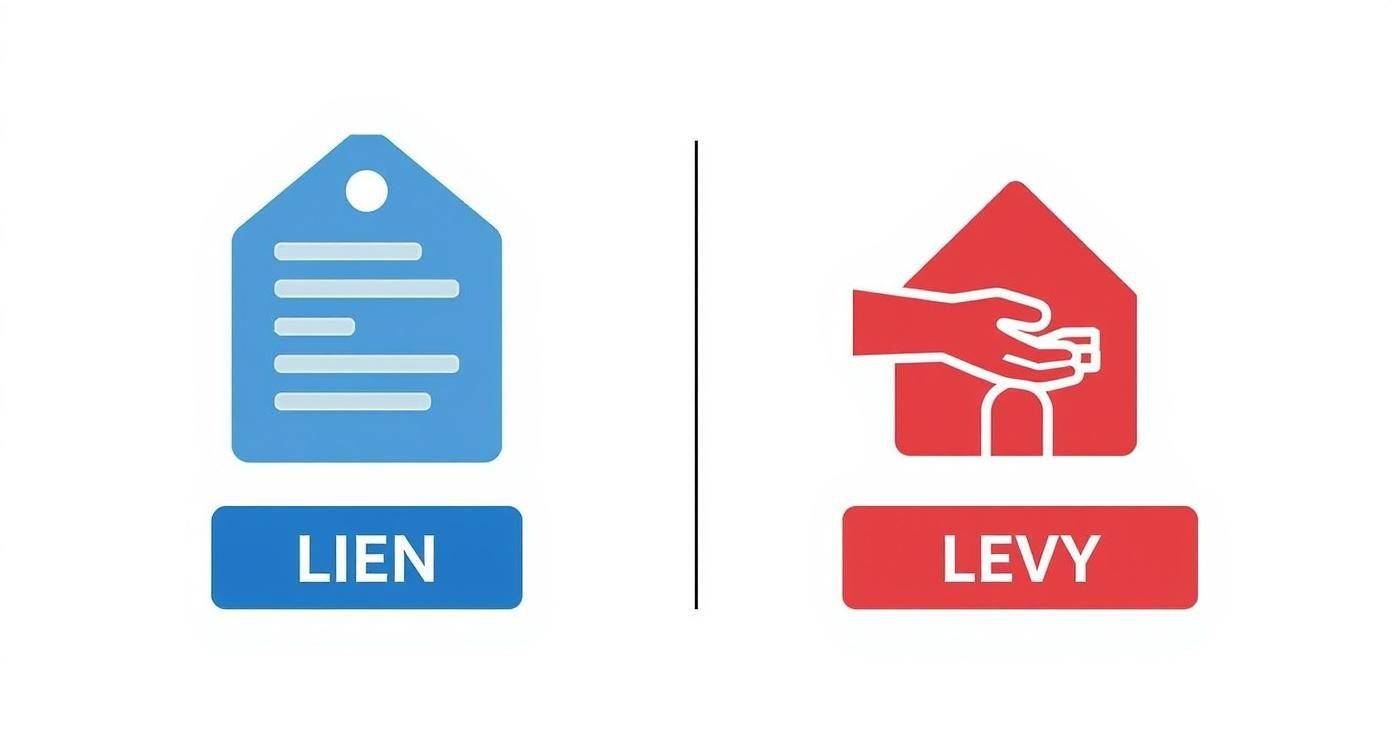
As you can see, the lien is like a sticker slapped on your property saying, "We have a claim to this." The levy is the hand that comes and takes it away.
Seizure of Assets
If that 30-day window closes and you haven't responded to the Final Notice, the IRS is legally cleared to move forward. Their authority comes directly from the law. In the U.S., Internal Revenue Code §6331 empowers the IRS to seize any property you own or have rights to, unless it’s specifically exempt.
This means they can go after your wages, drain your bank accounts, or even take a piece of your Social Security benefits. This is truly the last resort after their multiple attempts to contact you have failed. You can read the IRS's own official explanation of what a levy is and how it works.
Key Takeaway: The levy process is predictable. Getting that "Final Notice of Intent to Levy" is your moment of truth. It triggers a 30-day countdown for you to formally appeal and stop them from taking your assets.
By understanding these stages, you can pinpoint exactly where you are in the process and take the right steps to protect yourself before a levy becomes a reality.
What Assets Are at Risk During a Levy?
When you get a levy notice from the IRS, the first question that probably flashes through your mind is, "What can they actually take?" It's a scary thought, but understanding the scope of their power is the first step toward dealing with the situation.
An IRS levy grants the government sweeping authority to seize your property—or your rights to property—to pay off your tax debt. This isn't just about the cash in your wallet; it covers a surprisingly wide range of financial and physical assets.
Common Targets for Seizure
The IRS usually goes after the low-hanging fruit first—assets that are easy to locate and convert into cash.
Here’s what they typically target:
- Bank Accounts: A bank levy is a one-time seizure. The IRS orders your bank to freeze your account and send them whatever funds are available at that moment to cover your debt.
- Wages and Income: This is a continuous levy, better known as a wage garnishment. Your employer will be ordered to send a portion of every single paycheck directly to the IRS before you ever see it. You can learn more about this in our guide on how the IRS can garnish wages.
- Retirement Accounts: Don't assume your retirement funds are untouchable. Money in your IRA, 401(k), or other pension plans can absolutely be seized by the IRS to satisfy a tax debt.
- Physical Property: In more serious cases, the IRS won't hesitate to seize and sell your physical assets. This could be your house, a vacation property, cars, boats, or other valuable personal items.
The legal concept behind this isn't unique to taxes; it's a fundamental part of debt collection. You can get a broader perspective by reading about the principles of seizing goods for debt recovery.
Assets That Are Legally Protected
Thankfully, the law doesn't allow the IRS to take everything you own and leave you with nothing. Certain assets are protected to ensure you can still meet your basic living needs.
While an IRS levy is a powerful collection tool, it is not limitless. Federal law establishes clear exemptions to ensure taxpayers can maintain a basic standard of living during the collection process.
These legally protected assets, known as exemptions, are spelled out in the Internal Revenue Code. They act as a critical safety net.
Here are some of the key assets that are generally off-limits to an IRS levy:
- A certain amount of your wages, calculated based on your filing status and the number of dependents you claim.
- Specific public assistance payments, like Supplemental Security Income (SSI).
- Essential personal items, such as necessary clothing and school books.
- A limited value of furniture and household goods needed for basic living.
- Tools of your trade that are essential for you to earn a living (up to a certain value).
- Undelivered mail.
- Certain unemployment and workers' compensation benefits.
Knowing what's at risk and what's protected is the foundation for building a strategy to resolve your tax issues. It gives you a clear picture of what you're up against and what you need to do next.
How to Stop an IRS Levy and Resolve Your Debt

Getting a Final Notice of Intent to Levy can feel like the clock is ticking down, and in many ways, it is. But it’s not a lost cause—far from it. The absolute key to stopping a levy is to take swift, decisive action and open a line of communication with the IRS. Being proactive is your best defense.
The worst thing you can possibly do is ignore that notice. Doing so all but guarantees the IRS will move forward with seizing your assets. Instead, you can get back in the driver's seat by looking into the relief programs the IRS has in place for taxpayers who've fallen behind.
Set Up an IRS Installment Agreement
One of the most straightforward ways to halt a levy is to formally agree to a payment plan. This is called an Installment Agreement, and it’s a deal you work out with the IRS to make manageable monthly payments until your tax debt is paid off in full.
The moment your Installment Agreement is approved, the IRS must stop all collection activities—including any levy they were about to start. This gives you immediate breathing room and a clear, predictable path to getting square with them. It's a great fit if you have the means to pay what you owe but just need more time to do it without torpedoing your finances.
Submit an Offer in Compromise
But what if you simply can't pay the full amount, even if it’s spread out over time? This is where an Offer in Compromise (OIC) can be a game-changer. An OIC is a formal agreement with the IRS to settle your tax liability for less than the total amount you owe.
This path is reserved for people experiencing true financial hardship. When you apply, the IRS will scrutinize your entire financial picture—your income, expenses, ability to pay, and the value of your assets. It’s a rigorous process, but getting an OIC approved can feel like a fresh start. You can get a better sense of the process by learning about what an Offer in Compromise entails.
Important Note: Just submitting an OIC application puts an automatic hold on all IRS collection efforts, including levies, while they review your case. That pause alone can provide critical time to work toward a final solution.
Request a Collection Due Process Hearing
That "Final Notice of Intent to Levy" letter contains more than just a warning; it also informs you of your rights. One of the most important is your right to an appeal. You have 30 days from the date on that letter to request a Collection Due Process (CDP) hearing.
A CDP hearing is your formal chance to make your case before an independent IRS Appeals Officer. It's an opportunity to challenge the levy itself and propose a different way forward.
During the hearing, you can argue for alternatives like:
- An Installment Agreement
- An Offer in Compromise
- A temporary pause on collection because of economic hardship
- Innocent spouse relief, if that applies to your situation
Filing for a CDP hearing is a powerful step. It legally prevents the IRS from taking your property while your appeal is under review. This is a fundamental taxpayer right, ensuring you get a fair shot to negotiate a resolution before anything is seized.
Common Questions About Tax Levies
Even after you get the basics down, it’s natural to have specific, pressing questions when you’re staring down an IRS levy. Let’s tackle some of the most common concerns head-on to give you the clarity you need to figure out your next move.
How Long Does a Tax Levy Last?
There’s no single answer here—it really depends on what the IRS is seizing. A tax levy isn't some temporary hold you can just wait out; its effects can be instant and painful, or they can drag on for a long, long time.
Think of a levy on a bank account as a snapshot in time. The IRS seizes whatever is in the account at that exact moment. If there’s nothing there, that specific attempt comes up empty, but don't get comfortable. The debt is still there, and they can and will try again.
A wage garnishment, on the other hand, is a continuous drain. It latches onto your income and siphons off a piece of every single paycheck. This continues relentlessly until one of three things happens: the tax debt is paid in full, you work out a deal with the IRS to release it, or the time limit for collecting the debt runs out.
Can the IRS Take My Social Security Benefits?
Yes, they absolutely can. This is a tough one for many people to accept, as there's a common belief that these benefits are untouchable. When it comes to federal tax debt, that protection disappears.
The IRS uses the Federal Payment Levy Program (FPLP) to go after these funds, and they can legally take up to 15% of your monthly Social Security payment. While you might be able to claim a hardship exemption, you should never, ever assume your benefits are safe. The only way to shield them is to get ahead of the problem and communicate with the IRS.
It's a huge misconception that government benefits are completely safe from an IRS levy. Federal law carves out a specific exception for Social Security, allowing a portion to be taken to cover unpaid taxes.
What if My Bank Account Is Empty When Levied?
If the IRS levies your bank account and finds a zero balance, that specific attempt to grab your money will fail. The bank simply tells the IRS there was nothing to hand over.
But this isn't a "get out of jail free" card. An empty account on levy day just means that one attempt didn't work. Your tax problem hasn't gone away, and the IRS won't stop. They will almost certainly try to levy that same account again down the road or pivot to seizing other assets, like your paycheck or any future tax refunds.
Is It Possible to Get My Money Back After a Levy?
Getting your money back after the IRS has already taken it is a real uphill battle, but it’s not completely impossible in a few very specific situations. Your chances depend entirely on acting fast and proving the levy has created a devastating situation for you.
You might be able to recover the funds if you can prove the levy is causing an immediate and significant economic hardship, meaning you can no longer cover basic, reasonable living expenses. Another, much rarer, path is to prove the levy was a mistake—for example, if they seized funds that were legally exempt from seizure in the first place.
For general information on IRS actions and tax changes that may influence your financial planning, consider reading about recent IRS tax exclusion updates. But the best strategy is always the proactive one: negotiate a solution before the money is gone.
Navigating an IRS levy requires expert guidance and a proactive strategy. The team at Allied Tax Advisors has the experience to help you understand your options and negotiate with the IRS to find the best possible resolution. Visit us at https://alliedtax.com to schedule a consultation and take the first step toward resolving your tax issues.