
It’s a common question we hear all the time: "Can I write off my rent?" The short answer is usually no—at least, not for your personal living expenses on your federal return.
But that's where the simple answer ends. For business owners, freelancers, and other self-employed folks, a portion of that monthly rent payment can absolutely become a valuable tax deduction. This is one of the most powerful and often overlooked ways to lower your taxable income.
Can You Deduct Rent From Your Taxes?
One of the biggest myths in personal finance is that rent is a complete tax write-off dead end. While it's true you can't deduct the rent on your apartment just for living in it, the rules change the moment that space starts making you money.
Think about it like this: if you owned a commercial building for your business, you'd deduct things like mortgage interest and property taxes. The IRS sees business rent in the same light. It's simply a necessary cost of keeping the lights on and generating income. This opens the door for deducting rent from taxes for a few specific groups:
- Self-Employed Individuals: If you've carved out a dedicated space in your rented home for your business, you can likely claim the home office deduction.
- Business Owners: Do you rent an office, a storefront, or a workshop? That's a clear-cut business expense and is 100% deductible.
- Certain State Residents: Some states offer their own renter's credits or deductions to ease the burden of housing costs, and these are completely separate from any business-related write-offs.
Figuring out which bucket you fall into is the key to unlocking these savings. The federal rules are almost always tied to business activity, but your state might offer relief based purely on your income or how much rent you pay. It pays to check both. To get a better handle on how write-offs fit into your bigger tax picture, see our guide on the standard deduction vs. itemized deductions.
Rent Deduction Scenarios at a Glance
Navigating the rules can feel a bit tricky, so we've put together a simple table to show the most common scenarios where you can deduct rent. It breaks down who qualifies, what you can write off, and the forms you'll need.
| Deduction Type | Who Is Typically Eligible | What You Can Deduct | Primary IRS Form |
|---|---|---|---|
| Home Office Deduction | Self-employed, freelancers, gig workers | A percentage of your rent based on the square footage used exclusively for business. | Form 8829 / Schedule C |
| Commercial Rent | Business owners leasing non-residential space | 100% of the rent paid for the commercial property (office, retail, etc.). | Schedule C / Form 1120 |
| State Renter's Credit | Renters meeting specific state income and residency requirements. | A credit or deduction amount set by the state, not tied to business use. | State-specific tax forms |
As you can see, the right form and the right situation make all the difference. The home office deduction is for when your home is your office, while commercial rent is for a separate business location. And state credits? That’s a whole different ballgame that depends entirely on where you live.
Using the Home Office Deduction as a Renter
If you're one of the millions of self-employed people—a freelancer, contractor, or small business owner—your apartment isn't just a place to live; it's a potential tax write-off. The home office deduction is your key to deducting a portion of your rent from your taxes, effectively turning a personal living expense into a legitimate business one.
Think of it like this: you're essentially creating a "micro-lease" inside your own home. You're carving out a specific area and dedicating it solely to your business. This deduction isn't reserved for homeowners. If you rent, you can claim a percentage of what you pay your landlord, plus a slice of your utility bills. But, and this is a big but, the IRS has some strict rules you need to follow.
The Two Critical IRS Tests
Before you even think about crunching numbers, your workspace has to pass two non-negotiable tests from the IRS. If you fail either one, the deduction is off the table.
First up is the regular and exclusive use test. This is exactly what it sounds like. You must use a specific part of your home only for your business, and you have to use it consistently. That dining room table where you take client calls in the morning but eat dinner with your family at night? That won’t work. A dedicated desk in the corner of your bedroom used only for work? Now you're talking.
Second is the principal place of business test. Your home office needs to be the main hub of your business operations. It’s where you do your most important work, manage administrative tasks, or meet with clients. If you have another primary office or storefront elsewhere, you generally can't claim your home space, too.
A Word of Advice: The IRS does not mess around with the "exclusive use" rule. The space can't be a hybrid work/life area. It's a smart move to document your dedicated workspace with photos and a simple floor plan, just in case you're ever audited. It's your proof.
Calculating Your Deduction Two Ways
Once you’ve confirmed your space qualifies, you have two ways to figure out how much you can deduct. Each has its pros and cons, and the best one for you really depends on how much you like (or dislike) keeping records.
This flowchart lays out the different paths renters can take to turn housing costs into tax savings.
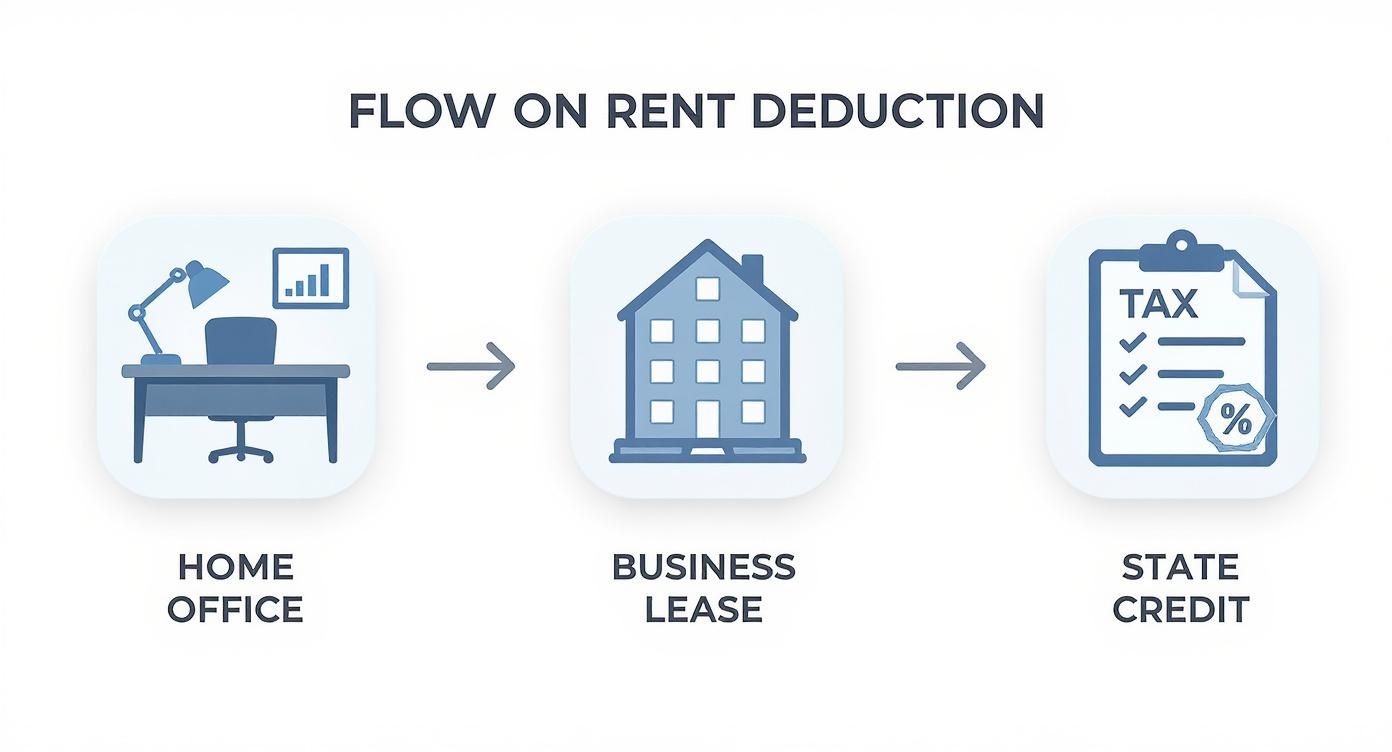
As you can see, whether it's through a home office, a commercial lease, or a state-specific credit, the end goal is always the same: legally reducing your taxable income.
1. The Simplified Method
This is the "set it and forget it" option. If you hate tracking receipts and doing math, this is for you. It requires minimal paperwork and straightforward calculation.
- How it Works: You get a standard deduction of $5 per square foot for your office space.
- The Catch: The IRS caps this at 300 square feet, which means your maximum possible deduction is $1,500.
- Example: Let's say your office is a 10-foot by 12-foot room (120 sq. ft.). Your deduction is simple: 120 sq. ft. x $5 = $600.
This method is perfect if you want a no-fuss way to claim the deduction without saving every single utility bill.
2. The Actual Expense Method
This approach takes more work, but it almost always leads to a bigger tax deduction. It's for the diligent record-keepers. Here, you calculate the exact percentage of your home that's used for business and apply that to your actual housing expenses.
First, you have to figure out your business-use percentage. Get out the tape measure and find the square footage of your office and the total square footage of your apartment.
- The Formula: (Square Footage of Your Office / Total Square Footage of Your Home) = Your Business-Use Percentage
- Example: Your dedicated office is 150 sq. ft. and your entire apartment is 1,000 sq. ft. The math is 150 / 1,000, which gives you a 15% business-use percentage.
Now, you apply that 15% to all your relevant home-related expenses for the year, which can include:
- Rent you paid to your landlord
- Renter's insurance
- Utilities (electricity, heat, water, internet)
- General repairs that benefit the whole apartment
Let's stick with the example. Say you paid $24,000 in rent for the year ($2,000/month) and another $3,000 in utilities. Your total expenses are $27,000. Your deduction would be 15% of $27,000, which comes out to $4,050.
As you can see, the extra effort pays off. For a deeper dive, check out our guide on the tax implications of working from home. Just remember, this method means you absolutely must keep all your receipts and records to back up your claim.
Deducting Rent for a Commercial Business Space

After navigating the complexities of the home office deduction, you'll find that deducting rent for a dedicated commercial space is refreshingly straightforward. If your business leases an office, storefront, warehouse, or any other commercial property, the rent you pay is a direct, clear-cut business expense.
This is the cleanest scenario when it comes to deducting rent from taxes. There are no tricky percentages to calculate or grey areas about personal vs. business use. The entire expense is considered "ordinary and necessary" for doing business, which means you can deduct 100% of what you pay.
Understanding Ordinary and Necessary Expenses
So what does the IRS mean by "ordinary and necessary"? It’s simpler than it sounds. An "ordinary" expense is just something common and accepted in your line of work. A "necessary" expense is one that's helpful and appropriate for your business.
For almost any business that needs a physical location—from a small bakery to a busy law firm—commercial rent easily checks both boxes. You simply can't run a coffee shop without the shop, and the cost to secure that space is a fundamental part of your operations, just like inventory or payroll.
Key Takeaway: Unlike the home office deduction, which carves out a piece of a personal expense, commercial rent is a pure business expense from the start. This makes justifying the deduction much simpler and far less likely to draw scrutiny from the IRS.
How to Report Commercial Rent on Your Taxes
For sole proprietors and single-member LLCs, claiming this deduction is a direct process. You'll report the total rent you paid for the year on your Schedule C (Profit or Loss from Business), which is the financial summary of your business that you file with your personal tax return.
Inside the "Expenses" section of the form, you'll find what you're looking for.
- Line 20b "Rent or lease (other business property)": This is exactly where you enter the total amount you paid for your commercial space during the tax year.
Let’s say you paid $2,500 per month for your workshop. Your total annual deduction would be a solid $30,000. You just enter that number on this line. It's a clear, direct expense that reduces your business's taxable profit, dollar for dollar.
Don't Forget Related Rental Costs
Your rent deduction isn't limited to just the base amount you send your landlord each month. Many commercial leases tack on additional fees that are also fully deductible as part of your rental expenses. These often fall under the umbrella of Common Area Maintenance (CAM) fees.
Be sure to tally up these related costs and include them in your total deduction:
- CAM Fees: Your share of the cost for maintaining common areas like lobbies, parking lots, and landscaping.
- Property Taxes: If your lease makes you responsible for a portion of the building's property taxes.
- Insurance: Any property insurance your lease requires you to carry for your specific unit.
- Utilities: If utilities are rolled into a single payment to the landlord, that entire amount is considered rent.
For example, imagine a consultant leases a small office for $1,800 a month. Her lease also requires a $200 monthly CAM fee. Her total deductible rent expense isn't just the base rent; it's $2,000 per month, adding up to $24,000 for the year. Catching these extra costs is key to maximizing your deduction.
Essential Documentation for Your Records
Even though this deduction is about as simple as they come, keeping meticulous records is absolutely non-negotiable. If the IRS ever has questions, you need a clear paper trail to back up every dollar you claim.
Your file should always include:
- A Signed Lease Agreement: This is the core document proving your legal obligation to pay rent.
- Records of Payment: This means canceled checks, bank statements, or digital payment confirmations showing the rent was actually paid.
- Receipts for Related Costs: Keep every invoice and proof of payment for CAM fees, property taxes, or insurance paid as part of your lease.
Organizing these documents by month or quarter will save you a massive headache come tax time and give you the solid evidence you need to claim your deduction with confidence.
How Landlords Deduct Rental Property Expenses
When you’re a landlord, the entire tax game changes. While your tenants might be able to deduct a small portion of their rent for a home office, you get to treat your rental property like a full-fledged business. And that’s a huge deal.
The rent you collect isn't just pocket money; it's business revenue. This simple shift in perspective opens the door to a massive list of tax deductions. Every dollar you spend to keep your rental running—from fixing a leaky pipe to advertising for a new tenant—can potentially lower your taxable income. For savvy investors, this is where you turn everyday costs into powerful tools for boosting your bottom line.
The Wide World of Landlord Deductions
Unlike the home office deduction, which is tied to a specific area of a home, landlord deductions cover almost everything associated with owning, managing, and maintaining your investment property. You'll report these expenses on Schedule E (Supplemental Income and Loss), which you file right alongside your personal tax return.
The list of potential landlord tax write-offs is long and varied. If you’re not tracking these expenses carefully, you're almost certainly leaving money on the table.
Here are just a few of the most common write-offs:
- Mortgage Interest: This is often the single biggest deduction. The interest you pay on your property loan is fully deductible.
- Property Taxes: Whatever you pay in state and local property taxes on the rental is a straightforward business expense.
- Insurance Premiums: The cost of your landlord, hazard, and liability insurance policies is completely deductible.
- Repairs and Maintenance: From patching drywall to hiring a plumber, the costs of routine upkeep are deductible in the year you pay for them.
- Professional Fees: Did you pay a property manager, accountant, or lawyer? Those fees are deductible.
- Advertising Costs: Any money you spent finding good tenants, whether online or in print, can be written off.
Depreciation: The Ultimate "Paper" Deduction
Now let's talk about one of the most powerful, and often misunderstood, deductions available: depreciation. It's what we call a non-cash deduction, which means you get to claim it without actually spending a dime that year.
Think of your rental property like a new piece of machinery. From the day you put it into service, it starts to wear out. The IRS recognizes this gradual decline in value and lets you deduct a piece of your property's cost each year over its "useful life."
The IRS has determined the useful life for a residential rental property is 27.5 years. This lets you write off the value of the building (not the land—land never depreciates) in equal chunks over nearly three decades.
This deduction is a game-changer because it directly reduces your taxable rental income without touching your cash flow. It's an essential part of any smart investor's tax strategy. To see how this fits into the bigger picture, check out our complete guide to rental property tax deductions.
What About State-Specific Renter Tax Credits?
While the IRS generally limits rent deductions to business use, don't stop there. Many states have their own programs designed to give renters a break, and these are completely separate from the federal home office deduction. Think of them as a way for your state to help ease the burden of high housing costs, particularly for people with low-to-moderate incomes.
Forgetting to check your state's tax laws is one of the easiest ways to leave money on the table come tax time. These programs usually come in the form of a renter's tax credit, which is fantastic because it reduces your state tax bill dollar-for-dollar. Some states even make these credits refundable, meaning you could get a check in the mail even if you don’t owe any state tax at all.
Just remember, these benefits aren't automatic. You have to know about them and actively claim them when you file your state return. The rules can be wildly different from one state to another, but the potential savings make it worth a look.
How State Renter Credits Usually Work
Unlike the sometimes-tricky calculations for a home office, state renter credits are typically much more straightforward. The logic behind most of them is simple: your state recognizes that a chunk of your rent goes toward paying the property taxes your landlord owes. These credits are their way of passing some of that property tax relief back down to you.
Most states that offer these programs will look at a few key things to see if you qualify.
Common eligibility requirements often boil down to:
- Income Limits: These programs are almost always aimed at helping those below a certain income level. For instance, in California, a single filer might need to earn less than $52,421 to be eligible.
- Residency Status: You’ll need to be a legal resident of the state and have rented there for a certain amount of time, usually at least six months out of the year.
- Filing Status: You typically can't be claimed as a dependent on someone else's tax return.
- Property Tax Payments: The building you rent in must be subject to local property taxes. This is almost always a given, but it’s the legal foundation for these credits.
Heads Up: Every state has its own forms and rules for claiming a renter's credit. You absolutely have to read the instructions from your state's department of revenue to make sure you're filing correctly and have the right paperwork, like proof of rent paid.
A Look at Renter Tax Benefits in Different States
The value of these tax breaks varies quite a bit. Some states give you a flat credit, while others let you deduct a portion of the rent you paid. This is exactly why you have to do a little digging into your own state's rules.
Here’s a quick snapshot of how a few states help renters:
- Massachusetts: This one is a big deal. Renters there can deduct 50% of the rent they paid during the year, with the deduction maxing out at $4,000 for 2023.
- Indiana: Allows qualified renters to deduct up to $3,000 of the rent paid on their main home.
- Minnesota: Has a refundable property tax credit for renters. The actual refund depends on your income and how much rent you paid, but it can be more than $2,000.
- New Jersey: Folds tenants into its property tax relief program by letting them treat 18% of their rent paid as property taxes when calculating their credit.
This is just a small sample, of course. States like Maine, Maryland, and Michigan all have their own versions. Your best bet is to go directly to your state's department of revenue website and search for terms like "renter's tax credit" or "property tax credit for tenants." You might just find some savings you never knew were there.
Common Mistakes to Avoid When Deducting Rent

Knowing you can deduct rent from your taxes is one thing; doing it correctly is another. The path is filled with little traps, and even a small misstep can mean a lost deduction or, worse, an audit notice from the IRS.
By understanding where others often go wrong, you can avoid these pitfalls and file with confidence. These mistakes are surprisingly common, but thankfully, they’re also easy to sidestep once you know what to look for.
Failing the Exclusive Use Test
This is probably the biggest hurdle for home office deductions, and it’s where most people stumble. The IRS is an absolute stickler for the "exclusive use" rule. It means exactly what it sounds like: your workspace can't double as personal space.
Think of it this way: if you work at your dining room table during the day but eat dinner there with your family at night, it fails the test. That space isn't used exclusively for business. On the other hand, a desk in the corner of a guest room that is never used for anything but work? That passes. The space must be 100% dedicated to your business.
"The 'exclusive use' rule is the bedrock of the home office deduction. Failing to respect this boundary is the quickest way to have your deduction disallowed in an audit. Documenting your dedicated space with photos is always a smart move."
This isn't just the IRS being difficult. They need to see a clear line drawn between your personal life and your business operations, especially when they happen under the same roof.
Inaccurate Calculations and Measurements
"Good enough" isn't good enough for the IRS. Guesstimating the size of your home office or your expenses is a surefire way to attract unwanted attention. Both the Simplified and Actual Expense methods hinge on precise figures.
It's tempting to eyeball your office and call it 10% of your apartment, but if an audit shows it's only 7%, you're in trouble. The same goes for shared expenses. You can't deduct 100% of your internet bill if the rest of your family is using it to stream movies and play games. You have to figure out a reasonable percentage that reflects actual business use.
- Do: Grab a tape measure. Get the exact square footage of your office and your entire home.
- Don't: Guesstimate. It’s a gamble you don't want to take.
- Do: Keep detailed utility bills and a note explaining how you landed on your business-use percentage.
- Don't: Apply your business-use percentage to unrelated costs, like a plumbing repair in a bathroom across the hall. The expense has to benefit the workspace.
Keeping Poor Records
A deduction without a paper trail is just a number on a form. If the IRS ever comes knocking, "I'm sure I paid it" won't cut it. This is probably the most critical mistake you can make because it undermines everything else.
You need to be able to back up every single dollar you claim. When it comes to deducting rent from taxes, your file should have:
- Proof of Rent Payments: Canceled checks, bank statements showing the transfers, or receipts from your landlord for the entire year.
- Utility Bills: Every single monthly statement for expenses you’re partially deducting, like electricity, gas, and internet.
- Lease Agreement: A signed copy of your lease that clearly states your rent obligation.
Without these documents, you're leaving yourself exposed. Think of good record-keeping as your insurance policy—you hope you never need it, but you'll be incredibly glad you have it if you do.
Diving Deeper: Your Rent Deduction Questions Answered
Once you get the basics down, the real-world "what if" scenarios start popping up. Let's tackle some of the most common questions people ask to give you the confidence you need when tax time rolls around.
Can I Claim the Home Office Deduction in a Studio Apartment?
You absolutely can. Many people think the home office deduction requires a separate room with a door you can close, but that's not the case. The IRS just requires that a specific area is used exclusively for your business.
So, that corner of your studio with your desk, computer, and file cabinet? That counts. You'll just need to measure the square footage of that dedicated work area and use it to figure out the business-use percentage of your apartment.
I Work From Home for an Employer. Can I Deduct Rent?
This is a big one, and unfortunately, the answer for most employees is no. After the Tax Cuts and Jobs Act of 2017, employees who receive a W-2 can no longer claim the home office deduction on their federal tax return.
This valuable deduction is now almost exclusively available to self-employed individuals—think freelancers, independent contractors, and gig workers who file a Schedule C.
What Records Are Essential for a Home Office Deduction?
If you’re going to claim this deduction, solid paperwork is your best friend. Think of it this way: good records are your defense if the IRS ever comes knocking.
Key Takeaway: In an audit, the burden of proof is on you, not the IRS. Without clear records, your deduction could be thrown out, even if you were entitled to it. A little organization upfront can save you a massive headache later.
Here's the documentation you'll want to have on hand to properly back up your claim when deducting rent from taxes:
- Proof of Rent: Keep copies of your canceled checks, bank statements showing the payment, or digital receipts for every single month.
- Utility Bills: Save all your monthly statements for electricity, gas, internet, and any other household expenses you're partially deducting.
- Measurements: A simple, hand-drawn floor plan is perfect. Just be sure it shows the total square footage of your home and the specific measurements of your office space.
- Visual Proof: It might sound silly, but a few photos of your workspace can go a long way in proving its existence and exclusive business use.
Figuring out the nuances of tax deductions can feel like a maze. The experts at Allied Tax Advisors are here to give you personalized guidance, making sure you get every deduction you deserve while staying 100% compliant. Visit us at https://alliedtax.com to book a consultation and get your finances on the right track.