
Choosing between an LLC or C Corporation really boils down to what you want your business to become. Think of it this way: LLCs are built for operational simplicity and tax flexibility, making them a fantastic fit for most small businesses and service providers. C Corporations, on the other hand, are designed from the ground up to attract serious investors and scale to a massive size.
LLC vs C Corp at a Glance
Picking your business entity is a foundational decision. It’s not just paperwork; it dictates how you’re taxed, how you’re managed, and your ability to bring on investors down the road. Both an LLC and a C Corp give you that all-important limited liability protection, meaning your personal assets are shielded from business debts.
But that's where the similarities end. An LLC operates more like a souped-up partnership with a ton of flexibility, while a C Corp is a completely separate legal entity with a much more formal, rigid structure. Let's break down exactly what that means in practice.

Key Differences LLC vs C Corporation
This table is your cheat sheet for the big-picture differences. Use it to get a quick handle on how LLCs and C Corps stack up on the issues that matter most, from taxes to compliance.
| Feature | LLC (Limited Liability Company) | C Corporation |
|---|---|---|
| Taxation | Profits and losses "pass-through" to the owners' personal tax returns. This avoids the infamous double taxation problem. | The corporation pays taxes on its profits first. Then, when profits are distributed to shareholders as dividends, they pay personal income tax on them again. This is double taxation. |
| Ownership | Owned by "members." The ownership structure is incredibly flexible and has very few restrictions on who can be a member. | Owned by "shareholders." C Corps can issue different classes of stock (like common vs. preferred), which is a key reason investors love them. |
| Management | You have options. It can be managed directly by the members (member-managed) or by appointed managers (manager-managed). | There’s a required formal structure: a Board of Directors that oversees the big picture and corporate officers (CEO, CFO, etc.) who run daily operations. |
| Fundraising | Much harder to attract venture capital. The ownership structure can get messy, which makes VCs hesitant. | This is the gold standard for venture capital. Issuing stock and stock options to investors and employees is straightforward. |
| Compliance | Far less demanding. The requirements for formal meetings, minutes, and extensive record-keeping are minimal. | The administrative burden is high. You must hold regular board and shareholder meetings, keep detailed minutes, and file annual reports. |
Getting a feel for these distinctions is the perfect starting point. To see where these two fit into the larger picture, you can learn more about the full range of business structure types. At the end of the day, the right choice syncs up perfectly with your specific business goals and how you plan to grow.
Analyzing the Tax Consequences of Each Structure
When you get right down to it, the choice between an LLC or C corporation almost always comes down to taxes. The way your business profits are taxed directly hits your bottom line, influencing your take-home pay, your ability to reinvest, and your company's long-term financial health. The differences aren't just minor details; they represent two fundamentally different philosophies of taxation.
The LLC: Simplicity and Pass-Through Taxation
An LLC, in its default state, is what we call a "pass-through entity." This is a crucial concept. It means the business itself doesn't file a corporate tax return or pay federal income tax. Instead, all the profits and losses are "passed through" directly to the owners (known as members), who then report that income on their personal tax returns. This setup elegantly sidesteps the dreaded "double taxation" problem.
But that simplicity has a catch: self-employment taxes. For any member who is actively working in the business, the entire share of net profit is generally subject to a 15.3% self-employment tax, which covers both Social Security and Medicare. As your business grows, that 15.3% can become a very heavy burden.

Unlocking Tax Savings: The S Corp Election for LLCs
So, what do you do when your LLC becomes profitable and that self-employment tax bill starts to sting? This is where a smart strategic move comes into play: electing to be taxed as an S Corporation. This doesn't change your LLC's legal structure, but it completely changes the tax game, creating a powerful hybrid.
Here’s how it works. Once you make the S Corp election, you, as the owner-employee, must pay yourself a "reasonable salary." That salary is subject to normal payroll taxes (FICA), which are the employee/employer equivalent of self-employment tax. But here's the magic: any remaining company profits can be paid out to you as distributions, and these distributions are not subject to that 15.3% tax. Splitting your income between salary and distributions can save you thousands.
Key Insight: The S Corp election is, without a doubt, the most powerful tax-saving tool for a profitable LLC. It lets you cap your self-employment tax liability to just your salary, protecting the rest of your hard-earned profits.
Let's put some real numbers to this. Imagine a business in a high-tax state like California with $150,000 in net profit. As a standard LLC, the owner would face the full 15.3% self-employment tax on the entire $150,000, which comes out to roughly $19,837.
Now, let's say that same LLC makes an S Corp election. The owner pays themselves a reasonable salary of $75,000. The payroll taxes on that salary would be $11,475. The other $75,000 in profit comes out as a distribution, completely avoiding that tax. The annual savings? A cool $8,362. It's a clear financial win for any growing business.
The C Corp: A Separate Taxpaying Entity
A C Corporation operates on a completely different principle. It's a distinct legal and taxable entity, entirely separate from its owners. This separation is the source of its main drawback and its greatest advantage.
The tax process is a two-step affair, which leads to the infamous "double taxation":
- Corporate-Level Tax: First, the C Corp pays federal income tax on its net profits. Thanks to the Tax Cuts and Jobs Act (TCJA), this is a flat 21% rate.
- Shareholder-Level Tax: Then, if the corporation decides to distribute its after-tax profits to shareholders as dividends, those shareholders have to pay personal income tax on that dividend income.
That's the double hit: the same dollar of profit gets taxed once when the corporation earns it, and again when it's paid out to an owner. For a business owner who needs to pull cash out of the company regularly, this can lead to a much higher overall tax rate compared to an LLC.
The C Corp's Secret Weapon: The Reinvestment Advantage
Given the double taxation issue, why would anyone even consider a C Corp? The answer is simple: reinvestment.
That flat 21% corporate tax rate is a game-changer for businesses laser-focused on growth. Think of a startup that needs to pump every last dollar back into R&D, marketing, and scaling operations. A C Corp allows them to do just that after paying a predictable 21% tax. The second layer of tax—the one on dividends—is completely deferred as long as the money stays in the company. This makes the C Corp the perfect vehicle for aggressive growth and building capital.
For a deeper look into these mechanics, check out our guide on the primary tax advantage of an LLC and how it performs in various situations.
A Head-to-Head Tax Scenario
Let's make this crystal clear with a practical comparison. We'll take two businesses, each with $200,000 in net profit.
Scenario A: LLC with S Corp Election
- Net Profit: $200,000
- Reasonable Salary: $80,000
- Profit Distribution: $120,000
- Taxes Paid:
- Payroll Taxes on Salary (15.3%): $12,240
- Personal Income Tax on the full $200,000 is paid, but the key is that $120,000 of it escaped the 15.3% FICA/SE tax.
Scenario B: C Corporation (Distributing all Profits)
- Net Profit: $200,000
- Corporate Tax (21%): $42,000
- Remaining for Dividends: $158,000
- Taxes Paid:
- Corporate Tax: $42,000
- Qualified Dividend Tax on $158,000 (assuming a 15% rate): $23,700
- Total Tax: Around $65,700
When you plan to take the profits out, the S Corp is the clear winner from a tax-efficiency standpoint. But if the C Corp had reinvested that $158,000 back into the business, its total tax bill would have been just $42,000. This highlights its power for companies in growth mode. Ultimately, the right choice depends entirely on what you plan to do with your profits.
Formation Costs and Compliance: The Day-to-Day Reality
Tax strategy is just one piece of the puzzle. The choice between an LLC or a C corporation will fundamentally change how you run your business every single day. This is where the rubber meets the road—where the administrative headaches and real-world costs start to add up. The operational demands are night and day, impacting your startup budget, your calendar, and your sanity.
A primary reason for forming either a C Corp or an LLC is to shield your personal assets from business debts and lawsuits, especially when it comes to thorny issues like joint and several liability. Both entities get you there, but the journey to set up and maintain that protection is vastly different in terms of both complexity and cost.
The LLC: Built for Simplicity and Speed
For most entrepreneurs, the LLC is the path of least resistance, and for good reason. Setting one up is usually straightforward. You file a document called "Articles of Organization" with your state and draft an internal "Operating Agreement." That agreement is a critical document—it spells out who owns what and how the business will be run—but it typically stays private, out of the public record.
This simplicity carries through to the day-to-day operations. LLCs are known for their operational flexibility.
- No Formal Board Meetings: You aren’t legally required to hold annual board meetings or keep detailed corporate minutes.
- Flexible Management: You can have the owners run the show directly (member-managed) or appoint specific managers (manager-managed). There's no need for a rigid hierarchy of officers.
- Minimal Reporting: In most states, ongoing compliance just means a simple annual report and a fee. The administrative burden is kept low.
This light touch translates directly into lower costs. When you stack up the annual expenses, an LLC often costs between $500 and $1,500 to maintain. This covers basic state filings and, in states like California, a minimum franchise tax. It’s an ideal setup for a solopreneur or real estate investor who needs that liability shield without the weight of corporate bureaucracy. You can explore a detailed business tax structure comparison that breaks down these costs further.
The C Corporation: A Commitment to Formal Structure
Opting for a C Corporation means you're signing up for a higher level of formality, which inevitably comes with higher costs. The setup is more involved, requiring you to file "Articles of Incorporation" and create corporate "bylaws"—basically, a detailed rulebook governing how the company must operate.
From the get-go, a C Corp runs on a strict set of rules that demand constant attention.
- Mandatory Meetings: You absolutely must hold regular board of directors and shareholder meetings, and every single one needs to be documented with official minutes.
- Rigid Hierarchy: The management structure is set in stone. You need a board of directors for big-picture oversight and corporate officers (CEO, CFO, Secretary) to handle daily operations.
- Formal Payroll is a Must: If you're an owner and you work in the business, you have to be paid a reasonable salary through a formal payroll system. This adds another layer of complexity and cost.
Crucial Takeaway: If you get lazy with C Corp formalities—like skipping meetings or failing to keep minutes—you risk a court "piercing the corporate veil." This dissolves your liability protection, making you personally responsible for the company's debts.
This rigorous framework means higher annual maintenance costs, plain and simple. A C Corp should budget anywhere from $3,000 to $6,000 or more each year just for compliance. That money goes toward legal fees for keeping corporate records in order, accounting for payroll management, and state filing fees. This structure is really built for companies that need that formal governance, usually because they're courting outside investors who demand transparency and accountability. Ultimately, the LLC or C corporation decision has to factor in whether you have the time and money for these ongoing demands.
How Your Choice Impacts Fundraising and Investor Appeal
If your business roadmap includes raising capital from outside investors, the decision between an LLC or C corporation is one of the most important you’ll make. For founders with big growth plans, this isn't just a legal formality. It’s a strategic move that broadcasts your intentions to the investment world and can either open doors or slam them shut.

The world of venture capital (VC) and angel investing runs on established norms. Investors need a clear, simple, and scalable way to inject cash into a company and track their ownership. In this arena, the C Corporation is the undisputed champion. An LLC, on the other hand, often introduces complications that can bring a potential deal to a grinding halt.
Why Investors Overwhelmingly Prefer the C Corporation
Venture capitalists and seasoned angel investors almost exclusively fund C Corporations, and for good reason. This preference is so ingrained that most LLCs looking for funding are told to convert to a C Corp before any serious talks can even begin. The C Corp’s entire design is built for growth and welcoming outside owners.
A C Corp’s biggest advantage is its ability to issue different classes of stock. Investors rarely take the same kind of equity as founders. They typically receive preferred stock, which carries special rights like liquidation preferences (they get their money back first if the company sells) and anti-dilution protections. An LLC's structure, based on "membership interests," just isn't built to handle this kind of tiered ownership cleanly.
On top of that, C Corps make creating employee stock option plans (ESOPs) straightforward. Granting equity is a crucial tool for luring top talent, and the process for issuing stock options in a C Corp is standardized and well-understood. Trying to replicate this in an LLC is a legal headache and a major red flag for investors. You can learn more about the built-in advantages of a corporation that make it so appealing.
Investor Insight: Venture capital funds have their own complex legal and tax structures. The pass-through taxation of an LLC can create a nightmare of tax complications for a VC fund and its partners, making it an unworkable investment from the get-go. A C Corp’s self-contained tax status neatly avoids all these problems.
The Game-Changer: Qualified Small Business Stock (QSBS)
One of the most powerful reasons investors flock to C Corps is a tax incentive called Qualified Small Business Stock (QSBS). Under Section 1202 of the IRS code, investors in certain C Corporations can potentially exclude up to 100% of their capital gains from federal taxes when they sell their stock, as long as they hold it for at least five years.
This is a massive financial windfall that can turn a great return into a legendary one. The catch? This tax break is only available for stock in a C Corporation. LLC membership interests don't qualify. For any sophisticated investor, the shot at a tax-free exit makes C Corps the obvious choice, and the lack of QSBS eligibility is often a deal-breaker.
Why LLCs Don't Work for Venture Capital
While LLCs offer incredible flexibility for businesses run by their owners, that same flexibility becomes a liability when you’re courting institutional money. An LLC’s operating agreement is often a highly customized document. A VC’s legal team would have to spend a ton of time and money just to figure out what it all means.
In contrast, C Corp bylaws and shareholder agreements follow a familiar, standardized format. The investment community knows what to expect, which greases the wheels and speeds up the entire deal-making process.
The data backs this up. An estimated 95% of U.S. venture funding flows into Delaware C Corps, which are prized for being ready for an IPO and eligible for QSBS. C Corps can have an unlimited number of shareholders of any type—including other companies and foreign investors—and can easily create the multiple classes of stock that complex deals require.
Ultimately, if your business plan depends on raising outside money to grow, starting as a C Corporation aligns your company with investor expectations from day one and clears the path to getting the capital you need.
Putting It All Together: Which Structure Fits Your Business?
Theory is one thing, but the real test is seeing how an LLC or C Corp plays out in the real world. The best choice for your business isn't found in a textbook; it's revealed by your goals, your industry, and how you plan to grow.
Let's walk through four common scenarios. Instead of just listing pros and cons, we'll look at what each type of business owner actually needs and see which entity structure gets the job done.
The Solo Consultant or Freelancer
If you're a one-person show—a marketing consultant, a freelance designer, or a software developer—your priorities are simple. You need to protect your personal assets and keep your taxes as straightforward as possible. The last thing you want is to be bogged down by corporate paperwork when you should be focused on clients.
This is a textbook case for a single-member LLC. It creates that critical legal barrier between your business and your personal life (your house, your car, your savings) without the headache of corporate meetings and resolutions. For taxes, it’s a breeze. All your business profit just passes through to your personal tax return, so there's no separate corporate filing to worry about.
Down the road, once your income grows, you can easily have the LLC taxed as an S Corp. This is a game-changer. It lets you pay yourself a "reasonable salary" and take the rest of the profit as a distribution, which can slash your self-employment tax bill.
A Local Service Business with Employees
Think about a growing local business—a landscaping crew, a popular salon, or an auto shop. These businesses often have a few partners, a team of employees, and plans to expand. They're not looking for venture capital; they just need a solid structure that protects them, saves on taxes, and is flexible enough to manage.
A multi-member LLC is almost always the right move here, especially with an S Corp election. One of the best parts of the LLC for partnerships is the flexibility in how you split profits. It doesn't have to mirror ownership percentages, which is perfect for rewarding a partner who puts in more "sweat equity" or accommodating different initial investments.
Filing for the S Corp election provides the same payroll tax savings we mentioned earlier, but the benefit is magnified when you have partners and employees. It's a smart, efficient way to run the business and keep more money in the owners' pockets.
Situational Insight: If you're in a licensed profession like medicine, law, or accounting, you'll likely form a Professional LLC (PLLC). It works just like a regular LLC but is designed to meet the specific compliance rules your state has for your profession.
The Real Estate Investment Partnership
When you're pooling money to buy property, your needs are very specific. You’re focused on protecting each asset, managing capital from different partners, and handling rental income and property sales in the most tax-efficient way possible.
The multi-member LLC is the gold standard for real estate investors for a reason. Its greatest strength is the ability to create a separate LLC for each individual property. This compartmentalizes risk, meaning a lawsuit or issue with one property can't touch the others in your portfolio. Trying to do this with C Corps would be a nightmare.
Plus, the LLC's pass-through taxation is perfectly suited for real estate. Major tax benefits like depreciation flow directly to the investors' personal returns, helping to offset rental income. The LLC's operating agreement also makes it simple to handle complex profit-sharing splits and capital arrangements between partners.
For those operating across borders, it's also helpful to look at how different countries handle business entities by understanding Canadian business structures like the LLC equivalent.
The High-Growth Tech Startup
Now, let's shift gears to a tech startup with dreams of raising millions from venture capitalists and maybe, one day, going public. For this kind of company, the entire structure needs to be built around attracting investors and top-tier talent.
This is C Corporation territory, and there’s really no other option. Specifically, most startups form as a Delaware C Corp. Why? Because it's the only structure that can easily issue different classes of stock—like the preferred stock that VCs demand—and set up employee stock option plans to lure in the best engineers and executives.
The potential for Qualified Small Business Stock (QSBS) tax exemptions is another huge factor. It offers a massive tax break to early investors, giving them a powerful reason to fund your company. While double taxation is a concern on paper, most high-growth startups reinvest every penny of profit back into the business for years, so there's no dividend tax to pay. The C Corp isn't built for paying out annual profits; it's built for a massive exit.
A Strategic Framework for Making Your Final Decision
When you get right down to it, the choice between an LLC or a C corporation really hinges on your long-term vision. Forget the technical weeds for a moment and just ask yourself a few honest questions about what you're trying to build. Your answers will almost always point you in the right direction.
This decision tree helps visualize how different ambitions lead to very different entity choices.
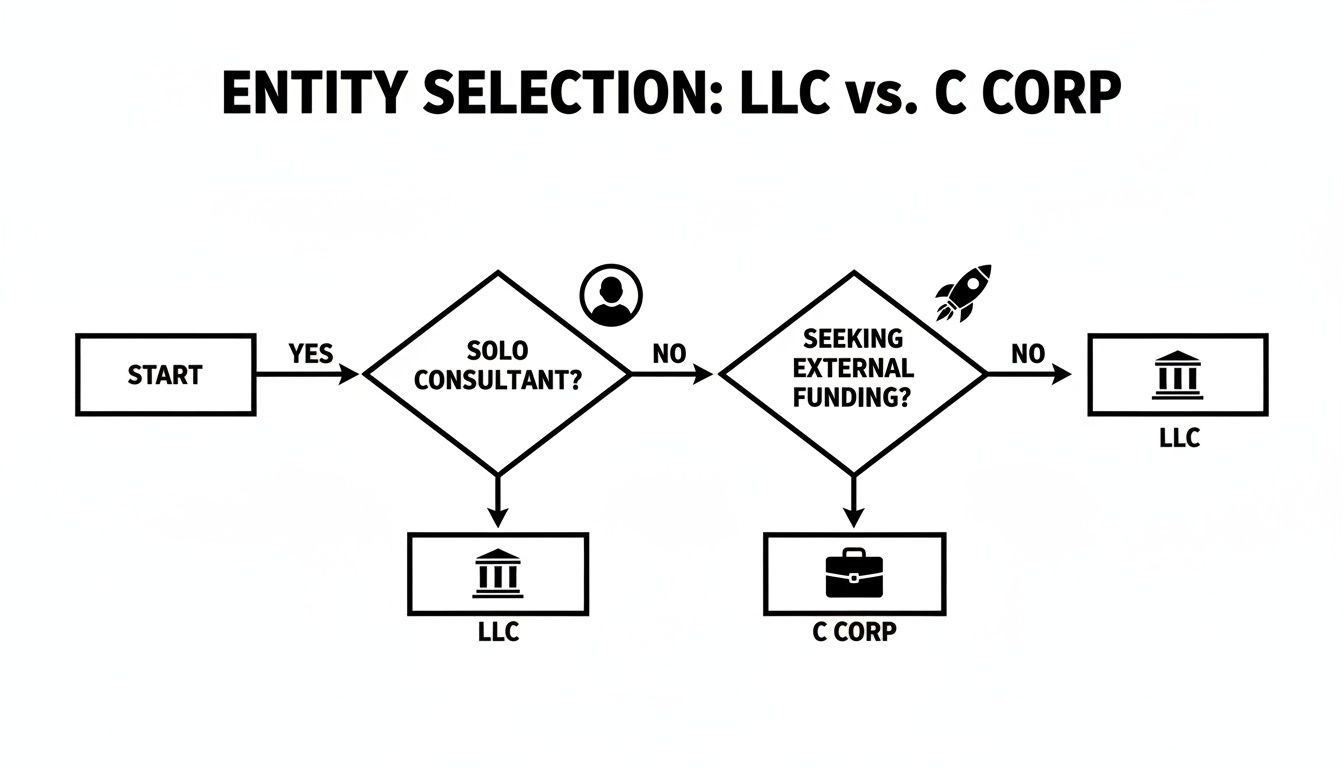
As you can see, a solo consultant or a lifestyle business will likely find the LLC is a perfect match. On the other hand, a high-growth startup chasing venture capital is almost always better off as a C Corp from the get-go.
Key Questions to Guide Your Choice
Think of these questions as the core of your decision. Answering them honestly now can save you from a world of expensive restructuring headaches down the road.
- What's the real end goal here? Are you building a solid lifestyle business to support your family? That points toward an LLC. Or are you aiming for massive scale and a big exit event? That's classic C Corp territory.
- Will you need outside investment? If you have any plans to pitch angel investors or VCs in the next five years, a C Corp is pretty much the only game in town.
- How will profits be used? Do you plan to regularly pull profits out as personal income? An LLC, especially with an S-Corp election, is great for that. Or will you reinvest every spare dollar back into growth? That's a key advantage of the C Corp structure.
- Who are the owners going to be? Is ownership staying within a small group of U.S. citizens? An LLC works just fine. But if you see international investors or other corporations coming on board as shareholders, you'll need a C Corp.
Expert Tip: Remember, your initial choice isn’t forever. It's actually quite common for a successful LLC to convert to a C Corporation when it's time to raise a serious round of funding. Starting as an LLC can give you simplicity and tax advantages in the early days without shutting the door on future growth.
This is a decision with serious legal and financial consequences. The last, and most critical, step is always to talk it through with experienced tax and legal professionals. At Allied Tax Advisors, we can dive into the specifics of your situation to make sure your entity choice perfectly aligns with your goals, setting you up for success from day one.
Common Questions We Hear
What if I choose the wrong structure? Can I change it later?
Absolutely. It’s actually a pretty common move for a growing business. Many startups begin life as an LLC for the tax simplicity and then, once they're ready to bring in venture capital, they'll convert into a C Corporation.
It's not just a flip of a switch, though. The conversion involves a fair bit of legal paperwork and has some serious tax consequences. You'll definitely want to map out the process with your legal and tax advisors. The good news is that starting as an LLC doesn't lock you in forever; it just gives you tax-friendly flexibility in the early days.
I've heard about S Corps. Is that another option?
This is a great question and a point of frequent confusion. An S Corporation isn't a separate legal entity like an LLC or C Corp. Instead, it's a tax status you elect with the IRS.
Both an LLC and a C Corporation can file Form 2553 to be taxed as an S Corp. Doing so allows profits to pass directly to the owners' personal tax returns, which is how you sidestep the C Corp's double taxation problem. For LLC owners, it can also be a smart way to reduce self-employment taxes on distributions.
Which one gives me better liability protection?
When it comes to protecting your personal assets, both an LLC and a C Corporation provide the exact same level of limited liability protection. One isn't inherently better than the other in this regard.
Choosing between an LLC or a C Corporation is a foundational decision that impacts everything from your taxes to your ability to grow. The team at Allied Tax Advisors specializes in helping business owners make sure their structure is a perfect match for their long-term goals.
Ready to get it right from the start? Schedule a consultation with our experts today.