
The biggest tax win for an LLC comes down to one core concept: pass-through taxation. It’s a beautifully simple and flexible system that lets all the business profits flow directly onto the owners' personal tax returns.
This means the business itself doesn't pay a dime in income tax. You get taxed just once, completely sidestepping the "double taxation" headache that plagues other corporate structures.
Understanding the Core LLC Tax Advantage

Here’s a simple way to think about it. Imagine your business is a clear glass pipe. When you set up an LLC, the profits it makes flow straight through that pipe to you, the owner. The money isn't taxed while it's in the pipe (the business entity). It only gets taxed once it lands in your hands and you report it on your personal 1040 tax return.
This pass-through approach is the number one reason countless entrepreneurs opt for an LLC. Before you can really appreciate the tax perks, it helps to understand the basics of limited liability company formation. This foundational idea is a world away from the C Corporation model, which is often much more complex.
The Problem of Double Taxation
With a traditional C Corporation, the business is its own separate taxpayer in the eyes of the IRS. This creates a two-layered tax hit:
- At the Corporate Level: First, the corporation pays income tax on its net profits.
- At the Shareholder Level: Then, when the company distributes those after-tax profits to shareholders as dividends, the shareholders have to pay personal income tax on that same money again.
This is the infamous double taxation, and it can take a serious bite out of the money owners actually get to keep. The LLC’s default tax setup completely avoids this problem, making it a much more efficient choice for most small businesses. The IRS even reports that over 95% of small businesses in the U.S. use some form of pass-through taxation, which speaks volumes about its appeal. To get a better handle on how the IRS views this, check out our guide on the default tax classification for an LLC.
To make this crystal clear, let's compare the two structures side-by-side.
LLC vs C Corporation At-a-Glance Tax Comparison
Here's a quick summary that highlights the fundamental tax differences between a default LLC and a C Corporation.
| Tax Aspect | LLC (Default) | C Corporation |
|---|---|---|
| Business Profits | Taxed once on owner's personal return | Taxed twice: first at the corporate level, then again on shareholder dividends |
| Tax Rate | Owner's individual income tax rates | Flat corporate tax rate + shareholder's dividend tax rate |
| Tax Forms | Reported on personal forms (e.g., Schedule C for single-member LLCs) | Filed on a separate corporate tax return (Form 1120) |
This table shows just how different the paths are. For an LLC, it's a direct route. For a C Corp, it's a two-step process that can be costly.
This isn't just a minor technicality; it’s a major strategic advantage. Choosing an LLC puts more of your hard-earned money back where it belongs—in your pocket—right from the start. You're picking a path of financial simplicity that lets you worry less about navigating tax mazes and more about actually growing your business.
How Pass-Through Taxation Actually Works

It’s one thing to hear the term "pass-through taxation," but it’s another to see how it actually plays out on your tax forms. This isn’t just theory; it's the real-world mechanics of how your LLC's profits land on your personal tax return. The process shifts a bit depending on whether you’re flying solo or have partners, but the core idea is identical.
The business itself doesn't write a check to the IRS for income tax. Instead, the profits (or losses) are reported by the owners on their personal returns. For tax purposes, the IRS basically ignores the LLC and looks straight at the owner(s), which is why it's often called a "disregarded entity" in its default state.
Let’s pull back the curtain and see how this works with a couple of clear examples.
The Single-Member LLC Scenario
If you're a one-person show, the tax situation for your single-member LLC is refreshingly simple. By default, the IRS treats you just like a sole proprietorship.
This means all your business income and expenses get reported on Schedule C, "Profit or Loss from Business," a form that gets filed right alongside your personal Form 1040.
Think of your Schedule C as the business's official financial story for the year. You'll report your gross income, subtract all your legitimate business expenses (things like software, supplies, or marketing), and arrive at your net profit. That final number—your net profit—is what "passes through." It travels from Schedule C directly onto your Form 1040, where it gets added to any other income you might have.
Example: A Single-Member LLC in Action
Let's say you're a freelance graphic designer operating as a single-member LLC. You brought in $90,000 in revenue this year. After subtracting $20,000 in deductible expenses like software subscriptions and home office costs, your net profit is $70,000. That $70,000 is the number you report on Schedule C, and it flows right onto your personal 1040 to be taxed at your individual rate.
Don't forget, this profit is also subject to self-employment tax, which covers Social Security and Medicare. If that's a new concept, it’s smart to understand how much self employment tax you’ll owe. This direct link between business profit and your personal tax bill is the heart of the LLC's simplicity for solo owners.
The Multi-Member LLC Scenario
When an LLC has two or more owners, the IRS automatically classifies it as a partnership for tax purposes. The pass-through concept is the same, but there’s an extra layer of paperwork to make sure everyone's share of the profit is tracked correctly.
First, the LLC files its own informational tax return: Form 1065, U.S. Return of Partnership Income. This form details the LLC’s total income, expenses, and overall profit. No tax is paid with this form; its only job is to report the numbers to the IRS.
Based on that Form 1065, the LLC then issues a Schedule K-1 to every single member. The K-1 is a critical document. It breaks down each owner’s individual slice of the company’s profits, losses, and deductions, typically based on the ownership percentages laid out in your operating agreement.
Each member then takes their K-1 and uses that information to report their share of the income on their personal Form 1040.
Example: A Multi-Member LLC Breakdown
Imagine you and a friend own a coffee shop as a 50/50 multi-member LLC. The business clears $120,000 in net profit. The LLC first files Form 1065 to report that $120,000 profit. Then, it issues a Schedule K-1 to both you and your partner, each showing a $60,000 share. You'll each take your K-1 and report that $60,000 on your respective 1040s.
This two-step process ensures profits are still only taxed once—at the personal level—while creating a clear, official paper trail for dividing the tax responsibility among all the owners.
Unlocking Savings with the QBI Deduction
One of the most significant tax advantages of running an LLC is the ability to claim the Qualified Business Income (QBI) deduction. This isn't just another small write-off; it's a major tax break introduced by the Tax Cuts and Jobs Act of 2017 specifically for businesses like yours.
At its core, the QBI deduction allows you to take up to 20% of your business's net profit right off your taxable income. Think of it as a special discount the IRS offers to small business owners. The impact is huge—the Bipartisan Policy Center estimates it created $415 billion in tax savings over ten years. If you're curious about where this policy might be headed, it's a key part of the ongoing 2025 tax debate.
By lowering the amount of profit you're taxed on, the QBI deduction directly reduces your final income tax bill.
How the QBI Deduction Works in Practice
Let's see what this looks like with real numbers. Imagine you run a single-member LLC, say, a local coffee shop. After a solid year, once you've paid for beans, rent, and your baristas, you're left with a net profit of $100,000. This amount is your qualified business income.
Here's where the magic happens:
- Qualified Business Income: $100,000
- QBI Deduction Rate: 20%
- Potential Deduction: $100,000 x 0.20 = $20,000
You could potentially deduct that $20,000 straight from your income. Instead of paying taxes on the full $100,000 profit, you'd only be taxed on $80,000. That's a direct and powerful way to keep more of what you earn.
It's important to remember this is a "below-the-line" deduction. It lowers your adjusted gross income (AGI) for income tax purposes, but it won't reduce what you owe for self-employment taxes. Still, the income tax savings alone make it an essential tool for any LLC owner.
Understanding the Rules of the Game
While the 20% deduction is fantastic, it's not quite a free-for-all. The IRS has put some guardrails in place to determine who qualifies and for how much. Getting familiar with these rules is key to confidently claiming this benefit.
The two main things that can affect your QBI deduction are your total taxable income and the type of business you run.
Income Thresholds
For the 2024 tax year, the rules are pretty straightforward if your total taxable income (before the deduction) is below $191,950 for single filers or $383,900 for those married filing jointly. If you're under these limits, you generally get the full 20% deduction without much fuss.
Things get a bit more complicated once your income climbs above these thresholds. At that point, new rules phase in that might limit your deduction based on factors like the W-2 wages you pay employees or the value of your business property.
Specified Service Trades or Businesses (SSTBs)
The IRS also has a special category for what it calls a "Specified Service Trade or Business" (SSTB). This basically includes any field where the main asset is the reputation or skill of the owners or employees.
Think of businesses like:
- Health: Doctors, dentists, therapists
- Law: Attorneys and legal firms
- Accounting: CPAs and tax preparers
- Consulting: Professionals who provide advice and counsel
- Performing Arts & Athletics: Actors, musicians, athletes
If you run an SSTB and your income is above the thresholds, your QBI deduction starts to phase out and could disappear completely. But here's the good news: if your income is below those thresholds, you can still claim the full deduction, even in one of these fields. This is precisely why the QBI deduction remains a massive tax advantage for so many LLCs—you just have to know where you stand.
Using the S Corp Election to Reduce Taxes
While the standard pass-through tax structure for an LLC is wonderfully simple, there's a more advanced play you can run once your business starts making real money. By choosing to have your LLC taxed as an S Corporation, you can take a serious bite out of one of your biggest tax headaches: self-employment tax.
This move fundamentally changes how you pull money out of your business. Instead of every dollar of profit being treated the same, you get to split your earnings into two different streams. That separation is where the magic happens.
The Salary and Distribution Split
The entire strategy hinges on separating your compensation. Once you make the S Corp election, you have to start paying yourself a "reasonable salary" through a real payroll system. That salary gets hit with FICA taxes (Social Security and Medicare), which are just the employee/employer versions of the self-employment tax you were paying before.
Here's the key: any profit left over after paying that salary and your other business expenses can now be taken as a distribution. Distributions are not subject to self-employment taxes. This allows you to legally shield a big chunk of your profits from that nasty 15.3% tax.
The Big Idea: By classifying a portion of your company's profit as a distribution instead of owner salary, you legally sidestep self-employment taxes on that amount. This is a primary tax advantage of an LLC choosing the S Corp election.
To see how this works, this decision tree illustrates how business profits can lead to powerful tax deductions and savings strategies.
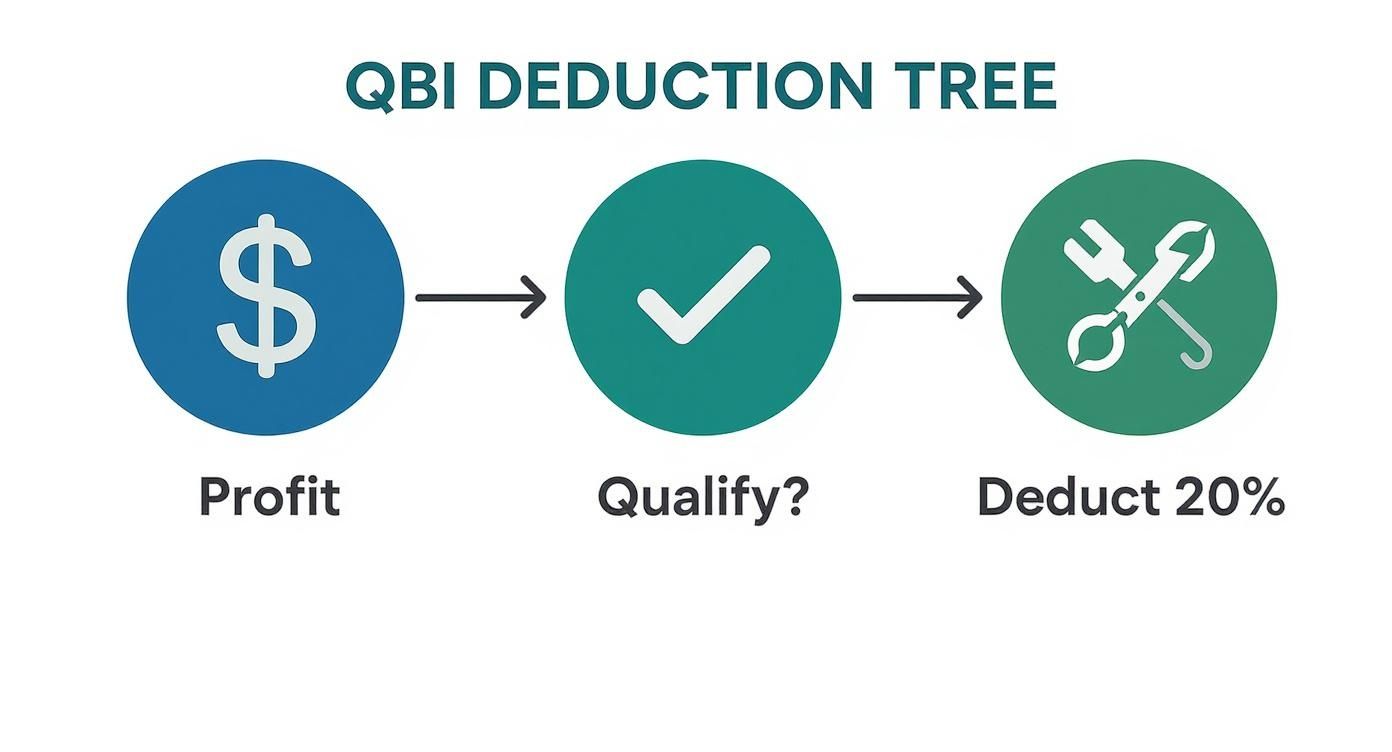
This visual highlights that qualifying your profits opens the door to significant tax reductions, just like the S Corp election does for self-employment tax.
A Real-World Savings Example
Let's put some real numbers to this to see how it plays out. We'll compare a profitable LLC in its default status against one that's elected to be taxed as an S Corp.
Imagine your consulting business cleared a net profit of $150,000 for the year. To show the potential savings, here is a quick breakdown of the tax implications for each structure.
Tax Savings Example LLC vs LLC as S Corp
| Income Item | LLC (Default Partnership Taxation) | LLC Taxed as S Corp |
|---|---|---|
| Business Net Profit | $150,000 | $150,000 |
| Reasonable Salary | N/A | $70,000 |
| Profit as Distribution | N/A | $80,000 |
| Income Subject to SE Tax | $150,000 | $70,000 |
| Estimated Self-Employment/FICA Tax | ~$21,194 | ~$10,710 |
| Annual Tax Savings | ~$10,484 |
As you can see, the S Corp election in this scenario saves you $10,484 in self-employment taxes in a single year. That's a significant amount of cash you can put back into the business or your own pocket.
The Trade-Offs and Responsibilities
Of course, this tax strategy isn't a free lunch. Electing S Corp status comes with some new administrative burdens and costs you have to be ready for.
- Running Payroll: This is non-negotiable. You have to set up and run a formal payroll for yourself, which means withholding taxes, filing quarterly reports, and issuing yourself a W-2 at year-end.
- Determining a "Reasonable Salary": The IRS is watching this. You can't just pay yourself a token salary of $10,000 if the business made $200,000. Your salary needs to be justifiable for the work you actually do.
- Filing Form 2553: To officially make this tax election, you have to file a specific form with the IRS. To get a handle on the rules and deadlines, you can learn more about Form 2553 in our detailed guide.
Ultimately, the S Corp election is a strategic decision. It makes the most sense for established LLCs with consistent, healthy profits—the point where the tax savings clearly outweigh the added administrative costs and complexity.
Don't Forget About State Taxes and Fees
Federal taxes get all the attention when you're thinking about forming an LLC, but that's only half the story. The state where you set up shop has its own set of rules, and they can absolutely make or break your budget.
It’s a classic rookie mistake to focus only on the IRS and forget about your state's tax department. A great federal tax setup can quickly lose its shine if you get sideswiped by high state fees you didn't see coming. Thinking about geography is just as important as thinking about structure.
What to Expect on Your State Tax Bill
State costs for LLCs usually boil down to a few common types. The exact names and amounts are all over the map, but you'll almost certainly run into some of these.
- Annual Report Fees: Just about every state wants you to file an annual or biennial report to keep your business info up-to-date. This isn't free—expect a fee anywhere from a token $20 to several hundred dollars.
- Franchise Taxes: Don't let the name fool you; this has nothing to do with franchising. It’s simply a tax for the "privilege" of doing business in a state. It's often a flat rate or based on your assets, not your profits.
- State Income Tax: If your state has a personal income tax, get ready to pay it on your LLC's profits. Since the money "passes through" to you, it's taxed at your personal state rate, just like it is at the federal level.
Getting a handle on these costs before you register your LLC is non-negotiable. It’s the only way to create a realistic budget and avoid those nasty surprise bills that can really throw a wrench in your plans.
How State-Friendly Is Your State?
The financial difference between states can be shocking. It creates a clear spectrum, with some states being incredibly business-friendly and others… not so much. Where you operate matters.
Take states like Wyoming or South Dakota. They're famous for rolling out the red carpet for business owners. With no state income tax and minimal annual fees, they let you keep more of what you earn. Delaware is another go-to, not for its taxes, but for its well-respected business courts and predictable franchise tax.
Then you have the other end of the scale: California. It hits every single LLC with an $800 minimum annual franchise tax. It doesn't matter if you made a single dollar or even did any business that year—you owe them $800. For a brand-new business, that’s a tough pill to swallow.
This sharp contrast shows that choosing your state is a major financial decision, not just a logistical one. While you generally have to register where you’re physically doing business, understanding these differences is crucial, especially if you run an online or location-flexible company. Knowing the lay of the land from a tax perspective helps you make smarter decisions from day one.
Knowing When to Call a Tax Professional
Navigating the tax world as an LLC owner is a huge leap forward, but even the most capable entrepreneurs know when to call for backup. While this guide gives you a solid game plan, some situations just scream for a specialist. Knowing when to raise your hand for help isn't a weakness—it's one of the smartest moves you can make for your business.
Think of a tax pro as more than just a number-cruncher you hire in April. They're a strategic partner. They cut through the fog of complex tax code, keep you on the right side of ever-changing laws, and spot savings opportunities you'd almost certainly miss on your own.
Key Moments to Seek Expert Advice
You can probably handle the day-to-day bookkeeping just fine. But certain milestones and complexities really up the ante. Before you even think about hiring someone, make sure your own financial house is in order. Understanding the importance of robust bookkeeping is step one, as clean books are the foundation for any sound tax strategy.
Here are the big red flags that mean it's time to find a CPA:
-
You're Eyeing that S Corp Election: Are your profits climbing? Does the idea of saving a bundle on self-employment taxes by becoming an S Corp sound good? This is a major decision, and you absolutely need a pro to run the numbers. They’ll do a proper analysis to see if the tax savings will actually outweigh the new costs like payroll and administrative fees. They're also critical in helping you set a "reasonable salary" that won't get you in hot water with the IRS.
-
Your Business is Crossing State Lines: The minute you start selling, operating, or hiring employees in another state, you've waded into the murky waters of state tax nexus. Each state has its own rules about income taxes, franchise taxes, and filing requirements. A tax professional who specializes in multi-state issues is essential to keep you compliant and avoid a nightmare of penalties.
-
Your QBI Deduction Gets Complicated: The Qualified Business Income (QBI) deduction is fantastic, but it gets tricky once your income passes certain thresholds. Suddenly, things like W-2 wages paid and the value of your business property come into the calculation. This is far beyond what standard tax software is built to handle accurately, and an expert can make sure you get every penny you're entitled to.
Bringing in a tax professional is a direct investment in your company’s future. Their guidance ensures you're not just taking advantage of every LLC tax break available, but also building a financially strong and compliant business that's set up for the long haul.
Common Questions, Answered
Let's be honest, figuring out the tax side of your business can feel overwhelming. You're not alone. Here are some straightforward answers to the questions I hear most often from entrepreneurs about getting the most out of their LLC.
Does an LLC Really Save Me from Double Taxation?
Yes, it does—right out of the box. By default, an LLC is what the IRS calls a "pass-through entity." This just means the business profits "pass through" to you, the owner, and you pay taxes on them once on your personal return.
This is a huge advantage over traditional C Corporations, which get hit with a classic one-two punch: profits are taxed once at the corporate level, and then again when that money is paid out to shareholders. The LLC structure neatly sidesteps that entire problem.
When Should I Think About Making an S Corp Election?
The S Corp election starts to look really attractive when your business is consistently profitable and bringing in more money than you'd pay yourself as a "reasonable salary." If your profits are still growing, the savings on self-employment taxes probably won't outweigh the added hassle and cost of running payroll.
A good rule of thumb is to start seriously considering the switch once your net earnings are consistently clearing $60,000-$80,000 a year. But this isn't a hard-and-fast rule; talking it over with a tax pro is the only way to know for sure if the timing is right for you.
Can a Single-Person LLC Still Get the QBI Deduction?
You bet. The Qualified Business Income (QBI) deduction was practically made for pass-through business owners. That includes:
- Single-member LLCs (which are treated like sole proprietorships)
- Multi-member LLCs (treated like partnerships)
- And yes, even LLCs that have chosen to be taxed as an S Corp
As long as you meet the IRS income thresholds and your business is in a qualifying industry, you can use this powerful deduction to knock down your taxable income.
Is It a Good Idea to Move My Rental Property Into an LLC?
Yes, and it's a very common strategy for smart real estate investors. Putting your rental property into an LLC builds a firewall between your personal finances and your business activities. If something goes wrong—say, a tenant sues—only the assets held by the LLC are on the line.
Just be aware of a couple of potential hurdles. If you have a mortgage, you'll likely need your lender's permission to make the transfer. You'll also want to check your state's laws, as some charge a transfer tax for this kind of transaction.
At Allied Tax Advisors, our entire focus is helping business owners like you unlock every tax advantage an LLC offers. Whether you're just starting out or planning your next stage of growth, our team has the expertise to guide you. See how we can make your taxes simpler and your business more profitable at https://alliedtax.com.