
The biggest myth I see new business owners fall for is thinking there’s a single, specific LLC tax rate. The truth is, the IRS doesn't actually have a tax rate for an LLC as a business entity. This flexibility is what makes the LLC structure so powerful, but it’s also a huge point of confusion.
Why There Is No Single LLC Tax Rate

It helps to think of your Limited Liability Company (LLC) as a legal container for your business. From a tax perspective, the IRS doesn't really care about the container itself; it cares about who owns it and how they're structured. This brings us to the core concept you need to understand: pass-through taxation.
Instead of the business entity paying its own income tax, the profits and losses "pass through" the LLC and land directly on the owners' personal tax returns. Your business income is then taxed at your individual income tax rate, right alongside any other income you have from a day job, investments, or other sources.
To get a feel for how different this is from other setups, it's worth understanding the pros and cons of various business structures. The pass-through approach is the main reason LLCs have become the go-to choice for so many entrepreneurs.
Here’s the bottom line: Your LLC's federal income tax rate is your personal income tax rate. The business itself doesn’t file and pay its own federal income taxes.
The Power of Pass-Through Taxation
This system is a world away from how traditional C corporations are taxed. A C corp is treated as a completely separate taxpayer. It has to pay a flat 21% federal corporate income tax on its profits. Then, when those after-tax profits are paid out to shareholders as dividends, the shareholders get taxed on that money again on their personal returns. It's a classic case of "double taxation."
LLCs, by default, skip that first layer of tax entirely. All the income flows straight to the owners, and tax is paid just once. This simple but profound difference has massive implications for your final tax bill.
Of course, the actual rate you end up paying depends on a few key factors:
- How many owners? The IRS automatically treats a solo-owned LLC differently than one with partners.
- Your personal tax bracket. Adding your LLC's profit to your other income could easily push you into a higher tax bracket.
- Optional tax elections. You aren't stuck with the default. You can choose to have your LLC taxed differently, which can be a game-changer for your rate.
Ultimately, your tax classification for the LLC is what drives everything. Let's look at how the IRS automatically classifies LLCs.
LLC Default Tax Status at a Glance
The IRS has a simple, default system for classifying your LLC based on the number of members (owners) it has. This table breaks it down.
| Number of Members | Default IRS Tax Classification | How Income Is Taxed |
|---|---|---|
| One | Disregarded Entity (Sole Proprietorship) | Profits/losses reported on your personal Form 1040, Schedule C. |
| Two or More | Partnership | The LLC files an informational return (Form 1065), and each partner reports their share of profit/loss on their personal tax return (Schedule K-1). |
As you can see, the default is straightforward. A single-member LLC is treated just like a sole proprietor for tax purposes, while a multi-member LLC is treated like a partnership. But remember, these are just the starting points—you have options to change this classification, which we'll get into later.
How Your LLC Is Taxed by Default
When you form an LLC, the IRS doesn't leave you guessing. They automatically assign your business a default tax status based on a simple question: how many owners (or "members") do you have? This initial classification is your starting point for everything from tax rates to which forms you'll file.
It's one of the great things about an LLC, really. You get the legal protection of a formal business structure without a mountain of initial tax paperwork. The IRS has a default path ready for you.
The Single-Member LLC: A “Disregarded Entity”
If you're the sole owner of your LLC, the IRS defaults to treating you as a "disregarded entity." It's a fancy way of saying that for federal income tax purposes, the IRS ignores the LLC and looks straight through to you, the owner. Your business isn't seen as a separate taxpayer.
Think of it this way: you might have a personal checking account and a separate business checking account to keep things organized, but at the end of the day, it's all your money. That's how the IRS sees it. The LLC's income and expenses are simply your personal business activity.
You'll report all this activity on Schedule C (Profit or Loss from Business), which gets attached to your personal Form 1040 tax return. This is the exact same form a sole proprietor uses, which is perfect for freelancers or consultants who are just formalizing their business. The net profit from your Schedule C just flows onto your personal return and is taxed at your individual income tax rate.
The Multi-Member LLC: A Partnership
Once your LLC has two or more members, the game changes. The IRS automatically classifies it as a partnership for tax purposes. This makes sense, as the structure needs to account for multiple owners sharing the profits and losses.
Unlike a single-member LLC, a partnership has its own filing requirement. The LLC itself must file an informational return each year using Form 1065 (U.S. Return of Partnership Income). This form tells the IRS about the business's total income, deductions, and overall profit or loss.
Key Takeaway: Form 1065 is an informational return. The LLC doesn't pay its own income tax. The form simply reports the numbers and shows the IRS how the profits were split among the members.
After filing Form 1065, the LLC issues a Schedule K-1 to each member. This document details your individual slice of the LLC's financial pie—your share of the income, losses, and deductions. You then take the figures from your K-1 and report them on your personal Form 1040.
The tax impact can differ significantly between these two structures. For example, federal data shows that sole proprietorships (the default for single-member LLCs) face an average effective tax rate of just 13.3%. Small business partnerships, on the other hand, average 23.6%.
Don't forget about self-employment taxes, either. This is how you pay into Social Security and Medicare, and it's a critical piece of the tax puzzle for active owners in both single and multi-member LLCs. These added layers are exactly why many business owners start looking at other tax elections, which you can read about in our guide comparing the S Corp vs LLC for small business.
Calculating Your True Tax Burden
So, you understand that your LLC’s profits pass through to your personal tax return. That’s a great start, but it’s really just the first step. Thinking your personal income tax bracket is the whole story is a common mistake. To get a real handle on what you'll owe, you need to piece together the entire puzzle, and the first piece often comes as a surprise to new business owners.
The IRS keeps it simple by default: how your LLC is taxed depends entirely on how many owners (or "members") it has.
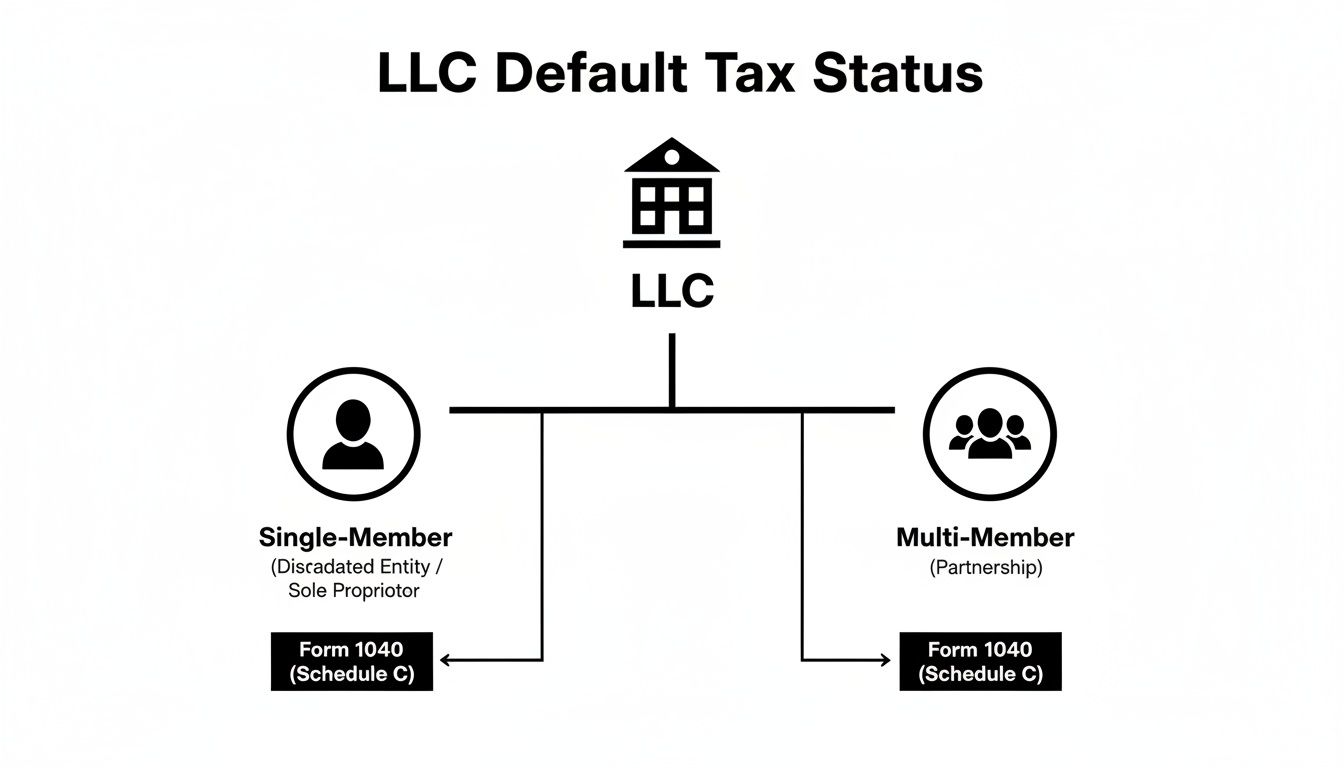
As you can see, a single-member LLC is automatically treated as a "disregarded entity," which is just the IRS's fancy way of saying it's taxed like a sole proprietorship. If you have two or more members, your LLC defaults to being taxed as a partnership.
The Self-Employment Tax Reality
When you have a W-2 job, your employer handles half of your Social Security and Medicare taxes. You see 7.65% come out of your paycheck, and your employer matches it with another 7.65%. It's a clean split.
But when you own an LLC (taxed as a sole proprietorship or partnership), you wear both hats. You're the employer and the employee. That means you're on the hook for the whole thing.
This is called self-employment tax, and it's a flat 15.3% tax on 92.35% of your net business earnings. This gets stacked right on top of your regular federal income tax. For many entrepreneurs, this is the gut-punch moment when they see their first big tax bill. They planned for their income tax bracket but completely forgot this hefty 15.3% layer.
A Powerful Tax Break: The Qualified Business Income Deduction
It’s not all bad news, though. Thankfully, there’s a massive tax deduction created specifically for owners of pass-through businesses like LLCs. It’s called the Qualified Business Income (QBI) deduction, or sometimes the Section 199A deduction, and it's a game-changer for lowering your taxable income.
In a nutshell, the QBI deduction lets eligible LLC owners slice off up to 20% of their qualified business income. This isn't a business expense; it's a personal deduction that directly reduces the income you pay tax on.
Let's say your LLC brings in $100,000 in qualified profit. The QBI deduction could let you simply subtract $20,000 from your income before the IRS even starts calculating your tax.
Example: If you're in the 24% tax bracket, that $20,000 QBI deduction puts $4,800 right back in your pocket ($20,000 x 24%). It's a huge benefit that can seriously lower your effective tax rate.
Of course, the tax code is never that simple. There are income limits and specific rules about what types of businesses qualify, but a massive number of small business owners can take full advantage of it.
The Overlooked Layer: State and Local Taxes
Your tax journey doesn't end with the IRS. Where your business operates has a huge say in your final tax bill. State and local governments want their piece of the pie, and their rules can vary dramatically from one border to the next.
Here are the most common state-level taxes you need to watch out for:
- State Income Tax: The majority of states have a personal income tax. Since your LLC profits pass through to you, they'll get taxed by your state on top of what you owe Uncle Sam.
- Franchise Tax: Some states, like California and Texas, levy a franchise tax. This isn't a tax on profit but rather a fee for the "privilege" of doing business there. It might be a flat fee or based on revenue or net worth, even if you don't make a profit.
- Annual Report Fees: Just about every state requires LLCs to file an annual report and pay a fee to stay in good standing. While not an "income tax," it's a mandatory cost you have to budget for.
This means an LLC owner in a high-tax state like New York or California will have a significantly higher total tax bill than an owner in a state with no income tax, like Florida or Texas. You have to factor in these state-specific costs to truly understand your LLC tax rate and avoid any nasty surprises come tax time.
A Quick Summary
Putting it all together can be a lot. This table breaks down the different taxes that contribute to an LLC owner's total bill, helping you see all the layers at once.
| Component | Who Pays It | Typical Rate/Calculation Basis | Key Considerations |
|---|---|---|---|
| Federal Income Tax | The LLC Owner (personally) | Progressive rates (10% to 37%) based on total taxable income. | Your business profit is added to your other income (W-2, investments) to determine your marginal tax bracket. |
| Self-Employment Tax | The LLC Owner (personally) | 15.3% on the first $168,600 (2024) of net earnings, 2.9% after. | Covers Social Security and Medicare. This is often the biggest tax surprise for new entrepreneurs. |
| State & Local Income Tax | The LLC Owner (personally) | Varies wildly by state (0% to 13%+). | Your state of residence and where the LLC operates both matter. |
| State Franchise Tax/Fees | The LLC (directly) | Flat fee (e.g., $800/year in CA) or based on revenue/equity. | This is a cost of doing business, separate from income tax. Not all states have one. |
| QBI Deduction | Reduces the Owner's Taxable Income | Up to 20% of qualified business income. | A powerful deduction that lowers your income subject to tax, not a direct credit. Income and business-type limits apply. |
By looking at these components together—federal income tax, self-employment tax, and state obligations, minus powerful deductions like QBI—you can start to build a much more accurate picture of your true financial reality as an LLC owner.
Strategic Tax Elections to Lower Your Rate
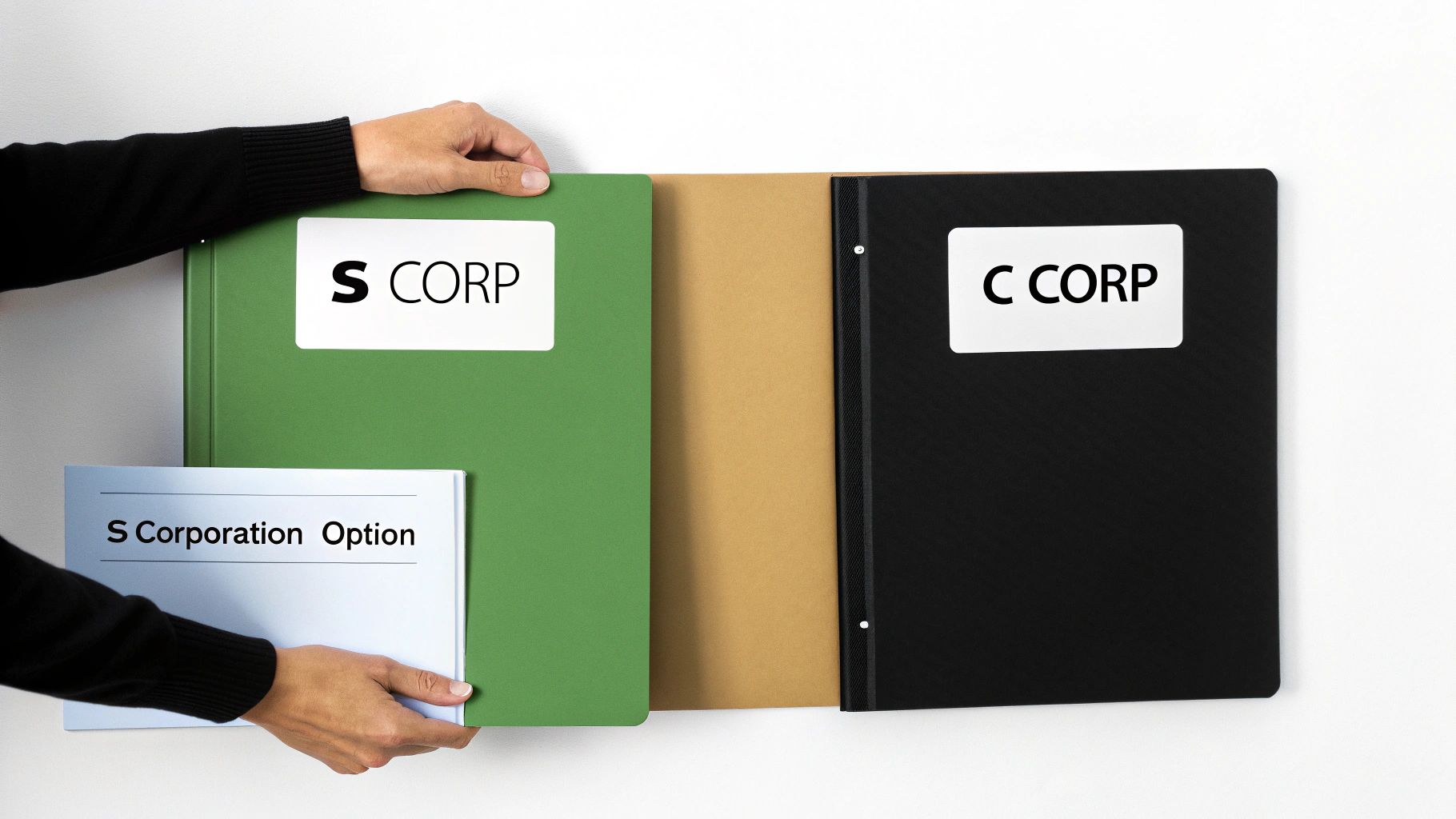
Your LLC’s default tax status is just that—a default. Think of it as a starting point, not a permanent destination. The real beauty of the LLC is its flexibility, giving you the power to tell the IRS how you want your business to be taxed. This is where you can stop just accepting your tax rate and start actively managing it.
For many successful LLCs, the single most powerful move you can make is electing to be taxed as a corporation. Let’s be clear: this doesn't change your legal structure. Your business is still an LLC in the eyes of the state. This is purely a tax play, a formal request to the IRS to say, "Hey, I'd like you to tax my profits using corporate rules instead."
You have two main paths here: the S Corporation and the C Corporation. Each one treats your money in a completely different way, and they come with their own distinct pros and cons.
The S Corporation Election: The Go-To Strategy for Service Businesses
Hands down, the S Corporation (S Corp) election is the most popular tax-saving strategy for profitable LLCs. Its main draw is a clever way to sidestep a significant chunk of the burdensome 15.3% self-employment tax.
As a default LLC, every single dollar of profit gets hit with that tax. But when you make the S Corp election, you get to split your business income into two different buckets:
- A Reasonable Salary: You have to pay yourself a "reasonable salary" for the actual work you perform. This is paid out like any other employee's wages (W-2), and it's subject to the usual payroll taxes—which are essentially the same as self-employment taxes.
- Distributions: Any profit left over after paying your salary and other business expenses can be taken as a distribution. And here's the key: distributions are not subject to self-employment or payroll taxes.
That separation is where the magic happens. By only paying the 15.3% tax on your salary, you can save a small fortune on the rest of the profits you take out of the business.
Let's See it in Action:
Imagine your LLC has a net profit of $100,000 for the year. As a standard single-member LLC, that entire $100,000 is subject to the 15.3% self-employment tax, costing you about $15,300.Now, let's say you elect S Corp status and determine that a reasonable salary for your job is $60,000.
- The $60,000 salary is hit with payroll taxes (still around $9,180).
- But the remaining $40,000 can be taken as a tax-free distribution (from a self-employment tax perspective).
In this scenario, you just put roughly $6,120 back in your pocket (15.3% of $40,000). The more profitable your business becomes, the bigger those savings get.
Of course, this benefit comes with some new administrative duties. You'll have to run formal payroll, file payroll tax returns, and be prepared to justify your salary as "reasonable" to the IRS. It's more work, no doubt, but the tax savings often make it well worth the effort. Filing for this election is a formal process, and you can get the full rundown in our guide on what Form 2553 is.
The C Corporation Election: A Niche but Powerful Choice
The C Corporation (C Corp) election is a much rarer choice for small LLCs, but it can be the perfect tool in a few specific situations. Unlike an S Corp, a C Corp is a completely separate taxpayer. It files its own return and pays its own taxes at a flat federal rate.
This setup is famous for creating what's known as "double taxation." First, the corporation pays tax on its profits. Then, if you pay those profits out to yourself as dividends, you pay personal income tax on them again. It’s easy to see why most small business owners steer clear.
However, the game changed quite a bit with the Tax Cuts and Jobs Act of 2017. The law slashed the top federal corporate rate from a steep 35% down to a flat 21%. This dramatically altered the math for certain types of businesses.
So, when would an LLC owner ever choose to be taxed as a C Corp?
- When You Reinvest Heavily: If your plan is to pour most of the profits right back into the company to fuel aggressive growth, that flat 21% corporate rate might be much lower than your personal income tax bracket.
- For Access to Better Fringe Benefits: C Corps can offer owners a wider array of tax-deductible fringe benefits, like certain health insurance plans, that are more limited for S Corp owners.
- To Attract Venture Capital: While not a concern for most small LLCs, some investors strongly prefer the C Corp structure because it's easier to issue different classes of stock.
Choosing C Corp status is a major strategic decision. You should only make this move after running the numbers with a tax professional who can model out the long-term implications for you. For the vast majority of LLC owners, the S Corp election remains the most direct route to lowering their annual tax bill.
Navigating State LLC Taxes and Annual Fees
Federal taxes are just one side of the coin. Once you've got a handle on your IRS obligations, it's time to zoom in on the state level, where the rules can change dramatically the moment you cross a state line. It’s a common—and costly—mistake for new LLC owners to focus only on federal rules and overlook these state-specific duties.
Every state has its own unique recipe for taxing businesses and collecting fees. This means your total tax bill, and your true effective LLC tax rate, is shaped just as much by where you form and operate your business as it is by federal law. These obligations usually boil down to three main types.
Common State-Level LLC Obligations
Getting familiar with these distinct requirements is the first step toward staying compliant and planning your finances accurately.
- State Income Tax: If your state has a personal income tax, you can bet it wants a piece of your LLC's profits. Just like with the IRS, the income "passes through" to you, and you pay tax on it through your personal state return.
- Franchise or Privilege Tax: Think of this as a fee for the "privilege" of doing business in a state. It's a tricky one because it’s often not based on profit. You might have to pay it even if your LLC lost money all year.
- Annual Reporting Fees: Almost every state requires you to file an annual or biennial report to keep your business info up-to-date. This filing almost always comes with a fee, which can be a minor administrative cost or a few hundred dollars.
These costs are a fundamental part of your business budget. They can really add up if you aren't ready for them.
A Tale of Three States: Examples in Practice
To see just how different things can be, let's look at how three big states handle LLCs. This comparison drives home why a one-size-fits-all approach to state taxes is a recipe for disaster.
California is notorious for its $800 annual minimum franchise tax. It doesn't matter if your LLC made a million dollars or $0—if you're registered or doing business there, you owe the state $800 every year. This is on top of California's personal income tax rates, which are some of the highest in the nation.
Now, let's head over to Texas. It’s famous for having no personal income tax, which is a huge plus for pass-through entities like LLCs. But Texas has its own unique twist: a "Margin Tax." It only kicks in for businesses with revenue above a certain threshold (over $2.47 million for 2024/2025), so many smaller LLCs pay nothing. Larger ones, however, have to deal with its complex formula.
Then you have a state like Florida, which is widely considered business-friendly. Florida has no state personal income tax, no LLC-specific income tax, and no franchise tax. For most LLCs, the main state requirement is just filing an annual report and paying a relatively modest fee—a world away from California’s $800 minimum.
This stark difference highlights the most important takeaway: you absolutely must research the specific rules for your home state and any other state where you do business. Relying on what you know about federal taxes will leave you completely unprepared for the full picture.
Proactive Tax Planning and Compliance for Your LLC
Managing your LLC’s taxes isn't something you can just cram for once a year when April rolls around. It’s an ongoing process. Honestly, the most successful business owners I work with are the ones who treat tax planning as a year-round discipline, not a last-minute scramble. This mindset shift turns taxes from a dreaded burden into a predictable, manageable part of doing business.
The absolute bedrock of any smart tax strategy is clean bookkeeping. I can't stress this enough. You need to meticulously track every dollar that comes in and every deductible expense that goes out. This isn't just about CYA for an audit; it gives you a clear, real-time picture of your business's financial health, which is crucial for making smart decisions on the fly.
And for any LLC with more than one member, getting an Employer Identification Number (EIN) is a must for proper tax compliance. If you're not sure about the details, you can learn more about what an EIN is and how to obtain one to get your business properly set up with the IRS from the get-go.
Making Quarterly Estimated Tax Payments
Since an LLC's profits pass through directly to your personal return, the IRS doesn't take a cut from your earnings like a traditional employer does with a W-2 paycheck. That responsibility falls squarely on your shoulders. You have to pay your income and self-employment taxes as you earn the money, and you do this by making quarterly estimated tax payments.
Blowing off these payments is a rookie mistake that leads straight to underpayment penalties. The IRS has a "pay as you go" system, and if you get behind, you'll get hit with a nasty, and completely avoidable, penalty on top of your final tax bill. The process involves estimating your total income and deductions for the year, figuring out the tax you'll owe, and then paying that amount in four equal installments.
Key Takeaway: Think of estimated taxes like pre-paying your annual tax bill in smaller chunks. It smooths out your cash flow, prevents a monster bill in April, and keeps you on the right side of the IRS.
Actionable Tax-Saving Strategies
Getting compliance right is just the first step. Where you can really move the needle is with proactive planning that actively lowers your LLC tax rate. With those clean books we talked about, you can start using some powerful strategies to keep more of what you make.
Here are a few of the most effective tactics I recommend to LLC owners:
- Max Out Retirement Contributions: Look into opening a SEP IRA or a Solo 401(k). Every dollar you contribute is a tax deduction, which directly lowers your taxable income while you build for the future. For 2024, you can put away up to 25% of your compensation, with a maximum contribution of $69,000.
- Deduct Health Insurance Premiums: If you aren’t eligible for a spouse’s employer-sponsored health plan, you can typically deduct 100% of the premiums you pay for yourself, your spouse, and your dependents. It's a huge benefit.
- Track Every Single Business Expense: Don't leave deductions on the table. Be diligent about tracking everything from your home office expenses (if it's your main place of business) and business-related vehicle mileage to software subscriptions and professional courses. Every little bit adds up.
By meshing diligent compliance with smart, forward-looking tax planning, you can turn your tax situation from a source of anxiety into a genuine strategic advantage for your business.
Common Questions About LLC Taxes, Answered
When you're running a business, tax questions are bound to pop up. Let's tackle some of the most frequent ones we hear from LLC owners.
Is an LLC Cheaper on Taxes Than a Sole Proprietorship?
Not by default, no. From the IRS's perspective, a standard single-member LLC is treated exactly the same as a sole proprietorship. All the business profits simply "pass through" to your personal tax return, where you'll pay taxes at your normal individual rate.
The real magic of an LLC is the legal shield it provides, separating your business liabilities from your personal assets. It's a liability benefit, not an automatic tax break.
When Should My LLC Become an S Corp?
This is a great question, and the answer comes down to a cost-benefit analysis. The S Corp election really starts making sense once your LLC's profits are high enough to make the tax savings worth the extra administrative hassle.
As a general rule of thumb, it's time to have a serious conversation about it when your net income is consistently hitting the $40,000-$50,000 range. At that point, the savings on self-employment tax can begin to outweigh the costs of running payroll and other formalities. But always run the numbers with a tax pro first.
The Big Idea: Electing S Corp status lets you split your earnings. You pay yourself a "reasonable salary" (which gets hit with payroll taxes) and take the rest as a "distribution" (which doesn't). That's where the savings come from.
How Do My Rental Properties in an LLC Change My Taxes?
Holding rental properties in an LLC has a fantastic tax advantage: the income is typically considered passive. Why does that matter? Because passive income is not subject to self-employment tax.
The rental income still flows through to your personal return and is taxed at your regular income tax rates. But you get to deduct all the usual landlord expenses—mortgage interest, property taxes, repairs, and even depreciation—to significantly reduce what you actually owe.
At Allied Tax Advisors, our job is to make LLC taxes simple so you can keep every dollar you've rightfully earned. Whether it's figuring out the right time for an S Corp election or optimizing your rental property strategy, we provide the straightforward advice you need to build your business.