
Selling your home is a massive financial milestone. But that hard-earned profit can come with a surprisingly hefty tax bill if you’re not prepared for capital gains.
So, what exactly are they? In the simplest terms, a capital gains tax is levied on the profit you make when you sell your house for more than you've put into it. It’s crucial to get a handle on these rules to protect the equity you’ve spent years building.
What Are Capital Gains on a House Sale?

When you sell your house, the IRS looks at the difference between the sale price and what’s known as your "cost basis"—your total investment in the property. That difference is your capital gain.
From a tax perspective, this profit isn't just extra cash in your pocket; it’s treated as income. Think about it like a stock investment. If you buy a share for $100 and sell it for $150, you have a $50 taxable gain. Your house operates under the same principle, just with much bigger numbers.
This guide will break down the rules for you, turning confusing tax jargon into clear, practical advice you can actually use.
Short-Term vs. Long-Term Gains
The first thing to wrap your head around is the difference between short-term and long-term capital gains. How long you owned the property is everything, as it determines your tax rate. This holding period is the line in the sand between a potentially painful tax bill and a much more manageable one.
- Short-Term Capital Gains: If you own your home for one year or less before selling, your profit is considered a short-term gain. The IRS taxes this at your regular income tax rate, which could be as high as 37%.
- Long-Term Capital Gains: If you’ve owned the home for more than one year, the profit is a long-term gain. These are taxed at much friendlier rates: 0%, 15%, or 20%, depending on your income.
For the vast majority of homeowners, making sure your sale qualifies for the long-term capital gains rate is the single most important step you can take to lower your tax bill.
We'll walk you through calculating what you owe, explain powerful tax breaks like the primary home exclusion, and show you exactly how to report the sale. The goal here is to give you the confidence to navigate this process without leaving money on the table.
How to Calculate Your Taxable Gain
Figuring out the profit from your home sale isn't as simple as subtracting what you bought it for from what you sold it for. To get to the real number the IRS cares about—the capital gains on a house sale—you need to work through three key figures: your cost basis, your adjusted basis, and the amount you realized from the sale. Getting this right ensures you're only taxed on your actual profit.
Think of your cost basis as your official starting point. It’s mostly the price you paid for the house, but it also includes some of the closing costs from when you first bought it. Things like abstract fees, legal fees for the purchase, recording fees, and property surveys all count.
Most people forget about these initial expenses, but they're crucial for setting an accurate baseline. Your best bet is to dust off your original closing documents to make sure you capture every eligible cost.
Understanding Your Adjusted Basis
Your home's cost basis isn't set in stone. It actually changes over time as you invest in the property. This new, evolving figure is called your adjusted basis, which you find by adding the cost of any significant upgrades to your original basis.
A capital improvement isn't just any repair; it's a major, long-term upgrade that adds real value, extends the life of your home, or adapts it for new uses. Fixing a leaky pipe or slapping a new coat of paint on the walls doesn't make the cut.
Here are some classic examples of what does count as a capital improvement:
- Major Renovations: Gutting the kitchen, finishing the basement, or building a new addition.
- System Upgrades: Putting in a new HVAC system, rewiring the house, or replacing all the old plumbing.
- Exterior Enhancements: A new roof, new windows, a new deck, or major professional landscaping.
- Energy Efficiency: Adding insulation or installing new energy-efficient appliances that you leave behind for the new owners.
Keeping meticulous records of these expenses is one of the smartest things you can do as a homeowner. Every dollar you spend on a qualifying improvement increases your adjusted basis, which in turn shrinks your taxable gain when you eventually sell.
Calculating the Amount Realized from the Sale
Next up is your amount realized. This is simply the final sale price of your home, minus all the selling expenses you paid to get the deal done. These costs come directly out of your pocket, so they reduce the profit the IRS will look at.
Common selling expenses include:
- Real estate agent commissions (usually the biggest chunk)
- Title insurance and escrow fees
- Legal fees
- Advertising costs
- Inspection fees paid by you, the seller
Subtracting these costs from the gross sale price gives you the net proceeds, which is the number that really matters. To nail this down, you need an accurate valuation of your property; running an effective comparative market analysis is a great way to start.
Putting It All Together A Practical Example
Let's see how this works with a real-world scenario. Say you bought your home for $350,000 and paid $5,000 in closing costs. You just sold it for a cool $650,000.
Along the way, you invested $45,000 in a kitchen remodel and $15,000 for a new roof. To sell the house, you paid $35,000 in realtor commissions and other closing costs.
Here’s a breakdown of the math, laid out in a simple table to make it clear.
Calculating Your Adjusted Basis and Taxable Gain
This table breaks down the key components needed to determine the final taxable gain from a home sale, showing how capital improvements and selling costs impact the final number.
| Calculation Step | Description | Example Amount |
|---|---|---|
| 1. Initial Cost Basis | Original purchase price + initial closing costs. | $355,000 ($350,000 + $5,000) |
| 2. Adjusted Basis | Initial Cost Basis + Capital Improvements. | $415,000 ($355,000 + $60,000) |
| 3. Amount Realized | Gross sale price – selling expenses. | $615,000 ($650,000 – $35,000) |
| 4. Total Capital Gain | Amount Realized – Adjusted Basis. | $200,000 ($615,000 – $415,000) |
As you can see, following the proper steps is critical for accurately calculating your final gain.
Let's break that down one more time:
-
Calculate the Adjusted Basis:
- Original Purchase Price: $350,000
- Initial Closing Costs: +$5,000
- Capital Improvements: +$60,000 ($45k + $15k)
- Total Adjusted Basis: $415,000
-
Calculate the Amount Realized:
- Gross Sale Price: $650,000
- Selling Expenses: -$35,000
- Total Amount Realized: $615,000
-
Calculate the Capital Gain:
- Amount Realized: $615,000
- Adjusted Basis: -$415,000
- Total Capital Gain: $200,000
In this scenario, your taxable gain isn't the simple $300,000 difference between the buy and sell prices. It's $200,000, thanks to proper accounting for improvements and selling costs.
This example really drives home why keeping good records is so important. For a deeper dive into the mechanics, our guide on how to calculate capital gains has even more details. Understanding this formula is the first step toward minimizing your tax bill and protecting your hard-earned equity.
Using the Primary Residence Exclusion to Save Thousands
Alright, you've crunched the numbers and figured out your total gain. Now for the good part: seeing how much of that profit you actually get to keep. For most homeowners, the single best tool for this is the primary residence exclusion.
Think of it as the IRS's way of giving a huge tax break to people selling their main home. This isn't just a minor deduction; it's a financial lifeline that can often erase your entire tax bill from the sale.
Under current tax law, a single person can exclude up to $250,000 of gain from their taxable income. For married couples filing a joint tax return, that number skyrockets to $500,000. If your profit is less than your exclusion amount, and you meet the rules, you could walk away owing zero in federal capital gains tax. You can find more details on how powerful this is at TaxesForExpats.com, which breaks down the savings.
This flowchart gives you a bird's-eye view of how we get to that final number.
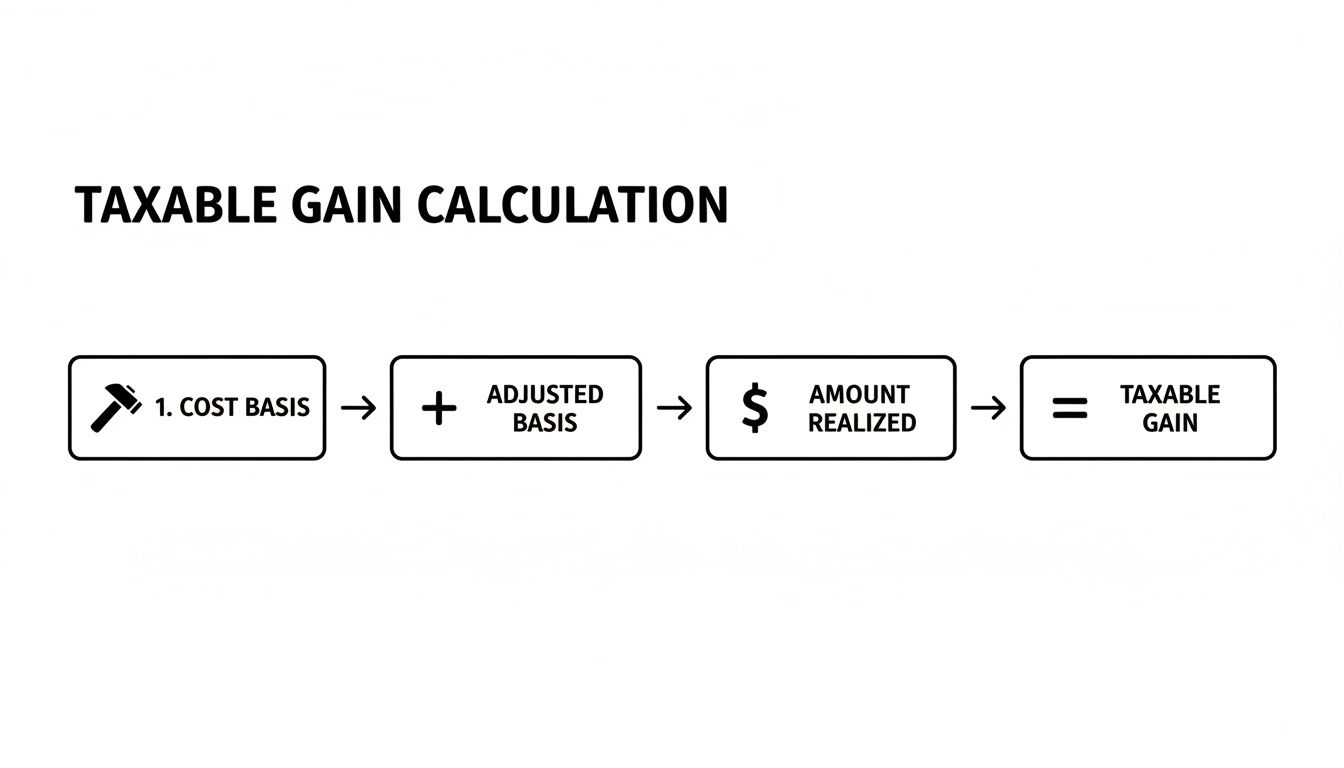
As you can see, each step builds on the last, ultimately leading to the gain that you can then shrink—or eliminate—with the primary residence exclusion.
The Two Critical Hurdles: The Ownership and Use Tests
Of course, a tax break this good comes with a few strings attached. To claim it, you can't just own the property; you have to prove it was truly your home. The IRS boils this down to two simple tests, both measured over the five-year period ending on the day you sell.
- The Ownership Test: You must have owned the home for at least two years (or 24 months) within that five-year window.
- The Use Test: You must have lived in the home as your main residence for at least two years within that same five-year window.
Here's the key: the two years don't have to be consecutive. You could live in the house for a year, rent it out for two, and then move back in for the final year before selling. As long as you rack up 24 months of ownership and 24 months of use, you're generally in the clear.
The logic behind these tests is to ensure the exclusion benefits genuine homeowners, not real estate investors who are just flipping properties for a quick buck.
Real-World Scenarios and Examples
Let’s put this into practice with a couple of common situations.
Example 1: A Single Homeowner
Sarah bought her condo five years ago for $250,000. She lived there for three straight years, but then a new job prompted her to move and rent it out for the last two years. She sells the condo and nets a total capital gain of $150,000.
- Ownership Test: Pass. She owned it for all five years.
- Use Test: Pass. She lived there for three of the last five years, easily clearing the two-year hurdle.
- Result: Sarah gets to exclude the entire $150,000 gain, since it's well under her $250,000 single-filer limit. She pays $0 in federal capital gains tax.
Example 2: A Married Couple
Mark and Lisa bought their family home six years ago. They lived in it for four years before deciding to travel, so they rented it out for the past two. They sell the house and realize a profit of $550,000.
- Ownership Test: Pass. They’ve owned it for six years.
- Use Test: Pass. They lived in it for four of the last five years.
- Result: As a married couple filing jointly, they can exclude up to $500,000. Their taxable capital gains on the house sale shrink to just $50,000 ($550,000 gain – $500,000 exclusion).
Exceptions and Special Circumstances
Life rarely goes according to plan. The IRS gets this and has built some flexibility into the rules for situations you couldn't control. If you're forced to sell before meeting the two-year tests, you might still qualify for a partial (or prorated) exclusion.
This relief typically applies if you had to move because of:
- A change in employment where your new job is at least 50 miles farther from the home than your old job was.
- Health-related reasons, like needing to move to care for a family member or get specialized medical treatment for yourself.
- Other unforeseen circumstances, such as a divorce, the death of a spouse, or having twins or triplets.
In these cases, your exclusion is prorated based on how long you did live there. For example, if a job transfer forced you to sell after just one year, you could potentially claim 50% of the exclusion ($125,000 for a single filer). Knowing about these exceptions can save you a bundle when life throws you a curveball.
Navigating Taxes for Investment and Rental Properties
When the property you're selling is a rental or an investment, you're playing a whole different ballgame with the IRS. That generous tax exclusion you get for selling your main home? It's off the table. Instead, a new set of rules comes into play, and for landlords and investors, getting these right is key to protecting your hard-earned returns.
The tax picture for investment properties really boils down to two critical concepts: depreciation recapture and the incredibly powerful 1031 exchange. If you want to accurately calculate the capital gains on a house sale that wasn't your primary residence, you have to master these first.
The Unavoidable Cost of Depreciation Recapture
Chances are, for every year you owned that rental property, you claimed a depreciation deduction on your tax return. It’s a fantastic write-off that lowers your taxable rental income each year to account for the property's natural wear and tear. But the IRS has a long memory. They don't just let you keep that tax benefit for free.
When you finally sell, the IRS "recaptures" all those depreciation deductions you took over the years. Think of it as settling the score—you're essentially paying back the tax savings you enjoyed. It’s not a penalty, just the tax code's way of balancing the books.
Here's the kicker: this recaptured amount is taxed as ordinary income, but at a special maximum rate of 25%. That's often quite a bit higher than the more favorable long-term capital gains rates of 0%, 15%, or 20%. Any profit you made above and beyond the amount you depreciated is then taxed at the standard long-term capital gains rate.
Key Takeaway: Depreciation recapture is a separate piece of your total gain, and it gets taxed at its own rate. This is often a nasty surprise for new investors who are only expecting to pay the lower long-term capital gains tax.
For homeowners with investment properties, understanding ongoing taxable income is as crucial as capital gains. You can use a rental income tax calculator to manage your liabilities effectively.
Deferring Taxes with a 1031 Exchange
For savvy real estate investors, the 1031 exchange is one of the most powerful tools in the entire tax code. It gets its name from Section 1031 of the Internal Revenue Code, and it lets you sell an investment property and kick the tax can down the road—deferring all capital gains tax and depreciation recapture—by rolling the proceeds directly into a new, similar investment property.
It's a bit like trading in your old car for a new one without having to pay sales tax on the trade-in value. You're simply moving your investment from one asset to another, and the IRS lets you postpone the tax bill until you finally decide to cash out for good.
But make no mistake, a 1031 exchange is no simple handshake deal. It’s a formal process with strict rules and deadlines that are absolutely unforgiving.
- Like-Kind Property: You have to swap your property for another that is "like-kind." Luckily for real estate investors, this term is defined very broadly. You can exchange a rental house for a commercial building, an apartment complex for raw land, and so on.
- The 45-Day Rule: From the moment you close the sale on your old property, the clock starts ticking. You have just 45 days to officially identify, in writing, the potential properties you intend to buy.
- The 180-Day Rule: You must complete the purchase and close on the new property within 180 days of selling the first one (or by your tax filing deadline for that year, whichever comes first).
These timelines run at the same time and are non-negotiable. If you miss a deadline by even a single day, the whole exchange is disqualified, and you’ll get hit with an immediate—and often massive—tax bill. Given the complexity, a 1031 exchange should always be handled by a qualified intermediary and planned out with a tax professional.
To dig deeper into the specifics, check out our guide on the tax implications of selling rental property. This strategy demands careful planning, but it can be the cornerstone of a truly successful real estate portfolio.
Reporting the Sale on Your Tax Return
Once you’ve done the math—calculating your total gain and subtracting any exclusions—it's time to report the sale to the IRS. Think of this as the final, official step in the transaction. Getting it right is key to staying on good terms with the tax authorities and avoiding any unwelcome letters down the road.
The good news? If you qualify for the full primary residence exclusion and it completely covers your gain, you might not have to report the sale at all. There is one big exception, though: you must report the sale if you receive a Form 1099-S, Proceeds From Real Estate Transactions. This form is the closing agent's way of telling the IRS you sold a property, so you'll need to file a return to show them exactly why that profit isn't taxable.
The Tax Forms You'll Need
For most people who end up with a taxable gain, the reporting process centers on two main forms: Form 8949 and Schedule D. They work together. Form 8949 is where you get into the nitty-gritty details, and Schedule D is where you tally it all up.
-
Form 8949, Sales and Other Dispositions of Capital Assets: This is your detailed report. You'll plug in the sale price, your adjusted basis, and the dates you bought and sold the home. It’s where you officially calculate the gain (or loss) for this specific transaction.
-
Schedule D, Capital Gains and Losses: This is the summary sheet. The totals from Form 8949 carry over to Schedule D. Here, they get combined with any other capital gains or losses you might have—from selling stocks, for instance—to arrive at your total net capital gain for the year.
If you're an investor selling a rental property, you've got another form to contend with. You’ll almost certainly need Form 4797, Sales of Business Property, to handle the gain, particularly the part that comes from depreciation recapture.
Why Meticulous Records Are Your Best Friend
Throughout this whole process, your records are your ultimate backup. The IRS really works on a "show me, don't tell me" basis. If you can't prove a cost or an expense, it's as if it never happened in their eyes. Should you ever get audited, your documentation is what will validate your numbers.
Pro Tip: I always tell my clients to create a dedicated folder—digital or physical—for everything related to their home. This means the original closing documents, every single receipt for capital improvements, and the final settlement statement from the sale. Solid records are the foundation of a smooth, stress-free tax season.
Every number on your return, from the purchase price to the last dollar in selling costs, needs a paper trail. Without it, you can't properly calculate your adjusted basis or prove your expenses, which could easily lead to overpaying your capital gains on a house sale by thousands.
Don't Forget About State Taxes
Finally, keep in mind the IRS isn't the only one with a stake in your home sale. Nearly every state with an income tax will want its piece of the pie, and their rules don't always mirror federal law.
Some states, for example, have entirely different tax rates for capital gains, and others may not offer the same generous primary home exclusion. You absolutely have to check your state's specific tax code or, better yet, work with a professional who knows the local landscape. Forgetting about your state tax bill is a surprisingly common—and expensive—mistake that can catch you off guard long after the sale is complete.
Smart Strategies to Minimize Your Tax Liability

Knowing the rules of capital gains is one thing, but actually putting them to work for you is where the real savings happen. With some smart planning, you can make moves that directly slash the tax you owe on your home sale, often keeping thousands of dollars right in your pocket.
Often, the most powerful strategies come down to something surprisingly simple: timing. Just by adjusting your sale date, you can dramatically change the outcome, turning a painful tax bill into a much bigger profit.
Master the Art of Timing Your Sale
Timing isn't just about trying to sell when the market is hot; it's about making sure your sale aligns with crucial tax deadlines. Two of the most important timelines to keep an eye on are the one-year holding period and the two-year residency rule.
First, make absolutely sure you’ve owned the home for more than one year. If you sell even a few days too soon, your entire profit gets slapped with short-term capital gains tax, which is the same high rate as your regular income. Wait until you cross that one-year mark, and you’ll qualify for the much friendlier long-term capital gains rates.
Second, if it's your main home, hitting the two-year ownership and use tests is a game-changer. Missing this deadline means you forfeit the primary residence exclusion, a massive tax break that can wipe out up to $500,000 of gain for married couples. It pays to check your calendar before you even think about listing.
A few months' difference in your closing date can unlock massive tax savings. Never underestimate the power of patience when it comes to the capital gains on a house sale.
Advanced Planning for High-Value Gains
So, what happens if your profit is so big that it blows past the primary residence exclusion? This is a great problem to have, and it's becoming more common as home values have soared, a trend detailed in J.P. Morgan's research on housing market dynamics. When you’re looking at a serious taxable gain, it's time to bring in more advanced strategies.
One excellent option is an installment sale. This structure allows you to take payments from the buyer over several years. Instead of recognizing all the gain in a single year, you report a piece of it each year you get a payment. This can keep you from getting bumped into a higher tax bracket.
Another powerful tool, though reserved for investment properties, is a tax-deferred exchange. While it won't work for your primary home, understanding what a 1031 exchange is is essential for any real estate investor hoping to roll their gains into a new property without an immediate tax hit.
These strategies need to be set up carefully, and it’s always best to walk through them with a tax professional. By planning ahead, you can structure your sale to be as tax-efficient as possible and protect the equity you’ve spent years building.
Common Questions About Capital Gains on a Home Sale
It’s easy to get tangled up in the tax rules for selling a home, but you don't need to be a CPA to grasp the basics. Let's walk through some of the most common questions and sticking points we hear from homeowners every day.
What if I Lived in My Home for Less Than Two Years?
If you sell your main home but haven't hit that two-year mark for both owning it and living in it, you typically can’t claim the full $250,000/$500,000 exclusion. But that doesn't mean you get nothing.
The IRS often allows a partial exclusion if a major life event forced the sale. Think of things like a new job in a different city, a pressing health concern, or another unexpected situation. In these cases, your exclusion is prorated. For instance, if a job transfer made you sell after just one year, you might still get to claim 50% of the exclusion.
Do I Pay Capital Gains Tax if I Use the Profit to Buy Another House?
This is probably the biggest piece of outdated advice still making the rounds. Years ago, you could put off paying taxes by "rolling over" the profit from one home sale into the next. That rule is long gone for primary residences.
Today, the tax math for your home sale is completely separate from what you do next. Your eligibility for the tax exclusion depends entirely on meeting the ownership and use tests. If your profit is more than the exclusion amount, you'll owe tax on the difference—even if you sink every last dollar into your new house.
How Does a Home Office Affect My Taxes?
Here’s a detail that trips up many self-employed people. If you used a part of your home as a dedicated office and took depreciation deductions on your tax returns, the calculation gets a bit more complex.
You cannot exclude the portion of your gain that comes from the depreciation you claimed after May 6, 1997.
This "recaptured" depreciation is taxed at its own rate, which can be as high as 25%. It’s a critical detail to get right, as it’s separate from the normal capital gains rates.
What About Selling a Home I Inherited?
Inheriting a property comes with a massive tax advantage called a "step-up in basis." This rule resets the home’s cost basis to whatever its fair market value was on the date the original owner passed away.
What this means for you is huge. Instead of inheriting the original, low purchase price from decades ago, your starting point is the current market value. If you turn around and sell the property quickly for that same value, your capital gain could be minimal or even zero. That means little to no tax to worry about.
Getting the details right on capital gains on a house sale can save you a significant amount of money and stress. At Allied Tax Advisors, we've spent decades guiding homeowners and real estate investors through these exact scenarios. Contact us today to make sure you're keeping as much of your hard-earned equity as possible.