
Let's get one of the biggest myths out of the way first: there is no single, fixed S corp tax rate at the federal level. It just doesn't exist. Instead of the business paying its own taxes, an S corp's profits and losses "pass through" directly to you, the owner. What you ultimately pay is based on your personal income tax bracket, not some flat corporate rate.
The Truth About the S Corp Tax Rate

The easiest way to think about an S corp is like a pipeline. It channels the company's earnings straight to your personal tax return (your Form 1040). This whole structure was created to help small businesses sidestep the dreaded "double taxation" that hits traditional C corporations. With a C corp, profits get taxed once at the corporate level, and then again when they're paid out to shareholders as dividends. It's a painful one-two punch.
For any business owner, this distinction is huge. Before you even get into the weeds of tax rates, you have to answer the bigger question of whether to incorporate your business in the first place. That decision alone has massive effects on your liability and tax strategy. Electing S corp status is a powerful move, but it's crucial to know how it stacks up against other options. If you're weighing your choices, our guide on the S corp vs LLC for small business is a great place to dig deeper.
S Corp vs C Corp Federal Taxation at a Glance
The real beauty of the S corp structure shines through when you compare it side-by-side with a traditional C corp. The core difference is how profits are treated by the IRS.
To make this crystal clear, let's break down the fundamental tax differences between the two. This table offers a quick, high-level comparison.
| Taxation Feature | S Corporation | C Corporation |
|---|---|---|
| Corporate-Level Tax | No federal income tax | Yes, at a flat 21% rate |
| How Profits Are Taxed | Passed through to owners' personal tax returns | Taxed at the corporate level first |
| Shareholder Dividends | Not applicable; owners take distributions | Taxed a second time at the shareholder level |
As you can see, the S corp path is much more direct. You avoid that initial layer of corporate tax entirely. While a C corp first pays a 21% federal tax on its profits, S corp owners simply report their share of the income on their personal returns and pay tax at their individual rates, which can go up to 37%. When you factor in the additional tax on C corp dividends, the S corp advantage for many small businesses becomes obvious.
How Pass-Through Taxation Actually Works
The idea of "pass-through taxation" is the secret sauce behind the S corporation's popularity. To really get it, you first have to understand the problem it solves: the dreaded “double taxation” that hits traditional C corporations.
With a C corp, the business itself pays corporate income tax on its profits. Then, when it pays out those after-tax profits to shareholders as dividends, the shareholders have to pay personal income tax on that same money all over again. It’s a one-two punch from the IRS.
The S corp neatly ducks that first punch. Instead of the business entity paying federal income tax, all the profits (or losses) "pass through" directly to the owners' personal tax returns. This direct path from the company’s books to your personal return is what makes it so efficient.
The Profit’s Journey From Business to Owner
Let’s trace the path of a $100,000 profit from a fictional consulting firm to see this in action. It's a surprisingly straightforward process.
- The Business Earns a Profit: Your S corporation finishes the year with $100,000 in net profit. At this point, the business itself pays zero federal income tax.
- The Company Files an Informational Return: The S corp files Form 1120-S with the IRS. Think of this as the company's report card, detailing its income, expenses, and the final profit figure.
- The K-1 is Issued to You: For each shareholder, the company prepares a Schedule K-1. If you're the sole owner, your K-1 will show that your share of the profit is 100%, or the full $100,000.
- The Profit Lands on Your Personal Return: You take that $100,000 figure from the K-1 and report it as income on your personal Form 1040.
And that's it. The profit is taxed just once, at your individual rate.
By completely avoiding a separate tax at the corporate level, the S corp ensures business owners keep more of what they earn. The company’s success is directly linked to your personal bottom line, without the IRS taking two bites of the apple.
This structure wasn’t just a clever idea; it was a necessary lifeline. When the S corporation was created back in 1958, small businesses were getting crushed by taxes. Top C corp rates were 52%, and the highest individual rates could hit an eye-watering 91%. A dividend could face an effective federal tax rate approaching 96%!
The S corp put an end to that double-tax nightmare. Fast forward to 2021, and over 5 million S corps filed returns, making up about 52% of all business tax filings. If you're interested in the details, you can learn more about the history of S corporations and their impact.
Splitting Salary and Distributions to Save on Taxes
This is where the real magic of an S corp happens. The single biggest tax advantage comes from how you, the owner, get paid. By strategically structuring your compensation, you can significantly reduce your overall tax bill.
S corps give you the unique ability to pay yourself in two different ways: a formal W-2 salary and shareholder distributions.
Understanding the tax treatment for each is the key to unlocking savings. Your salary is treated just like any other employee's wage, meaning it's subject to payroll taxes. We're talking about FICA taxes here, which cover Social Security (12.4%) and Medicare (2.9%). Together, that's a 15.3% tax bite on every dollar you take as salary.
Distributions, on the other hand, are a different animal. They represent your share of the company's profits and, crucially, are not subject to that 15.3% FICA tax. This distinction is the very heart of S corp tax planning.
The Power of the Split: A Clear Example
Let's put some real numbers to this to see the impact. Imagine your S corp had a great year and netted $150,000 in profit.
How you classify that income makes a world of difference to your tax bill.
- Scenario A (All Salary): If you classify the entire $150,000 as your salary, you're on the hook for $22,950 in FICA taxes ($150,000 x 15.3%).
- Scenario B (Salary + Distribution): Instead, you do some research and determine a fair market salary for your role is $70,000. You pay FICA taxes only on that amount, which comes to $10,710 ($70,000 x 15.3%). The remaining $80,000 can be taken as a distribution, which has $0 in FICA taxes.
Just by making that simple split, you’ve put an extra $12,240 back in your pocket for the year. That's a huge win. For a deeper dive, check out our complete guide to understanding the tax rate on S corp distributions.
The process of how your business profit flows through to your personal tax return is pretty straightforward, as this chart shows.
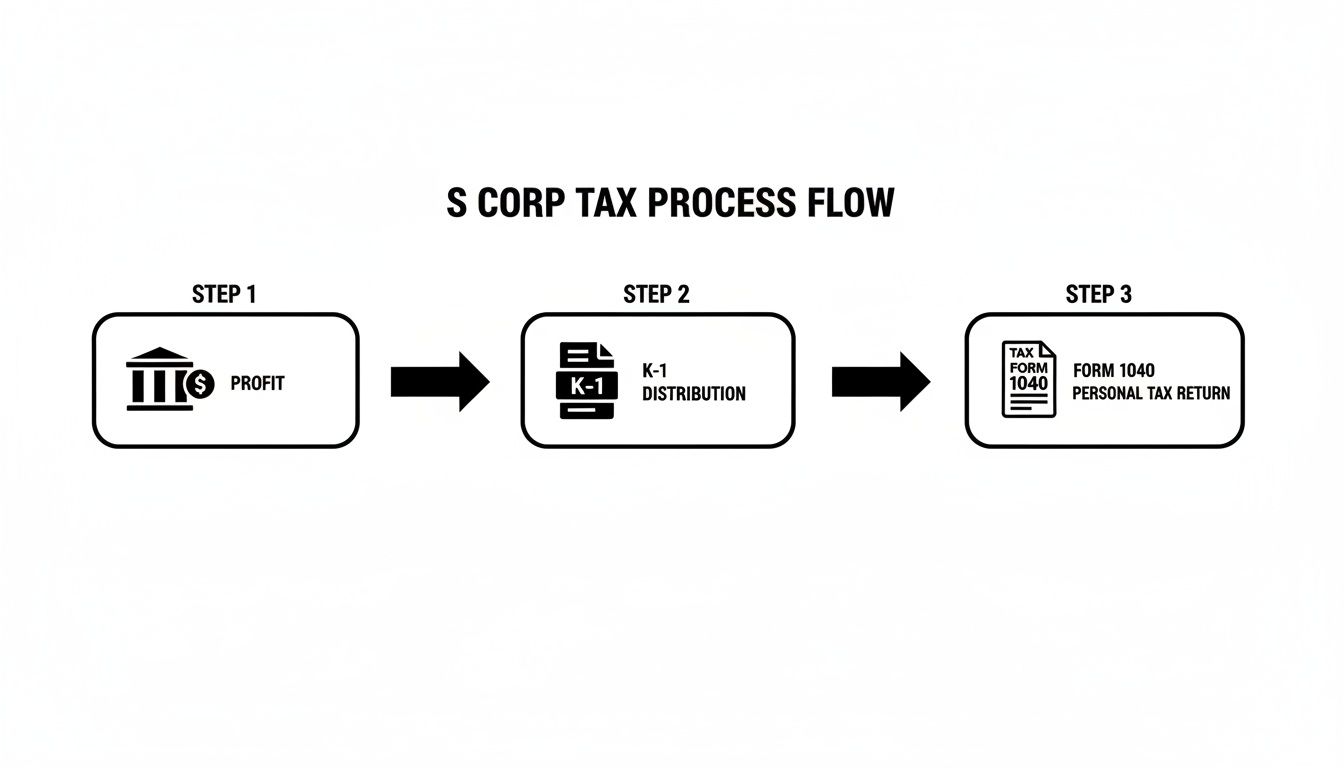
This visual highlights the direct path from your company's bottom line to your personal 1040, showing just how efficiently the S corp structure works.
Defining "Reasonable Compensation"
Now, before you get too excited and decide to pay yourself a $1 salary, you need to know about the "reasonable compensation" rule. The IRS is fully aware of this tax strategy and has put rules in place to keep it from being abused.
The law requires S corp owners who work in their business to pay themselves a reasonable salary before taking any distributions. This prevents the obvious loophole of taking all profits as distributions to completely avoid payroll taxes.
So, what's a "reasonable" salary? The IRS doesn't give you a specific dollar amount. The general guideline is that your salary should be what a similar business would pay someone for the same or similar services.
To land on a defensible number, you need to weigh a few factors:
- Your Role & Duties: What do you actually do day-to-day? Are you the CEO, the lead technician, the marketing guru, or all of the above?
- Experience & Expertise: What skills, training, and qualifications do you bring to the table?
- Time Commitment: How many hours are you putting in? Is this a full-time job or a part-time venture?
- Industry Benchmarks: What are other companies in your industry and geographic area paying for similar roles? This is a big one.
Getting this wrong is one of the biggest red flags for an IRS audit. If they determine your salary is too low, they can reclassify your distributions as wages and hit you with back taxes, penalties, and interest. It’s always best to do your homework, document how you arrived at your salary figure, and pay yourself a fair wage.
Using the QBI Deduction to Lower Your Tax Bill

Beyond the savings on payroll taxes, S corp owners have another powerful tool in their tax-saving arsenal: the Qualified Business Income (QBI) deduction. Think of it as a potential 20% discount on your business profits, designed to give pass-through entities a significant break.
This deduction, formally known as Section 199A, was a cornerstone of the Tax Cuts and Jobs Act of 2017. That same law made headlines for slashing the C corp tax rate to a flat 21%. To keep S corps and other pass-throughs competitive, Congress created the QBI deduction. It was their way of ensuring small business owners weren't left behind. You can read more about the global impact of these corporate tax rate changes to see the bigger picture.
How QBI Works in Practice
So, what does a 20% discount on your income actually look like? The magic of the QBI deduction happens on your personal tax return, not your business's. It works by directly lowering your adjusted gross income (AGI), which means less of your money is subject to federal income tax.
Let’s say your S corp passes $100,000 in qualified business income through to you.
The QBI deduction could allow you to subtract 20% of that—a full $20,000—right off your taxable income. If you're in the 24% tax bracket, that single deduction just put $4,800 back in your pocket.
It's a straightforward benefit that effectively lowers your personal S corp tax rate without requiring any complicated financial gymnastics.
To see just how much of a difference this can make, let's look at a simple scenario. This table shows how a $100,000 profit is taxed with and without the QBI deduction.
| Sample QBI Deduction Impact on Taxable Income |
| :— | :— | :— |
| Financial Item | Without QBI Deduction | With QBI Deduction |
| S Corp Net Profit | $100,000 | $100,000 |
| QBI Deduction (20%) | $0 | -$20,000 |
| Final Taxable Income | $100,000 | $80,000 |
As you can see, the deduction creates a much lower taxable income base, leading directly to a smaller tax bill.
Key Qualifications and Limitations
Of course, a tax break this good comes with a few rules. The QBI deduction isn't a free-for-all, and the guidelines can get a bit complex. Your eligibility really boils down to a few key factors.
- Your Taxable Income: The IRS sets income thresholds. For 2023, if your taxable income is below $182,100 (for single filers) or $364,200 (for married couples filing jointly), you generally qualify without major hurdles.
- Type of Business: Most businesses are eligible. However, the rules are stricter for what the IRS calls a "specified service trade or business" (SSTB). This category includes fields like consulting, athletics, law, and certain health services, where the primary asset is the owner's reputation or skill.
- W-2 Wages and Property: If your income exceeds the thresholds mentioned above, your deduction might be limited. The final amount could be capped based on the W-2 wages your S corp pays its employees or the original purchase price of its physical assets.
Navigating these rules is where having a good tax professional pays off. They can help you confirm your eligibility and make sure you're taking full advantage of this valuable deduction.
State Taxes: A Whole Different Ball Game
While the pass-through nature of an S corp is a fantastic advantage on your federal return, don't assume you're home free. When it comes to taxes, the states write their own rulebooks. Skipping federal corporate income tax is a huge relief, but it doesn't mean you've sidestepped state-level obligations entirely.
Many states impose their own corporate income taxes, franchise taxes, or other annual fees directly on the S corporation itself. This patchwork of regulations means your actual tax burden can swing wildly depending on where your business hangs its shingle. Forgetting to budget for these state-specific taxes is one of the most common—and expensive—mistakes I see new entrepreneurs make.
A Real-World Example: California S Corp Taxes
Let's zoom in on California to see just how different things can be at the state level. The Golden State acknowledges the S corp structure, but it definitely wants its cut.
In California, S corporations owe a franchise tax calculated at 1.5% of the company’s net income. But here's the kicker: there's a minimum annual franchise tax of $800. You have to pay this every year, even if your business doesn't make a profit.
That's right—from your first year in business, your California S corp owes the state a minimum of $800. If your net income is high enough that the 1.5% calculation exceeds that floor, you'll pay the higher amount.
For instance, if your S corp has a net income of $100,000, you’d owe $1,500 in California franchise tax ($100,000 x 1.5%).
California is also strict about its paperwork. S corps must file a specific state return, Form 100S (California S Corporation Franchise or Income Tax Return). For businesses that follow the calendar year, the deadline is typically March 15th. Keeping these state-specific rules and deadlines on your radar is non-negotiable for staying out of trouble.
Common S Corp Mistakes to Avoid
The S corp can be a fantastic tool for saving on taxes, but it's not a free-for-all. Think of it less like a magic wand and more like a precision instrument—it works wonders when used correctly, but one wrong move can cause a lot of damage.
These aren't just tiny accounting slip-ups. They're fundamental errors that can get you in hot water with the IRS and wipe out the very tax savings you were trying to achieve. Let's walk through the three most common traps I see business owners fall into so you can sidestep them completely.
Paying Yourself an "Unreasonable" Salary
This is, by far, the biggest mistake people make. The temptation is obvious: pay yourself a tiny salary to minimize payroll taxes and take the rest of the company's profit as a tax-free distribution. It sounds great in theory, but the IRS is all over this.
You are legally required to pay yourself a reasonable salary for the work you do before you take any owner distributions. If you don't, you're waving a giant red flag for an audit.
If the IRS decides your salary is too low for the services you provide, they'll reclassify your distributions as wages. Suddenly, you'll be on the hook for all the back payroll taxes (that nasty 15.3% FICA tax) on that reclassified amount, plus a lovely pile of penalties and interest. Do your homework, document what similar positions pay in your industry, and pay yourself that salary.
Forgetting About the Built-In Gains Tax
This trap is specifically for businesses that started life as a C corp and later converted to an S corp. If your C corp had assets on the books that were worth more than their tax basis (think real estate, equipment, or intellectual property), you need to be careful.
Selling one of those appreciated assets within five years of making the S corp election can trigger the Built-in Gains (BIG) tax.
The BIG tax is a nasty surprise. It's a corporate-level tax, currently set at a flat 21%, that gets slapped on the gain that existed before you became an S corp. It's the IRS's way of preventing companies from using the S corp election as a last-minute trick to dodge C corp taxes on a big asset sale.
Losing Track of Your Shareholder Basis
Your shareholder basis is, in simple terms, your financial skin in the game. It starts with the money and property you put into the company. It goes up with profits and additional contributions and goes down with losses and distributions. Taking distributions that exceed your basis is where things get painful.
Distributions are only tax-free as long as you have a positive basis. Once you take out more than you have in your basis account, that "excess distribution" gets taxed—usually as a long-term capital gain. This is why keeping clean, accurate books isn't just a good idea; it's essential for avoiding an unexpected tax bill on what you thought was tax-free cash.
Your S Corp Tax Questions, Answered
Once you get the hang of the basics, you start running into more specific "what if" scenarios. Let's walk through some of the most common questions business owners have about S corp taxes to clear up the details and help you make smart decisions.
When Is the Right Time to Become an S Corp?
This is the big one, and the answer isn't always black and white. The switch to an S corp usually starts making sense once your business is consistently profitable enough that the tax savings on distributions are greater than the extra costs of running payroll and handling more complex compliance.
A good rule of thumb is to start considering it when your net earnings are consistently hitting the $40,000-$60,000 range per year.
But remember, that's just a general guideline. The only way to know for sure is to sit down with a tax pro and run the numbers for your unique business. When you're ready to see what's involved, our guide on how to file as an S corp breaks down the entire process.
Can My Business Lose Its S Corp Status?
Absolutely. The IRS sets strict rules for who can be an S corp, and if you break them, they can terminate your election. Staying on top of compliance is non-negotiable.
Here are the most common tripwires that can get you in trouble:
- Exceeding 100 shareholders: S corps are meant for closely-held businesses, not massive corporations.
- Having an ineligible shareholder: This means no corporations, partnerships, or non-resident aliens can own stock.
- Issuing a second class of stock: Every share must have the exact same rights when it comes to distributions and liquidation. You can't create preferred stock with special privileges.
How Are S Corp Losses Handled for Taxes?
The pass-through structure works both ways. Just as profits flow to your personal return, so do losses. This can be a real silver lining, especially in the early startup years or during a tough economic patch.
Those business losses can typically be deducted against other income on your personal return, like a W-2 job or investment gains. This directly lowers your total taxable income, giving you a tax break when you need it most.
Of course, there are rules governing these deductions, like basis limitations, so careful tracking is key. Getting your books in order is crucial, and a great way to prepare is by focusing on your Year End Tax Readiness to make sure you can take full advantage of any potential savings.
At Allied Tax Advisors, our entire focus is on helping entrepreneurs like you make sense of these rules. Whether you're just thinking about the S corp election or need help with ongoing tax strategy, we're here to make sure your business structure is working for you, not against you. Visit us at https://alliedtax.com to see how we can help.