
So, you're thinking about making the S Corp election for your business. Smart move. At its core, this is a strategic tax decision. You’re not changing your business's legal identity—your LLC or C Corp stays intact—but you are changing how the IRS taxes it by filing IRS Form 2553, Election by a Small Business Corporation.
This simple election allows your company's profits and losses to pass directly to you and any other owners, showing up on your personal income tax returns. This avoids the dreaded corporate-level tax, and that's where the magic really happens.
Understanding the S Corp Advantage

Before you get bogged down in the paperwork, let's get clear on why this is such a popular move for savvy entrepreneurs. The single biggest driver is the potential for significant tax savings.
The S Corp structure elegantly sidesteps the "double taxation" nightmare that C Corporations can face. With a C Corp, profits get hit with taxes once at the corporate level, and then again when they’re paid out to shareholders as dividends. It’s a painful one-two punch to your bottom line.
An S Corp, on the other hand, is what’s known as a pass-through entity. This means the business itself pays no federal income tax. All the profits, losses, deductions, and credits are "passed through" to the shareholders to report on their personal tax returns. One layer of tax, not two. That simple difference can add up to a lot of money saved.
The Power of Pass-Through Taxation
Let's look at the numbers. Research from the U.S. Department of the Treasury, analyzing data from 2018 to 2021, found that S corporations enjoyed an average effective federal income tax rate of about 15%. That's a full 10 percentage points lower than if those same businesses had been taxed as standard C corporations.
Choosing the right tax structure isn't just a compliance task; it's a fundamental business strategy.
S Corp vs Sole Proprietorship Tax Snapshot
A common question I get is how this compares to being a sole proprietor or a standard LLC. The key difference comes down to self-employment taxes. As a sole proprietor, every dollar of profit is subject to these taxes. As an S Corp owner, only your "reasonable salary" is.
Here’s a quick breakdown:
| Tax Consideration | Sole Proprietorship / Standard LLC | S Corporation |
|---|---|---|
| Earnings Taxation | All net profits are subject to both income tax and self-employment taxes (Social Security & Medicare). | Only the owner's "reasonable salary" is subject to payroll taxes (Social Security & Medicare). |
| Profit Distributions | All profits are automatically subject to self-employment tax. | Additional profits taken as "distributions" are not subject to self-employment tax, only income tax. |
This distinction is precisely how S Corp owners can realize substantial savings. By paying yourself a fair salary and taking the rest of the profits as distributions, you legally minimize your self-employment tax bill.
Key Takeaway: Think of the S Corp structure as a tax overlay. It lets you keep the legal protection of your LLC or C Corp while unlocking a more favorable tax treatment, potentially lowering your overall tax burden significantly.
Is This the Right Move for You?
The first step is always confirming if this path aligns with your business goals. While the process itself is manageable, it demands real attention to detail—from meeting all the IRS eligibility rules to hitting every filing deadline. It's critical to understand the full picture of what an S Corporation really means for your operations and compliance.
This guide is designed to give you that clarity. I'll walk you through exactly what you need to do, step-by-step, so you can confidently file your S Corp election and set your business up for greater financial success.
Does Your Business Actually Qualify? Checking the IRS Boxes
Before you get caught up in the paperwork, let's pump the brakes for a second. The first and most critical step is making sure your business is even eligible for S-Corp status in the eyes of the IRS. They have a strict, non-negotiable checklist, and if you miss even one item, your election is dead on arrival.
Think of it like this: you wouldn't try to enter a marathon without confirming you're healthy enough to run. This is your business's financial health check.
First things first, where was your business born? To even be in the running for S-Corp status, your company must be a domestic corporation. That just means it has to be formed and organized right here in the United States. If your entity was established abroad, you'll have to stop here, as foreign entities simply don't qualify.
Getting Shareholder Rules Right
This is where a lot of businesses stumble. The IRS is very particular about who can own a piece of your company and how many owners you can have.
You're capped at no more than 100 shareholders. Honestly, for the vast majority of small businesses I work with—from solo entrepreneurs to small partnerships—this is never an issue. But if you have ambitions of bringing on a lot of small-time investors down the road, it's a number you need to keep etched in your mind.
Even more important than the number is the type of shareholder. The IRS has a clear list of who's in and who's out.
- Who's Allowed In: Shareholders must be individuals (U.S. citizens or resident aliens). Certain estates and trusts can also be shareholders, which is a big help for family businesses thinking about succession.
- Who's Not Allowed: This is a hard "no" for partnerships, other corporations, or non-resident aliens as shareholders. For example, if your LLC is currently owned by another one of your business partnerships, you're out of luck until you restructure.
A Word of Caution: Take a hard look at your cap table or ownership agreement right now. If one of your partners is not a U.S. resident, or your business is owned by another company, you have a problem to solve. You’ll need to clean up your ownership structure before even thinking about filing Form 2553.
The "One Class of Stock" Rule Explained
This rule sounds more complicated than it is, but it catches a surprising number of people off guard. It simply means that all shares must have the same rights to distribution and liquidation proceeds.
You can absolutely have different ownership percentages. A founder can own 70% and an early partner can own 30%. That's perfectly fine. What you can't do is create different tiers of stock where, for example, "Class A" shares get twice the dividends per share as "Class B" shares. When it comes to the money, every share must be treated equally.
Interestingly, you can have differences in voting rights. It’s completely acceptable to issue both voting and non-voting stock without violating this rule.
So, to recap, the IRS has a clear, non-negotiable set of requirements. Your business must be domestic, have 100 or fewer eligible shareholders, and maintain only one class of stock. You can always get the full story straight from the horse's mouth by checking out the official IRS guidelines on S Corporations for small businesses. Nail this down first, and the rest of the process will go much more smoothly.
A Practical Walkthrough of IRS Form 2553
Once you've confirmed your business is eligible, the real work begins with IRS Form 2553, "Election by a Small Business Corporation." This is the official, two-page document you'll send to the IRS to request S-Corp tax status. I know government forms can look intimidating, but this one is straightforward once you know what to look for.
Essentially, this form is your way of telling the IRS who you are, what your business is, and—most importantly—that every single shareholder has agreed to this change. Accuracy is everything here. A simple mistake, like an incorrect date or a forgotten signature, can get your application rejected. That means delays, frustration, and a major setback for your tax planning.
This graphic breaks down the key steps to getting Form 2553 prepared and filed correctly.
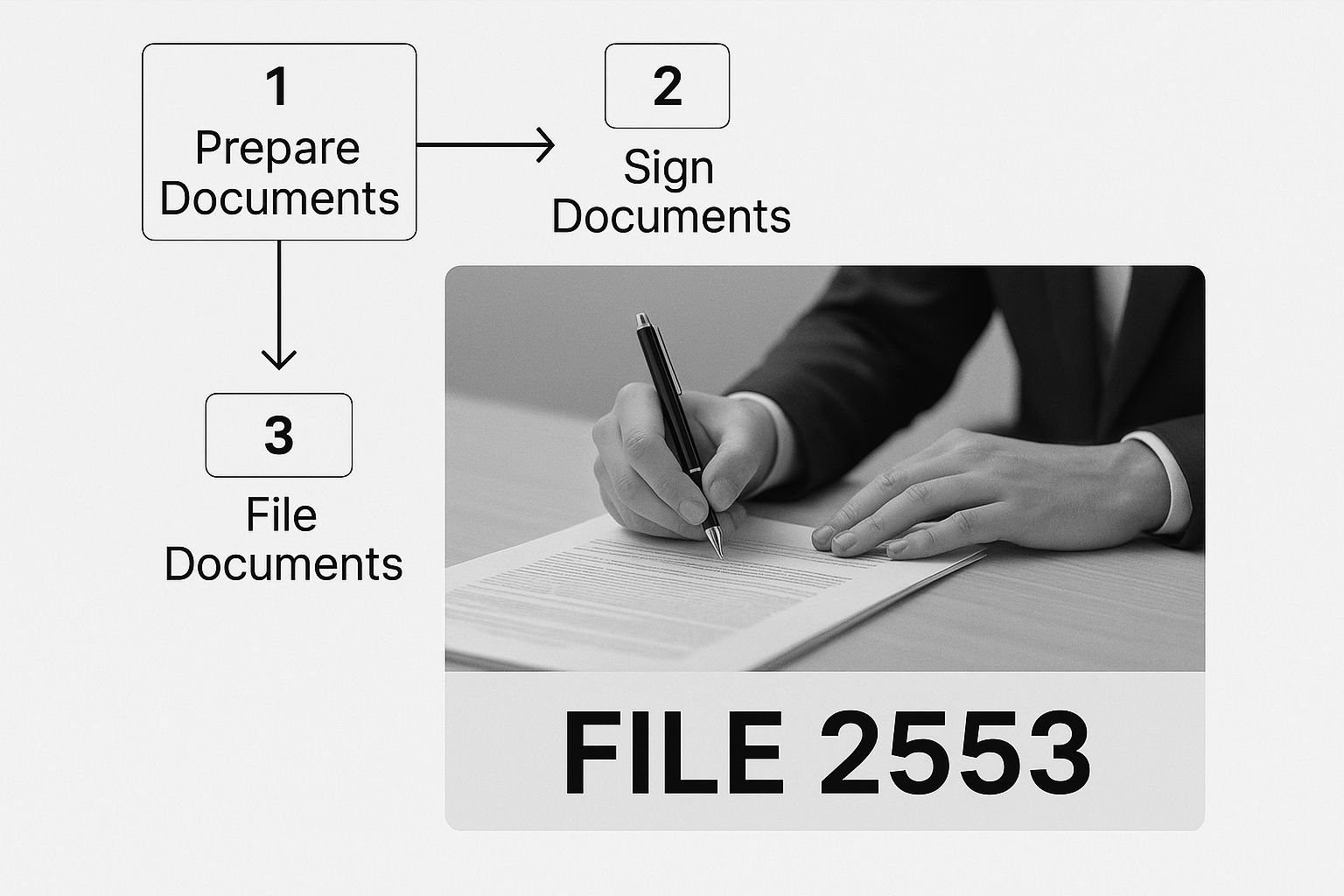
As you can see, getting all your ducks in a row before you even touch the form is the secret to a smooth filing.
Nailing The Details In Part I
Part I is all about the fundamentals: the who, what, and when of your S-Corp election. You’ll start with the basics—your business name, address, and Employer Identification Number (EIN). My advice? Pull up your original business registration documents. The information here must exactly match what the IRS has on file for your LLC or C-Corp. Even a small discrepancy can flag your form for review.
Next comes a critical decision: the effective date of your S-Corp election.
- For a brand-new business: You can simply use the date your company was legally formed.
- For an existing business: You'll almost always want the election to be effective on the first day of your tax year. For most companies, that’s January 1.
You’ll also need to specify your fiscal tax year. The vast majority of small businesses run on a calendar year ending December 31, which keeps things simple. If your business uses a different fiscal calendar, you’ll need to justify it in a separate attachment.
The All-Important Shareholder Consent
This is where I see most people trip up. It’s not just a formality; it’s a dealbreaker. Every single person who owns stock in your company must consent to the S-Corp election. This means signing and providing their personal details in Column K of the form—name, address, signature, ownership percentage, and Social Security Number.
My Pro Tip: Don't just assume everyone is on board. Before you fill out a single line on the form, hold a meeting or send a formal email to get explicit, written consent from every shareholder. This avoids last-minute surprises where one holdout can derail the entire process.
Forgetting even one signature is an automatic rejection. No exceptions. If you have more shareholders than the form has space for, just attach a separate consent statement containing all the required information and signatures.
What About Filing Deadlines and Late Elections?
When it comes to filing as an S-Corp, timing is everything. To make your election effective for the entire current tax year, you must file Form 2553 within the first two months and 15 days of that tax year. If your business uses a calendar year, that means you have until March 15.
Missed the deadline? Don't panic. The IRS has a late election relief procedure. If you can show "reasonable cause" for filing late—maybe you got bad advice from a previous accountant or genuinely didn't know about the deadline—you can often get it approved retroactively. You'll just need to attach a statement to your Form 2553 explaining what happened.
For a deeper dive into managing these deadlines and the entire submission process, you can find more detailed guidance on how to file for an S Corp.
Navigating State-Level S Corp Requirements
Filing Form 2553 with the IRS feels like you've crossed the finish line, but really, you've just finished the first lap. One of the most common—and costly—mistakes I see business owners make is assuming their federal S Corp election automatically trickles down to the state.
That assumption can be a painful one. Ignoring your state's specific rules can lead to some serious compliance headaches, like unexpected tax bills, late-filing penalties, or even having your S Corp status revoked by the state. That would completely erase the tax benefits you worked so hard to get in the first place.
How Different States Handle S Corp Elections
When it comes to S Corp status, states generally fall into one of three camps. Where your business operates will dictate your next steps.
-
Automatic Acceptance: A good number of states, like California and Delaware, keep things simple. Once the IRS gives your federal S Corp election the green light, these states automatically honor it. You don't have to file any extra forms. This is the ideal scenario, but you should always double-check on your state's Department of Revenue website just to be safe.
-
Separate State Filing Required: Then you have states like New York and New Jersey, which require their own, separate S Corp election. This is a distinct filing from your federal Form 2553. Be aware that these states have their own forms and deadlines, which don't always line up with the IRS. If you miss this crucial step, the state will keep taxing you as a C Corp or LLC, wiping out any potential state tax savings.
-
No S Corp Recognition: Finally, a handful of states and even some major cities don't recognize the S Corp election at all. Places like Tennessee and New York City, for example, might hit you with their own entity-level taxes, like a franchise or excise tax, no matter what your federal status is. It’s absolutely critical to know these local quirks.
Finding and Filing the Right State Forms
So, how do you sort all this out? Your best bet is to go straight to the source: your state’s official business portal or the website for its Department of Revenue (or Taxation). A quick search for terms like "S Corporation election," "state S Corp form," or "corporate tax election" usually does the trick.
Here’s a real-world scenario: Let's say you run an LLC in New Jersey. You were on top of it and filed Form 2553 with the IRS right on time, by the March 15 deadline. But you didn't realize New Jersey requires its own Form CBT-2553, which also happens to be due on March 15. If you miss that state filing, New Jersey will tax your business under its standard partnership rules for the entire year, and you'll forfeit all the state-level tax savings you were counting on.
This is exactly why you have to treat the state filing as its own critical task. Find the form, pinpoint the deadline, and see if there are any filing fees. A few minutes of research now can save you a full year of tax headaches later.
Life After Your S Corp Election

Popping the champagne after your S Corp election is approved by the IRS is a great feeling, but it’s really just the beginning of a new chapter for your business. The real work—and the real benefits—come from what you do next. Staying compliant and managing your business like a corporation is what keeps you in the IRS's good graces and makes the whole effort worthwhile.
The most immediate and significant change? How you get paid. Say goodbye to simply taking owner's draws whenever you feel like it. You are now officially an employee of your own company, which means you have to run formal payroll.
This isn't just a minor administrative shift; it's the core of the S Corp strategy. One of the biggest draws for business owners is the potential savings on self-employment taxes. As an S Corp, you split your earnings into two buckets: a reasonable salary and shareholder distributions. Your salary gets hit with the usual payroll taxes, but the distributions don't. This is where the magic happens.
Running Payroll and Paying Yourself a Reasonable Salary
The IRS doesn't mess around with this one. If you’re an owner who works in the business, you must be paid a "reasonable salary." There's no getting around it.
So, what does "reasonable" actually mean? In short, it's what you would have to pay someone else to do your job. It’s not just a number you pull out of thin air.
You need to think like an HR manager hiring for your own position and consider things like:
- What are your actual day-to-day duties and responsibilities?
- How much time and effort do you put into the business?
- What unique skills and experience do you bring to the table?
- What do similar jobs pay in your local area?
Let’s be clear: paying yourself a tiny $10,000 salary while taking $200,000 in distributions is a huge red flag for the IRS. Your salary has to be justifiable and reflect the real value you provide. This salary is subject to FICA taxes (Social Security and Medicare), and the business pays its matching share, just like it would for any other employee.
My Pro Tip: Document everything. Do some research on sites like the Bureau of Labor Statistics or Glassdoor to find comparable salary data. Keep records of how you landed on your salary number. This paperwork is your best friend if the IRS ever comes knocking.
Maintaining Corporate Formalities
Beyond payroll, running an S Corp means you need to act like a corporation. This means observing certain corporate formalities that prove your business is a separate legal entity from you, the owner.
These ongoing tasks are non-negotiable for compliance:
- Hold Annual Meetings: You need to hold official shareholder and director meetings. Yes, even if it’s just you in the room.
- Keep Corporate Minutes: These are the official written records of what happened in those meetings. Document any major decisions you made throughout the year.
- File Annual Tax Returns: S Corps file an annual informational tax return on Form 1120-S. The company's profit or loss from this form is then "passed through" to your personal tax return using a Schedule K-1.
I know these administrative tasks can feel tedious, but they are absolutely essential. They’re what protect your personal assets and ensure you keep the tax advantages you elected the S Corp for in the first place. If you’re trying to decide if these new responsibilities are a good fit, our guide comparing the S Corp vs LLC structure for small businesses can help you weigh the pros and cons.
Got Questions About S Corp Filings? You're Not Alone.
Even with the clearest instructions, a few questions are bound to pop up when you're navigating the S Corp election for the first time. That's completely normal. The tax code is a complicated beast, and getting the details right from the start can save you a world of headaches down the road.
Let's walk through some of the most common sticking points we see business owners run into. Getting these answers locked down will help you move forward with confidence.
What if I Missed the S Corp Filing Deadline?
First off, don't panic. If you’ve missed that March 15 deadline for a calendar-year business, you might still have a path forward. The IRS knows life happens and provides a late election relief procedure.
The key is proving you had "reasonable cause" for filing late. You’ll need to attach a carefully written statement to your Form 2553 that explains exactly why you couldn't get it done on time. Maybe you got bad advice from a professional, or perhaps you were genuinely unaware of the requirement. These are often considered valid reasons. Just be honest and thorough in your explanation.
How Do I Figure Out My "Reasonable Salary"?
This is probably the single most important question you'll face as an S Corp owner, and it's one you'll need to answer year after year. A reasonable salary is simply what you would have to pay someone else to do your job. There’s no magic formula from the IRS, but they do expect your number to be grounded in reality.
To land on a defensible salary, you’ll want to look at a few key factors:
- What are your actual duties and responsibilities? Are you the CEO, the lead salesperson, and the janitor?
- What’s your experience level and what unique skills do you bring to the table?
- How much time are you actually putting into the business?
- What do similar jobs pay in your industry and, just as importantly, in your local area?
Do your homework. You can find solid salary data from sources like the Bureau of Labor Statistics to back up your decision. Deliberately paying yourself a tiny salary to maximize tax-free distributions is one of the brightest red flags for an IRS audit. Always document how you came up with your salary figure and keep that record safe.
Expert Tip: A reasonable salary isn't a "set it and forget it" number. As your business grows and your role changes, you should review and adjust your salary each year. This keeps you compliant and ensures your compensation reflects your true contribution.
Do I Need to Dissolve My LLC to Form an S Corp?
Absolutely not. This is a huge misconception that trips up a lot of entrepreneurs. Think of an S Corp as a tax status, not a completely separate business structure.
If you have an LLC, it stays an LLC. Your legal protections and limited liability under state law don't change one bit. When you file Form 2553, you’re simply telling the IRS, "Hey, from now on, I'd like you to tax my LLC as an S Corp."
This is an incredibly popular strategy because it gives you the best of both worlds: the robust legal protection of an LLC and the significant tax savings—especially on self-employment taxes—that come with an S Corp.
Navigating S Corp filings, reasonable salaries, and compliance can feel overwhelming. The team at Allied Tax Advisors brings deep expertise to make these complex rules manageable for business owners like you. From the initial paperwork to payroll and strategic advice, we offer proactive support to keep you compliant and find new savings opportunities. Visit us at https://alliedtax.com to start building your long-term financial success.