
Let's get straight to the point: the tax rate on an S Corp distribution is most often 0%. Surprising, right? It feels like a trick question, but it’s true because of how S Corps are designed from a tax perspective.
The money you take as a distribution has already been taxed. The IRS accounted for it on your personal tax return the moment your business earned it, long before it ever hit your personal bank account.
How Pass-Through Taxation Works
To really get why these distributions are tax-free, you have to understand pass-through taxation. It’s the foundational concept behind the S Corporation structure.
Imagine your S Corp is just a conduit. When the business makes a profit, those earnings "pass through" the company directly to you, the shareholder. From the IRS's point of view, that profit becomes part of your personal income in the year it was earned, not when you decide to take it out.
So, whether you leave that cash in the company's account to fund future growth or transfer it to your personal checking, you've already paid the income tax on it.
So, a Distribution Isn't Considered New Income?
Exactly. This pass-through system is the S Corp's superpower. It was created to sidestep the dreaded "double taxation" that hits C Corporations, where the company pays corporate income tax, and then shareholders pay taxes again on any dividends they receive.
Because S Corp profits are only taxed once—at your personal tax rate—pulling that money out isn't a new taxable event. You're just moving money that's already yours from one pocket to another.
Think of it this way: A distribution is just a transfer of after-tax profits from the business's bank account to your own. The tax was settled when the profit was earned, not when it was moved.
This simple concept is a game-changer for managing your business and personal finances. It separates the earning of income from the receiving of cash.
For a clearer picture, let's compare how S Corps and C Corps handle profits at a high level.
S Corp vs C Corp Taxation at a Glance
| Taxation Point | S Corporation (Pass-Through) | C Corporation (Double Taxation) |
|---|---|---|
| Business-Level Tax | No federal income tax on profits. | Pays corporate income tax on profits. |
| Shareholder-Level Tax | Shareholders pay personal income tax on their share of the profits, whether distributed or not. | Shareholders pay income tax on dividends received from the corporation. |
| Final Result | Profits are taxed once at the personal level. | Profits are taxed twice—first at the corporate level, then again at the shareholder level. |
This table boils it down. The S Corp's pass-through nature is designed for tax efficiency, ensuring the money is only hit by taxes one time.
Tying It All Into Your Financial Future
Getting a handle on your S Corp distributions is more than just a business task; it’s a core piece of your personal wealth strategy. As you plan how and when to take distributions, it’s also the perfect time to think bigger. A solid financial plan goes beyond your business, which is why understanding tax-deferred vs. tax-free retirement options is a crucial next step for securing your long-term goals.
Understanding Your Shareholder Basis
The secret to getting that sweet 0% tax rate on S corp distributions all comes down to one number: your shareholder basis. This is, without a doubt, the most critical figure for figuring out if the money you take out is tax-free or if you're about to get an unpleasant surprise from the IRS.
Think of your basis like a running tab of your investment in the company. The cash and property you put in to get things started? That's your opening balance.
Each year, your slice of the S corp's profits gets added to that tab, increasing your basis. When you take a distribution, you're just taking some of that investment back out, which lowers the balance. As long as you never take out more than you have in your "account," those distributions stay completely tax-free.
How Your Basis Changes Over Time
Your basis isn't a static number you calculate once and forget about. It's a living figure that fluctuates based on the company's performance and your own financial activities within the business.
Here's a quick rundown of what moves the needle:
- What increases your basis? Your share of the company's profits, any new cash you inject into the business, and certain kinds of tax-exempt income.
- What decreases your basis? Any distributions you take (in cash or property), your share of any company losses, and certain non-deductible expenses.
This infographic breaks down how your S Corp's net income is typically divided. Part of it becomes your salary (which gets hit with payroll taxes), and the rest can be taken as distributions (which don't).
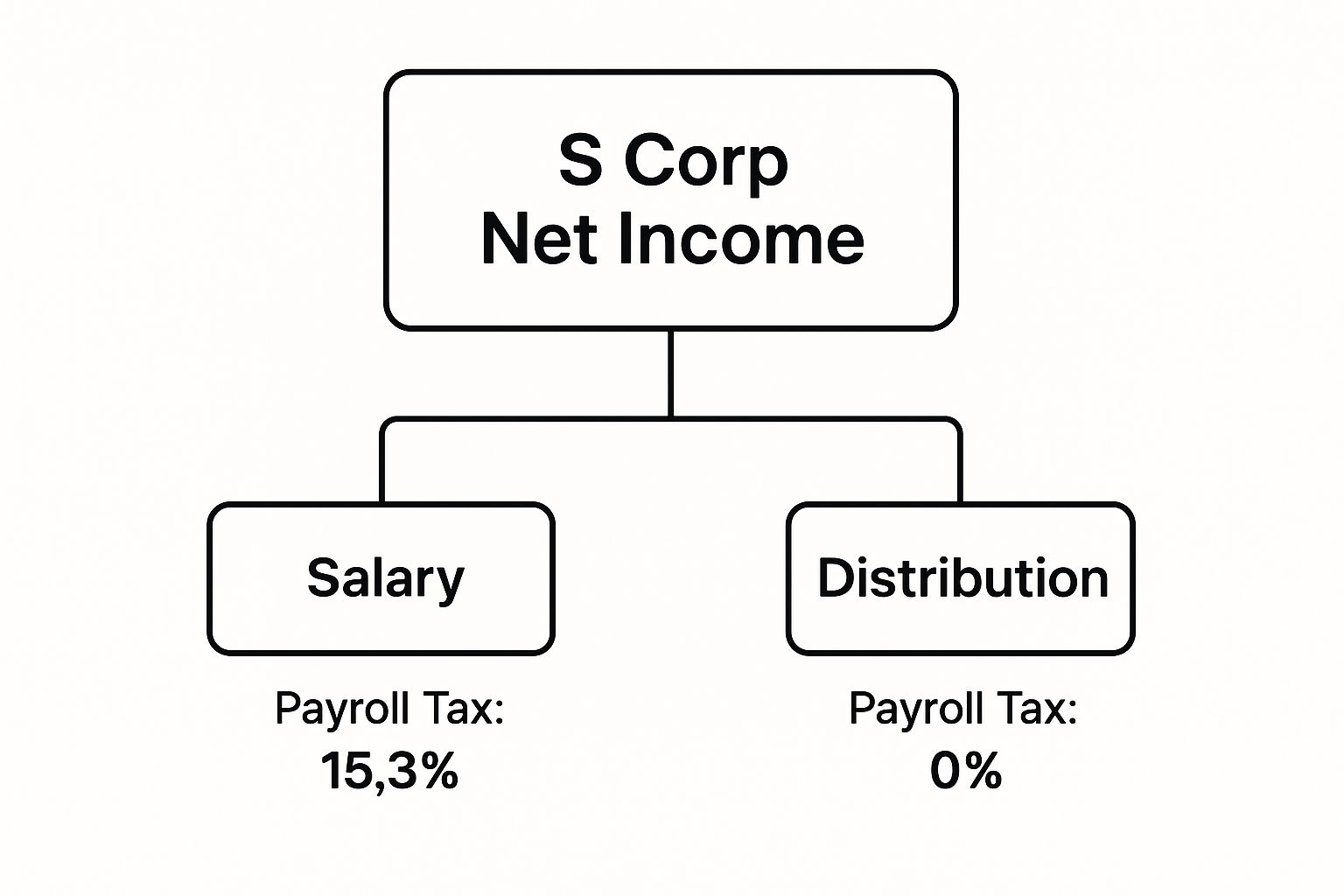
As you can see, your salary is subject to a 15.3% payroll tax right off the bat. But your distributions? They come with a 0% payroll tax, which is precisely why this structure is so powerful for business owners.
Why Basis Calculation Is So Important
The trouble starts when your distributions exceed your basis. If you take out more money than you have in your basis "account," the IRS stops seeing it as a simple return of your investment. At that point, the rules change.
The moment a distribution exceeds your shareholder basis, the excess portion is typically treated as a long-term capital gain. This means it becomes taxable at capital gains rates, which can range from 0% to 20% depending on your income.
Keeping an accurate, up-to-date basis calculation is a non-negotiable part of good financial housekeeping for any S corp owner. To get this right, it's essential to know how to prepare financial statements that properly reflect these changes. If you lose track of your basis, you're essentially flying blind and could easily turn a tax-free withdrawal into a costly mistake.
When S Corp Distributions Become Taxable
While the ideal scenario for any S corp owner is paying 0% tax on distributions, that's not always how it plays out. The tax-free nature of S corp distributions hinges entirely on playing by the IRS's rules. If you stray outside those lines, what you thought was a simple withdrawal can suddenly create a tax headache.
There are really two main ways this can happen. The most common pitfall is taking distributions that are larger than your shareholder basis. The second is a more complex situation, but it's crucial for any S corporation that used to be a C corporation.
Taking Distributions in Excess of Your Basis
Think of your shareholder basis as a running tally of your financial stake in the business—your investment plus any profits left in the company. As long as your withdrawals don't exceed that amount, you're golden. The money comes out tax-free.
But what happens if your basis is, let's say, $50,000, and you decide to take a $70,000 distribution?
That first $50,000 is treated exactly as you'd hope: a tax-free return of your basis. No problem there. However, the IRS views that extra $20,000 you took as a long-term capital gain. And that means it's taxable income.
Example of a Taxable Distribution
Let's imagine your S corp had a fantastic year, and your current shareholder basis is $40,000. Feeling good about the company's performance, you take a distribution of $65,000.
- The first $40,000 is considered a tax-free return of your basis.
- The remaining $25,000 ($65,000 – $40,000) is a distribution in excess of your basis.
- This $25,000 now gets hit with capital gains tax. The actual tax rate you'll pay on it—which can be anywhere from 0% to 20%—is determined by your total personal income for the year.
This rule is in place to stop owners from pulling more value out of the company than they've personally put in or earned on a tax-free basis.
The C Corp Earnings and Profits Exception
The second scenario is less common but absolutely critical for businesses that converted from a C corp to an S corp. When that switch happens, the company sometimes brings along old profits that were earned but never paid out to shareholders. The IRS calls this Accumulated Earnings and Profits (E&P).
Here's the catch: that E&P was generated under C corp tax rules. The corporation already paid taxes on it, but the shareholders never did. So, if you take a distribution that dips into this specific pool of old C corp money, it gets taxed as a dividend.
This is a huge distinction. Dividend tax rates are often different from capital gains rates, and they're a whole separate animal from your typical tax-free S corp distribution. This is one of the big reasons why the initial choice of business entity is so important. Major shifts in corporate tax law, like the rate reduction in the Tax Cuts and Jobs Act of 2017, constantly change the strategic calculus. You can dive into the history of these figures by checking out the corporate tax rates on the IRS website to see just how much things have evolved.
Navigating the Reasonable Compensation Rule
For any S corp owner who also works in the business, the IRS draws a very clear, very important line in the sand: the one between your salary and a distribution. Getting this distinction right isn't just about following the rules—it's about protecting your business from some seriously painful penalties.
The whole issue boils down to payroll taxes. The wages you receive on your W-2 are hit with Social Security and Medicare taxes (FICA), but the distributions you take are not. You can see the temptation, right? It’s easy for an owner to think, "Why not pay myself a tiny salary and take the rest as a distribution to save on taxes?" The IRS is way ahead of you on that one.
What Is a Reasonable Salary?
This is why the IRS insists you pay yourself a reasonable salary for the work you actually do before you start taking distributions. Now, "reasonable" might sound fuzzy, but the IRS has a pretty good idea of what it means. In short, your salary should be in the same ballpark as what another company would pay someone to do your job.
So, how do you land on a number that won't get you in trouble? You have to look at several factors:
- Your Role and Responsibilities: What do you actually do all day? Are you the CEO, the top rainmaker, the chief coder, or all of the above?
- Experience and Training: Your years of expertise, certifications, and hard-won skills are worth real money.
- Time and Effort: How much of your life goes into this business? A 60-hour workweek demands a different salary than a 10-hour advisory role.
- Industry and Location: What you do and where you do it matters. A marketing consultant in New York City is going to have a very different "reasonable" salary than one in rural Montana.
Getting the mechanics of this right is a crucial part of running your S corp. Our guide on how to do payroll for small business can walk you through the practical steps of setting up and processing W-2 wages correctly.
The Consequences of Getting It Wrong
Let me be blunt: trying to game the system with a lowball salary is one of the biggest red flags you can wave at the IRS. If they audit you and decide your salary is unreasonably low, they have the authority to reclassify your distributions as wages.
This isn't just a simple paperwork fix. The IRS will treat those reclassified funds as unpaid wages. That means you'll be on the hook for all the back payroll taxes, plus hefty penalties and interest. What looked like a clever tax-saving move can quickly become a financial nightmare.
When thinking about your total compensation, don't forget to factor in other benefits. Things like workplace pension schemes can also play a role in your overall financial picture and have their own tax considerations.
This is where the S corp structure really shines, as long as you play by the rules. As a shareholder, you only pay self-employment taxes on your reasonable salary, not on your distributions. Contrast that with a C corp, where dividends can get hit with a combined tax rate approaching 40%. S corp distributions, on the other hand, are generally taxed just once at your personal income tax rate. You can find more deep-dive analysis on S corporation tax advantages on TheTaxAdviser.com.
Putting It All Together With Real-World Examples
Theory is one thing, but seeing how S corp distributions play out with actual numbers is where the understanding really clicks. Let's walk through a few common scenarios that business owners face. These examples will show you exactly how your shareholder basis and your salary interact to determine what you ultimately owe in taxes.
Example 1: The Simple Tax-Free Distribution
Meet Maria, the sole owner of a thriving S corp. She began the year with $25,000 in her shareholder basis account. The business had a fantastic year, pulling in a net profit of $80,000. She's already paid herself a reasonable salary, so this profit is now available to her.
In December, Maria decides it's time to pay herself and takes a $50,000 distribution.
First, we need to update her basis with the year's profit:
- Starting Basis: $25,000
- Add Net Profit: +$80,000
- Basis Before Distribution: $105,000
Her $50,000 distribution is well below her available basis of $105,000. Because of this, the entire amount is treated as a tax-free return of her investment in the company. She can move the money from her business account to her personal one without any immediate tax hit. The tax rate on this S corp distribution is effectively 0%.
Example 2: When a Distribution Becomes Taxable
Now let’s look at Ben's situation. He's also the 100% owner of his S corp and started his year with a basis of $10,000. His business generated $30,000 in profit. Ben is saving up for a down payment on a house and needs a larger-than-usual payout, so he decides to take a $60,000 distribution.
Let's do the math on his basis.
- Starting Basis: $10,000
- Add Net Profit: +$30,000
- Basis Before Distribution: $40,000
Here’s where things get interesting. Ben’s distribution is more than his basis. The IRS has a clear, two-step process for this:
- The first $40,000 of his distribution is considered a tax-free return of capital, since it's covered by his basis. This step reduces his basis all the way down to $0.
- The remaining $20,000 ($60,000 – $40,000) is what the IRS calls a "distribution in excess of basis."
This extra $20,000 is treated as a long-term capital gain. Ben will have to report it on his personal tax return and pay capital gains tax, which could range from 0% to 20%, depending on his overall income level.
Example 3: Salary and Distribution Combined
Finally, let’s look at Clara, a classic shareholder-employee. Her S corp netted $150,000 for the year. After researching her role and responsibilities, she sets a reasonable salary for herself at $70,000, leaving $80,000 in profit.
Her total compensation is split into two distinct parts, each with its own tax treatment:
- Salary ($70,000): This is regular employment income. It’s subject to FICA taxes (Social Security and Medicare), with Clara paying the employee portion and her S corp paying the employer portion. This income is reported on her W-2.
- Distribution ($80,000): Assuming Clara has enough basis to cover it, she can take the remaining profit as a distribution. The best part? This amount is not subject to self-employment or FICA taxes, which can lead to significant savings.
By carefully separating her reasonable salary from her profit distribution, Clara is following IRS rules to the letter while maximizing her tax efficiency. This is the core financial advantage of the S corp structure in action.
To help visualize these outcomes, the table below summarizes how distributions are taxed based on the shareholder's basis.
S Corp Distribution Tax Treatment Scenarios
| Scenario | Distribution Amount | Shareholder Basis | Taxable Outcome |
|---|---|---|---|
| Sufficient Basis | $50,000 | $105,000 | $0 is taxable. The entire distribution is a tax-free return of capital. |
| Insufficient Basis | $60,000 | $40,000 | $20,000 is taxable. The first $40,000 is tax-free, but the excess is treated as a long-term capital gain. |
| No Basis | $25,000 | $0 | $25,000 is taxable. With no basis to offset, the full amount is a long-term capital gain. |
As you can see, your shareholder basis is the gatekeeper that determines whether a distribution is a tax-free event or a taxable one. Keeping a close eye on your basis throughout the year is absolutely essential for smart tax planning.
Common Questions About S Corp Distributions
Let's be honest, navigating the rules around your S corp can feel like learning a new language. Even after you get the hang of the main concepts, specific questions always seem to pop up. This section gives you clear, direct answers to the things business owners ask most about S corp distributions and how they're taxed.
Think of it as your quick-reference guide. It's here to reinforce what you've learned and help you feel more confident managing your S corp's finances the right way.
Are S Corp Distributions Always Tax-Free?
Usually, yes—but there's a catch. The short answer is that distributions are tax-free as long as they don't go over your shareholder basis. Think of your basis as the total amount you have invested in the business, including profits you've left in the company.
A distribution does become taxable in two specific situations:
- It exceeds your basis: If you take out more money than your basis is worth, that excess amount is taxed as a long-term capital gain.
- An old C corp pays out old profits: If your business used to be a C corporation, any distributions from its leftover "Accumulated Earnings & Profits" are taxed as dividends.
What Is the Difference Between a Distribution and a Salary?
A salary is what you earn for the actual work you do in the company. The IRS calls this "reasonable compensation," and it’s subject to payroll taxes like Social Security and Medicare. A distribution, on the other hand, is a payout of company profits that you receive simply for being an owner.
The biggest difference is how they're taxed. Your salary gets hit with payroll taxes (around 15.3%), but your distributions do not. This is why the IRS is so strict about you taking a reasonable salary first before you start taking any distributions from profits.
How Do I Calculate My S Corp Shareholder Basis?
Calculating your basis isn't a one-and-done task; it's something you have to track every year. It starts with your initial investment of cash and property, and from there, it goes up and down with the business's activity.
- Basis Increases With: Your share of the company's profits and any additional money you put into the business.
- Basis Decreases With: Your share of the company's losses and any distributions you take out.
Here’s a simple example: Say your initial investment was $20,000. The company earned $60,000 in profit this year (which is your share). You then took a $30,000 distribution. Your basis at the end of the year would be $50,000 ($20,000 + $60,000 – $30,000). Keeping accurate track of this is absolutely essential.
Can I Give Myself a Bigger Distribution Than My Partner?
No, you absolutely cannot. This is a critical S corp rule that catches a lot of new owners by surprise. All distributions must be paid out pro-rata, which means they have to match each owner’s share percentage perfectly.
If you own 70% of the company and your partner owns 30%, every single distribution has to be split 70/30. You can’t take a $10,000 distribution for yourself and only give your partner $1,000. If you make unequal distributions, you're breaking a core S corp requirement, and the IRS could revoke your S corp status—creating a massive tax headache.
Managing your S corp's tax obligations correctly from day one is the key to financial peace of mind. At Allied Tax Advisors, we specialize in helping business owners navigate these complex rules to stay compliant and build a smart tax strategy.