
When you first glance at your W-2, your eyes probably go straight to Box 1 to see your total wages. But one of the most important—and often most confusing—sections is Box 12. This is where your employer details specific types of compensation and benefits you received that aren't part of your regular taxable pay.
These Box 12 codes on W-2 forms give the IRS a more complete picture of your financial situation, breaking down everything from retirement plan contributions to health savings accounts. Getting a handle on these codes is key to making sure your tax return is filed correctly.
What Are the Codes in Box 12 of a W-2 Form?

Think of your W-2 as a summary of your year's earnings. While Box 1 gives you the headline number—your gross taxable wages—Box 12 provides the crucial footnotes. It's a special section where employers use specific letter codes to report a whole host of financial details.
This box is so critical because the amounts listed here can directly affect your tax bill, often for the better. It clarifies the pre-tax deductions that have already lowered your taxable income in Box 1, and it also reports other figures that are purely for the IRS's information.
Why This Section Is So Important
Understanding the Box 12 codes on W-2 forms isn't just about ticking a box for the IRS; it's about seeing your complete financial picture. These codes are the Rosetta Stone for your total compensation package.
For example, they tell you:
- Exactly how much you and your employer put into your retirement accounts.
- The total cost of your employer-sponsored health coverage.
- Any extra taxable income from fringe benefits, like group-term life insurance over $50,000.
Without this detailed breakdown, you'd be flying blind. It would be nearly impossible to confirm if your taxable income was calculated correctly or to be sure you're taking advantage of every tax deduction and credit you deserve.
At first glance, Box 12 can seem like an intimidating jumble of letters and numbers. But don't worry—each code simply tells a specific story about your money, from your tax-deferred retirement savings to taxable perks.
Your employer uses a whole alphabet of codes, from A to HH, to report this wide variety of benefits and compensation items to the IRS. This level of detail ensures the government has a full view of your earnings beyond your basic salary. For a great visual walkthrough, this video offers a helpful explanation of W-2s and their various boxes.
To help you get started, here's a quick look at some of the codes you're most likely to see.
Quick Guide to Common Box 12 Codes and Their Meanings
This table gives you a high-level summary of the codes that pop up most frequently on W-2s. It's a great starting point for decoding your own form.
| Code | What It Represents | Tax Impact (Generally) |
|---|---|---|
| C | Taxable cost of group-term life insurance over $50,000 | Taxable (Included in Box 1, 3, and 5 wages) |
| D | Elective deferrals to a 401(k) cash or deferred arrangement | Pre-Tax (Reduces federal taxable income) |
| DD | Cost of employer-sponsored health coverage | Informational (Not taxable to the employee) |
| E | Elective deferrals under a 403(b) salary reduction agreement | Pre-Tax (Reduces federal taxable income) |
| W | Employer contributions to a Health Savings Account (HSA) | Pre-Tax (Not included in employee's income) |
| AA | Designated Roth contributions under a 401(k) plan | Post-Tax (Already included in Box 1 taxable wages) |
| EE | Designated Roth contributions under a governmental 457(b) plan | Post-Tax (Already included in Box 1 taxable wages) |
| FF | Permitted benefits under a qualified small employer health reimbursement arrangement (QSEHRA) | Pre-Tax (Reduces federal taxable income) |
This isn't an exhaustive list, but it covers the essentials you'll need to know for most situations. Taking a moment to understand what these codes mean is a crucial first step toward filing an accurate and optimized tax return.
Understanding Retirement and Health Savings Codes

Some of the most common box 12 codes on a W-2 are all about how you’re saving for the future, particularly for retirement and healthcare. Think of these contributions as seeds you’ve been planting all year. The codes in Box 12 simply label what kind of seeds they are and, most importantly, how they affect your taxes right now.
These codes are powerful because they usually represent pre-tax deductions. This means the money was pulled from your paycheck before the IRS calculated your income tax, directly lowering your taxable income for the year. It’s an immediate, tangible tax break just for saving for your future.
Cracking the Common Retirement Plan Codes
The alphabet soup in Box 12 is often filled with codes for employer-sponsored retirement plans. For millions of Americans, these are the heavy lifters when it comes to long-term savings.
Here’s a quick rundown of the ones you’re most likely to see:
- Code D (401(k) contributions): This is the big one. It shows your elective deferrals into a traditional 401(k) plan. The amount you see here has already been subtracted from your wages in Box 1, giving you that nice reduction in taxable income.
- Code E (403(b) contributions): Very similar to a 401(k), a 403(b) is a retirement plan typically offered by public schools, universities, and certain non-profits. Code E tracks your pre-tax contributions to this type of account.
- Code AA (Roth 401(k) contributions): This code tracks your contributions to a Roth 401(k). The key difference is that this money is taxed before it goes into your account. The huge upside? Your qualified withdrawals in retirement are completely tax-free.
- Code BB (Roth 403(b) contributions): This is just the Roth version of a 403(b), working exactly like Code AA. You contribute with after-tax dollars to get tax-free growth and withdrawals later on.
Since so many Box 12 codes deal with retirement, getting a handle on the differences between plans like 403(b) and 401(k) plans can really help you see the full picture of your financial strategy.
The Role of Health Savings Account (HSA) Contributions
It’s not all about retirement. Box 12 also reports contributions to one of the most powerful savings tools out there for healthcare: the Health Savings Account (HSA).
The code to look for is Code W. This represents the total amount your employer contributed to your HSA on your behalf. This money is not included in your taxable income. It’s important to know that Code W only shows what your employer put in; your own pre-tax contributions from your paycheck aren't reported here but are still correctly excluded from your Box 1 wages.
Imagine your taxable income is a bucket of water. Every pre-tax dollar you put into a traditional 401(k) or HSA is like scooping a cup of water out of the bucket before it gets measured for taxes. Less water in the bucket means a lower tax bill.
Unraveling Lesser-Known Retirement Codes
While D, E, and W are the most common, you might stumble upon a few others. For example, Code H is for elective deferrals to a Section 501(c)(18)(D) tax-exempt organization plan. Interestingly, this code is often misused; one IRS study found a shocking 94% of employers who used it misapplied it to things like health benefits instead.
This is a perfect example of why it's crucial to not just see a code, but to understand what it's supposed to mean. As retirement rules evolve, it's also smart to stay informed. You can learn more about recent updates in our guide to understanding new 401(k) penalty-free withdrawal rules for emergencies in 2024.
Connecting Box 12 to Box 13 and Your IRA
The details in Box 12 don't live on an island. They have a direct relationship with other parts of your W-2, especially Box 13, which contains a little checkbox labeled "Retirement plan."
If your W-2 has amounts next to codes like D or E, you can bet your employer checked that "Retirement plan" box. This small checkmark has big implications. It tells the IRS that you were an "active participant" in a workplace retirement plan during the year.
So why does that matter? Being an active participant can limit—or even eliminate—your ability to deduct contributions you made to a separate, traditional IRA, depending on your income. For the 2024 tax year, this rule impacts roughly 70% of single filers with a modified adjusted gross income (MAGI) over $77,000. It's the IRS's way of preventing people from "double-dipping" on tax deductions from multiple retirement accounts.
By looking at your codes in Box 12 and then glancing at Box 13, you get a quick, clear view of your retirement savings activity and how it will shape your tax filing for the year.
Making Sense of Taxable Benefits and Stock Options
While a lot of the codes you'll find in Box 12 represent pre-tax deductions that help lower your tax bill, not everything in there is a tax-saver. Some codes are actually there to report taxable benefits or income—money that's already been added to your wages. It's just as important to understand these so you have a clear picture of your finances.
Two of the most common codes that fall into this category are Code C and Code V. They often trip people up because they represent value you didn't necessarily see in your bank account but still have to pay taxes on. Let's pull back the curtain on how these work.
Unpacking Code C: Group-Term Life Insurance
If your employer offers group-term life insurance, it's a fantastic perk. But the IRS has a rule: any employer-paid coverage over $50,000 is considered a taxable benefit. The value of that extra coverage gets reported in Box 12 with Code C.
Think of it this way: your employer is paying for a valuable benefit for you. The IRS views the portion above that $50,000 limit not as a free gift, but as a form of non-cash income. You'll often hear this called "imputed income."
Now, this imputed income amount isn't something you need to panic about. Your employer has already factored this value into the total wages reported in Box 1 (Wages, tips, other compensation), Box 3 (Social Security wages), and Box 5 (Medicare wages). Essentially, you've already had taxes withheld on it throughout the year.
The amount next to Code C isn't an extra tax you suddenly owe at the end of the year. It's simply a transparent report of a taxable benefit that's already been "baked into" your total income, making sure everything is properly accounted for.
Reporting this correctly is a big deal for tax compliance. Among the many box 12 codes on W2 forms, Code C is one to watch because it represents income many employees might not even realize they have. The same goes for Code V, which deals with non-statutory stock options. It reports the taxable "spread" between the stock's market value and what you paid, and that amount is also included in Box 1. To give you some perspective, in 2023 alone, over 4 million employees exercised options valued at around $150 billion, making this code incredibly relevant, especially for folks in tech and at startups. You can always dig deeper into how the IRS handles these items by checking their guidance on common W-2 reporting errors.
How Is the Taxable Amount for Code C Calculated?
The math behind that imputed income isn't based on what your employer actually paid for the insurance premium. Instead, the IRS provides a specific table—the Uniform Premium Table I—that sets a standard monthly cost per $1,000 of coverage, and that cost goes up with your age.
Here’s a quick rundown of how it works:
- Figure Out the Excess: Your employer takes your total life insurance coverage and subtracts the $50,000 tax-free amount.
- Grab the IRS Rate: They look up the official rate for your age group. For instance, an employee who is 40-44 has a rate of $0.10 per $1,000 of coverage each month.
- Calculate the Monthly Cost: They multiply the excess coverage (in thousands) by that rate.
- Get the Annual Total: Finally, they multiply that monthly cost by 12 to get the total annual taxable value. That's the number you see next to Code C.
This standardized approach ensures everyone is treated fairly, no matter what kind of deal their company got on insurance premiums.
Demystifying Code V: Nonstatutory Stock Options
Another important taxable item you might come across is Code V, which is all about the income you get from exercising nonstatutory stock options (NSOs). If you work at a startup or a big tech company, this one is probably on your radar, as stock options are often a key part of the compensation package.
When you "exercise" an NSO, you're buying company stock at a locked-in price (often called the "exercise price" or "strike price"). If the stock's Fair Market Value (FMV) is higher than your price on the day you buy, that difference is considered income. This instant profit is known as the "spread."
Let's say you have the option to buy 100 shares at $10 each. On the day you decide to buy, the stock is trading at $50 a share. You've got an immediate paper gain of $40 on every single share.
The calculation is pretty simple:
- Market Value: 100 shares x $50/share = $5,000
- Your Cost: 100 shares x $10/share = $1,000
- Taxable Income (The Spread): $5,000 – $1,000 = $4,000
That $4,000 spread is treated as regular compensation income. Just like with Code C, your employer reports this amount with Code V in Box 12 and has already rolled it into your taxable wages in Boxes 1, 3, and 5. Code V is just the official heads-up that you had a stock-based income event during the year.
A Complete Breakdown of W-2 Box 12 Codes
Alright, let's dive into the alphabet soup that is Box 12 on your W-2. This section can look intimidating, but it’s really just your employer’s way of giving the IRS—and you—specific details about your compensation and benefits for the year.
Think of it as the footnotes to your financial story. Some of these codes represent money that reduces your taxable income (like 401(k) contributions), while others are simply for informational purposes. We’ll go through every single code, from A to HH, so you know exactly what each one means for your tax return.
This chart helps visualize how certain benefits, even if they aren't cash in your pocket, can still be considered taxable income.
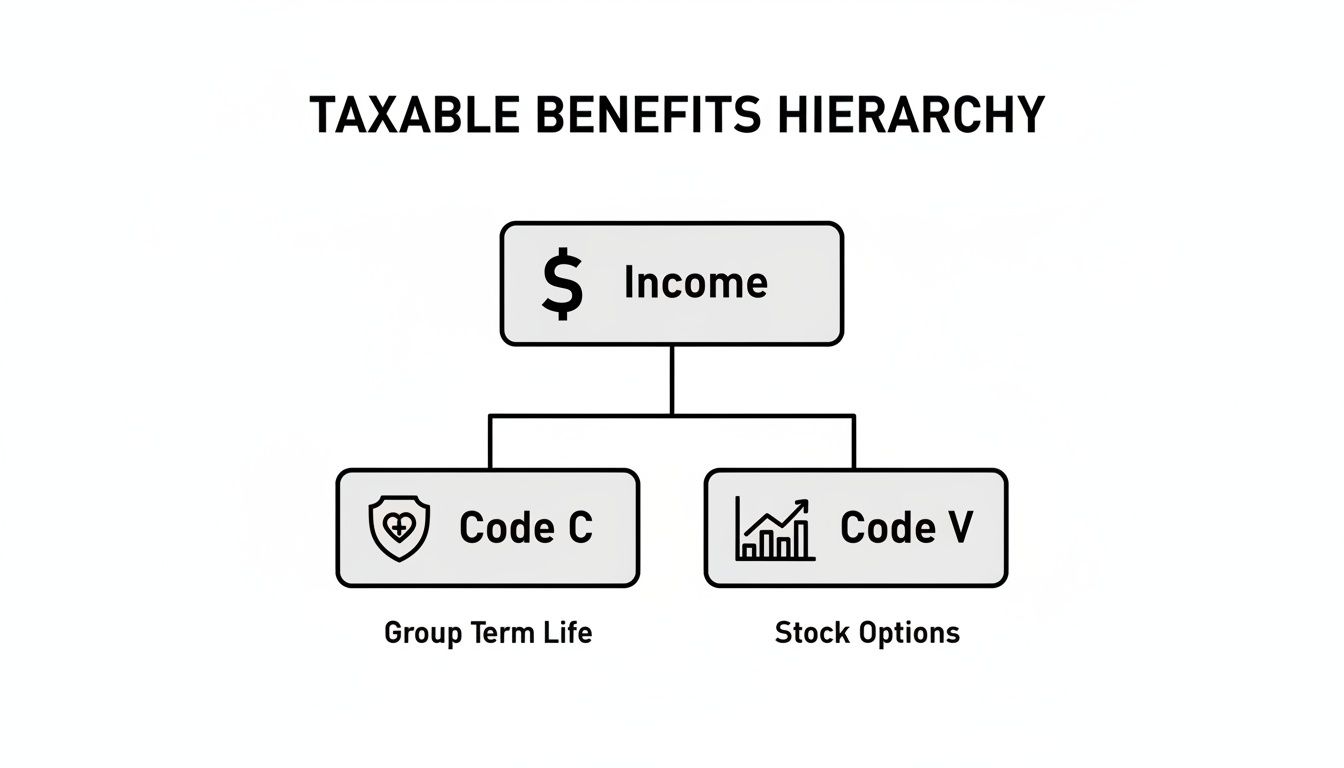
As you can see, things like the value of significant group-term life insurance (Code C) or income from exercising certain stock options (Code V) are already baked into the taxable wages you see in Box 1.
The Official W-2 Box 12 Code Cheat Sheet
To make this easy to reference, here’s a comprehensive table that breaks down every code you might come across. Keep this handy when you sit down to do your taxes—it can save you a ton of guesswork.
Complete Breakdown of W2 Box 12 Codes
| Code | Official IRS Description | Key Taxpayer Action or Implication |
|---|---|---|
| A | Uncollected Social Security or RRTA tax on tips | You owe this as additional tax on your Form 1040. |
| B | Uncollected Medicare tax on tips | You owe this as additional tax on your Form 1040. |
| C | Taxable cost of group-term life insurance over $50,000 | Already included in Boxes 1, 3, & 5. No extra action needed. |
| D | Elective deferrals to a 401(k) plan | Reduces your taxable income in Box 1. |
| E | Elective deferrals under a 403(b) salary reduction agreement | Reduces your taxable income in Box 1. |
| F | Elective deferrals under a Section 408(k)(6) salary reduction SEP | Reduces your taxable income in Box 1. |
| G | Elective deferrals and employer contributions to a 457(b) plan | Reduces your taxable income in Box 1. |
| H | Elective deferrals to a Section 501(c)(18)(D) tax-exempt organization plan | Reduces your taxable income in Box 1. |
| J | Nontaxable sick pay | Not taxable. For your information only. |
| K | 20% excise tax on excess golden parachute payments | An extra tax you may owe. |
| L | Substantiated employee business expense reimbursements | Not taxable. For your information only. |
| M | Uncollected Social Security or RRTA tax on taxable group-term life insurance (for former employees) | You owe this as additional tax. |
| N | Uncollected Medicare tax on taxable group-term life insurance (for former employees) | You owe this as additional tax. |
| P | Excludable moving expense reimbursements (for members of the U.S. Armed Forces) | Not taxable. For your information only. |
| Q | Nontaxable combat pay | Not taxable. For your information only. |
| R | Employer contributions to an Archer MSA | Not included in your income. |
| S | Employee salary reduction contributions to a 408(p) SIMPLE plan | Reduces your taxable income in Box 1. |
| T | Adoption benefits | Use Form 8839 to determine the taxable portion. |
| V | Income from exercise of nonstatutory stock options | Already included in Box 1. No extra action needed. |
| W | Employer contributions to your Health Savings Account (HSA) | Not included in your income. |
| Y | Deferrals under a Section 409A nonqualified deferred compensation plan | Informational. May affect future tax planning. |
| Z | Income under a Section 409A nonqualified deferred compensation plan | Already included in Box 1. No extra action needed. |
| AA | Designated Roth contributions under a 401(k) plan | Post-tax contributions. Does not reduce taxable income in Box 1. |
| BB | Designated Roth contributions under a 403(b) plan | Post-tax contributions. Does not reduce taxable income in Box 1. |
| DD | Cost of employer-sponsored health coverage | Informational only. This is NOT taxable income. |
| EE | Designated Roth contributions under a governmental 457(b) plan | Post-tax contributions. Does not reduce taxable income in Box 1. |
| FF | Permitted benefits under a qualified small employer health reimbursement arrangement (QSEHRA) | Can affect premium tax credit eligibility. |
| GG | Income from qualified equity grants under section 83(i) | Already included in Box 1. No extra action needed. |
| HH | Aggregate deferrals under section 83(i) elections | Informational. May affect future tax planning. |
This table covers every code the IRS currently uses for Box 12. Knowing what each one represents is the first step to making sure your tax return is accurate and you aren't paying a penny more than you need to.
What to Do If Your W-2 Box 12 Information Looks Wrong

That mini-panic you feel when you spot a potential mistake on your W-2 is completely normal. But don't worry, it's a problem that can almost always be fixed. Errors in the box 12 codes on w2 forms happen more often than you'd think, and they can affect everything from your retirement account records to your final tax bill. The most important thing is to act quickly and follow a clear process.
First things first, make sure there's actually an error. The best way to do this is to grab your very last pay stub from the tax year. It's your ground truth, showing all the year-to-date (YTD) totals for your deductions and contributions.
Line up your pay stub next to your W-2. Compare the YTD amount for your 401(k), HSA, or other benefits directly with the numbers listed next to the codes in Box 12. If they don't match, you've got a good reason to take the next step.
Start by Contacting Your Employer
With a confirmed discrepancy in hand, your first call should be to your company's payroll or HR department. They're the ones who issued the W-2, so they're the only ones who can officially correct it.
When you get in touch, be ready with the details. Point out exactly which Box 12 code and amount you believe is wrong and have a copy of that final pay stub ready to show them. Nine times out of ten, it’s a simple clerical error that they can fix without much fuss.
If your employer confirms the mistake, they will issue a Form W-2c, Corrected Wage and Tax Statement. This new form is critical—it shows the original error and the corrected figures side-by-side. You'll need to use this W-2c, not the original W-2, when you file your taxes. If you already filed, you'll have to file an amended return. You can learn more about that process and find helpful information on how to amend a tax return.
What If Your Employer Won't Cooperate?
It’s rare, but what happens if your employer drags their feet or refuses to issue a W-2c? If you've tried in good faith but are getting nowhere, you aren't stuck. The IRS has a plan for this.
Your next move is to file your tax return on time using Form 4852, Substitute for Form W-2, Wage and Tax Statement.
To fill out Form 4852, you’ll need to:
- Carefully estimate your wages and the correct Box 12 amounts, using that final pay stub as your primary source.
- Clearly explain the efforts you made to get a corrected W-2 from your employer.
Think of Form 4852 as your way of telling the IRS, "I've done my part, and this is the most accurate information I have." It allows you to meet your filing deadline even when your employer hasn't provided the right paperwork.
Just be aware that filing with a Form 4852 might slow down your refund while the IRS verifies the numbers. It's always better to get that official W-2c from your employer, but this form is an essential backup plan when you need it.
Using Box 12 Information for Your Tax Strategy
Decoding the individual box 12 codes on w2 forms is one thing, but the real magic happens when you use that information to fine-tune your financial strategy. Don't just see Box 12 as a reporting field; think of it as a roadmap to becoming more tax-efficient and building wealth.
When you strategically max out contributions to the accounts listed here, you can directly lower your annual tax bill. It’s a powerful, proactive way to take the wheel.
Turning Pre-Tax Deductions into Savings
The biggest win comes from the codes for pre-tax contributions, like D (401k), E (403b), and W (HSA). Every single dollar next to one of these codes was pulled from your income before the IRS calculated its cut, which directly reduces your taxable income for the year.
This means more of your hard-earned money stays with you—or even better, it gets to grow in your retirement and health accounts. A lower taxable income can also open the door to other tax credits and deductions you might not have qualified for otherwise, creating a beneficial ripple effect across your entire tax return. To see how this works in detail, check out our article on what is adjusted gross income and how these deductions fit in.
A Powerful Tool for Small Businesses
If you're a small business owner, offering benefits that populate Box 12 is a savvy move for both your team and your bottom line. A solid 401(k) or a Health Savings Account (HSA) plan is a huge magnet for attracting and keeping great employees.
Beyond just being a great perk, employer contributions to these retirement and health accounts are generally tax-deductible for the business. It’s a true win-win: you invest in your team's financial future while simultaneously improving your company's tax situation.
At the end of the day, Box 12 is far more than just a box to be checked for compliance. It’s a snapshot of the financial tools you have access to. By really understanding and using the benefits reported here, both employees and business owners can make smarter financial decisions that pay off for years to come.
Your Top Questions About Box 12 Codes Answered
It's completely normal to have a few questions when you're looking at all those letters and numbers in Box 12. Let's clear up some of the most common things people ask during tax season.
"Why is the huge number next to Code DD not affecting my refund?"
This is probably the number one question we get. You see Code DD on your W-2, which shows the total cost of your employer-sponsored health coverage, and it's a big number! It’s easy to think it should impact your taxes.
But here’s the key: that number is purely for your information. The amount reported under Code DD is not taxable. It doesn't change your income, your deductions, or the final number on your tax return. It’s just the government’s way of tracking healthcare costs.
"My Code D amount for my 401(k) looks wrong. What happened?"
You’ve been tracking your 401(k) contributions all year on your pay stubs, but the amount next to Code D on your W-2 doesn't match. What gives?
Often, the year-to-date total on your final pay stub includes both your contributions and your employer's matching funds. Your W-2, however, is more specific. The Code D amount should only show what you personally put into the plan from your own paycheck. Your employer's contributions aren't reported there.
"Is it possible to have the same code listed twice?"
While your W-2 has space for up to four different Box 12 codes (like D, W, C, and DD), you should almost never see the exact same letter code pop up more than once.
If you spot a duplicate code, it’s a red flag for an error. Your best move is to contact your employer or HR department right away and ask them to issue a corrected Form W-2c.
At Allied Tax Advisors, we make sense of confusing tax forms for people and businesses just like you. If you need an expert to look over your filings, see how we can help at our Allied Tax Advisors services page.