
Ever look at your paycheck, see your total earnings, and then wonder where a chunk of that money went before it hit your bank account? The culprit is payroll withholding.
It’s a system where your employer holds back a portion of your earnings to pay taxes directly to the government on your behalf. Think of it as a mandatory, pay-as-you-go tax plan. It's designed to keep you from facing a massive, unexpected tax bill come April.
What Is Payroll Withholding?

At its heart, payroll withholding is simply the money your employer is legally required to deduct from your paycheck. This isn't your employer keeping your money; they're acting as a middleman, collecting your taxes and sending them to the right government agencies.
This process covers several different types of taxes, from federal and state income taxes to Social Security and Medicare. It’s a way to ensure that you meet your tax obligations bit by bit throughout the year, rather than having to come up with one giant lump sum when you file your return.
To give you a clearer picture, let's break down the most common deductions you'll see.
Key Components of Payroll Withholding
Here’s a quick summary of the main taxes your employer withholds from your paycheck and what they fund.
| Withholding Type | What It Funds | Who Pays |
|---|---|---|
| Federal Income Tax | General government operations, defense, infrastructure | Employee |
| State & Local Income Tax | Public schools, state police, parks, local services | Employee |
| Social Security Tax | Retirement, disability, and survivor benefits | Employee & Employer |
| Medicare Tax | Health insurance for people 65+ and those with disabilities | Employee & Employer |
These components make up the bulk of the deductions that turn your gross pay (your total earnings) into your net pay (what you take home).
How Your W-4 Controls Withholding
You actually have a surprising amount of control over this process. The key is the Form W-4, Employee's Withholding Certificate, which you fill out when you start a new job or have a major life event like getting married or having a child.
This form is your instruction manual for your employer. It tells them exactly how much to withhold based on your personal financial situation.
The information you provide on your W-4 includes your:
- Filing Status (Single, Married Filing Jointly, etc.)
- Number of Dependents
- Other Income (from a side gig or spouse's job)
- Anticipated Deductions (like student loan interest or IRA contributions)
Getting your W-4 right is the single most important thing you can do to avoid a nasty surprise at tax time. An accurate W-4 helps your employer withhold an amount that closely matches what you'll actually owe for the year.
Ultimately, the goal is to break even—not owing a lot of money, but also not getting a massive refund (which is just an interest-free loan you gave the government). Understanding these details is crucial, and you can learn more about what "FIT" means on your paystub in our detailed guide on FIT.
The Building Blocks of Payroll Taxes
Ever looked at your paycheck and wondered where all the money between your "gross pay" and "net pay" actually goes? Think of your total earnings as a whole pie. Before you get your slice, the government takes a few pieces first. Those pieces are payroll withholdings.
Let's break down exactly what those deductions are.
The biggest slice for most people is Federal Income Tax. This is the money that funds everything from national defense to highways and federal agencies. It's a progressive tax, which just means the more you make, the higher the percentage you pay. The details you put on your Form W-4 at the start of your job directly tell your employer how much of this to hold back.
Your Contributions to FICA
Next up, you’ll see a deduction for FICA. This isn't just one tax; it's a bundle of two critical social insurance programs, mandated by the Federal Insurance Contributions Act.
- Social Security Tax: This is your contribution to the system that provides retirement, disability, and survivor benefits. You only pay this tax on your income up to an annual limit, which changes most years.
- Medicare Tax: This portion goes straight to funding the Medicare health program, mostly for folks 65 and older. Unlike Social Security, there's no income cap here—you pay it on every dollar you earn.
Here’s a key detail: for every dollar you put into FICA, your employer has to match it. That’s right, they contribute the exact same amount on your behalf. So, the government is getting double what you see deducted from your check for these specific programs.
Don't Forget State and Local Taxes
Beyond the federal level, where you live makes a huge difference. Most states, and even some cities or counties, have their own income taxes. This is the money that pays for things closer to home, like public schools, local road repairs, and first responders.
The differences from one place to another can be massive. If you work in a state like California, you'll see a significant state tax deduction. But if you're in a state like Texas or Florida, you won't pay any state income tax at all. It's one of the biggest variables affecting your take-home pay.
All these taxes add up. The average payroll tax burden in the United States usually lands somewhere between 10% to 15% of a person's gross pay. Just for FICA, every employee pays a mandatory 7.65% (6.2% for Social Security and 1.45% for Medicare), and remember, your employer matches that contribution completely. You can discover more insights about average payroll taxes in the US and how the math works.
Each one of these withholdings—federal, FICA, state, and maybe local—is a separate piece of the puzzle. When you put them all together, you get the full picture of how your gross salary becomes the net pay you actually take home.
How Is Your Withholding Amount Calculated?
The amount of money your employer withholds from each paycheck isn't just a random guess. It's a precise calculation guided by the information you provide on a crucial document: Form W-4, Employee's Withholding Certificate.
Think of your W-4 as a set of instructions you give your employer. By detailing your filing status, the number of dependents you have, and any other income or deductions, you're telling their payroll system exactly how much federal income tax to set aside. The goal is to get this number as close as possible to what you’ll actually owe at the end of the year, helping you avoid a nasty tax bill or a giant refund (which is really just an interest-free loan to the government).
This chart provides a great visual of how your pay flows through the tax withholding process, from gross earnings to your final take-home pay.
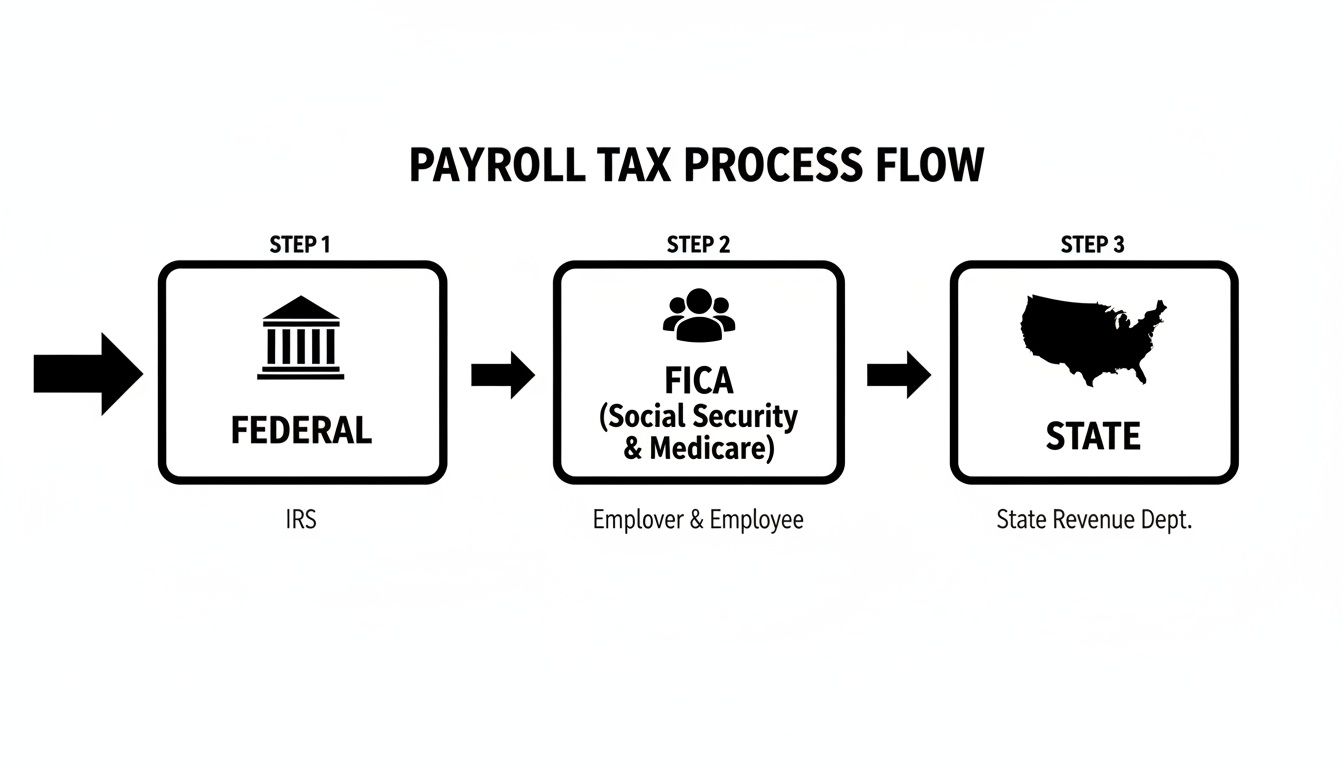
As you can see, withholding is a multi-layered process that accounts for federal, FICA, and state taxes before arriving at your net pay. Once you've filled out your W-4, your employer takes it from there.
Turning Your W-4 into Dollars and Cents
So how does your employer translate that W-4 into an actual dollar amount? They rely on one of two IRS-approved methods to figure out your federal income tax withholding for each pay period. While modern payroll software automates this, it’s helpful to know what’s happening behind the scenes.
The two main ways they run the numbers are:
The Wage Bracket Method: This is the go-to for many employers. It involves looking up your withholding amount in the tables found in IRS Publication 15-T. They find the table for your pay schedule (weekly, bi-weekly, etc.), locate the row for your wage bracket, and cross-reference it with the column that matches your filing status and W-4 details. It's a straightforward lookup system.
The Percentage Method: This approach is more like a direct math formula and is commonly built into automated payroll systems. It starts with your gross pay, subtracts any pre-tax deductions and allowance amounts based on your W-4, and then applies a series of tax rate percentages to the remaining income.
No matter which method your employer uses, the result is always driven by your W-4. The single biggest reason for withholding mistakes is an outdated or incorrect form. If you get married, have a baby, or experience another significant life event, you need to update your W-4 to ensure your withholding stays accurate.
If you're interested in really getting into the weeds of the calculations, our detailed guide explains how to calculate payroll taxes with step-by-step examples. Understanding the math gives you the power to fine-tune your paycheck and make sure your tax withholding is working for you.
An Employer’s Guide to Managing Payroll Withholding
If you're a business owner, getting a handle on what is payroll withholding isn't just about crunching numbers—it’s a core legal duty. When you manage these deductions the right way, you’re not only staying compliant but also protecting your business from some pretty serious penalties. It all boils down to a consistent workflow that keeps everyone, including your employees, in the clear.
The whole process kicks off the second a new employee walks through the door. Your first job is to have them fill out and sign a Form W-4. Think of this form as the instruction manual for calculating their federal income tax, so getting it right from the start is absolutely essential. From there, you'll calculate the correct withholding amounts every single payday.
Core Employer Responsibilities
Managing payroll withholding is a cycle that goes way beyond just cutting a check. You're in charge of these funds from the moment they're deducted until they're reported to the government.
- Calculate Withholdings: Every pay period, you need to accurately calculate and subtract the right amounts for federal income tax, Social Security, and Medicare, plus any state or local taxes that apply.
- Deposit Taxes: You can't just hold onto that money. You have to deposit the withheld funds—along with your share of FICA taxes—to the IRS and state agencies on a strict schedule, which is typically monthly or semi-weekly.
- File Reports: You also need to file quarterly reports, like Form 941 (Employer's QUARTERLY Federal Tax Return), to show the government that the taxes you've withheld match what you've deposited.
Compliance isn't optional here. The IRS has rigid deadlines and expects complete accuracy. If you miss a deposit deadline or mess up the calculations, you could be looking at hefty penalties, interest, and legal headaches that can put your business's financial stability at risk.
The Challenge of Modern Payroll Management
Trying to keep all these plates spinning can be a real operational challenge, especially as your team grows. The latest data backs this up. A recent report found that 66% of payroll professionals don't feel they have the right tools to get a clear picture of their costs. On top of that, 61% say that keeping up with legal and regulatory rules is their biggest headache. For a deeper look at these industry trends, you can explore key insights from the 2025 Global Payroll Payments Report.
With so much at stake, it’s no wonder many business owners lean on professional tax services or dedicated payroll software. These tools can automate the math, keep track of deposit schedules, and make reporting much smoother, ensuring everything is done right and on time. For more tips on setting up a system that works, read our guide on how to do small business payroll without mistakes.
If you’re looking for a complete guide to managing the entire process, including effective withholding strategies, check out this resource on streamlining your payroll process efficiently. Relying on expert guidance can give you the confidence to handle these financial responsibilities like a pro.
Common Withholding Mistakes and How to Avoid Them
Even tiny mistakes in payroll withholding can create massive headaches for everyone involved. For an employee, a small oversight might lead to a nasty surprise tax bill at the end of the year. On the flip side, it could mean you've been giving the government an interest-free loan with your own money, only to get it back as a refund.
Mistakes Employees Make
The most common slip-up for employees? Forgetting to update their Form W-4. Life happens—you get married, have a kid, or pick up a side gig—and all of these events change your tax picture. If you don't adjust your W-4 accordingly, you risk under-withholding, which can leave you owing the IRS way more than you expected, plus potential penalties.
Then there's the other side of the coin: over-withholding. This is when too much tax is taken out of each paycheck. Sure, getting a big refund feels nice, but it's not a bonus. It's just your own money that you could have been using all year long.
How Employees Can Stay on Track
The good news is that managing your withholding is pretty straightforward. A little proactive effort goes a long way.
- Do an Annual "Paycheck Checkup": Make it a yearly ritual to review your W-4. The IRS even has a free Tax Withholding Estimator tool that walks you through it. It helps you figure out if you're on the right track for the year.
- Update Your W-4 After Big Life Events: Just got married? Bought a house? Welcomed a new baby? These are all perfect times to fill out a new Form W-4 and give it to your employer. It ensures your paychecks accurately reflect your new financial life.
Critical Errors for Employers
For business owners, the stakes are much higher. Payroll mistakes can quickly spiral into expensive fines and serious legal trouble with tax authorities.
One of the most dangerous mistakes is misclassifying employees as independent contractors. It might seem like a clever way to dodge payroll taxes, but if you get caught, you could be on the hook for a mountain of back taxes and penalties.
Another frequent fumble is failing to deposit withheld taxes on time. The IRS sets strict deadlines for these payments, and missing them repeatedly will bury you in penalties and interest. To navigate these rules and keep your business safe, a good payroll compliance checklist is an invaluable resource.
A small mistake in payroll can snowball into a major compliance issue. Proactive audits and professional oversight are not just best practices—they are essential safeguards for your business's financial health.
Think of it as a small investment to prevent a huge loss. Bringing in a tax professional to perform a periodic payroll audit can help you catch classification errors, confirm you're meeting deposit schedules, and ensure your business stays on the right side of the law. It’s about spotting problems before they become catastrophes.
Managing Payroll Withholding for Remote Teams
Remote work has completely changed the game for many businesses, but it’s also thrown a major curveball into payroll withholding. When your team is scattered across different states, you can't just apply one set of tax rules anymore. The location that matters isn't your main office—it's where your employees are actually doing their work.
This all comes down to a concept called tax nexus. Think of it this way: the moment you have an employee logging in from a new state, your business has just set up a "presence" there. That means you’re now on the hook to play by that state's rules for withholding and paying taxes, from state income tax to unemployment insurance.

Navigating a Complex Web of State Laws
Running payroll for a distributed team is no small feat. Every state has its own way of doing things, creating a complicated puzzle that employers have to piece together correctly for every single employee.
You'll find that states differ on several key things:
- Income Tax Rates: The percentages you need to withhold can be worlds apart. You’ve got high-tax states like California and New York on one end, and on the other, states with no income tax at all.
- Unemployment Insurance: Each state has its own State Unemployment Tax Act (SUTA) rates and rules for how much of an employee's wages are taxable.
- Reporting Requirements: The specific forms you have to file and the deadlines for sending in the taxes you’ve withheld are different everywhere you look.
This isn't just a headache; it's a recognized global challenge. The United States now ranks as the sixth most complex country for payroll operations globally, a direct result of trying to manage withholding across 51 distinct state and jurisdictional systems. You can dig into the details in the 2025 Global Payroll Complexity Index.
For any business with a remote workforce, getting payroll withholding right means sweating the small stuff and really knowing your multi-state tax law. With steep penalties on the line for getting it wrong, solid payroll software and expert advice aren't just nice-to-haves—they're essential.
Frequently Asked Questions About Payroll Withholding
Getting payroll withholding right often comes down to a few key questions. Let's walk through some of the most common ones that pop up, so you can feel more in control of your paycheck and your taxes.
When Should I Update My Form W-4?
Think of your Form W-4 as a living document. It’s not something you just fill out on your first day and forget about.
You'll definitely want to update it after any major life event. Things like getting married or divorced, having a baby, or even you or your spouse starting a new job can all have a big impact on how much tax you should be paying.
It's also a great idea to give it a quick "health check" once a year. If you got hit with a surprisingly large tax bill last April, or if you received a massive refund, that's a clear sign your W-4 needs a tune-up. The IRS actually has a handy Tax Withholding Estimator tool to help you figure out if you need to make a change.
Can I Be Exempt From Payroll Withholding?
It’s possible, but it's not common. To claim an exemption from federal income tax withholding, you have to meet a very specific set of criteria. Basically, you must have owed zero federal income tax last year and reasonably expect to owe zero this year, too.
There are catches, though. You usually can't claim an exemption if your income is over a certain amount or if someone else, like a parent, can claim you as a dependent on their tax return.
It’s critical to remember that this exemption is only for federal income tax. You can't get out of FICA taxes. Your contributions to Social Security and Medicare are almost always mandatory, no matter what your income tax situation looks like.
What Happens If My Employer Withholds the Wrong Amount?
At the end of the day, paying the right amount of tax is your responsibility. If your employer doesn't withhold enough money throughout the year, you’ll have to make up the difference when you file your tax return. You might even get hit with an underpayment penalty from the IRS.
On the flip side, if they withhold too much, you'll get that extra money back in the form of a tax refund. If you spot a mistake, let your HR or payroll department know immediately so they can fix it for your future paychecks. For any past errors, it’s a good idea to chat with a tax professional to figure out the best way to handle it.
Understanding the ins and outs of what is payroll withholding is fundamental for keeping your personal finances on track and ensuring your business stays compliant. The team at Allied Tax Advisors provides expert guidance to make sure your withholding is accurate and works for you. Learn more about our payroll and tax services.