
You’ve done the work. The service is complete, the closing happened, the tenant moved in, or the consulting project wrapped. You sent the invoice. It’s sitting in QuickBooks as an asset, and on paper your business looks stronger because of it.
But some invoices won’t get paid.
That doesn’t mean your books are broken. It means you need to account for credit risk like a professional. The allowance for uncollectible accounts is how you do that. It gives you a realistic receivables number, a cleaner profit picture, and fewer surprises when one customer goes silent at the worst possible time.
For small business owners and real estate investors, this matters more than is commonly understood. If you ignore likely nonpayment, you can overstate assets, overestimate profit, and make decisions based on cash you probably won’t collect. If you handle it correctly, your financial statements become useful instead of flattering.
Why Every Business Needs a Plan for Unpaid Invoices
Most owners don’t struggle with the concept of unpaid invoices. They struggle with timing.
You record a sale today, but you may not learn for months that part of that receivable won’t convert to cash. If you wait until the account is obviously dead, your books can look healthy right up until they don’t. That’s when a lender questions your numbers, a partner loses confidence, or your own cash planning falls apart.
An allowance for uncollectible accounts solves that problem by treating some level of nonpayment as a normal business cost, not as a rare emergency.
What goes wrong when you skip it
Without a reserve, accounts receivable stays inflated. So does profit in the period when you made the sale.
That creates three common issues:
- You trust the wrong balance sheet: Gross receivables look collectible even when some customers are already slipping.
- You make weak cash decisions: Owners spend against expected collections that may never arrive.
- You react too late: Collection problems show up after the damage has already hit the business.
What a practical plan looks like
A workable plan doesn’t need to be complicated. It needs to be consistent.
Start with these habits:
- Review open invoices on a set schedule.
- Separate normal late payers from accounts that are turning risky.
- Estimate likely losses before year-end pressure forces a rushed adjustment.
- Decide who owns follow-up, write-off approval, and documentation.
Practical rule: If you extend credit, you need a process for customers who won’t pay on time and a reserve for customers who won’t pay at all.
If your receivables process itself is weak, it helps to look at operational guidance on collections and monitoring. A practical overview of accounts receivable services is useful for seeing how businesses structure follow-up before an account becomes a bookkeeping problem.
Understanding the Allowance for Uncollectible Accounts
A small business can show solid sales and still overstate what it will collect.
That is the problem the allowance for uncollectible accounts solves. It records an estimate of the receivables that are unlikely to turn into cash, so the balance sheet shows a more realistic accounts receivable number.

What it is on the balance sheet
The allowance for uncollectible accounts is a contra-asset account. It carries a normal credit balance and reduces gross accounts receivable to the amount you reasonably expect to collect.
Owners usually care about one number: net receivables. If QuickBooks shows $250,000 in open customer balances, but past experience says some portion will not be collected, the allowance adjusts that balance to something you can use for planning.
This matters in practice. Gross receivables help you track billing activity. Net receivables help you judge liquidity, borrowing capacity, and whether reported profit is backed by cash you are likely to receive.
Why GAAP uses an allowance
Under GAAP, bad debt expense is recorded in the same period as the related credit sales. That keeps revenue and credit loss tied to the same reporting period instead of making one month look stronger and a later month look worse.
For owners on accrual books, that is the key point. If you book revenue today, you also need to record a reasonable estimate of the collection risk attached to that revenue. If you need a refresher on cash basis vs accrual basis accounting, that distinction drives why the allowance matters for financial reporting.
At Allied Tax Advisors, we often see businesses miss this step because they focus on whether a customer has officially defaulted. GAAP does not wait for certainty. It requires a reasonable estimate based on the facts you have at the reporting date.
What happens when a specific invoice is written off
The estimate and the write-off are two separate events.
First, the business records bad debt expense and builds the allowance. Later, when a specific invoice is clearly uncollectible, the write-off reduces accounts receivable and reduces the allowance. In a properly maintained allowance system, that later write-off does not create a new expense at that point.
The Financial Accounting Standards Board describes this framework in its glossary discussion of allowance accounts and valuation accounts, which are used to reduce related asset balances for financial reporting purposes (fasb.org).
That distinction is where a lot of bookkeeping errors happen. I regularly see owners write off an invoice directly to expense months after year-end, even though the loss related to an earlier sales period. The books then show distorted margins in both periods.
Why small businesses and real estate investors should care
Even if your bank never asks for audited financials, this account improves the quality of your reporting.
It helps you answer practical questions such as:
- How much of receivables is collectible?
- Are current profits overstated because old balances are still sitting on the books?
- Does a property look profitable only because unpaid tenant charges have not been adjusted?
- Is your AR aging getting worse even though sales still look strong?
For real estate investors, the same issue shows up in billed but doubtful tenant receivables, CAM reimbursements, and chargebacks that are aging past a realistic collection window. For other small businesses, it often shows up in retainers, progress billings, and old customer balances that stay open because no one wants to clear them.
A good allowance does not make the numbers look worse. It makes them usable.
How to Estimate Your Allowance Three Proven Methods
You close the month with a healthy profit on paper, then notice that several large invoices are 90 days old and collection calls are going nowhere. That is the point where the estimation method matters. A weak method can leave receivables overstated and expense pushed into the wrong period.
There is no single method that fits every business. The right choice depends on how you bill, how your customers pay, and whether your receivables behave consistently enough to support a repeatable estimate. In practice, I tell owners to choose a method they can apply the same way every month or quarter, then adjust it when collection patterns change.
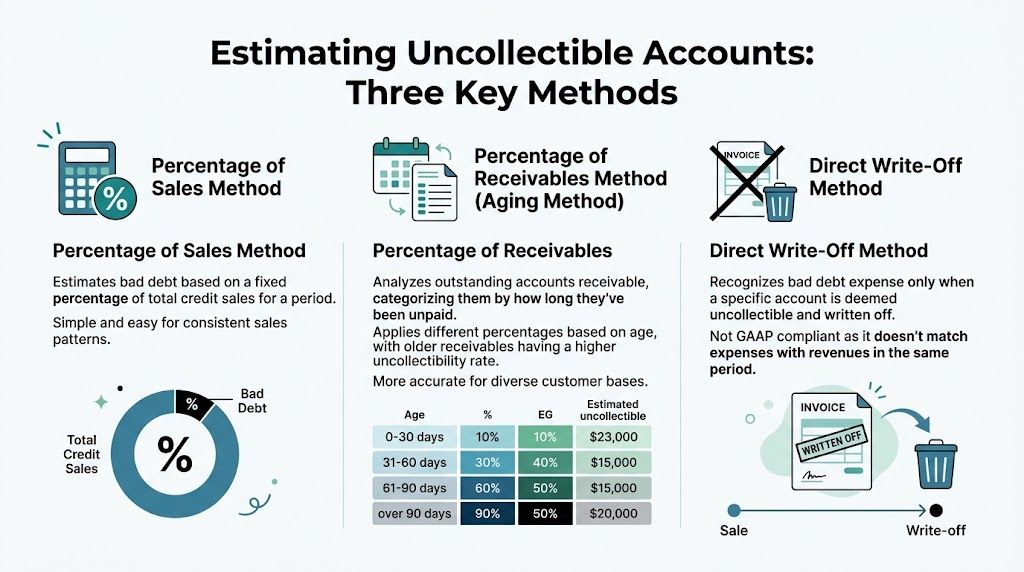
Percentage of sales method
This method starts with credit sales for the period. You apply a loss percentage based on your own history, industry experience, or a policy you can support from prior results. The goal is to estimate bad debt expense for the period in a way that tracks with current revenue.
It works best when sales are steady and customer risk does not shift much from month to month. Many small service businesses start here because it is easy to maintain in QuickBooks with a recurring adjusting entry at month-end.
Best fit
- Businesses with stable credit sales patterns
- Companies with a broad customer base and similar terms
- Owners who want a straightforward income statement estimate
What works
- Simple to apply
- Easy to document
- Efficient for monthly closes
What to watch
- It can miss deterioration in older invoices
- It may understate risk if a few large customers are slowing down
Aging of accounts receivable method
The aging method focuses on what is still unpaid at the end of the period. Balances are grouped by age, then each bucket gets a higher estimated loss rate as collectibility declines.
For many growing businesses, this is the more useful method because it lines up with how owners already manage collections. Current balances usually carry less risk than invoices sitting at 60, 90, or 120 days. Real estate investors also benefit from this approach because tenant receivables, reimbursements, and chargebacks often age very differently from standard trade invoices.
Best fit
- Companies with uneven customer payment behavior
- Businesses with larger invoice amounts
- Real estate operators tracking tenant and CAM-related balances
What works
- Better balance sheet accuracy
- Clearer view of collection problems
- Stronger support for account-by-account review
What to watch
- It depends on clean AR aging
- Bad invoice dates, unapplied credits, and misclassified balances will distort the estimate
If you are still deciding whether your books should track receivables under accrual accounting, this explanation of the difference between cash basis and accrual basis gives the right context. Once receivables are on the books, the allowance becomes part of keeping those numbers realistic.
Historical loss rate method
This method uses your own collection history to build the reserve. A common approach is to review several prior periods, measure actual write-offs as a percentage of receivables or credit sales, and use that history to set a current estimate.
It is a practical choice for established businesses with repeat customers and enough history to show a pattern. It is less reliable for newer companies, businesses that changed credit policies recently, or firms that had unusual collection issues in prior years. If last year's write-offs were driven by one failed customer, carrying that rate forward without adjustment can overstate the reserve.
In QuickBooks, I usually see this method work best when the owner or controller exports write-off history to Excel, calculates an average rate, and then books the adjustment manually. QuickBooks can store the entry cleanly, but the support for the estimate usually lives outside the file.
A quick comparison
| Method | Main strength | Main weakness | Usually best for |
|---|---|---|---|
| Percentage of sales | Fast and consistent for period expense | Less sensitive to old invoices still outstanding | Businesses with stable credit sales |
| Aging method | Reflects actual collection risk in receivables | Requires clean customer-level AR detail | Businesses with mixed payment patterns |
| Historical loss rate | Uses your own results as support | Weak if history is thin or no longer relevant | Established businesses with repeat trends |
A method to avoid for GAAP reporting
Some owners wait until they are certain an invoice will not be collected, then record bad debt at that point. That is the direct write-off method.
For GAAP financial reporting, that approach usually creates poor matching between revenue and expense. It can also make one period look stronger than it really was and the next period look worse. Tax reporting may follow different rules, which is why many businesses keep one approach for financial statements and another for the return.
If receivables are material, the simplest method is rarely the safest one.
Calculating and Recording Your Allowance Step by Step
You close the month, open your A/R aging in QuickBooks, and see several old balances that no longer look collectible. The question is not whether some of those invoices will turn into losses. The question is how to record that risk correctly before you send financials to a lender, investor, or partner.
For many small businesses, this is the point where accounting shifts from theory to process. If you are building year-end reports, the allowance should tie into the rest of your close cleanly. This guide on how to prepare financial statements shows how the reserve fits into the broader reporting package.
Step 1 Build an aging schedule
Start with your accounts receivable aging report as of the reporting date. In QuickBooks, that usually means running the A/R Aging Detail or A/R Aging Summary, then reviewing the balances by age bucket.
Assume your receivables look like this:
- Current: $400,000
- 31 to 60 days past due: $200,000
- 61 to 90 days past due: $100,000
- Over 90 days past due: $50,000
Next, apply the loss rates your business uses for each bucket. For example:
- Current at 1% = $4,000
- 31 to 60 days at 5% = $10,000
- 61 to 90 days at 20% = $20,000
- Over 90 days at 50% = $25,000
That produces a required ending allowance of $59,000.
The math is easy. The judgment behind the percentages is the harder part. A contractor with a few large commercial customers may need different rates than a property manager collecting from dozens of tenants, even if the aging totals look similar.
Sample Aging of Accounts Receivable Schedule
| Customer | Total Due | Current (0-30 days) | 31-60 Days Past Due | 61-90 Days Past Due | Over 90 Days Past Due |
|---|---|---|---|---|---|
| Customer A | Included in total | Included in total | |||
| Customer B | Included in total | Included in total | |||
| Customer C | Included in total | Included in total | |||
| Customer D | Included in total | Included in total |
Before you calculate the reserve, clean up obvious errors. Remove duplicate invoices, unapplied credits, and balances that are really billing disputes rather than collection problems. Otherwise, the allowance will be off before you even book the entry.
Step 2 Record the estimate
Once you know the required ending balance in the allowance account, compare it to what is already on the books.
If the allowance account is new and has no balance, and your target is $59,000, the journal entry is:
- Debit Bad Debt Expense $59,000
- Credit Allowance for Uncollectible Accounts $59,000
If the allowance account already has, for example, a $15,000 credit balance, you do not book another full $59,000. You book only the adjustment needed to bring the ending balance to $59,000. In that case, the entry would be:
- Debit Bad Debt Expense $44,000
- Credit Allowance for Uncollectible Accounts $44,000
It is common for owners to make a practical mistake. They calculate the right ending reserve, then post the wrong entry because they forget to account for the existing balance.
The Financial Accounting Standards Board describes this approach in its glossary entry for the allowance method. The estimate is recorded before specific accounts are written off.
Step 3 Write off a specific invoice
Later, when a particular invoice is no longer collectible, write it off against the allowance, not against bad debt expense.
The entry is:
- Debit Allowance for Uncollectible Accounts
- Credit Accounts Receivable
That write-off reduces the customer balance and uses part of the reserve you already established. It does not create a new expense at the time of write-off.
For a small business owner, that distinction matters because it affects how the income statement reads. The expense belongs in the period when the risk became reasonably estimable, not in the later period when everyone finally gives up on collection.
How this looks in QuickBooks
QuickBooks handles the mechanics well, but the estimate still requires review. In most client files, I recommend this workflow:
- Run the aging report at month-end or year-end.
- Review customer-level detail for old balances, credit memos, and disputes.
- Calculate the target reserve outside QuickBooks if you need custom percentages by bucket or by customer type.
- Post a journal entry to bad debt expense and allowance for uncollectible accounts.
- Write off specific invoices through a controlled process so the customer history stays intact.
- Recheck the allowance before final reporting if collections changed late in the period.
For real estate investors and property managers, tenant receivables need extra care. Some balances belong in bad debt. Others may reflect vacancy concessions, lease disputes, or charges that should be reversed instead of reserved.
Common posting mistakes
The recurring errors are usually operational, not technical.
- Deleting invoices instead of writing them off. That removes the audit trail and makes later collection analysis harder.
- Posting the write-off to bad debt expense after an allowance was already booked. That records the same loss twice.
- Leaving the reserve untouched for long periods. A stale allowance can make receivables look healthier than they are.
- Treating every old balance as bad debt. Some items should be reclassified, credited, or sent for collection review first.
Clean A/R detail produces a defensible allowance. Messy receivables produce guesswork.
If a customer pays after a write-off
Record the recovery in two steps. Reinstate the receivable first. Then record the cash receipt.
That keeps the subledger accurate and preserves the customer history. It also helps if you want to track how often written-off accounts later pay, which is useful when you revisit your reserve percentages at year-end.
Navigating Tax Implications vs Financial Reporting
Many business owners stumble on this point. They assume that if bad debt expense appears on the books, it must also reduce taxable income right away.
Often, it doesn’t.
For your books
For financial reporting, the allowance method exists to present receivables at collectible value and to match the expected loss to the same period as the related revenue.
That’s why the estimate shows up before you know exactly which customer won’t pay. Good financial reporting is built on reasonable estimates, not on waiting for certainty.
For your taxes
Tax reporting often works differently.
In practice, many business owners discover that their book treatment and tax treatment for bad debts don’t line up in the same period. For tax purposes, the issue usually turns on whether a debt became worthless, and that requires support. You need records showing the amount was real, collection efforts were made, and there’s a defensible reason you concluded it won’t be collected.
Why the difference matters
This difference creates confusion in three places:
- Book-to-tax differences: Your financial statements may show bad debt expense before your tax return reflects a deduction.
- Owner expectations: Many owners think “I booked it” means “I deducted it.”
- Audit support: If a balance is written off for tax purposes, documentation matters.
What documentation you should keep
Even when the accounting is straightforward, support files matter.
Keep:
- Original invoices and contracts
- Collection emails and call notes
- Returned mail or failed contact attempts
- Settlement records or legal correspondence
- Internal approval for write-off
For real estate investors, this can include lease terms, tenant ledgers, notices, move-out documentation, and communication records tied to unpaid rent or other receivables.
Your books answer, “What is the receivable likely worth?” Your tax file answers, “What can you prove?”
A practical owner mindset
Don’t force your tax return to mirror your management books line for line.
Your internal books should help you run the business. Your tax return should follow tax rules. A good CPA bridges the two and explains the difference before it becomes a filing problem or an audit issue.
Practical Tips for Small Businesses and Real Estate Investors
Most allowance problems aren’t technical. They’re operational.
The estimate gets ignored because collections are decentralized, the software setup is loose, or nobody owns the review process. If you fix the workflow, the accounting gets easier.

What to do in QuickBooks
QuickBooks works well for many small businesses if you keep the process simple.
Use this setup:
- Create the allowance account correctly: Set it up as a contra-asset account tied to accounts receivable presentation.
- Create a bad debt expense account: Keep the estimate and the later write-off process distinct.
- Run aging reports regularly: Don’t wait until year-end to find out your receivables have aged badly.
- Use memorized or recurring review steps: Even if the entry amount changes, the workflow shouldn’t.
For clients that want hands-on support rather than a fully outsourced accounting department, Allied Tax Advisors handles QuickBooks bookkeeping and year-end review work that includes analyzing receivables and determining the needed allowance as part of the close process.
What works in day-to-day operations
Strong receivables control is boring, and that’s why it works.
A few habits make a real difference:
Review old balances before month-end
If you wait until after the books are closed, the allowance becomes a cleanup exercise.
Look at disputes, unapplied credits, and collection notes while the month is still open. Many “bad debt” balances turn out to be billing issues or unresolved customer disagreements.
Separate collection effort from final write-off approval
The person following up on invoices shouldn’t always be the person deciding to remove them from the books.
That separation helps prevent rushed write-offs and keeps documentation cleaner.
Revisit your percentages
An estimate that made sense last year might be weak now.
If one customer class is paying slower, or a property portfolio has more tenant turnover, update your approach. Don’t leave the allowance on autopilot.
Common mistakes I see
These errors are more common than they should be:
- Owners using one flat rate forever: A reserve needs review, not habit.
- Bookkeepers posting write-offs straight to expense: That defeats the purpose of the allowance method.
- No link between billing and collections notes: Accounting can’t estimate risk well if nobody records collection history.
- Treating every overdue balance as bad debt: Some should be credited, disputed, or escalated instead.
Considerations for real estate investors
Real estate operators often think this topic belongs only to product or service businesses. It doesn’t.
If you carry tenant receivables, reimbursements, fees, or other billed balances, you still need to assess collectibility. Unpaid rent can overstate income and assets if it remains on the books long after collection becomes doubtful.
That’s especially true when properties have frequent turnover, informal payment plans, or inconsistent documentation.
A few practical safeguards help:
- Keep tenant ledgers current: Don’t rely on bank activity alone.
- Document move-out balances clearly: Security deposit application and unpaid amounts should be easy to trace.
- Separate collectible balances from hopeful balances: Not every tenant charge belongs in active receivables forever.
If you manage rentals directly, choosing software with strong tenant ledgers, reporting, and receivable visibility matters. This review of the best accounting software for rental property is a useful starting point when comparing systems.
For businesses using multiple systems
Some businesses bill in one platform, collect in another, and summarize in QuickBooks or IRIS.
That can work, but only if one report becomes the official receivables source at month-end. If different systems show different balances, your allowance calculation turns into guesswork. Decide which report governs, reconcile it, and use that same source consistently.
When to Partner with a CPA for Your Business
Some businesses can manage this internally for a while. Others outgrow DIY bookkeeping faster than they think.
The moment your receivables become significant, the allowance for uncollectible accounts stops being a technical side issue. It affects profit, assets, lender reporting, tax conversations, and how confident you can be in your own numbers.
Signs the process is getting too risky
You should consider CPA involvement when any of these are true:
- Credit sales are growing quickly: Old shortcuts stop working when volume rises.
- You have a few large customer balances: One bad account can distort the financials.
- You’re applying inconsistent payment terms: Estimation gets harder when everything is custom.
- You need statements for financing or investors: Informal estimates won’t hold up well.
- Your tax return and books keep diverging: Book-to-tax treatment needs coordination.
- You’re facing audit or notice issues: Documentation and methodology matter.
What a CPA should help you do
A good CPA doesn’t just post an adjustment.
They should help you:
- Choose a method that fits the business.
- Review whether your receivables data is reliable enough to support the estimate.
- Separate accounting treatment from tax treatment.
- Build a repeatable close process instead of a year-end scramble.
If you’re at the stage where you need outside help, this guide on how to find a good CPA is a sensible starting point for evaluating fit.
The real value
The value isn’t only compliance.
It’s clarity. You want to know which receivables are solid, which customers are slipping, and whether the profit on your statements reflects business reality. When that answer starts getting fuzzy, professional review usually costs less than the mistakes.
If your business carries receivables and you want your books to reflect what you’re likely to collect, Allied Tax Advisors can help you review your allowance for uncollectible accounts, align your bookkeeping with your reporting needs, and sort out the book-versus-tax treatment before it becomes a bigger problem.